
A gym owner types body analysis into a search bar and gets back three unrelated industries: a machine that estimates fat and muscle, a set of scales with handles, and a camera rig that photographs somebody standing still. She wants the third and does not yet know it. What she is actually trying to buy is a record she can hand a member at the start of a programme and compare against at the end of it: how the member stands, where the load sits, whether the shoulders and hips are level, whether the knees lock back. That is a posture and alignment record, and it belongs to a narrower category than the phrase suggests.
This article sets out what that record contains on the X5, which of its entries are measurements and which are simply angles waiting for a reader, and how two very different rooms — a gym floor and a rehabilitation department — use the same pages for different purposes. It also spends time on the least glamorous and most decisive part of the whole exercise: making the session repeatable, so that the second record can be compared with the first. It is written from the manufacturer’s side, and it says clearly at the end what this equipment is not.
The vocabulary problem is worth naming once and then setting aside. Body analysis, posture analysis, alignment screening, biomechanical assessment — the market uses these phrases almost interchangeably, and the machines behind them measure different things. Some estimate composition. Some photograph a standing figure. Some record load through the feet while the figure walks. A buyer who does not separate them will compare prices across categories and conclude that the market is either a bargain or a swindle, when in fact she has been reading three different shopping lists.
The phrase promises more than any single room can deliver
Nothing measures a body. A device measures a set of positions, times or forces, and software arranges them into a description. That is true of every machine in this category, and saying it out loud early saves a great deal of disappointment later. What a posture system can honestly offer is a set of recorded angles and images taken under stated conditions, plus a foot record taken in the same session, which together describe how someone stands and loads today.
The honest boundary runs in two directions. A posture record says nothing about body composition, and a composition scanner says nothing about alignment; a buyer who wants both is buying two things. Nor does a posture record say anything about what caused what. A dropped shoulder and a pelvic tilt photographed in the same session are two observations, not an explanation, and the explanation is exactly the part that requires a trained reader with a history in front of them.
The comparison trap is worth flagging because it costs buyers weeks. A composition machine and a posture system are quoted in the same currency, so they look comparable on a spreadsheet, and the cheaper one wins an argument that should never have been held. The right first question is not what the machine costs but what document it produces, who in the room will read that document, and what the room intends to do with the second one a season later. Answer those three and the category chooses itself.
Where the phrase does earn its place is in the breadth of the record rather than the depth of any single entry. A session that captures the feet, the legs above them and the trunk above those gives an operator a whole-column view, and the whole-column view is what makes the individual numbers worth looking at. A knee angle without the pelvis above it is a number in search of a context.
What the X5 actually records, item by item
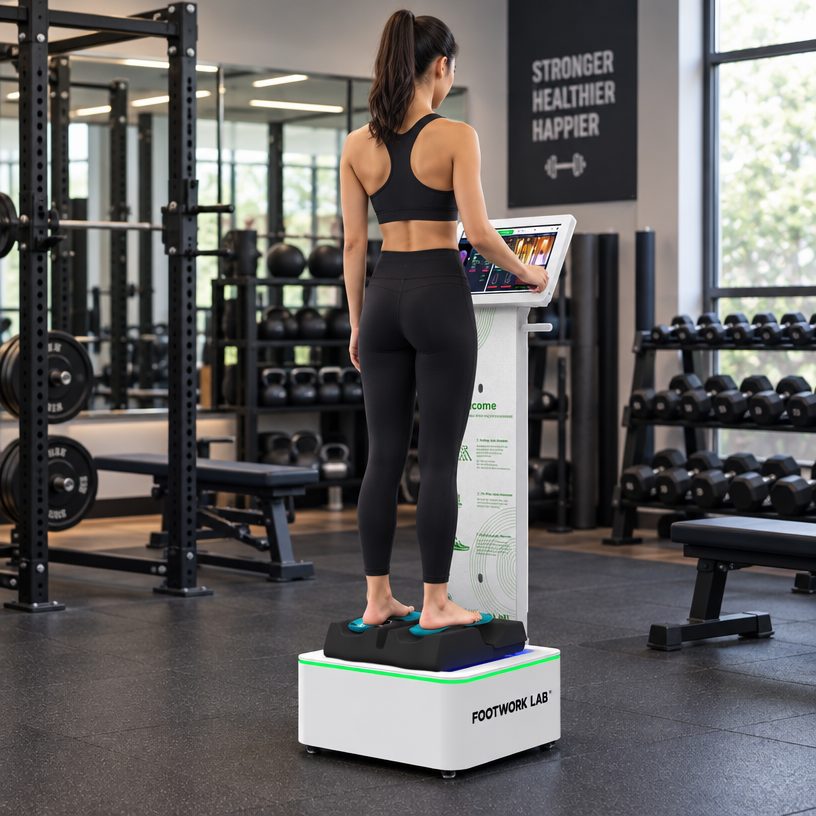
The system has three capture elements in one room: a foot capture area, a lower-limb camera and a posture camera, driven from a touchscreen. The foot area produces the plantar record — footprint length and width, contact area, the pressure distribution standing and walking, the arch as it presents under each condition. The lower-limb camera records how the knees and ankles sit relative to the feet. The posture camera takes the whole standing figure.
The posture entries are specific and unglamorous: neck tilt, shoulder drop, pelvic tilt and the forwards or backwards inclination of the pelvis, knee hyperextension, and the X or O tendency at the knees. Each is an angle or a displacement recorded from a marked position, and each appears on the report as a quantity rather than a verdict. There is no interpretation built into the number itself; a shoulder that sits lower than the other is a shoulder that sits lower than the other.
What the report adds is the assembly. Foot data, lower-limb alignment and the postural column arrive on one document, which is the practical difference between this kind of system and a collection of separate tools. An operator who has the foot record, the knee position and the shoulder line on one page can see whether the observations agree with each other. An operator holding three printouts from three devices usually cannot.
The last element is the one buyers forget to ask about: the customisation module. Because the same session can end with a pair formed on site, the record is not only a document but a specification. That is useful in a clinic and in a sports training room, and it is the reason some buyers choose a combined system over a better-specified single-purpose one.
Angles are not verdicts, and the report says so
Every entry on the report is a measurement taken at a moment, under conditions that the operator set. Posture is not a fixed property of a person; it changes with fatigue, with footwear, with what they did yesterday and with how long they have been standing in front of a camera. A record taken at nine in the morning after a commute is a different record from one taken at six in the evening after a shift, and neither is wrong.
This is why the report is framed as reference material and why the interpretation sits with a qualified professional. An operator can say what the record shows: the pelvis is inclined this way, the left shoulder sits lower, the knees pass beyond neutral when the member stands relaxed. An operator cannot say what it means, whether it matters, or what should be done about it. Those sentences belong to somebody with training, a history and the standing to make a judgement.
The commercial reason for holding that line is not modesty. A gym that starts interpreting posture records will eventually interpret one wrongly, in front of a member who then acts on it, and the resulting conversation is not one any insurer enjoys. A gym that describes the record and refers the reading is doing something narrower, more repeatable, and considerably more defensible.
There is a useful middle ground, though, and it is where most good operators work. Describing change over time is not diagnosis. Saying that the pelvic inclination reads differently from the record taken three months ago is an observation about two documents, and it is the kind of observation that makes a programme review substantive. The line is between describing the record and explaining the person.
On a gym floor: the baseline that makes a review mean something
A training programme without a baseline is a set of intentions. Most gyms sell an assessment at the start — sometimes a fitness test, sometimes a conversation — and then review progress against how the member feels. A posture and foot record gives the review something else to stand on: the same pages, taken the same way, three months apart, with the differences visible rather than asserted.
The gym use is modest by design. The record is taken before the programme starts, filed with the member’s details, and taken again at the end of a block. The trainer uses it in the review conversation alongside the training log, not instead of it. Nothing in that sequence requires the trainer to interpret a clinical question, and nothing in it turns the gym into a clinic. It simply means that when a member asks whether anything has changed, there is a document in the room.
There is a second use that gyms discover later: retention. A member who has a file, a photograph and a date attached to their membership is a member with a reason to return for the review. Gyms that run the retest as a scheduled event, booked at the same time as the programme, report that the review conversation is easier to hold and easier to charge for. The record is doing commercial work here, and there is nothing dishonest about that provided the claims stay inside the record.
What the gym should not do is screen. A member who arrives with a complaint, or whose record shows something the trainer does not understand, should be referred rather than assessed further. The equipment will still take the record; the reading goes elsewhere. Trainers who accept that boundary find the sessions simpler, not more constrained, because the awkward conversations stop happening at the desk.

In a rehabilitation room: the same pages, a different job
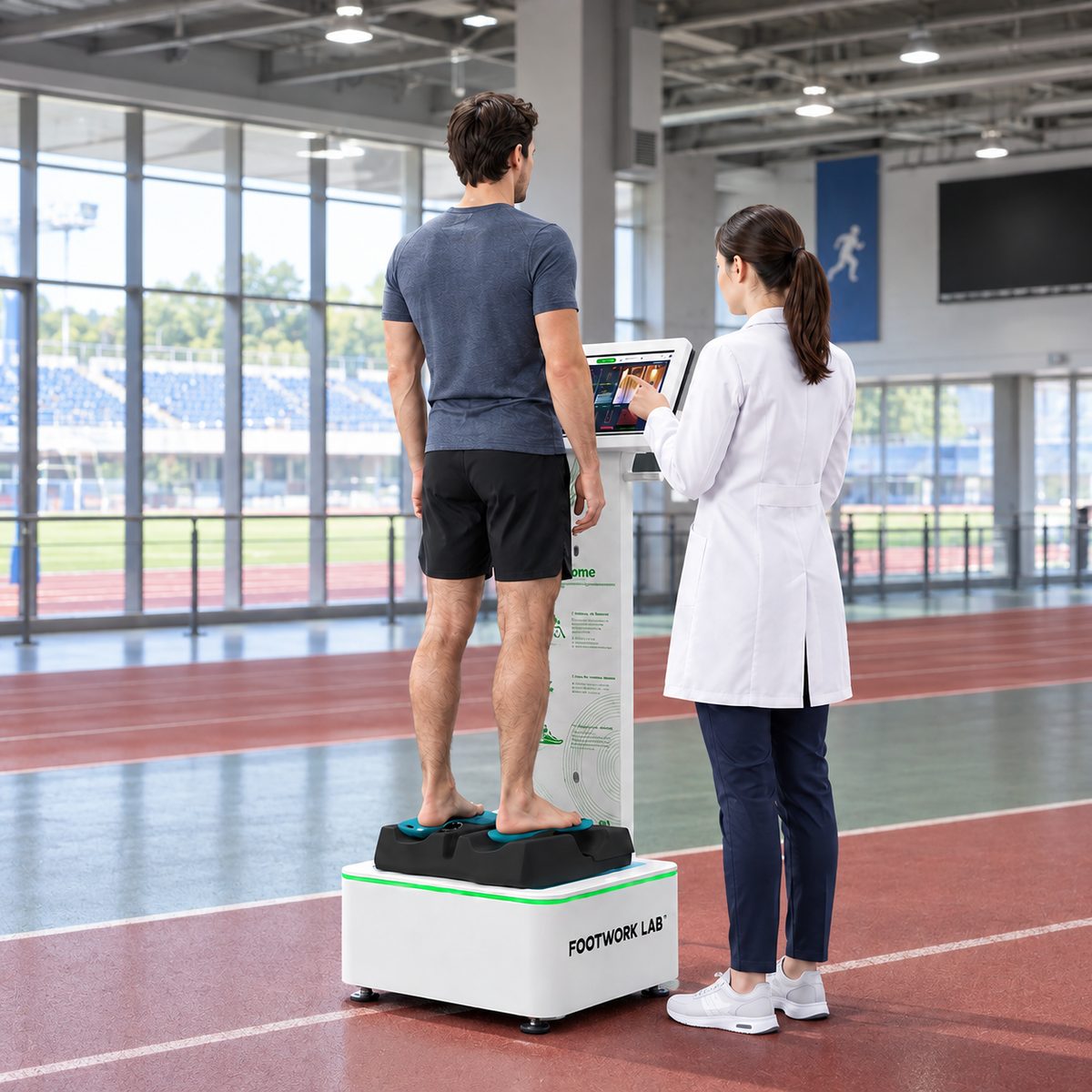
A rehabilitation department uses the same record for a different purpose. There, the baseline is taken before a course of care begins, and the interest is in change over a defined period: what the foot was doing at the start, what it is doing at the review, and whether the difference is consistent with the plan. The clinician reading it brings a history, an examination and a judgement that the equipment has no access to.
This is also where the whole-column view pays off most. A patient whose foot record changes but whose pelvic inclination does not is a different story from one where both move together, and the difference is only visible because both were captured in one session rather than in two appointments with two devices. Rehabilitation is largely a business of noticing which part of a chain is responding, and a single document makes that comparison cheaper.
The discipline the room needs is documentation rather than technology. Which session, which operator, which conditions, which build was fitted, and what the clinician concluded. A department that keeps those five things can defend its work to a funder, a referring physician or a patient asking why the plan changed. A department that keeps only the printout has the picture and not the story.
One caution specific to this setting: the record must not become a target. A clinician who starts forming a plan around making an angle move has confused the measurement with the goal. The angles are a description of how someone stands; the goal is what the clinician and the patient agreed the care is for. Systems that encourage the first confusion tend to be the ones with the most elaborate reports.
Making the session repeatable, which is most of the work
None of the comparison value survives if the second session is taken differently from the first. Four conditions have to be fixed and written down: where the feet start, how far the cameras sit from the capture area, what the person wears, and what they are told to do with their arms and their gaze. Change any one of those and the difference between two records may be a difference in the routine rather than in the person.
The practical instrument is a single page kept beside the equipment. It lists the standing position, the number of walking passes, which foot starts, the camera distance marked on the floor, and the instruction given to the person being recorded. New staff are briefed from that page, not from a demonstration by whoever happened to be trained first. In our experience the page does more for the quality of a programme than any additional feature on the machine.
Clothing and footwear deserve a line of their own, because they are the most common uncontrolled variable. A record taken in shoes and one taken barefoot describe different things, and a review that compares them is comparing a change of footwear. Rooms that decide once — barefoot, same stance, same distance — and then never vary it get records that hold together across a year. Rooms that let each operator decide get a folder of attractive pages that cannot be compared.
Finally, the retest interval should be set before the first session, not after. A baseline taken with no plan for a second record is a photograph. The interval belongs to the programme — the end of a training block, the review point in a course of care, the start of a new season — and the record is only as useful as the date attached to it.
Two limits from our side, stated where they are easiest to check. We do not publish prices in an article, because a quotation depends on configuration, quantity and destination, and we do not claim that a posture record predicts anything; it describes one person on one day. We also do not describe our systems as body composition tools, because they measure positions rather than tissue, and a buyer who needs the second thing should not be persuaded by the first.
Frequently asked questions
Does body analysis mean body composition?
In the market it often does, and that is why the phrase misleads. Our systems do not estimate fat, muscle or water. They record foot pressure, lower-limb alignment and postural angles from cameras. A buyer who wants composition figures is shopping in a different category, and mixing the two in one purchase decision usually produces disappointment.
Which postural items appear on the report?
Neck tilt, shoulder drop, pelvic tilt and the forwards or backwards inclination of the pelvis, knee hyperextension, and the X or O tendency at the knees, alongside the foot data and lower-limb alignment from the same session. Each is recorded as a quantity against a marked position.
Is a posture record a diagnosis?
No. It is a set of measurements taken at a moment under conditions the operator set. Reading those measurements, deciding what matters and what to do about it belongs to a qualified professional with a history in front of them. Every report is framed as reference material for that reason.
Can a gym use it without a clinician on staff?
Yes, for the baseline-and-review use: take the record, file it, repeat it at the end of a block, and compare. What a gym should not do is interpret a record clinically or screen members with it. A member with a complaint is referred, and the equipment still takes the record without anyone diagnosing anything.
How often should the record be retaken?
At the points the programme already has: the end of a training block, the review point in a course of care, the start of a season. What matters is that the interval is set before the first session, because a baseline with no planned second record is only a photograph.
What has to stay the same between two sessions?
Foot position, camera distance, clothing and footwear, and the instruction given about arms and gaze. Written on one page beside the equipment, those four things make records comparable. Left to each operator’s habit, they make a folder of pages that cannot be set beside each other.
What are the order and support terms?
Machines start at one unit, each is tested at the plant for seven days before dispatch, and the warranty covers twelve months against non-human damage with free parts. Support runs through a dedicated channel with engineers who can assist remotely, and connected units can take over-the-air updates.
What we would do next
Decide what the record is for before deciding which items it should carry: a baseline for a training block, a reference for a course of care, or a document to hand a customer. Write the session page first — stance, distance, clothing, instruction — and the equipment choice becomes a shortlist rather than a market survey. Send the page through the contact page and we will tell you which entries in the X5 report do the work you are describing. The X5 system page lists the capture elements and the posture items in the manufacturer’s wording.
Two related pieces may save a meeting. Postural analysis with the X5 walks a single session from the touchscreen to the printed page, and fitness analysis in a gym describes how one training floor folded the retest into its existing review cycle rather than adding a separate appointment.
This article is intended for professional and educational reference. It is not medical advice. Foot assessment equipment produces measurements and images; clinical interpretation and any decision about care remain the responsibility of a qualified professional. Certification scope is limited to the documentation we hold: European Union certification and ISO quality system certification.