
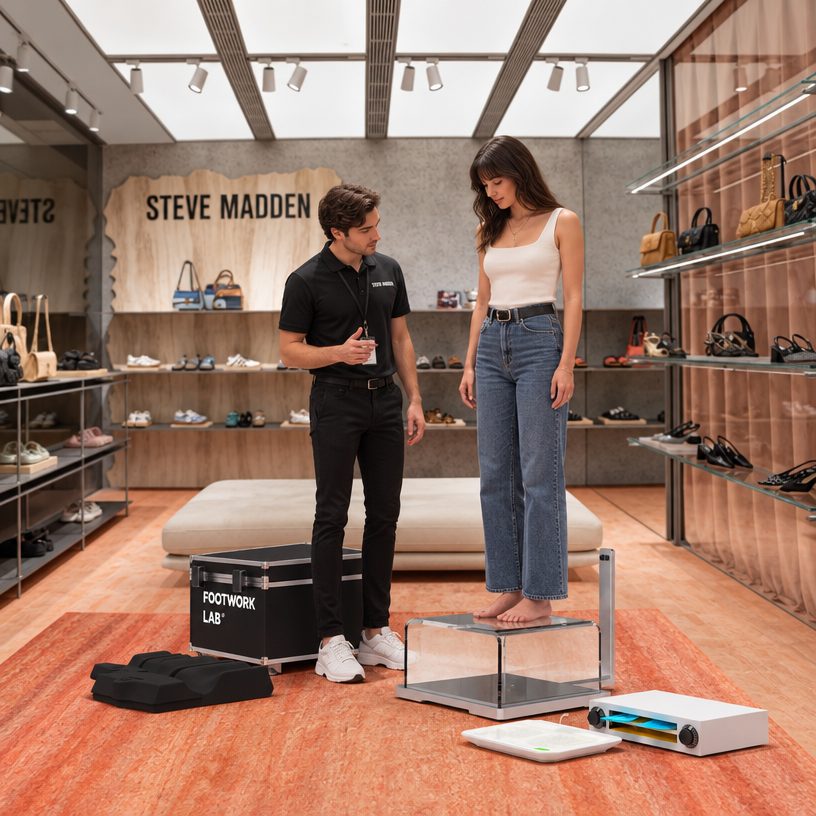
A shoe-shop owner in Valencia types maquina de escaneo de pies into a marketplace search bar at eleven at night, on a phone keyboard with no accents, and gets back three pages of listings that agree on nothing. One shows a colour map of a sole. One shows a rendered foot turning slowly in space. One shows a counter, a plate on the floor, and a customer standing on it in socks while an assistant reads a screen. All three pages use her phrase. None of them says what the thing measures, who reads the result, or what the customer carries out of the shop afterwards. Because the phrase is the one part of the purchase that arrives already decided, it is worth taking apart on the first screen. Maquina de escaneo de pies, máquina de escaneo de pies, escáner de pies — these are search words, the vocabulary the market has attached to a shelf of products, and the abbreviation most often bolted onto them is a market label rather than a description of any particular device. What our equipment records is pressure and force line: how load sits under the sole, how it travels through a step, how the leg aligns above the foot, and how the body sits above the leg. Nothing in this article will tell you what a foot looks like from the outside, because that is a different trade with different tools.
This article follows the phrase back to the question underneath it: who types it and from what kind of room, what the buyer is actually trying to capture, where the word scanner came from and what it costs to keep using it, what a pressure record holds item by item, how a counter session is set up so that a second visit can be compared with the first, and where our own answers stop.
One piece of context before the sections. The F2 is a foot pressure detection system: a fabric-sensing plate that takes static, dynamic and balance records, a lower-limb camera and a posture camera capturing alignment in the same session, and software that assembles the findings into one report. It was built for rooms where a session lasts minutes and the record has to earn its place in a single visit — rehabilitation hospitals, sports training facilities, foot therapy centres, shoe stores, podiatry clinics, gyms.
The phrase arrives without its accents
The phrase is rarely typed the way a catalogue would print it. The accent on máquina is dropped because a phone keyboard will not offer it without a long press; escaneo takes the place of escáner because the noun is easier to guess than the instrument; de pies arrives in the plural because the customer has two. Nobody writes that way in a brochure. People write it that way late at night, after seeing a machine in a competitor’s window or on a stand at a trade fair, when the only thing they are sure of is the outcome they want.
Four different buyers type it, and they are not shopping for the same thing. The owner of an ortopedía in a Spanish provincial city wants a session that fits between customers and produces a page she can hand over. A shoe-chain buyer in Mexico or Colombia is evaluating a fitting corner for a handful of stores, and needs to know how the same session behaves across staff who will not be trained twice. A distributor in Miami sourcing for Latin American accounts is buying a repeatable package: units, spares, training, documentation. A podiatry practice in Chile is buying a record it can compare with the one it took last season.
Those four purchases share a phrase and almost nothing else. One is a counter tool, one is a roll-out, one is a logistics exercise, one is a clinical archive. A listing that speaks to all four at once speaks to none of them clearly, which is why the pages she scrolled through at eleven at night were long on adjectives and short on items.
The correction is to describe the room before the machine. Who stands at the counter, how many minutes a session can take, who reads the output, what happens to the file afterwards, and what the customer is expected to leave with. Answer those five and the phrase turns into a shortlist of two or three. Skip them and the phrase turns into a comparison of photographs taken from flattering angles.
Three things the buyer is trying to capture
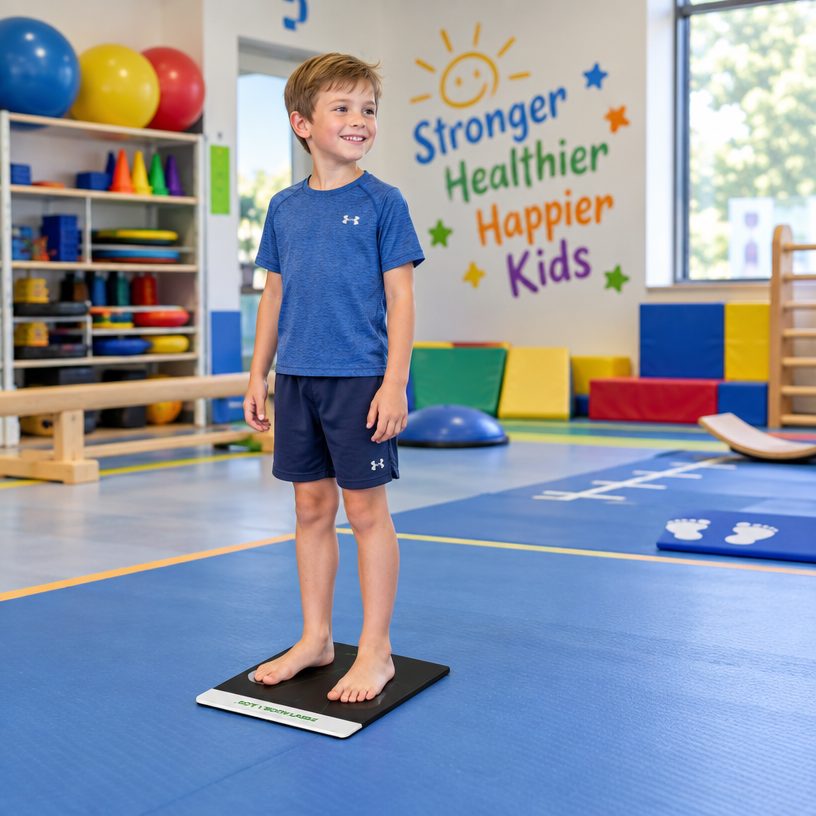
Underneath the search word there are three things a buyer is after, and they are usually asked for in the same breath. The first is the arch: how the sole presents at rest, how much of the medial side carries contact, whether the footprint reads broad or narrow. The second is load: where weight sits, where it peaks, how it travels from heel to forefoot through a step. The third is alignment: how the heel sits under the leg, how the knee tracks, how the shin rotates, how the column of the body sits over that base.
Arch is what the counter starts with, because it is what the customer asks about. A footprint at rest gives contact area, the outline’s length and breadth, and the medial border as it actually presents. It does not give a verdict. Whether a particular arch needs anything done about it is a judgement, and the judgement is not the assistant’s, not the machine’s and not ours; it belongs to a qualified professional, and the report says as much in the line printed at the foot of the page.
Load is the part a photograph cannot supply. Two customers can stand with near-identical outlines and walk completely differently: one rolling along the inside edge, one holding the arch firm through the very same step. A walk across the plate separates them in a single crossing, because what is recorded is behaviour rather than appearance. This is the distinction that decides whether a machine earns its floor space in a shop, and it is entirely invisible in a marketplace listing.
Alignment is the third, and it is what turns a sole measurement into something a fitter can work with. A camera at the lower limb captures the heel and knee line while the customer stands and walks; a second camera captures the posture above. The foot is where load meets ground, but the reason it meets ground that way sits higher up, and a record that stops at the sole leaves the fitter guessing at the half that matters most.
Where the word scanner came from, and what it costs
Scanner is a borrowed word. Spanish has escáner, and the trade has analizador, but the market reached for escaneo because it sounds like capture, and capture sounds like a file. That is the cost of the phrase in one sentence: it promises an object — a shape, a model, something a machine can be fed — when the more useful output for most of these buyers is a set of quantities plus a picture of alignment.
Two families of equipment live under the phrase, bought by different people for different reasons. Shape capture produces a contour that a milling bench, a printer or a mould can follow. Pressure recording produces numbers and alignment images that a specification is written against. Both are real trades. A shop fitting shoes needs the second; a workshop carving shells needs the first; a few operations need both and should budget for both rather than hoping one will cover the other.
The question that sorts a shortlist in one line is not about the phrase at all. Ask each vendor to list what their report contains, in their own words, and compare the lists. A shape vendor answers with a file format and a resolution. A pressure vendor answers with items: footprint dimensions, contact area, foot axis angle, phase shares, peak and mean pressure, centre-of-pressure travel, alignment images. Neither answer is long when the vendor is being straight with you, and length is not the signal — specificity is.
Our own answer, offered before anyone asks: we record pressure and force line. Fabric sensing under the sole, cameras for lower-limb and posture alignment, software that assembles the findings, and an AI-assisted report that puts them into one document. We do not produce a shape file of the foot. When a buyer arrives needing one, the honest move is to say so in the first message rather than at the packing stage, and that is the move we make.
What a pressure record holds, item by item
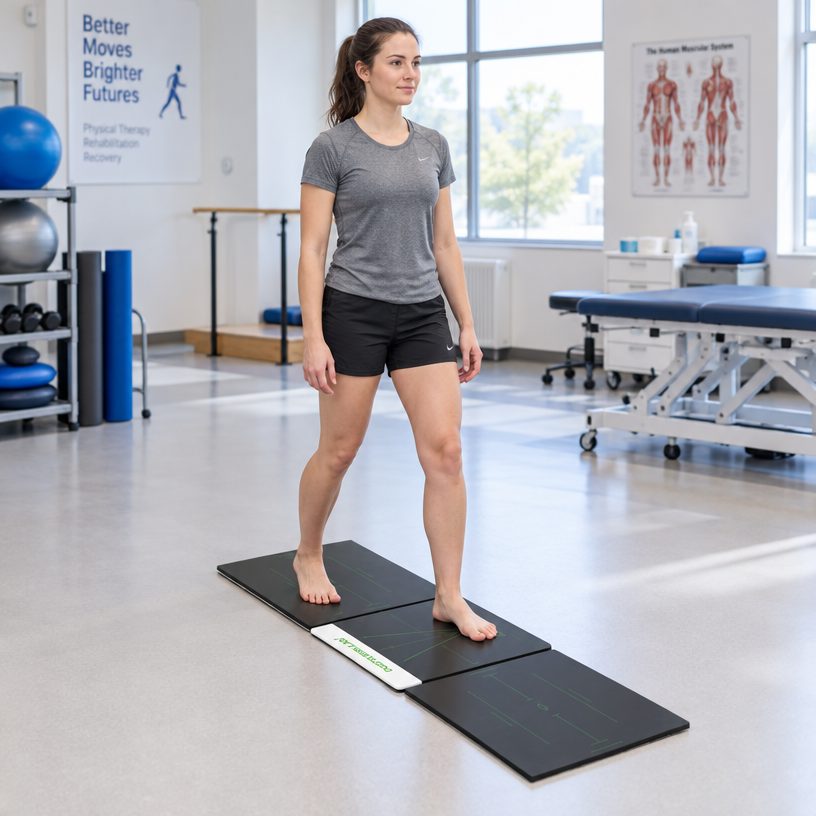
The static pass is the ground the rest stands on. Shoes off, feet where the assistant indicates, weight even, and the plate records the foot at rest: footprint length and width, contact area under each sole, the distribution across it, how the arch presents, and the comparison between the two sides. It is the shortest of the three passes and it produces the numbers most counter conversations begin from — usually the size the customer believes she wears against the size the record shows.
The dynamic pass is where the more useful half lives. The customer walks across the plate at a natural pace, several times, and each crossing captures the sequence: where contact begins, how load moves forward, where it peaks, how the foot axis points, how much of the step is spent in contact and how much in the flatter phase, and how quickly the centre of pressure travels. Feet that looked like twins standing still often part company here, and the customer can see it happening on the screen.
The balance pass closes the session. The customer is asked to hold still, eyes forward, weight even, and the record shows how load shifts when the body is not travelling through a step. It is a short trial, and it adds a dimension the other two do not contain: stability under load, and the symmetry between the sides while holding it. In a shop it is the pass customers find most surprising, because it is the one they can feel being measured.
The software then folds the three passes and the camera images into a single document, in the same order every time. That order matters more than it looks. A report whose sections move around between sessions cannot be compared with itself, and comparison is the only reason to keep a record at all.
A counter session that survives a second visit
A record is worth little on the day it is made and a great deal on the day it is repeated. The difference between those two days is routine. The same instruction for stance, the same number of crossings, the same starting foot, the plate in the same place on the floor, shoes off every time, and the same person counting if a person is counting. Written on a card and taped inside a cupboard, that is a page of procedure; left to memory, it is a coin toss with a customer’s confidence on it.
The handover decides whether the record survives the visit. Ask what the customer leaves with: a printed page, an email, a code to scan at home. Ask what the shop keeps, and where. The failure mode is common and quiet — the session runs, the customer is impressed, and six months later nobody can find the file, so the retest starts from zero and the second visit becomes a first visit with extra steps.
Staff turnover is the test that separates a counter tool from a personal skill. A shop where any assistant can run the routine after a morning of training is a shop that keeps a record consistent through a change of staff. A shop where one person knows the sequence is a shop that loses its archive the week that person leaves. When we demonstrate, we demonstrate to two people, and we ask the second to run it while the first watches.
Language belongs in the same list. A report read at a counter in Spanish should be a report in Spanish, from the headings to the closing line. That line is not decoration: it states that the data is for reference, and that interpretation and any decision about care belong to a qualified professional. Printing it in the customer’s own language is the difference between a document that is understood and a document that is signed without being read.
Where we stop
We will apply the distinction in this article to ourselves before applying it to anyone else. Our equipment does not capture the outside of the foot. There is no contour at the end of a session, no surface to carve against, no geometry for a milling bench. A buyer who needs a shape should be told that immediately, in whatever language the enquiry arrives in, because a sale built on an unresolved word comes back as a complaint with our name on the crate.
The second statement is about reading. Every figure in the report is a record: distribution, phase shares, axis angle, centre-of-pressure speed, alignment angles. None of it is a conclusion. What those figures mean for one particular person is clinical judgement, and clinical judgement is not something a counter, a camera or a vendor supplies. Our reports carry that sentence, and we would rather lose a sale than have it quietly removed to make a brochure look stronger.
The third is commercial, and it is short. We do not put prices in an article, because a quotation depends on the configuration, the destination and the service wrapped around it. What we can state is structure: machines start at one unit, machines accept ODM, every unit is tested at the plant for seven days before dispatch, the warranty runs twelve months against non-human damage with free parts, and after-sales runs through a dedicated WhatsApp group with engineers reachable directly, remote assistance when a room needs it, and over-the-air updates where the unit is connected.
What we will not do is promise that a machine fills a room, that footfall doubles, or that a territory is reserved for one buyer. Those promises are cheap to make at a fair and expensive to live with afterwards. The honest version of the offer is smaller and more useful: a record that holds what it says it holds, a routine that can be repeated by more than one person, and an engineer who answers the phone in the second year.
Frequently asked questions
What does maquina de escaneo de pies mean literally?
Machine for scanning feet, with the accent dropped from máquina and escaneo used where escáner would be more precise. In practice it works as a category search rather than a product name: buyers use it for anything from a counter plate to a workshop tool, and the listings it returns rarely agree on what is being measured.
Does a shoe shop need shape capture?
Most shops do not. A fitting counter works from load and alignment: where the customer’s weight sits, how the foot travels through a step, how the heel and knee line up. If the shop also mills or moulds, a contour is a separate purchase from a separate trade, and it should be budgeted as one.
What does the static pass record?
Footprint length and width, contact area under each sole, the distribution of pressure across it, how the arch presents at rest, and the comparison between the two feet. It is the shortest pass in the session and the one most counter conversations start from.
What does the walking pass add?
The step itself: where contact begins, how load travels forward, where it peaks, the foot axis angle, the share of the step spent in contact and flat phases, and the speed of the centre of pressure. Feet that look alike standing still often behave differently in motion, which is why the crossings are not optional.
Who reads the report?
A qualified professional. Every report carries a line stating that the data is for reference, and the interpretation of the figures — what the distribution means, what the alignment images suggest — belongs to clinical judgement rather than to the equipment or the vendor.
Can two visits be compared?
Yes, on one condition: both sessions ran the same routine. The same stance instruction, the same number of crossings, the same starting foot, the plate in the same position. Shops that write the routine down get records that can be set side by side; shops that improvise discover the problem at the retest.
What are the order and warranty terms?
Machines start at a minimum order of one unit and accept ODM. Every unit is tested at the plant for seven days before dispatch, and the warranty covers twelve months against non-human damage with free parts. After-sales runs through a dedicated WhatsApp group with engineers reachable directly and remote assistance available.
What we would do next
Write the five questions from the first section on a single page — who stands at the counter, how long a session may take, who reads the output, where the file goes, what the customer takes home — and send the same page to every vendor on your list. Send it through the contact page and we will answer it in our own words, including the parts where the answer is no. The F2 system page lists the record types and report items in the equipment’s own terms.
Two pieces go further into the same question. A 3D foot scanner for podiatrists takes the clinical version of this search apart, and a scanner for foot assessment sets out what a session is actually for once the machine is in the room. Foot type is a record, not a verdict is the short version of the boundary we keep drawing here, and it is the page we send to counter staff in their first week.
This article is intended for professional and educational reference. It is not medical advice. Foot assessment equipment produces measurements and images; clinical interpretation and any decision about care remain the responsibility of a qualified professional. Certification scope is limited to the documentation we hold: European Union certification and ISO quality system certification.