
A shop owner stands at her counter watching a customer wait for a fitting and asks the question behind half the foot-equipment searches we receive: can something useful happen in those three minutes, or does assessment always need an appointment? The phrase buyers type is podiatry detection, and the word detection carries the whole misunderstanding in it. What a doorway session can do is screen — record what the foot and ankle present, in minutes, against named items — and what it cannot do is detect in the sense a medical drama uses the word: decide, diagnose or promise. The Q1P podoscope was built for exactly the doorway role: a screening station that records arch type, foot shape, hallux valgus, hindfoot valgus, tibial rotation, foot length and width with a shoe size suggestion, and hands the customer a conclusion page that says for reference in its own print. This article walks through what such a quick screen records, how it fits a store or clinic entrance, where its results go next, and the limits we print on the report rather than leave to the operator’s discretion.
The commercial case is simpler than the vocabulary. A customer who sees their own feet described in specific items — not adjectives, items — stops treating the fitting as guesswork and starts treating the store as the place that knows feet. The screen takes minutes because it records rather than deliberates, and everything it finds either leads to a product on the shelf or leads to a referral. Both outcomes are honest, and both are revenue.
Detection means screening, and the word needs its fence built early
In ordinary retail language, detection implies finding something hidden. In a foot assessment setting, the honest version is narrower: a screen records what presents at the surface — how the arch sits, how the heel aligns, how the shin carries, how long and wide the foot actually is. It does not look inside, does not conclude and does not name a condition. The difference is not semantics; it decides who may operate the equipment, what the operator may say about the output, and what the printed page is allowed to claim.
This is why our reports carry the boundary in their own text. The conclusion page states that the results are for reference and directs anyone with a medical need to a professional institution. That sentence is not a legal ornament; it is the operating rule of the whole category. A store that removes it, or an operator who talks past it, has turned a screening record into a verdict, and a verdict made by a fitter with a machine is exactly the claim the equipment was designed not to make.
Buyers evaluating a screening device should listen for that fence in the vendor’s own materials. Ask what the report says about interpretation, and ask who is permitted to read the results aloud to a customer. A vendor whose marketing implies the machine finds problems is selling a liability along with the hardware, and the sensible buyer walks away from that sentence before walking away from a price.
The fence also protects the operator, which is a point buyers miss until their first difficult customer. A fitter who is handed a machine and no script will eventually be asked the question the screen cannot answer — is this bad, what should I do — and will improvise an answer, and the improvisation will be repeated to somebody as the store’s opinion. The reference line printed on the report is that operator’s script: the record is yours, the reading belongs to a professional, and here is what to take with you. Equipment that supplies the script is equipment a store can hand to new staff without a training course in damage control.
What a quick screen records in minutes
The session itself is short because every item is a recording rather than a deliberation. The customer stands on the podoscope platform; the plantar surface is captured; cameras record the lower limb. Within minutes the report lists arch type and foot shape, notes hallux valgus and hindfoot valgus presentation, records tibial internal and external rotation, and measures foot length and width — ending with a suggested shoe size, which in a shoe store is often the item the customer actually came for.
Notice what the item list has in common: every line describes structure as it presents today. None of the lines says what the foot will do, what should be done about it, or what any product will change. That restraint is deliberate and worth testing during a demonstration — ask the vendor to point at the report and name which items are recordings and which are conclusions. A report with no conclusions is a report a store can live with; a report full of conclusions is a report the store will eventually be asked to defend.
The lower-limb items deserve their own mention because they are the ones customers react to. Tibial rotation and hindfoot valgus are visible in a mirror but never quantified, and the moment a customer sees their own numbers, the conversation about shoes changes register: the question stops being which colour and becomes which build suits how their leg carries. That conversation is the commercial heart of the screening session, and it happens only when the operator knows the difference between reading a recording and making a judgement.
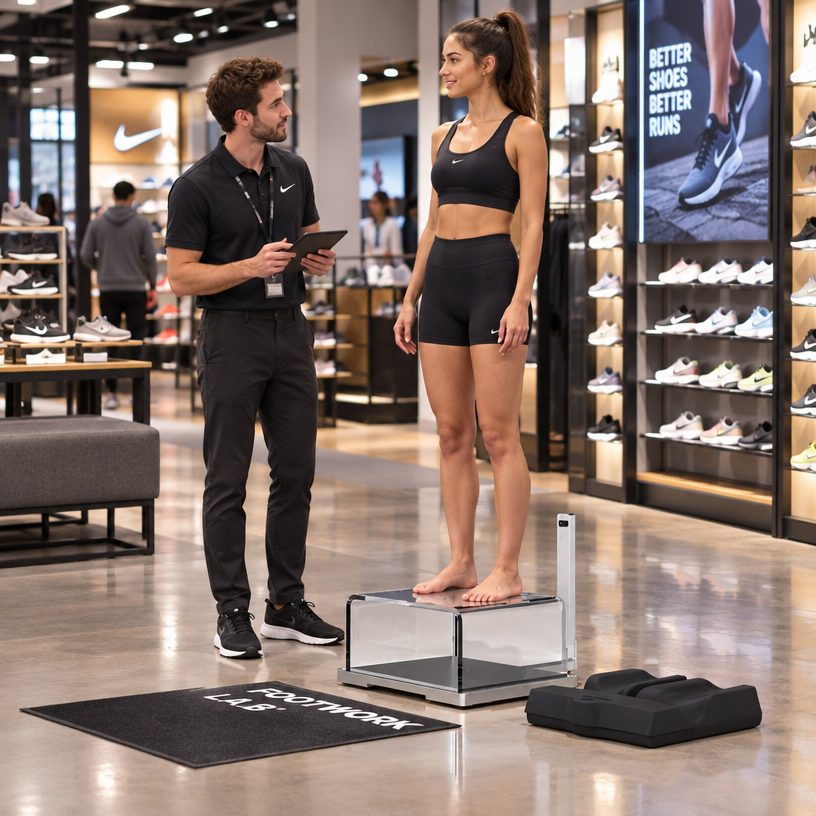
The shoe store as the natural setting for a doorway screen
The main scene for this kind of equipment is the shoe shop, and the fit is structural rather than incidental. A store already owns the three things a screen needs: passing traffic, a reason for the customer to be there, and staff who talk about fit all day. The screen adds the fourth thing the store cannot fake — specifics. A fitter who can point at a recorded foot length and width, an arch type and a size suggestion is no longer estimating by eye, and the customer can feel the difference in the first sentence.
The counter flow we see working in buyer stores runs like this. The customer waits or browses; the screen sits where the queue naturally pauses; the session takes minutes and needs no appointment; the report prints at the counter. If the foot record suggests nothing beyond a correct size, the sale is a correctly fitted pair of shoes and the customer leaves impressed by the precision. If the record shows presentations the customer wants to discuss further, the store has the next step on hand: the same system family that screened can support on-site customisation, or the store can refer out. Either branch closes cleanly.
Placement inside the store matters more than buyers expect. A screen tucked into the back room becomes a service requiring an appointment, which defeats the doorway role; a screen at the entry captures people who never intended to be assessed, which raises its own questions about consent and pace. The position that works is where waiting already happens — the fitting bench, the queue for the till — because there the session is offered, not sprung, and the customer can decline without embarrassment.
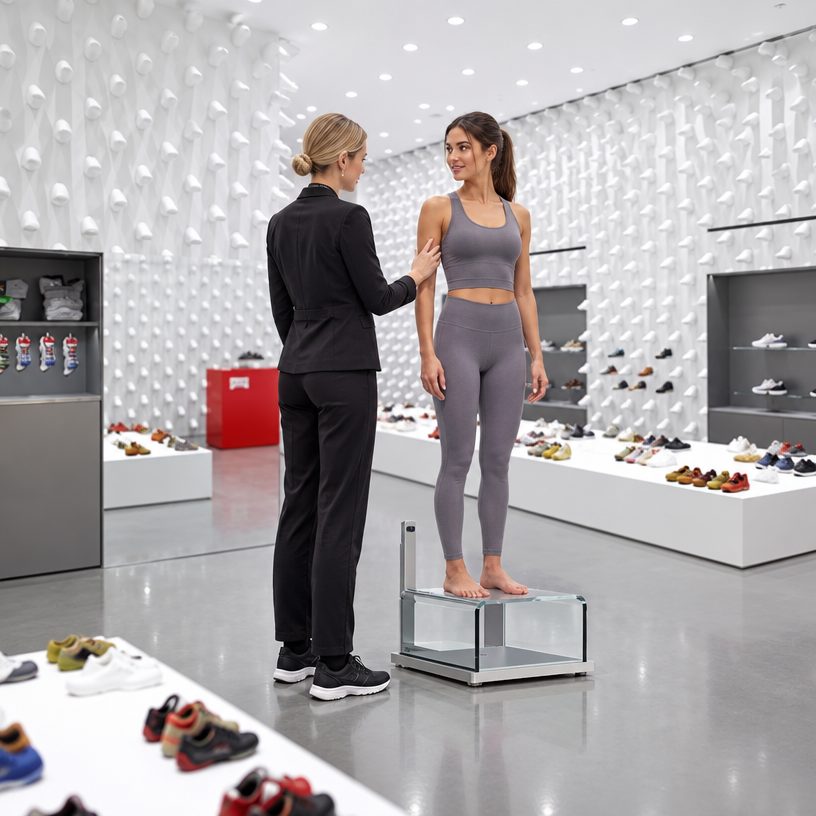
The conclusion page: what the customer actually takes away
The printed page is the product the customer remembers, and its design carries more weight than the hardware. Ours ends with the reference line — results for reference, medical needs to a professional institution — and that line does real work in the room. It gives the operator a script for the questions a screening session always attracts: no, we do not diagnose; yes, the record is yours; if this concerns you, the right next step is a professional, and here is the record to take there. An operator with a printed boundary is an operator who never has to improvise an answer.
The page also travels. A customer who takes the record to a professional hands that professional a starting point: named items, recorded on a stated date, on a machine whose report format does not change between visits. That handoff is the quiet justification for the whole doorway category — the screen does not close the conversation, it opens one elsewhere, with better evidence than the customer would have arrived carrying. Stores that explain the handoff this way find the referral branch of the flow builds goodwill rather than losing sales.
Training shapes what the page becomes. We teach operators to run the session, position the customer, print the report and explain the reference line; we do not teach them to interpret the items, because that judgement belongs to qualified professionals and a store course cannot confer it. Buyers comparing screening systems should ask exactly what the vendor’s training covers and what it pointedly does not — the honest answer is a better signal than any feature list.
From screen to service: where the record goes next
A screening record earns its keep twice: once at the counter, and again wherever the customer goes next. In stores that extend into custom work, the screen is the top of a funnel rather than a standalone attraction — the same record that suggested a shoe size can support a conversation about insoles, and where the store runs an on-site forming capability, the session can end with a specified pair rather than a recommendation to think about it. The screen does not specify the pair; the record is read, the build is chosen against it, and the forming kit handles the contour family.
The retest is the part buyers underrate. A foot changes with age, workload and footwear, and a customer whose record sits in a drawer has no reason to return; a customer whose record is re-taken next season has a comparison to discuss and a size to re-check. Stores that re-screen annually turn a one-time assessment into a standing appointment, and the fixed session routine — same stance, same platform, same conditions — is what makes the comparison worth making. The screen is cheap to run a second time; the relationship is what is expensive to rebuild.
For clinics and practices, the same doorway logic applies at reception rather than at a till. A screening record taken at intake gives the professional a baseline before the first consultation, and the minutes it costs are repaid in the consultation itself. The item list is the same, the reference line is the same, and the boundary stays the same: the practice reads, the machine records.
Whichever setting hosts it, the screen’s output should end up somewhere the next visit can find it. A report handed to the customer and never copied leaves the store blind at the retest; a store that keeps a copy — with the customer’s consent — can put two records side by side a year later and show the difference rather than describe it. We ask buyers where the records will live before we ask where the machine will stand, because the second question is easy and the first one decides whether the screen ever earns its floor space back.
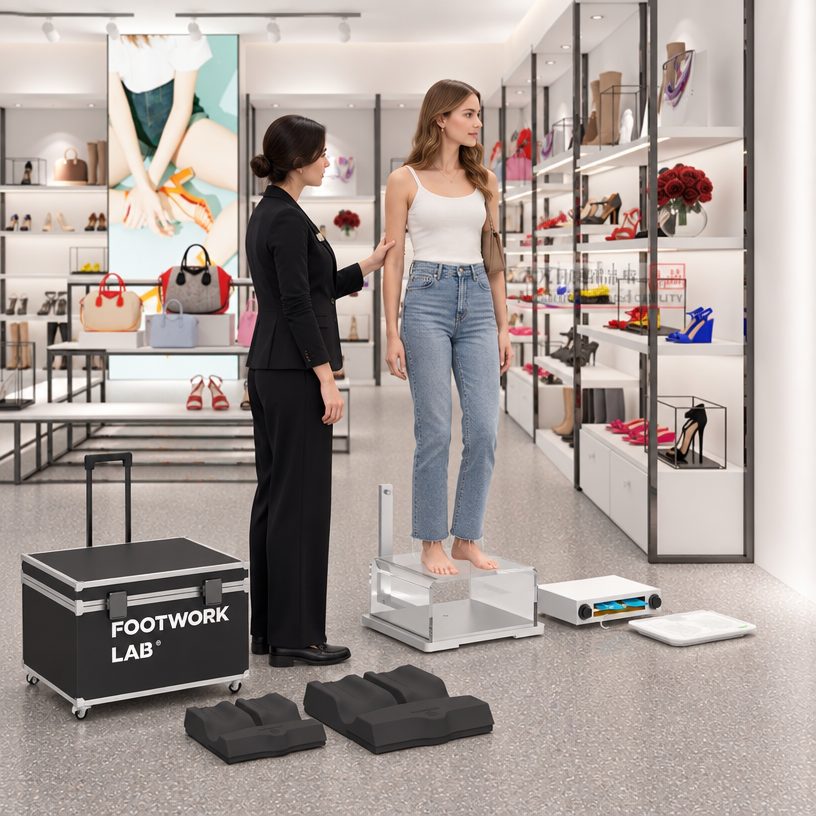
What a quick screen will not do
It will not diagnose, and we will not sell it as if it could. Every item on the report — arch type, foot shape, hallux valgus and hindfoot valgus presentation, tibial rotation, foot length and width — is a recording of structure as it presents, and naming what a presentation means is the work of a qualified professional. Our marketing says record, our reports say reference, and when a buyer asks us to tune either towards verdict language, we decline. The refusal has cost sales; it has never cost a lawsuit we would have deserved.
It will not promise what any product will do about a finding. A screen that ends with the suggestion that some insole or shoe will resolve what the record shows has quietly made a clinical promise, and no factory should be making clinical promises. What we supply is the record, the reference line and, where a build is specified by someone qualified to specify it, the product itself. The chain of responsibility stays visible, and every link knows which link it is.
And it will not substitute for the professionals further down the referral. The doorway screen exists because most people never have their feet recorded at all, and a three-minute session with a printed boundary is a better first step than a mirror or a guess. But the step is a first step, and the equipment knows its place in the sequence even when the marketing of other vendors suggests otherwise. We would rather be the machine that knows what it is than the machine that claims everything.
Frequently asked questions
Does “detection” mean the machine finds problems?
No. In this context detection means screening: the session records what the foot and ankle present — arch type, foot shape, alignment items, dimensions. It does not diagnose, and the report itself states the results are for reference.
How long does a screening session take?
Minutes. The customer stands on the platform, the plantar surface and lower limb are captured, and the report prints with the item list and a suggested shoe size. No appointment is needed, which is what makes the doorway role work.
What exactly does the report contain?
Arch type and foot shape, hallux valgus and hindfoot valgus presentation, tibial internal and external rotation, foot length and width, and a suggested shoe size — each a recording, with a reference line directing medical needs to a professional institution.
Can store staff interpret the results for customers?
Staff are trained to run the session, print the report and explain the reference line. Reading what the items mean belongs to qualified professionals, and our training deliberately does not cover interpretation.
What happens if the screen shows something concerning?
The customer takes the printed record to a professional institution. The report is designed to travel, and the reference line gives the operator a script for that conversation rather than leaving it to improvisation.
Can the screen connect to custom insole work?
Yes. Where a store runs on-site customisation, the record supports the specification conversation, and a build specified against it can be formed on site. The screen records; a qualified reader specifies; the forming kit handles the contour family.
Why re-screen customers who were screened before?
Because a retest taken under the same routine gives a comparison, and the comparison is what brings the customer back. Stores that re-screen annually turn a one-time assessment into a standing appointment.
What we would do next
Sketch your doorway: where the queue pauses, where the screen stands, who prints the report and who explains the reference line. Send the sketch through the contact page and we will tell you which branch of the flow your setting supports — fitted shoes, on-site customisation, referral, or a combination.
The Q1P podoscope page lists the screening items and the report contents in the equipment’s own terms. Podoscope for the shoe store describes the counter setting in detail, and a podoscope foot screening takes minutes walks the session itself.
Two more set the boundaries this article leans on. Foot type is a record, not a verdict makes the screening-versus-diagnosis argument plainly, and podiatry instruments in a clinic room shows where the doorway screen hands over to professional practice.
This article is intended for professional and educational reference. It is not medical advice. Foot assessment equipment produces measurements and images; clinical interpretation and any decision about care remain the responsibility of a qualified professional. Certification scope is limited to the documentation we hold: European Union certification and ISO quality system certification.