
The rider came back after his first long ride of the season with a straightforward complaint: the pair he had worn happily all winter was suddenly too much shoe for the cycling shoes. Nothing had changed in his feet between March and April. What changed was the platform underneath them. A cycling shoe does not behave like a running shoe, a walking shoe, or any other shoe the rider owns, because the sole is deliberately stiff and the foot is clipped to a machine rather than landing on the ground. A cyclist shopping for cycling shoe insoles is really asking how load behaves through a stiff plate, and the answer decides almost everything else: how little room there is inside the shoe, why the forefoot takes the brunt, where the numbness and the hot spots come from, which problems belong to the shoe and which to the pair inside it, and why some riders should change nothing at all. This article works through those questions in order, with the trade-offs stated plainly, because cycling is the discipline where the gap between what riders expect from a pair and what a pair can honestly do is widest.
A stiff sole changes the whole load path
In a running shoe, the sole bends. The foot flexes at the ball, the material compresses, and load is spent gradually across the contact from heel to toe. In a cycling shoe, the sole is built not to bend. Whether the plate inside is carbon or a stiff composite, the design intent is the same: the rider’s push should travel through the sole into the pedal as directly as possible, with as little of it lost to the shoe folding underneath the foot. Every efficiency argument for a stiff cycling sole rests on that one decision.
What the stiffness changes for the foot is the distribution of work. In a flexible shoe, the muscles and soft tissue of the foot share the job with the sole, because the sole gives and the foot works against it. In a stiff shoe, the sole refuses to give, and the load arrives at the sole of the foot as pressure against an unyielding surface, concentrated where the foot meets the plate. The foot stops being a spring and becomes a load carrier resting on a shelf. Neither arrangement is better in the abstract; they are different jobs, and the sole of the foot experiences them differently.
The concentrated pressure shows up in the record. A standing pass on a pressure system, or any honest look at a rider’s history of hot spots, tells the same story: with the foot on a rigid surface, load gathers under the ball of the foot and the heel, and the middle of the foot carries less than it does in a flexible shoe. The peak regions are sharper. This is not a defect of the shoe or the rider; it is the stiff sole doing what it was bought to do. Any conversation about the pair inside the shoe starts from accepting that distribution, rather than trying to talk the shoe out of it.
It also means the pair’s role changes. In a flexible shoe, a pair can work with the sole’s movement, filling volume and spreading contact across a bending platform. In a cycling shoe, the pair sits between a rigid plate below and a foot above, and its realistic job is to spread the contact against the plate and hold the foot steady on it. Riders who expect the same softness they feel in their everyday shoes are comparing two different constructions, and the disappointment that follows is a mismatch of expectations rather than a failure of either product.
Where the cleat sits decides where the load lands
The cleat is the small interface fixed under the shoe that locks it to the pedal, and its position decides where the foot’s push meets the machine. Move the cleat forward, towards the toes, and the lever arm under the forefoot lengthens: more pressure gathers under the ball, at the point the shoe presses into the pedal. Move it back, under the arch line, and the load spreads rearward, with less gathered at the ball. Riders feel the difference immediately, and the difference is mechanical, not a matter of the pair inside the shoe.
This is worth stating plainly because it is the most common confusion in the cycling conversation: many complaints that arrive as insole questions are cleat questions wearing a disguise. A rider with pressure gathering under one spot at the ball may have a cleat placement issue before they have any issue the pair can address. A pair can spread contact across the forefoot, but it cannot move the pedal. The first hour of a serious cycling fitting is usually spent on cleat position, saddle height and shoe fit, and only after those are settled does the question of what goes inside the shoe become answerable at all.
The practical ordering matters for anyone selling or fitting into this discipline. Set the mechanical interface first: cleat position, closure tension, strap and dial pressure across the instep. Then look at what the foot does on the plate with those settled. A pair built before the cleat is placed is a pair built to a moving target, and it will be blamed for sensations that were decided by hardware underneath it. We say this to partners because it protects them: the workshop builds to a record, and the record is only meaningful once the shoe is set up the way the rider will actually ride it.
There is also a symmetry worth naming. Just as a pair cannot fix a cleat problem, a cleat adjustment cannot do what a pair does. The cleat changes where the machine meets the shoe; the pair changes how the foot meets the shoe. Riders who move the cleat back expecting arch support get a pressure change, not a shape change, and the foot still sits on a flat plate. The two adjustments answer different questions, and a fitting session that runs both, in the right order, ends with fewer mysteries than one that runs either alone.
Very little room inside the shoe
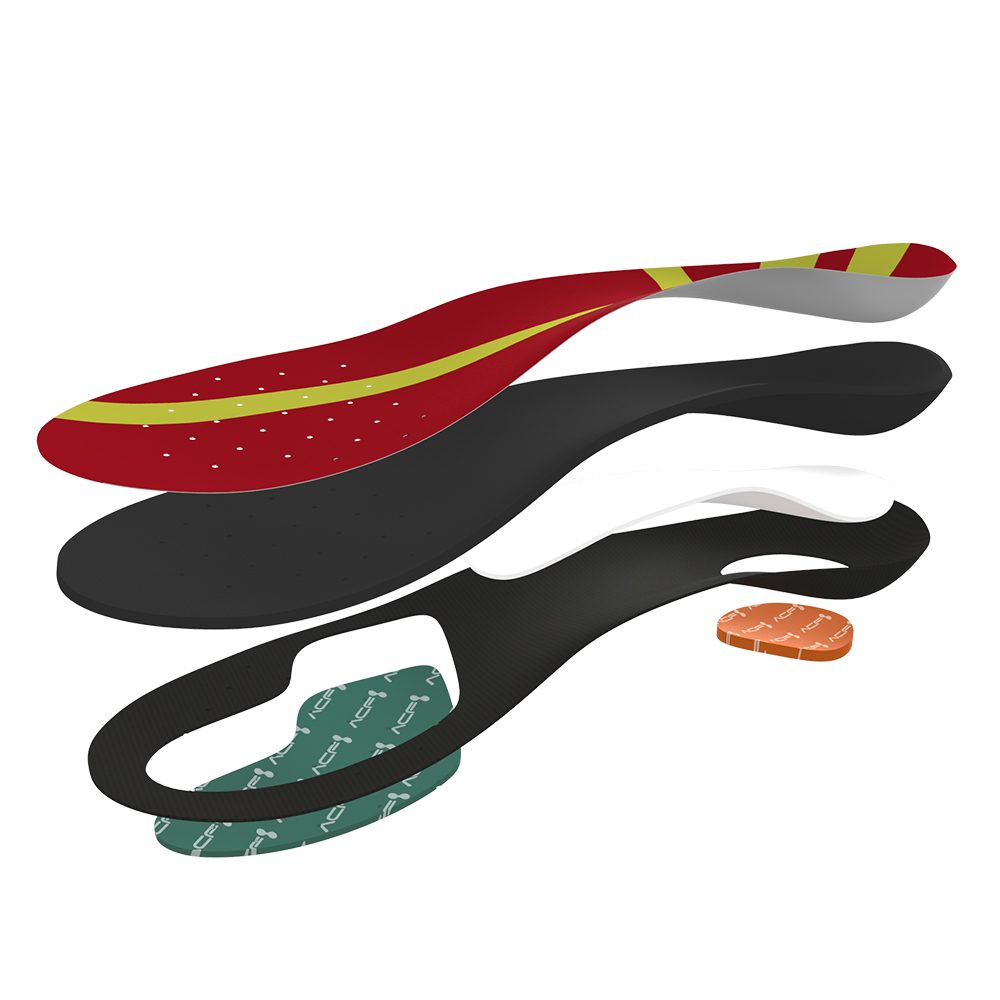
Cycling shoes are built close. The upper wraps the foot, the closure systems pull the shoe tight for the power transfer the sole exists to deliver, and there is no design budget for spare volume. Unlike a walking shoe with a removable footbed and slack over the instep, the cycling shoe has already spent its interior space on holding the foot firmly against the plate. The rider’s foot, their sock, and whatever pair goes inside have to share an interior that was measured close from the start.
This is why the thickness question is sharper in cycling than in any other discipline we write about. In a roomy everyday shoe, a pair that is a little thicker than the outgoing footbed causes some tightness. In a cycling shoe, the same excess shows up as immediate pressure across the instep, numbness at the toes from the front, or a closure that cannot dial out enough slack on a warm afternoon when feet swell. The build has to be planned thin from the first sketch, because there is no forgiveness in the host shoe, and trimming a finished pair down to rescue a tight fit gives up structure the foot was counting on.
Socks belong in the same sentence as the build. Riders who wear thick padded socks into a close-fitting cycling shoe have already spent interior space before the pair is considered, and the combination of thick sock and substantial build is the most common recipe for a shoe that cannot close comfortably. The realistic uniform for the discipline is a thin sock, and the honest fitting conversation names that early, because it changes what the pair is asked to do: with less padding arriving from the sock, more of the spreading job falls to the build itself.
The closure also decides where the room is. A shoe closed with a single dial over the instep concentrates its hold there; a shoe with straps lower across the forefoot gathers pressure lower down. Two riders with the same feet and the same pair can report different sensations purely because their shoes close differently. A fitter who asks which shoe model the pair is destined for, and which closure it uses, is asking the question that decides whether the build rides comfortably or fights the upper every ride.
Numbness and heat: where they usually come from
Numbness in a cycling shoe usually begins with pressure over a long time. The foot rests on a rigid plate, the shoe holds it still, and the same regions, the ball and the area between the long bones of the forefoot, sit under continuous load for the length of the ride. Unlike walking, where load moves across the sole step by step, pedalling returns the same contact over and over, and the tissue under that contact has no intervals in which to recover. Continuous pressure in one place is the mechanism behind the familiar report of tingling toes on longer rides.
Heat has a second origin, and it is the sole itself. A stiff plate is a barrier, and everything the foot might dissipate through flexion and movement stays close to it. Inside a wrapped upper, on a warm day, against a plate that will not breathe, the interior warms. Add the friction of a foot held immobile against the plate, and the hot spots riders describe under the ball are exactly where the mechanics put the contact. None of this is a fault to be repaired; it is the discipline’s construction behaving as designed, and the honest conversation is about managing it, not promising it away.
What a pair can realistically contribute is the spreading of contact and the steadying of the foot. A build that spreads the load across more of the forefoot reduces the concentration at any one spot, which is the mechanical reason fitters reach for it first. A build that holds the arch steady stops the foot from collapsing sideways against the plate under load, which keeps the contact where the fitting placed it instead of drifting with fatigue. Those are support and load distribution statements, and they are the honest ones. Whether a rider’s numbness resolves is a question for a professional, because persistent symptoms in the feet during sport deserve more than a product answer.
There is also the part the rider controls. Longer rides built up gradually, rest intervals off the bike, closure tension eased rather than maximised, thin socks, and shoes sized with warm feet in the shop all move the same needle the pair moves. A fitting conversation that covers the whole system, shoe, cleat, sock, build and riding habits, serves the rider better than any single-product answer, and it is the conversation we would rather our partners have.
What belongs to the shoe and what to the insole
Draw the boundary honestly and most cycling complaints sort themselves. The shoe owns the mechanical interface: sole stiffness, cleat mounting and position, the closure and its pressure pattern, the overall fit and the volume it offers. No pair inside the shoe changes any of those, and a rider whose discomfort comes from a badly placed cleat or a closure that presses in the wrong place needs a shoe-side answer, not a build-side one. The first job of a good fitting conversation is deciding which side of the boundary the complaint actually lives on.
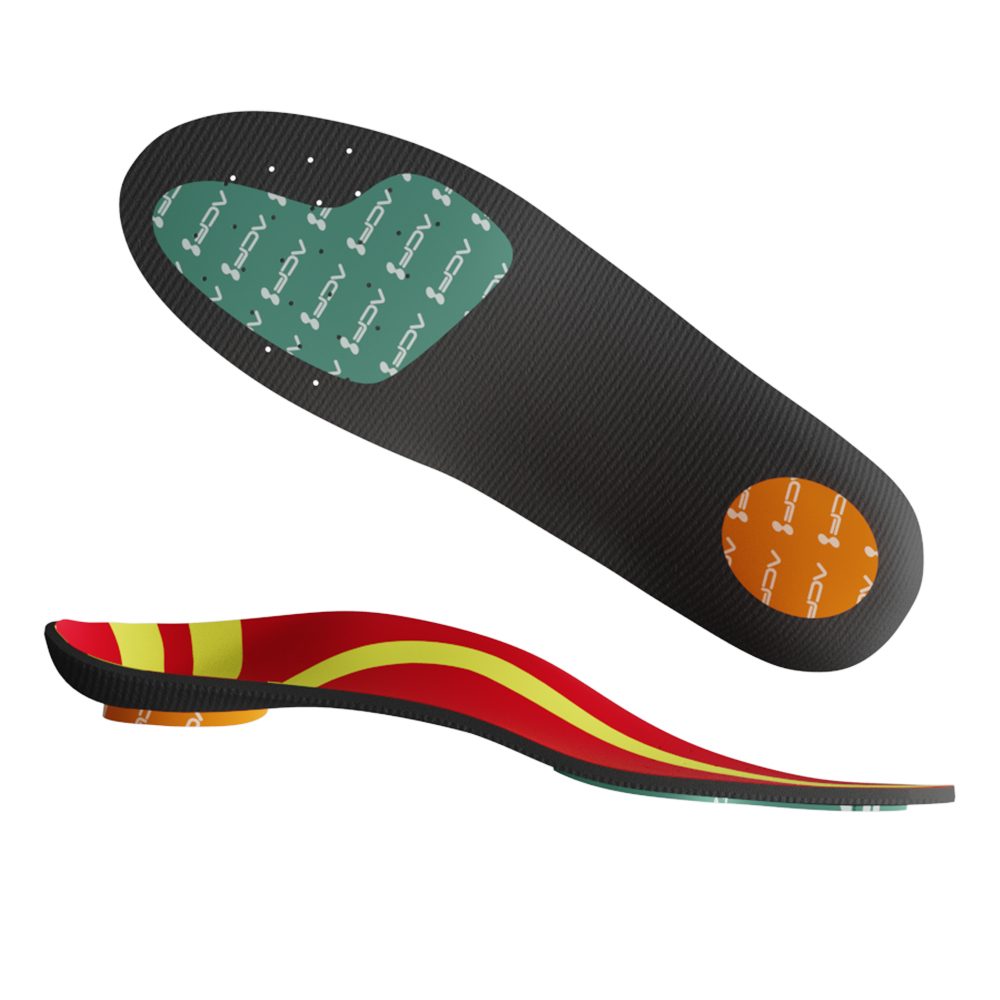
The build owns the foot-side surface: how contact is spread against the plate, how the arch is held steady under load, where the heel sits in the cup, and how the foot’s own shape meets the shoe’s fixed interior. Within that territory a pair can do real work, because the plate is flat and the foot is not, and the space between them is exactly what the build fills. The work is support and distribution, stated without promises about sensations, and it works best once the shoe-side questions have been answered and the shoe is set up as the rider will use it.
Two examples make the boundary concrete. A rider whose foot slides sideways inside the shoe under hard efforts has a foot-side question: the plate is flat, the shoe is close but the foot’s shape does not fill it, and a build that holds the arch and cups the heel addresses exactly that. A rider whose second toe goes numb after an hour has, first, a shoe-side question: closure pressure over the forefoot, cleat too far forward, or simply a shoe that is snug at the front on a swelling foot. Both riders may end up with a pair, but the pair is doing different work in each case, and the order of the conversation decides whether it works.
The boundary also protects the buyer’s money. A rider who solves a cleat problem with a new build has bought the wrong answer twice, once in the cleat session they skipped and once in the pair that now sits in a shoe still set up wrong. Partners who run the shoe-side conversation first, and only then record the foot on the plate, end up selling less and keeping more customers, which is the arithmetic that makes the honesty worth it.
The trade between load and comfort
Everything inside a cycling shoe is a trade against interior space, and the currency of the trade is thickness. Every feature a rider asks for, a deeper heel cup, firmer arch support, more material under the ball, costs interior room, and the room is already scarce. A build planned for a cycling shoe is an exercise in spending a small budget well: enough material where the foot needs it, none where it does not, and a profile the closure can live with across a long ride on a warm day.
The trade has two failure modes, and both are worth naming for partners. Built too generously, the pair fills the shoe, the closure runs out of travel, and the rider feels tighter than before, which reads as the pair being wrong when the arithmetic was wrong. Built too thinly, the pair fits the shoe easily and does little, and the rider who asked for support under load does not feel it, which also reads as the pair being wrong. The honest build sits between those, and the honest fitting conversation tells the rider which compromises were made and why, before the pair is ever ridden.
Discipline also matters in what the trade can offer. Racing on a stiff platform rewards a foot held steady and contact spread wide; the same rider walking around in the same shoes after the ride wants cushioning the plate cannot give. This is why some riders own builds for different disciplines rather than one pair for everything, and why the record taken in the assessment room should state which shoe and which discipline it was taken for. A build is a component in a system, not a universal upgrade, and the system is different every time the shoe changes.
The last part of the trade is time. Feet swell over a long ride; the interior does not. A pair that fits perfectly in the shop at the start of the day may feel different at the top of the climb, which is why experienced fitters fit with the closure set for the end of the ride rather than the beginning, and why the riding sock, the one that will actually be worn, belongs in the shop at fitting time. Comfort across a full ride is the standard the trade has to meet, and the shop that fits to that standard has fewer quiet returns.
Three situations where we would advise against a change
The first situation is an unsettled shoe. If the cleat position has never been properly set, the closure has never been dialled in, or the shoe itself is the wrong size on a warm foot, a pair added now would be built to a setup that is about to change. The right order is shoe first, pair second, and we would advise a rider in this state to settle the mechanical questions before ordering anything for inside the shoe. A build made to an unsettled shoe is a build that will be replaced, and nobody enjoys paying twice.
The second situation is a shoe whose fit is the problem. Where the shoe presses the forefoot in a way the closure cannot correct, where the toe box is genuinely short, or where the upper grips one spot on the instep no matter how the dials are set, the shoe is the answer. Thinning the pair to rescue a shoe that does not fit gives up the support the foot asked for and leaves the actual complaint standing. We would rather tell a partner to say that plainly and send the rider to a different model, because a sold squeeze always comes back as a returned pair and a lost customer.
The third situation is symptoms that deserve professional attention before any product conversation. Persistent numbness, symptoms that do not settle after the ride, or discomfort that keeps moving around the foot as setup changes are, in our view, questions for a professional rather than questions for a workshop. A pair spreads load and holds shape; it does not evaluate a rider, and it should not be sold as the answer to a symptom that has not been looked at. The partners we work with longest are the ones who refer those riders first and fit them afterwards, if a fit is still what they need.
None of these three situations is a lost sale in the end. The rider with an unsettled shoe comes back once the setup is done, and the build made to a settled shoe lasts. The rider with the wrong shoe comes back when they have the right one, grateful for the plain answer. The rider who was referred remembers who took the symptom seriously. Saying not yet, in the right cases, is the shortest route to being the workshop they all return to.
Frequently asked questions
Why do cycling shoe insoles have to be thinner than everyday ones?
Because the shoe is built close and spends its interior volume on holding the foot against a stiff plate. Whatever the build adds, the closure and upper must absorb. A build planned for a cycling shoe spends material only where the foot needs it, and the fitting is done with the riding sock, or the arithmetic fails on a long ride.
Can an insole fix numb toes on long rides?
Numbness on rides usually starts with continuous pressure over the forefoot, and a build can spread contact across more of the foot, which reduces the concentration. But cleat position and closure pressure decide as much or more, and persistent symptoms deserve a professional’s attention rather than a product answer. The pair is one part of the system, not the answer to it.
Should the cleat position be sorted before ordering a pair?
Yes. Cleat placement changes where load lands under the foot, so a build made before the cleat is settled is made to a moving target. Set the shoe-side questions first, cleat, closure, fit, then record the foot on the plate as the rider will actually ride, and build to that record.
Can I use the same pair in my cycling shoes and my running shoes?
Usually not. The two shoes give the pair different jobs: spreading contact against a rigid plate in one, working with a bending sole in the other. The interior volumes also differ sharply. Most riders who ride and run seriously end up with builds for each discipline, and the record should state which shoe each pair is for.
Why do the balls of my feet get hot in cycling shoes?
Because that is where the foot presses hardest against a plate that does not flex, in a wrapped upper that holds warmth and a foot held still against friction. It is the construction behaving as designed rather than a fault. Spreading contact and easing closure tension both reduce the concentration; a professional should look at anything that persists.
Does a stiffer build mean better power transfer?
The sole decides the transfer, not the pair. What a build can do is hold the foot steady on the plate and spread the contact, which keeps the foot doing its job under load. Claims that go beyond support and distribution are not supported by what a pair can physically change, and we do not make them.
When should a rider not change anything at all?
Three cases: a shoe whose cleat and closure are not yet set up, a shoe whose own fit is the problem, and symptoms that need professional attention first. In each, adding a build would treat the wrong variable or promise more than a pair can deliver. The honest answer is not yet, and the shoe-side work or the referral comes first.
What we would do next
Put the order of operations on the wall of your fitting area: shoe, cleat, closure, then the foot on the plate, then the pair. Then check whether your cycling customers are being fitted with the sock they actually ride in. Choosing sport insoles by load, not by name covers how we sort builds for different disciplines, what a load redistribution structure does and does not do sets the same boundary we use in the workshop, and the ski boot case: a pair inside a stiff shell is the closest cousin to the cycling construction in any other discipline. The insole categories page lists the sport builds we produce in our own terms, and the FAQ page carries the answers we give most often by message.
This article is intended for professional and educational reference. It is not medical advice. Foot assessment equipment produces measurements and images; clinical interpretation and any decision about care remain the responsibility of a qualified professional. Certification scope is limited to the documentation we hold: European Union certification and ISO quality system certification.