
The fitter came back from one mountain season with a verdict nobody had expected: the descents had decided it, not the climbs. The pair had been built for a trail customer in good faith, from a record taken in the shop, and the climbing days had passed without a word of complaint. What the customer reported instead was that every long downhill had left the front of the foot working harder than it ever did on flat ground, and that the pair felt like a different build on the way down than it had on the way up. That report is not unusual, and it is not a mystery either. Trail running loads the foot unevenly by design: descents shorten the time each step spends on the ground, push the load forwards and towards the outer edge, and arrive on ground that is loose, angled and unreliable in a way no shop floor can imitate. This article works through what a descent actually does to the recorded load, why climbing and descending are two different jobs wearing one sport’s name, where the shoe’s rock plate and the insole each begin and end, what cushioning costs in ground feel, what mud and water do to the space inside a shoe, and why the middle of a season is the wrong time to change a working configuration.
Why the descent is the test
Flat ground is the easiest condition a foot will ever meet. Contact is predictable, the surface is level, and the load arrives where the record expects it. A trail descent removes all three comforts at once. The ground falls away in front of the foot, each landing has to brake the body as well as carry it, and the surface underfoot is a mixture of loose stone, roots and angled ground that shifts between one step and the next. The foot that handled the climb without comment is suddenly doing a different job, at a different tempo, on a different surface.
This is why the shop record taken on a flat platform describes less of a trail runner’s year than it would for almost any other customer. The measurement is honest about what it measured: the foot, under controlled conditions, on level ground. It cannot rehearse a descent, because a descent cannot be performed on a level platform without pretending. What the record still does well is establish the baseline: where each foot carries its load when nothing is fighting it, and how the two sides compare. The descent is then read as a departure from that baseline, which is a more useful conversation than pretending the platform saw it coming.
The fitters who handle trail customers well say the same thing in the first conversation: the pair will be judged by the descents, so the build should be discussed in descent terms from the start. A configuration that feels excellent on the shop floor and during gentle climbs can still be the wrong answer for a season of long downhills, and no amount of standing on it in the shop will reveal which one it is. The honest position is to say what each choice is expected to trade away, and let the season provide the evidence.
Shorter contact, sharper arrival
The defining feature of a descent is time. On level ground, each foot spends a measurable, comfortable interval in contact, and the load has room to roll through its usual route from heel towards the front. On a steep downhill, the interval shortens sharply. The foot lands, has to accept and redirect the braking load almost immediately, and leaves. The rolling that a level stride permits gets compressed into a fraction of the time, and whatever part of the foot is positioned to receive the arrival receives it all at once.
Where the arrival lands is the second half of the story. On a descent the foot tends to land further forward, on the ball and the toes, and frequently on the outer edge first, because the ground is angled and the body is leaning back against the slope. The recorded load therefore concentrates in the forefoot and along the outside of the foot rather than spreading through the heel as it does on level ground. The heel still works, but it works as a brake arriving late, and the front of the foot does most of the carrying. Over a long downhill, that concentration repeats hundreds of times, and it is the repetition, not any single step, that the customer reports afterwards.
For a build, this changes which parts of the insole are being asked to work. The forefoot and the outer column are under repeated, concentrated load on ground that offers no favours, while the heel’s role is shorter and sharper than the same customer’s flat-ground record suggested. A configuration built only from a level-ground reading will distribute everything as though the rolling had time to happen. On a descent it does not, and the difference between the two situations is exactly the gap the customer feels at the end of a mountain day.
None of this argues for abandoning the record. It argues for reading it as a starting point and asking the customer about their terrain: how long the descents are, how steep, how loose the ground runs. Those answers, combined with the baseline, are what turn a level-ground measurement into a trail-appropriate specification.
Uphill and downhill are not the same load
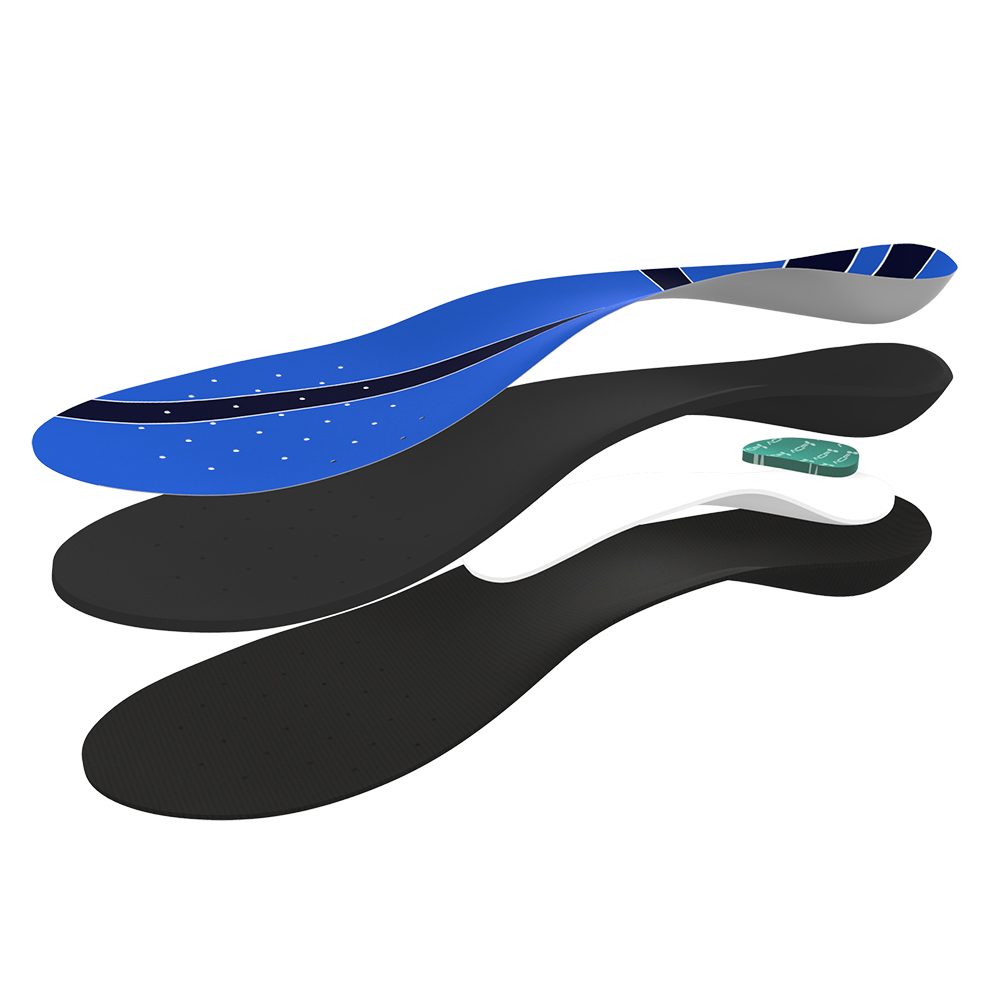
It is worth stating plainly, because the sport uses one word for both: climbing and descending put the load in opposite places. On a climb, the foot works in the front and the calf does much of the driving; the heel often barely lands, the load sits under the ball and the toes, and the surface angle tilts the pressure towards the front of the shoe. On a descent, the braking does the work, the arrival is sharper, and the outer edge takes the angled ground. The two directions share a shoe and share a pair of insoles, but they do not share a load pattern, and no single configuration serves both identically.
The compromise is not symmetrical either. Most trail routes spend more cumulative distance descending than climbing, because a climb is usually paid back on the way down, and long routes often descend continuously for stretches the climb never matched. A build weighted for the descending pattern is therefore weighted for most of the distance, even though the climbing pattern is the one that feels easier while it happens. Fitters who ask customers to describe a typical route, rather than a typical run, get this right more often than fitters who only ask how far.
The two directions also fail differently. A configuration that under-serves the descent announces itself quickly and clearly: the front of the foot is worked, the outer edge is aware of itself, and the customer names the downhills without prompting. A configuration that under-serves the climb tends to announce itself more slowly, as a general fatigue rather than a specific complaint. When a trail customer comes back with feedback, the direction of the complaint usually points at which half of the route the build was serving well, and that is the first diagnostic question worth asking before anything is changed.
What this means in practice is that the conversation should name both halves of the route explicitly. Which pattern the customer wants the build to favour, and what they accept about the other half, is a decision that belongs to them, informed by the record and by honest description of the trade-offs. A pair cannot be everything on both gradients, and pretending otherwise is how a first season ends in a disappointed customer rather than a working configuration.
The rock plate and the insole: who does what
A trail shoe carries a firm layer in its sole, usually called a rock plate, whose job is blunt: stop sharp ground from arriving at the foot. Stones, roots and steps that would print straight through a soft sole stop at the plate, and the foot above it receives a spread, muted version of what the ground offered. This is the shoe’s job, decided by the shoe’s designer, and it happens whether or not an insole is present. Any conversation about what a build does on rough ground has to start by acknowledging that the plate is already doing the heavy lifting against penetration and sharp local pressure.
The insole works in a different layer of the same problem. It shapes the contact between foot and shoe: how the load spreads across the sole, where the arch is held, how the heel sits in the cup, and how much of the forefoot’s concentrated descent load gets distributed towards the structures around it. The plate answers the ground; the insole answers the foot. The two are not substitutes, and a customer who expects one to do the other’s job will be disappointed in whichever one they asked.
We say this plainly because the boundary protects both sides of the conversation. An insole cannot add protection against a sharp stone that the shoe’s sole transmits; that is the shoe’s construction. A shoe cannot hold an arch or shape contact; that is the build. When a trail customer reports that the ground has become more noticeable through the shoe, the first question is about the shoe’s state and its sole, not about the pair inside it. When the report is about where the load sits and how the foot is held, the build is the right place to look. Sorting the complaints into their two layers is most of the diagnosis of a failed configuration, and it can be done in one conversation before anything is remade.
The practical reading for a fitter is to examine the shoe and the build separately before changing either. Read the wear on the shoe’s sole and the wear on the pair’s surface: they tell different stories, and together they usually say which layer is asking for attention.
Cushioning against ground feel
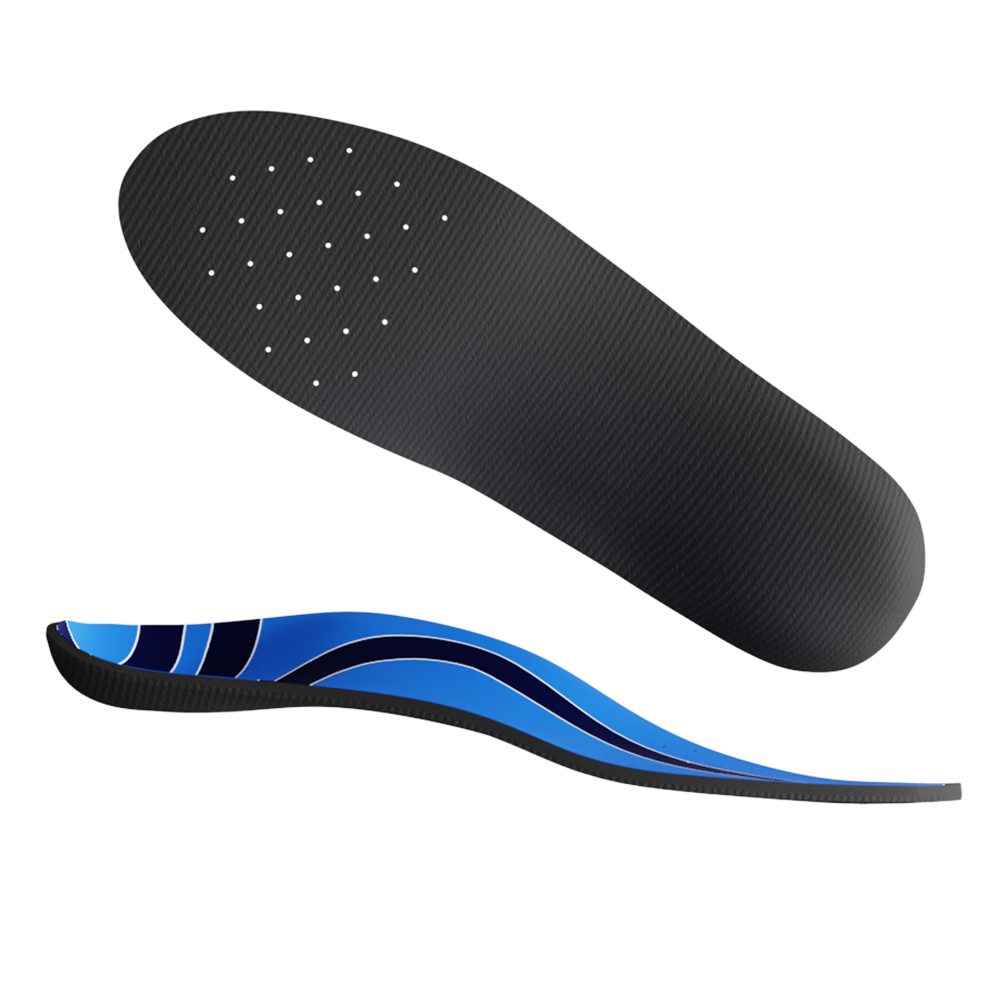
The most common request from trail customers is more cushioning, and the most common consequence is less of what they actually bought trail shoes for. Cushioning absorbs arrival; that is what it is for, and on a long descent with hundreds of sharp arrivals it earns its place. But the same material that softens the arrival also stands between the foot and every piece of information the ground offers. On terrain that shifts between steps, that information is not a luxury. The foot adjusts to loose stone and angled ground through what it feels, and the thicker the layer, the later and blurrier the message arrives.
This is the trade-off to describe honestly rather than resolve in the customer’s favour by default. A build that maximises cushioning serves the braking load of a long descent and dulls the ground sense that technical terrain demands. A build that keeps material thin preserves the feel and asks the foot to take more of the arrival itself. Neither is the correct answer in the abstract; the right answer depends on the customer’s routes, their pace on technical ground, and which half of the trade they would rather accept. What a fitter should not do is promise both, because the two sit on opposite ends of the same choice.
The shoe’s own sole complicates the arithmetic further. Trail shoes already differ widely in how much cushioning the manufacturer built in, and the insole is a thin layer working on top of that decision. Adding a thick, soft layer inside a shoe that is already generously cushioned rarely changes the descent much; it mostly raises the foot, changes the fit, and costs ground feel. The same layer inside a firm, low shoe does something entirely different. Reading the shoe before specifying the build is not optional on this terrain; it is the difference between a considered configuration and a guess with a price tag attached.
Where the trade usually settles, in our experience of the questions that reach the workshop, is in the middle: material where the descent concentrates load, restraint everywhere else, and a clear explanation to the customer of what was chosen and what it costs on the other side.
Mud, water and the space that is left
A trail shoe in dry summer conditions and the same shoe in a wet autumn season are not the same volume. Mud and water push the customer into thicker socks, gaiters and overlays, and the shoe interior that had a workable margin in July can be close in January. Whatever the build occupies, it occupies alongside all of that. A pair specified from a dry-season fitting on thin socks can simply be the wrong thickness for the wet season, through no fault of its own and no fault of the fitter’s either.
Water itself changes what the pair is made of and how it is made. A soaked insole carries differently, dries slowly, and behaves differently through the days after a wet outing if it was not built to dry back to shape cleanly. Top covers and bonding face their hardest conditions on this terrain, and the construction choices that suit a dry studio pair are not automatically the right ones for a pair that will spend a season wet. This is why the sport series is specified the way it is, and why we ask fitting partners to describe the customer’s season, not just their shoe, when the order is placed.
The fit arithmetic deserves its own sentence in the customer conversation. Inside a trail shoe, the original footbed is usually removed to make room, and what remains was never generous to begin with. Thick socks, mud displacement and a full-volume build all compete for the same interior. If the combination comes out too tight, the compression changes how the foot sits and how the load lands, and the customer reports the shoe as having changed rather than the configuration. Checking the assembled combination, in the socks the customer will actually wear, is worth the minutes it takes.
Mid-season changes, and when the shoe is the answer
The temptation to adjust a configuration mid-season is strongest exactly when it should be resisted. A build in its first weeks is still settling: the customer is adapting, the material is running in, and the reports coming back describe a moving situation. Changing the specification in response to a fortnight of feedback risks rebuilding towards a snapshot rather than a pattern. The better practice, and the one we suggest to fitting partners, is to gather the feedback, keep it dated, and let a longer stretch of use separate the settling from the structural. What survives four or five weeks of mixed terrain is a real finding; what appears in the first fortnight often resolves itself.
When a genuine mid-season change is needed, change one variable at a time and record it. Swapping the top cover, adjusting thickness and altering the arch hold in one revision produces a new pair whose behaviour cannot be attributed to anything, which makes the next round of feedback just as ambiguous as the last. One change, dated on the file, keeps the comparison honest. The wear a pair shows after a stretch of use is also evidence worth reading before remaking anything; it often answers the question the customer’s words raised.
Some complaints, though, are the shoe’s, and no revision inside it will fix them. A sole that has compressed past its useful life stops braking the descent the way it did, and the pair above it takes the difference. A upper that has loosened lets the foot move inside the shoe on angled ground, and the load lands somewhere new every step. When the wear reading points at the shoe, the honest advice is to say so and put the conversation there, even though it means selling the customer something other than a rebuild. Fitting a new configuration into a shoe that has finished its own job serves nobody, and it converts a shoe problem into a repeat complaint that arrives wearing the build’s name.
The pattern worth holding onto is the order of questions. Shoe first, socks and season second, build last. Most trail complaints that reach a workshop resolve in the first two layers, and the customers whose configurations genuinely needed revision are better served by a considered change in the low season than by an urgent one in the middle of it.
Frequently asked questions
Are custom insoles suitable for trail running?
The sport series is built for load patterns that include direction changes and uneven terrain, and trail running is part of that range. The build shapes contact and load distribution inside the shoe; it does not replace the shoe’s own construction, and the combination of shoe, sock and build is what the customer actually wears on the mountain.
Why do descents feel so different from climbs?
On a descent each step spends less time in contact, the load arrives further forward and often on the outer edge, and the foot has to brake as well as carry. Climbing loads the front of the foot in a slower, driven pattern. The two directions share one pair but do not share one load pattern, which is why the route should be discussed before the build is specified.
Does an insole replace the shoe’s rock plate?
No. The rock plate is part of the shoe’s sole and stops sharp ground from reaching the foot; that is the shoe’s job and it happens regardless of what is inside. The insole works on the foot’s side of the boundary: how load spreads, where the arch is held, how the heel sits. The two layers answer different questions and neither substitutes for the other.
Should cushioning be increased for long descents?
It depends on the trade the customer accepts. More cushioning softens the repeated arrivals of a long downhill and costs ground feel on technical terrain, where what the foot feels is what it adjusts with. The shoe’s own sole also matters: a thick layer inside an already cushioned shoe mostly raises the foot and dulls the message. Describe the trade rather than promise both ends of it.
How much room does a trail shoe leave for an insole?
Very little beyond the original footbed, which is why that footbed is usually removed before fitting. Wet-season socks, gaiters and the build all compete for the same interior. Check the assembled combination with the socks the customer will actually wear, because a combination that comes out too tight changes how the foot sits and how the load lands.
When should the shoe be replaced instead of the build adjusted?
When the wear reading points at the shoe: a sole that has compressed and no longer brakes the descent as it did, or an upper that has loosened enough to let the foot move inside on angled ground. Revising the pair inside a finished shoe converts a shoe problem into a repeat complaint, so the honest advice places the conversation on the shoe.
When is the right time to change a trail configuration?
Preferably the low season. The first weeks of a new build describe a settling situation, not a verdict, so dated feedback across four or five weeks is worth more than a fortnight of impressions. If a change is genuinely needed, make one variable at a time and record it, so the next round of feedback can be attributed to something.
What we would do next
Put the route question into the first trail conversation, alongside the shoe: how long the descents run, how technical the ground gets, and what the wet season does to the socks. Then read the shoe and the current pair’s wear before promising any change, because between them they usually say which layer is actually asking. Choosing a series by load rather than by name sets out how the sport range is specified, mesh, foam and board explained plainly covers the material decisions behind the trade-offs above, and shoes with and without a removable footbed explains the fitting difference that decides how much room a build has to work in. The insole categories page lists the series as we build them, and the FAQ page carries the operational answers we give most often by message.
This article is intended for professional and educational reference. It is not medical advice. Foot assessment equipment produces measurements and images; clinical interpretation and any decision about care remain the responsibility of a qualified professional. Certification scope is limited to the documentation we hold: European Union certification and ISO quality system certification.