
The third customer of the morning is still unlacing her shoes when the fourth walks through the door, and the waiting room has started to fill with coats. Five assessments booked back to back, one walk path, one platform, one pair of hands. Somebody in the queue is checking the time. Somebody else has already asked whether “this will take long.” Every person in the room today needs a fair record, and the clock does not care about that at all. You can feel the schedule starting to lean on you — and the lean is where the quality usually leaks.
This piece is about running a full assessment day without quietly buying speed with shortcuts. Where the schedule genuinely bends — the steps that cost time without touching the record — and where it must never bend: the settling, the conditions, the passes that make a measurement worth the file it goes into. It ends with the habits that keep documentation honest on a day when every spare minute has been spent, because a fast day that produces untrustworthy files has saved nothing at all.
Five bookings and one walk path
Every room that runs gait assessments eventually meets the arithmetic of the packed day. Each booking needs a share of the same physical resources: the walk path, the platform, the changing area, the desk where the history gets taken, and a few minutes of quiet for the customer to stop being a person who just ran from the car park. When five bookings stack up, the bottleneck is rarely the measurement itself — a crossing takes moments. The bottleneck is everything around the crossing: shoes off and on, forms and questions, the explanation of what the customer is about to do, and the settling time nobody scheduled but everybody needs.
The day goes wrong in a predictable way. The first assessment runs long because the second customer arrived early and questions were taking answers in the corridor. The second assessment starts compressed, so the assistant shortens the explanation, so the customer is unsure what is asked of her, so the first pass needs retaking, so the third assessment starts even more compressed. By mid-morning the room is running a deficit of seconds it keeps trying to repay by borrowing from the part of the session that has no receipt: settling, instructions, the second pass, the notes. Nothing dramatic fails. The records just get quietly thinner.
What separates rooms that survive a full day from rooms that end it apologising is not speed. It is knowing, in advance, which steps are load-bearing and which are not — so that when the pressure comes, it lands somewhere that can take it. The next two sections are exactly that map: where to bend, and what must hold.
Where the schedule actually bends
Most of the recoverable time in an assessment day lies outside the assessment room, and rooms that run smoothly have usually moved it there on purpose. The paperwork is the first candidate. History forms, consent, the referral question, previous records — all of it can be completed before the customer enters the room, on paper sent ahead, online forms, or a brief desk visit that happens while someone else is being measured. Every question answered at the desk is a question that does not interrupt the flow of the session, and an interrupted session is where minutes go to die.
The second candidate is preparation. Customers arrive not knowing whether shoes come off, whether tights are a problem, whether they should have brought the shoes they actually wear. A one-line reminder at booking — wear shoes you can slip off easily, bring the pair you walk in most — removes a category of friction that otherwise repeats itself five times a day. Inside the room, the same logic applies in miniature: have the chair, the step for shoes, the tissues and the forms in the same places every time, so the assistant’s hands know where things are without looking.
The third candidate is explanation. The briefing about what the customer will be asked to do can be practiced, standardised and short — the same words every time, delivered while she is still sitting down, not improvised at the start line. This is the counter-intuitive one: standardising the briefing costs nothing and buys back time twice, because a well-briefed customer produces better first passes and needs fewer retakes. Bending the explanation is the most expensive shortcut in the building, which is exactly why it belongs to the must-not-bend list that follows.

What must never bend
Some steps look like waiting, and waiting looks like waste when the room is full. They are not waste; they are the conditions that make the record mean anything. The first is settling. A customer straight from a brisk walk across the car park carries that walk into her first pass — breathing, circulation, footwear warmth all settling — and a record taken before she has been seated for a few minutes measures the arrival, not the person. The first minutes of the appointment belong to the chair and the questions, and skipping them buys nothing but a noisier line.
The second is the pace instruction and the start protocol, word for word, every customer, every pass. These are the load-bearing sentences of the whole session. Improvised versions of them are how one customer walks “at your own pace” and the next walks “briskly, like you’re late,” and no file survives that comparison. The same holds for footwear rules — barefoot or shod, which shoes, same lacing — decided before the customer stands, not negotiated at the line.
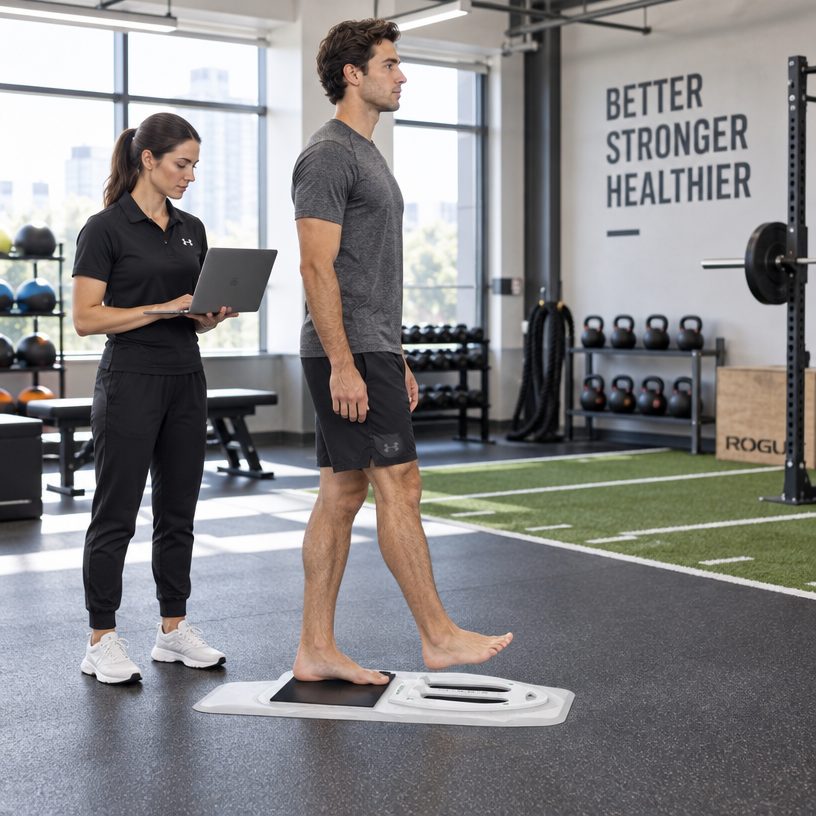
The third is the minimum passes the session’s question actually requires. When the queue leans on you, the tempting cut is the second pass, and sometimes that is the right call — but it is a professional decision about what this file needs, made out loud and written down, not a reflex. The capture equipment itself is the fast part of the day: a pressure platform such as the F2 plantar pressure system takes its measurement in the time a crossing takes, and no setting on it can recover the minutes lost to a retake caused by a rushed briefing. Speed, in this room, is an upstream product. It is manufactured in the desk, the forms and the standard sentences, or it is not manufactured at all.
Running parallel tracks
The single richest source of recovered time in a busy room is overlap done properly: two tracks running side by side without either contaminating the other. The classic split has one staff member owning the walk path and another owning the desk. While customer three is crossing, customer four is completing forms, answering history questions and being briefed — all in earshot but out of the path. The briefing can even be given while the previous customer finishes, as long as the walk path stays clear and the explanation does not have to compete with the assistant calling out pass results.
Parallel work extends to the file itself. Between customers there are minutes — entering today’s results, printing the sheet for the next one, checking which conditions yesterday’s file specified so today’s can match them. A room that treats these minutes as dead time spends them scrolling on phones; a room that treats them as the engine of the next session runs on schedule almost automatically. Assign them. The person on desk duty during customer three’s crossing can have customer four’s sheet open and pre-filled before four stands up.
One warning keeps the overlap honest: parallel tracks must never mean two customers near the walk path at once. A waiting customer watching the current one crosses the line between audience and subject — she unconsciously rehearses her own walk, and the current customer performs for a spectator, and both effects end up in the line. Keep the second track behind a desk, around a corner, or far enough back that neither person feels observed. The overlap that pays is administrative; the overlap that costs is behavioural, and it hides in records as subtle noise nobody can name later.

The late arrival and the overrun
Full days attract exactly the two events that break them: the customer who arrives twelve minutes late, and the assessment that runs twelve minutes long. Both are management problems, and both have professional answers that are not shortcuts. For the late arrival, the honest triage is to run a shorter session openly rather than a full session badly: take the passes the referral question genuinely requires, note on the sheet that conditions were compressed and why, and book whatever could not be done today. “Do less, properly” beats “do everything, roughly” every time it is tried, and the file stays trustworthy because it admits its own shape.
The overrun deserves its own discipline, because its cost is never paid by the assessment that overran — it is paid by the next four. The commonest cause is the conversation that belongs to a different appointment: the customer who wants to discuss her sister’s feet, the results she read online, the shoes she saw advertised. The professional move is a boundary that costs one sentence: “That deserves proper time — let’s book you a few minutes to talk it through properly,” and then back to the session. It feels abrupt and it is not; it is what protects every person still holding a numbered ticket in the other room.
Both events reward one preparation made in advance: a decided answer to the question “what gets cut when we are short?” written as policy rather than improvised under pressure. Rooms that have the answer on paper cut the same things every time — usually settling is protected, briefing is protected, and the optional second pass or the extended conversation goes first. Improvised rooms cut whatever the loudest pressure points at, which is how the load-bearing steps end up being the ones to bend.
Small structural changes that buy real time
Beyond the day itself, a handful of structural decisions repay every session that follows, and none of them touches the record’s integrity. Booking intervals are the first: rooms discover sooner or later that the nominal slot length and the real session length have drifted apart, usually because the real one includes shoes, forms and settling that the nominal one never budgeted. Re-timing the template against a stopwatch week — one day where each session’s actual phases get timed — usually finds ten to fifteen minutes a day hiding between the appointment book and the floor.
Grouped sessions are the second, where the caseload supports it: two customers booked together whose assessments can interleave — one on the path while one at the desk — effectively halve the idle time per customer without compressing either session. Screening days are the same idea at larger scale: when the goal of the day is a first look rather than a full file, the structure can be deliberately lighter, with fuller sessions booked for the customers the screen flags. What the two formats share is honesty about the file’s depth, printed on the record itself.
The third is station design. A walk path that does not require the platform to be recalibrated between customers, a changing spot that does not require moving furniture, a desk reachable from both tracks — each is a decision made once that saves seconds dozens of times a day. None of this requires new equipment; most of it requires walking the morning yourself, once, with a stopwatch and a notepad, and being slightly embarrassed by what you find. Everyone who does this exercise finds something. The embarrassment fades; the minutes stay found.
Speed that costs nothing and speed that costs clarity
By late afternoon the day has taken everything you offered it, and the last defence of quality is documentation discipline — because rushed notes are how a fast day files false memories. The rule that survives contact with a full diary is this: the conditions lines get written at the time, in the session, or they do not get written at all. Conditions reconstructed from memory at five o’clock are a blend of three customers’ mornings, and nobody can tell which parts belong to which feet. Thirty seconds in the session is the entire price of a file that a colleague can read next month without phoning you.
The second rule is that compression gets recorded, not hidden. A session that ran short because the customer arrived late, a pass count reduced by decision rather than accident, a briefing delivered while a previous customer was still in the room — each is one honest line that preserves the file’s value. The reader of a record weighs it by its conditions, and a file that declares its conditions keeps its worth even when those conditions were imperfect. What destroys a file is not the imperfect morning; it is the silent one.
The third rule is the audit habit: once a week, reread one file from a busy day cold, as if you had never seen it. Can you reconstruct what was done, why, and under what conditions, from the sheet alone? Files that fail this test are the ones that quietly train the team to distrust its own records — and the fix is never working faster, it is writing better in the same thirty seconds. Fast days are run on paper, not on the walk path. The rooms that internalise this stop experiencing full days as emergencies and start experiencing them as what they are: Tuesdays.
Frequently asked questions
How do you keep assessment sessions moving on a fully booked day?
By manufacturing speed upstream of the walk path: history and forms completed at the desk or before the visit, booking reminders that remove footwear friction, and a standardised briefing delivered while the customer is still seated. The crossing itself is the fast part of the session. Rooms that run on time spend their effort on everything around the measurement, not on rushing the measurement.
Which steps should never be shortened when the queue is long?
Three. Settling time, because a record taken before the customer stops measuring the arrival measures the arrival. The pace instruction and start protocol, word for word every time, because improvised versions poison every comparison. And the minimum passes the session’s question actually requires — cutting those is a professional decision made out loud and written on the sheet, never a reflex under pressure.
What can be moved outside the assessment room?
Everything that does not touch the record: history taking, consent, the referral question, previous files, and the briefing about what the customer will be asked to do. Run these on a parallel desk track while another customer is being measured. The one thing that must not run parallel is a second customer near the walk path — a waiting observer changes both walks.
How do you handle a late arrival without cutting corners?
Run a shorter session openly rather than a full session badly: take the passes the referral question genuinely requires, write on the sheet that conditions were compressed and why, and book the remainder. Do less, properly, beats do everything, roughly — the file stays trustworthy because it admits its own shape.
Is it acceptable to take fewer passes when the schedule slips?
Yes, when it is a decision rather than an accident. Ask what this specific file needs for its question to be answered, take that, and record the decision with its reason. What is not acceptable is the silent cut — a pass dropped so casually that the file later claims a completeness it never had.
What should staff do between customers?
Own the minutes. Enter results, pre-fill the next sheet, check which conditions earlier files specified so the next one can match them. A room that treats inter-customer time as dead time loses it to phones; a room that assigns it runs on schedule almost automatically. These minutes are the engine of the next session, not the ashes of the last one.
How do you keep documentation honest on a rushed day?
Three rules. Conditions lines are written in the session or not at all — memory blends customers by afternoon. Compression gets recorded, not hidden: one honest line preserves a file’s value. And once a week, reread one file from a busy day cold; if the sheet alone cannot reconstruct what was done and why, the fix is thirty seconds of better writing, not a faster walk path.
What we would do next
Do the stopwatch morning. Walk one full booked day yourself — arrival to file — and write down where the minutes actually go: shoes, forms, briefing, settling, passes, notes. Most rooms find their bottleneck is not where they assumed, and the fix usually costs a printed form or a rearranged chair rather than a new anything. Then write the two answers the day will eventually demand: what gets cut when a customer arrives late, and what gets cut when a session overruns — decided in advance, on paper, so the pressure lands somewhere chosen (The Late Arrival: Doing Less, Properly, in Half the Time).
And keep the question that separates a busy room from a careless one alive with your team: when the queue is out the door and you have to shorten a session, which step do you protect last — and would the file, read cold a month later, agree with your choice? We ask it of ourselves every quarter, and the answer has changed every time the booking template did. If yours has changed recently too, that is usually the sign the room is learning.
This article is intended for professional and educational reference. It is not medical advice. Foot assessment equipment produces measurements and images; clinical interpretation and any decision about care remain the responsibility of a qualified professional. Certification scope is limited to the documentation we hold: European Union certification and ISO quality system certification.