
A pressure plate records a few passes across a fixed surface; a gait treadmill records a continuous sequence on a moving belt. Buyers compare them as if one were a better version of the other, and the comparison collapses as soon as the appointment is described: one suits a short screening slot, the other suits a session where walking is studied over time.
The confusion is understandable, because both produce pressure maps, both are sold as gait assessment tools, and both appear in clinic photographs. What separates them is not accuracy but the shape of the record and the shape of the room, and those two facts decide most of the purchase.
This article describes what each instrument actually captures, how the appointment differs, where each one stops being useful, and how a buyer can choose with a written brief instead of a demonstration. We build a dynamic gait platform, so the treadmill side is described from our own production and installation experience, and the plate side is described in the terms its users use.
Two records, two shapes
A plate produces episodes. The client walks across it, and the system captures the frames that fall on the surface — usually a small number of steps per pass, repeated until enough passes exist to choose from. The record is a set of episodes that the operator selects and compares.
A treadmill produces a sequence. The client walks on a belt for a period, and the system captures continuously, which means the record includes the variation between steps rather than a hand-picked example. That difference is the whole point: walking varies, and a record that averages the variation away hides the thing a clinician may want to see.
Neither record is more truthful. An episode is easier to standardise and easier to explain; a sequence shows consistency and fatigue and the small asymmetries that a single pass cannot reveal. The question is which of those the appointment needs.
Buyers who understand the difference stop asking which instrument is better and start asking how many passes, over what distance, with what protocol — questions that both instruments can answer, and that reveal whether the supplier has thought about the workflow.
There is a third difference that matters in a busy room: how the client experiences the capture. Walking across a plate is a short, unfamiliar action that some people find awkward; walking on a belt is closer to something they do every day, and the record tends to look more like the person.
There is also a reporting difference that follows from the record’s shape. An episode-based record invites selection, so the report shows chosen passes; a sequence-based record invites summary, so the report shows distributions across many steps. Both are honest, and they answer different questions about consistency.
What a fixed plate does well
A fixed plate is quick. The client walks across it, the operator picks the cleanest passes, and the appointment moves on. In a room with twenty-minute slots, that speed is not a compromise; it is the only way the assessment happens at all.
It is also portable in the sense that matters: the plate can sit in a corridor, a retail floor or a screening event without a dedicated room. Systems designed around a plate often include posture capture from cameras mounted alongside, which means one appointment produces both a pressure record and an alignment image.
Standardisation is easier on a plate because the protocol is short. Two operators can be trained to the same routine in an afternoon, and the records they produce are comparable within a few passes. For a clinic that wants a baseline for every new client, that consistency is worth more than depth.
The limit is the sample. A few passes describe how someone walked for a few seconds, and the operator’s selection decides which seconds count. That is acceptable for screening and for a first conversation; it is thin for a programme that intends to compare records across months.
A plate also suits a room that hosts other activities. It can be covered, moved to a wall or used as a standing surface between appointments, which matters in a treatment room where every square metre has to earn its place.
What a treadmill adds
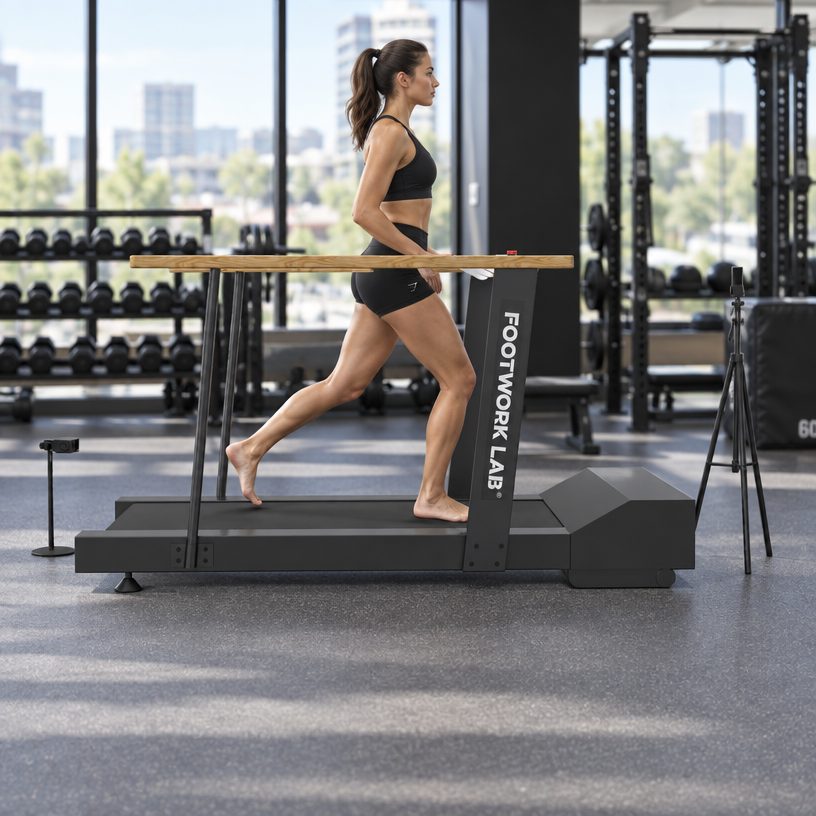
A treadmill adds duration and control. Speed can be set, the belt provides a consistent surface, and the client keeps walking while the operator watches rather than while the operator waits for a clean pass. Over a few minutes, the record accumulates enough steps to describe a pattern rather than an instant.
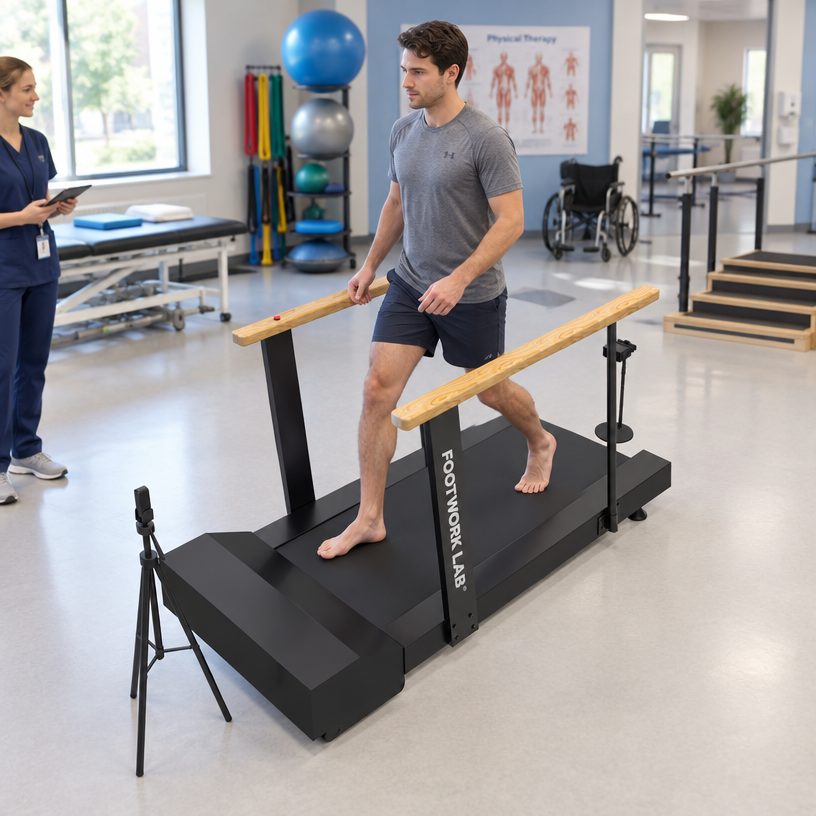
It also adds a second dimension to the room: the client walks in one place, so the space needed is the platform plus a safe approach, not a runway. Clinics with limited floor area often find this the decisive advantage, because a walkway long enough for repeated passes is a luxury many rooms do not have.
The cost is setup time and the risk of unnatural gait. Walking on a belt is not identical to walking on a floor, and some clients need a settling period before the record resembles their normal pattern. A protocol that ignores the settling period produces a clean record of an unfamiliar walk.
Our own platform is built for that reality: a controlled belt speed, a handrail arrangement that does not force a posture, and software that keeps the first minute visible so the operator can see when the client has settled rather than guessing.
Duration also changes the conversation. A record of several minutes gives the operator something to point at when the client asks why a pattern matters, and pointing at a sequence is easier than pointing at a single pass that may or may not represent the walk.
It is also worth asking how the platform handles a client who stops walking. A belt that cannot be slowed safely turns an assessment into an incident, and the answer belongs in the demonstration rather than in the manual. Safety behaviour is a specification item, not an afterthought.
The appointment, not the instrument
Write the appointment down before comparing instruments. How long is the client in the room, how many minutes belong to walking, who operates the capture, and what happens with the record afterwards. Those four answers eliminate most of the shortlist before a demonstration is booked.
A screening appointment — ten minutes, one operator, a decision at the end — fits a plate and posture capture. A programme appointment — thirty minutes, walking observed over time, a comparison with a previous record — fits a treadmill, and usually needs a larger screen and a report the client can take away.
The mismatch to avoid is buying duration for an appointment that has no room for it. A treadmill in a ten-minute slot produces a short record with a long setup, which is the worst of both. The reverse mismatch — a plate in a programme that needs comparison — produces records that cannot be compared and a slow drift back to guesswork.
It helps to count the appointments, not the clients. A clinic running four walking assessments a week needs a different instrument from one running twenty, and the difference is not about quality but about how much time per assessment is available to spend on setup.
It is worth writing the appointment as a script before comparing instruments: greeting, shoe removal, practice walk, capture, review, explanation. The script shows where each instrument inserts itself, and where it forces an extra step that the slot cannot absorb.
Space, power and the room around it
A plate needs a clear approach and a landing area. Clients decelerate after the plate, and a wall three steps beyond it changes how they walk. The instrument is small; the approach is the design problem, and it is the one most often discovered after installation.
A treadmill needs a platform footprint, a safe step-on point, and enough clearance for the operator to stand where they can see both the client and the screen. It also needs stable power and, in most installations, a network connection so records can be stored and software updated.
Both instruments benefit from being placed where the client can see the screen during the conversation. Assessment equipment that faces away from the client turns the record into something shown afterwards rather than something discussed in the moment, and the discussion is where the appointment earns its fee.
Ask the supplier for an installation drawing with clearances, not just a footprint. A supplier who has installed rooms will have the drawing; one who has only sold boxes will have a datasheet.
Noise belongs in the same paragraph as space. A treadmill in a small room is audible through a wall, and a clinic with treatment rooms adjacent will hear it. That is a design constraint rather than a technical one, and it is easier to solve before installation than after a complaint.
It helps to visit a room that already runs the instrument you are considering. Installations reveal the practical details — where the operator stands, how the client steps on, where the screen sits — and those details decide utilisation far more than any specification figure.
Where each instrument stops being useful
A plate stops being useful when the question is about consistency. If the clinical conversation is ‘does this pattern hold across a walk’, a handful of selected passes cannot answer it, and no amount of software will add the missing minutes.
A treadmill stops being useful when the room cannot support a natural walk or when the appointment cannot absorb the settling time. It also struggles where the client cannot walk unaided for several minutes, which is a real limit in some settings and should be discussed honestly before purchase rather than after.
Both stop being useful when the reporting layer is weak. A record that cannot be shown to the client, exported, or compared with the previous visit becomes a private artefact of the appointment, and private artefacts do not build a programme.
The honest position is that many clinics eventually want both, and the sensible sequence is to buy the one the current appointment needs, then add the other when the service has grown into it. Buying both at once usually means one of them is underused for a year.
A third limit applies to both: they describe load, not comfort. A record can show where pressure sits; it cannot say whether the person felt supported. That judgement comes from the conversation, which is why the appointment script matters as much as the instrument.
Choosing with a written brief
The brief should state the appointment length, the operator, the number of assessments per week, the record’s destination, and the space available. Five lines. A supplier can respond to five lines with a specific proposal; without them, every proposal looks similar.
Add the comparison requirement. If records must be compared across visits, ask how the protocol is held constant and how the software presents the comparison. If records are one-off, say so, and the software conversation becomes simpler and cheaper.
Add the export requirement. Records that can leave the system belong to the clinic; records that cannot create a dependency that is invisible on a quotation. Ask for one exported file before signing, and open it on a machine without the supplier’s software.
Finally, add the support expectation with a time attached. Ours is a WhatsApp group with an engineer on the other end and remote assistance when a capture misbehaves, because the failure that matters happens during an appointment. Every supplier should be asked the same question and judged on the specificity of the answer.
The brief should also state what will not be bought. Naming the excluded capability keeps the comparison honest and stops a late upgrade from being presented as a necessity rather than as an option.
Frequently asked questions
Is a pressure plate less accurate than a treadmill?
Not in the sense that matters. Both record pressure under the foot. The difference is the shape of the record: a plate captures selected passes, a treadmill captures a continuous sequence. Accuracy of the sensing surface and the protocol matter more than the platform type.
Can I assess walking on a plate in a small room?
Often yes, if there is a clear approach and a landing area. Clients change how they walk when a wall is close, so the approach distance is part of the installation decision.
How long should a client walk on a treadmill before the record is used?
Long enough to settle. Many clients need a period of familiarisation before their pattern resembles normal walking, and a protocol that ignores this produces a clean record of an unfamiliar walk.
Do you supply both types of system?
We build a dynamic gait platform and pressure-based assessment systems. Which one fits a room depends on the appointment, and we would rather discuss the appointment first.
What does the F5-LAB platform include?
A controlled walking surface with software for capturing and reviewing a walking sequence, plus the posture and alignment capture that belongs with it. Details are confirmed in writing for each installation.
What support comes with the equipment?
A dedicated WhatsApp group with an engineer, remote assistance, and software updates delivered over the air to connected units. Machines carry a twelve-month warranty against non-human damage.
Can records be exported for a client file?
That is a reporting-layer question and worth asking directly of any supplier. Ask for an export you can open without the supplier’s software, and confirm the report language for your market.
What we would do next
Start the comparison with the appointment, not the instrument: length, operator, volume, and where the record goes. The F5-LAB page describes the platform we build, and Our Factory covers the installation and support side.
The article on reading a foot scanner machine as three layers continues the same argument — capture, computation and reporting fail separately, whichever platform you choose.
This article is intended for professional and educational reference. It is not medical advice. Foot assessment equipment produces measurements and images; clinical interpretation and any decision about care remain the responsibility of a qualified professional. Certification scope is limited to the documentation we hold: European Union certification and ISO quality system certification.