
“We want to add custom orthoses to our range.” That sentence arrives with three completely different purchase orders behind it, and the only way to find out which one is on the table is to ask who the end customer is. A podiatrist means a device for one named patient. A shoe shop means something a fitter can hand over the same afternoon. A distributor means a private-label line with a brand on the box and a repeatable size run. The phrase is identical in all three cases, and it is a good phrase — it just does not describe a single product. This article separates the three readings, matches them to what our FX daily comfort series actually contains, and sets out what a first production order needs to specify before anything is cut.
The FX range is our biomechanically assessed custom insole line, organised into three series: daily comfort, rehabilitation care and sport. Within the daily comfort series there are three builds — one for everyday walking in casual shoes, one cut for leather shoes, and one for people who stand through a working day. All of them use the same construction logic and the same four build grades, which is what makes a range teachable to a shop assistant and repeatable across a reorder.
Custom orthoses is a trade word with three buyers behind it
In clinical English an orthosis is a device, and the plural covers everything from a foot orthosis to a knee brace. Retail borrowed the word for a moulded insert sold with a fitting. Wholesale borrowed it again for a product that leaves a factory with a customer’s brand on it. Each layer takes the term from the one above because it carries authority, and none of them means quite the same thing. A buyer who does not notice the drift ends up comparing a prescription service with a shelf product and wondering why the two quotations look nothing alike.
Our position is on the insole side, plus the measurement equipment that feeds it. We do not write prescriptions, and we do not present an insole as a clinical device that settles a case. A clinic that needs a device specified by a clinician wants a lab with a clinician in it, and saying so in the first call is faster than discovering it in month three. A retailer or a distributor who needs a range that can be measured, built, reordered and supported wants a factory, which is the conversation we are set up for.
Three questions separate the readings faster than any brochure. Is the pair built from a measurement of this person, or selected from a size chart. Can the same measurement be reopened when the customer comes back, or does the fitter start from nothing. And who owns the record at the end — the shop, the clinic or the supplier. A range that cannot answer the second question is a series of one-offs, and a range that cannot answer the third is one you rent rather than own.
At a trade show a distributor described his market with the phrase and then, twenty minutes in, corrected himself: what he actually needed was four builds under his own label, a size run that covered his dealers, and a measurement step his sales staff could run without training for a week. That is an ODM brief, not a clinical one, and the whole specification changed once the end customer was named.
Three everyday builds for three kinds of day
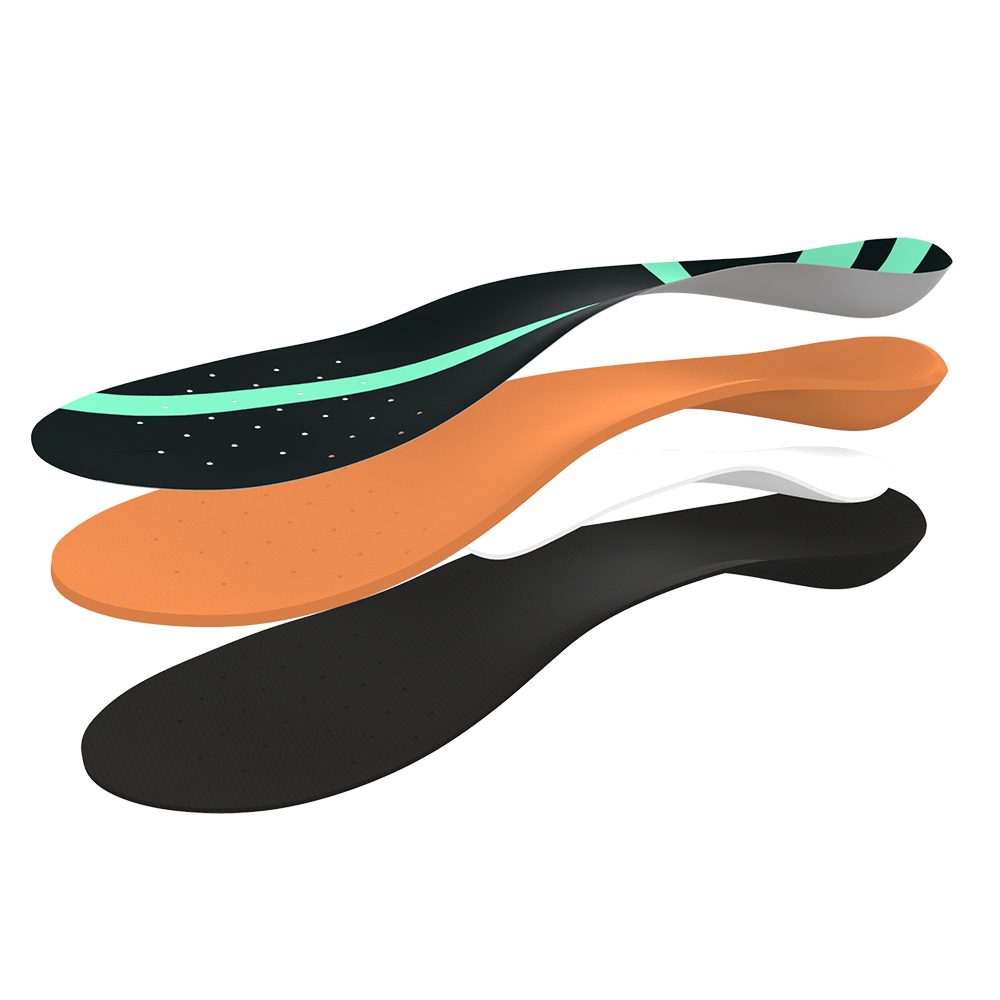
The daily comfort series splits by the day the wearer has rather than by foot type, and that choice is deliberate. Two people with similar feet can need different builds because one walks two kilometres between meetings and the other stands at a machine for a shift. The top layer, the cushioning layer and the polymer shaping board stay in the same family across all three builds; what moves is the stiffness of the board, where the cushioning sits, and how much room the shoe allows.
The everyday walking build is cut for casual shoes and the walking cycle. Its design brief centres on the regions that carry load in gait — the first three metatarsals, the lateral and medial heel — with arch contact, posture support and lateral stability doing the work, and cushioning spread under the forefoot and the heel. It is the build most retail customers start with, because it fits the shoe they already own.
The leather-shoe build starts from a harder constraint. A leather shoe is narrower and less forgiving, so the insole has to stay thin while still holding the arch, and the cushioning moves to external pads under the forefoot and the heel where there is room for them. The load map here runs across all five metatarsal heads plus both sides of the heel, and vertical stability matters more than the walking-cycle cushioning that suits a trainer.
The standing build answers a different physics problem. A person who stands for a shift is not cycling through a step; they are holding load in one place for hours, so the brief shifts toward forefoot and heel cushioning and an arch support that does not flatten by mid-afternoon. The heavy zones stay at the first three metatarsals and both sides of the heel — the same map as walking, read at a different duration.
The shoe sets the limits before the design does. A removable sockliner gives the build somewhere to sit; a shallow toe box removes the option of a thicker forefoot; a heel counter that grips tightly will change how a rear pad behaves within a week of wear. Fitters who check the shoe before they check the foot see fewer returns, and the check takes less time than the remake it prevents.
Inside each build the four grades decide the actual pair: support, anti-torsion, cushioning and starting ability. A fitter who understands those four axes can serve a customer without inventing a new product every time, and a distributor can describe a range in four numbers rather than forty SKUs.
In a pre-sales call a buyer asked for the softest pair in the range, which is a reasonable request and the wrong one. The useful question was how long she stood on a hard floor without sitting down. Once that answer was on the table, the recommendation moved from the casual build to the standing build, and the grade moved with it. Softness is a feeling; duration is a measurement, and the range is organised around the second one.
What a custom orthoses order needs from the buyer
Production terms are simple enough to state plainly. The minimum order is two hundred pairs, mixable across models and sizes, and both ODM and OEM are accepted. Sample pairs ship within three days, and the plant runs at roughly five hundred to one thousand pairs a day. Those four facts decide most first orders, because they tell a distributor whether a trial is affordable and tell a retailer whether a reorder can arrive before the season turns.
The size range runs from the smallest to the largest adult fitting, and it is the item that stalls more retail orders than any other. A shelf built only around the middle of the range leaves both ends unserved, and the ends are often where a fitting conversation begins — the customer who cannot find a shoe that fits is frequently the customer at one end or the other. Cutting the range short saves inventory and costs the sale that would have justified the whole display.
Durability belongs in the conversation before the first order, not after it. A daily-wear pair is expected to hold its support and cushioning for four to six months, and heavy training use shortens that. Treated as a service interval rather than a defect, it gives a shop a reason to see the customer again and gives a distributor a reorder rhythm. Treated as a surprise, it becomes a complaint.
The same four grades belong on the order sheet. A brief that reads “medium support, low cushioning, standard width” gives a factory something to build to and a shop something to reorder; a brief that reads “custom, like the last one” produces a pair nobody can repeat once the fitter who made it leaves.
The measurement step is what separates this range from a size code. The insoles are built on BODYFIT AI detection and evaluation and senthmetic flexible-fabric sensing, and the range is specified to work with the X5 detection system, where the data features recorded at the foot decide which build and which grade a pair should be made to. Without that step, custom means a length and a width; with it, custom means the load map the wearer actually presents.
The daily series is not the right answer to every request. A customer whose need sits in the rehabilitation series — flat-foot support, pressure distribution, hallux valgus, plantar fascia load — is served by a different build family, and a sport request belongs to the sport series. Sending an everyday build to do that work is how a range acquires a reputation it cannot hold.
Our sample room sees the same two checks from every new buyer. The first is whether the pair sits inside the shoe they brought with them, which is why we ask for three shoe types rather than one. The second is whether the left and right read as a pair — not identical, since feet rarely are, but clearly made to the same brief. Both checks happen before anyone discusses volume, and both have killed more orders than price ever has.
Frequently asked questions
What does custom orthoses mean in your range?
It means a biomechanically assessed insole built to a measurement rather than picked from a size run. We make the insole and the assessment equipment that feeds the build; we do not write prescriptions or present the product as a clinical device. Buyers who need a clinician-specified device are better served by a lab, and we say so.
Which daily build suits someone who stands all day?
The standing build, not the everyday walking one. It puts cushioning under the forefoot and the heel and holds the arch through a long static load, where the walking build is tuned to the gait cycle. The four grades — support, anti-torsion, cushioning and starting ability — then set the level within that build.
Do we need the X5 system to order FX insoles?
The range is specified to work with the X5 detection system, and the data features recorded there are what select the build and grade. A retailer already running an X5 can move from measurement to order without a second platform. Without a measurement step, the product becomes a sized insert rather than a custom one.
Can a retailer mix sizes and models in one order?
Yes. The minimum is two hundred pairs, mixable across models and sizes, and both ODM and OEM are accepted. Mixed orders are packed by size band, which is why the size spread needs to be settled at the quotation stage rather than added later.
How long does a daily-wear pair last?
The manual gives four to six months of daily wear, and heavy training use reduces both the life and the support and cushioning the pair provides. We treat that as a service interval and plan reorders around it rather than presenting it as a fault.
Can the insole be built for a leather shoe without changing the shoe?
Yes, that is what the leather-shoe build is for. It stays thin enough to sit inside a closed shoe and moves the cushioning to external pads under the forefoot and the heel, with vertical stability taking priority over the walking-cycle cushioning used in the casual build.
What we would do next
Name the end customer before you name the product. Tell us whether the range is for a clinic, a shop floor or a dealer network, and which shoes your customers actually wear, and we will point you to the build that fits that day rather than the one that looks best on a sample table. Our FAQ page carries the order, warranty and transit terms in full, and the insole category page sets out the three series side by side.
If a measurement step is part of the plan, the X5 foot and posture detection system is the platform the FX range is specified against. We will answer a specification question before asking for an order, and the build sheet can be settled while the shoe types are still on the table.
This article is intended for professional and educational reference. It is not medical advice. Custom insoles support alignment and load distribution; they do not treat or cure a condition, and clinical interpretation and any decision about care remain the responsibility of a qualified professional. Certification scope is limited to the documentation we hold: European Union certification and ISO quality system certification.