
A biomechanics lecturer who visited our stand in Dubai laid out her problem in one sentence: she has one lab, one apparatus and a timetable that puts twenty students in the room at once, and she needs every one of them to leave with a record worth comparing next month. That is a different brief from a clinic’s. A clinic optimises one session per person; a teaching lab optimises many sessions per hour, run mostly by people who are learning the procedure as they perform it. This article is about that second brief. It follows a pressure foot scanner session through a university teaching lab: how the extended platform changes what the room can do, how a class period is paced so students rotate without chaos, why the repeat pass is the most instructive part of the session, and how records stay comparable across a semester. It closes with archiving, printing and the boundaries we keep around what the record means — because a lab that teaches measurement should also teach the limits of the measurement.
Teaching labs buy this category of equipment for a reason that has nothing to do with volume throughput. A pressure record is one of the few places where a student can watch an abstract concept — load transfer, the division of a step into phases — turn into a line on a screen they generated themselves by walking across a plate. The apparatus teaches as much by being operated as by being read.
What the extended platform changes about the room
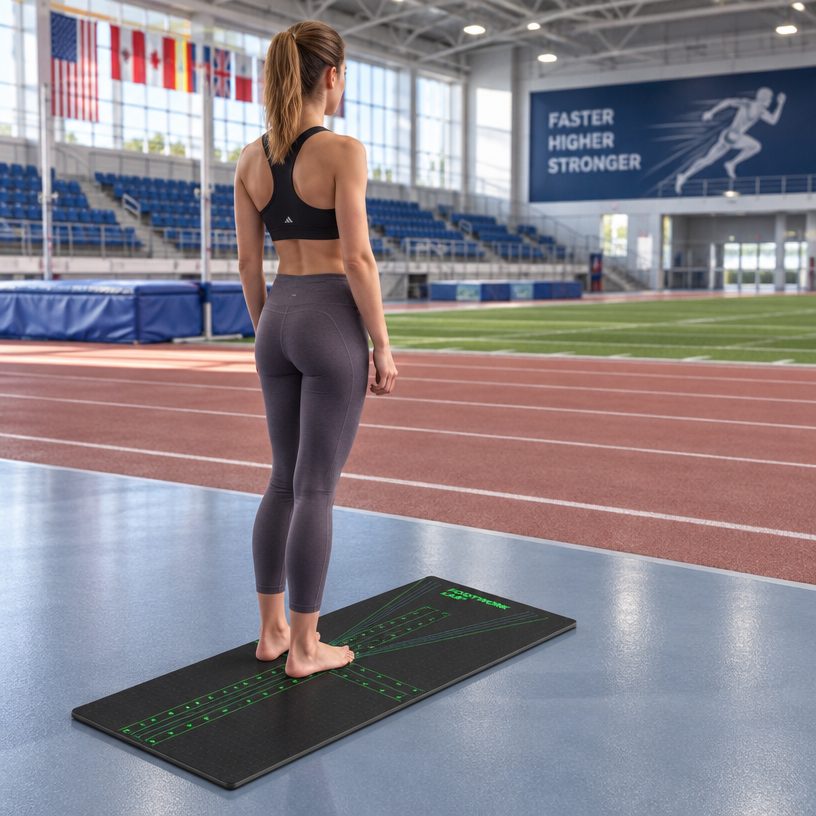
The F2-PRO is the extended version of our plantar pressure system, built to capture complete dynamic cycles rather than a single step taken in place. The walkway is long enough for a person to approach at a natural pace, cross the sensing area mid-stride and walk out of the measurement without adjusting their step to hit a target. Anyone who has watched a student shorten a stride to land precisely on a small plate knows why that matters: a record of a careful step is not a record of a walk.
Because the sensing run is continuous, the system divides the gait cycle into its named portions — stance and swing, and the double-support windows when both feet are on the ground. Students can see their own percentages beside the class reference, and the report carries the contact phase and flat phase proportions, peak and mean pressure, footprint length and width, contact area and the speed of the centre of pressure. For teaching, that list is the syllabus; each parameter corresponds to a question about walking that the course can then take apart.
The room arrangement is simpler than buyers expect. The main unit sits on the floor along one clear walking line, the lower-limb camera and posture camera stand where they can see the whole body, and everything travels in a carry bag when the lab is shared with other courses. Static and balance records are taken on the same plate the dynamic passes use, so three kinds of session fit into one footprint without re rigging the room between classes.
One planning note from installations: the walking line needs more clear floor than the machine itself occupies. A student who has to dodge a stool mid-approach delivers a record of the dodge. Labs that mark the approach line on the floor with tape spend less time re-running passes than labs that trust the floor plan.
How one class period is paced
A workable class period divides into four movements. First, the lecturer or technician walks one demonstration pass while the class watches the screen — arrival, roll-through, push-off appearing as a moving map is worth more than any slide. Second, students pair up: one is measured, one operates, then they swap. Third, each pair runs the repeat pass, because the second record is where the teaching happens. Fourth, the last stretch of the period goes to reading the reports together, with the lecturer picking two or three records and asking the room what changed and why.
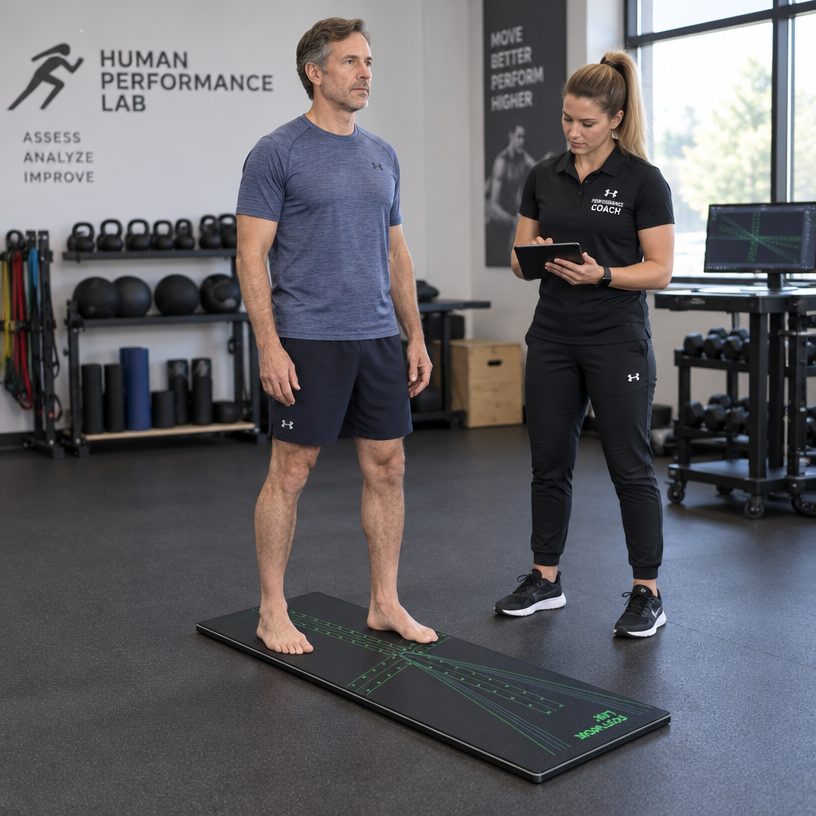
Pacing depends mostly on decisions made before the class starts. The prompts on screen carry the operator through each step — stand naturally, look at the camera, walk through without stopping — so the operator’s job is prompting, watching and re-running a pass when something obvious goes wrong. Pairs that swap roles halfway get both experiences inside one period, and the swapping itself teaches something: the student who just walked the plate reads the next record differently than the one who only watched.
Queuing is the part that kills a timetable. Labs that run one long single-file line lose half the room to standing around; labs that run two parallel activities — measurement pairs at the plate, a reading group working through printed reports at a bench — keep the whole class occupied. The printing option matters here more than its cost suggests, because a paper report at a bench can be discussed by six people at once, while a screen is a one-viewer medium.
Students as operators, and the drift that follows
A teaching lab accepts something a clinic never would: the person running the apparatus changes every period. That is fine, and it is the point of the equipment, but it produces a predictable drift that lecturers should plan for. One operator lets students lean on a bench before the static pass; another forgets the posture camera angle; a third permits a chat-friendly stroll instead of a walk. None of these is an error anyone commits on purpose, and by midterm the records quietly stop meaning the same thing they meant in week one.
The fix is procedural, not technological. We suggest a one-page session sheet that fixes the stance instructions, the walking pace in words, the number of passes per student and the camera positions, and we suggest the lecturer checks the first pair’s setup against it each period. In a support call earlier this year our engineers walked a lab through exactly this after their end-of-semester comparisons fell apart; the apparatus had been consistent, the instructions in the room had not. The sheet took an evening to write and the next cohort’s records compared cleanly.
Naming operators still matters even in rotation. Each period should have one student who owns the machine — prompts, re-runs, saving files — while the others rotate through the walking role. Ownership concentrates the learning: the operator sees every failure mode in a single session, from a partial-foot landing to a student who stops mid-plate, and that breadth of exposure is what makes the lab time transferable later.
Keeping records comparable across a semester
Comparability is the quiet requirement behind every teaching lab purchase, because the most valuable classroom exercise is longitudinal: the same student, same routine, records from week one and week ten set side by side. That exercise only works if everything except the student is held constant — same stance wording, same walking pace, same number of passes, same camera positions, same shoe state. Barefoot or shod should be decided once and never revisited mid-semester.
The repeat pass earns its place here too. When a student walks the plate twice and the two records agree, the class has seen that the measurement is stable; when they disagree, the class has seen how sensitive the measurement is to how the step was taken. Both outcomes teach, and lecturers who skip the repeat to save time lose the single cheapest demonstration of measurement discipline the apparatus offers. Two clean passes beat four rushed ones.
Archiving is the other half of comparability. Records should be saved against the student’s session with the date, the operator named and the protocol version noted, so that a record retrieved in week ten can be traced back to the conditions that produced it. Reports can be printed on site or generated online, and many labs keep both: the file for the archive, the paper for the bench discussion. What matters is that the archive is systematic from the first week, because a comparison exercise planned for the end of term cannot be rebuilt from memory in week nine.
We are upfront with labs about one boundary: the screen shows measurements, not conclusions. Nothing on the report marks a student’s feet as sound or unsound, and the reading of a record — what it suggests, what it rules out, what would warrant a professional referral — belongs to the qualified lecturer. A lab that teaches the measurement should teach that division of labour with the same care it teaches the walking protocol.
What the record actually shows, and what it is for
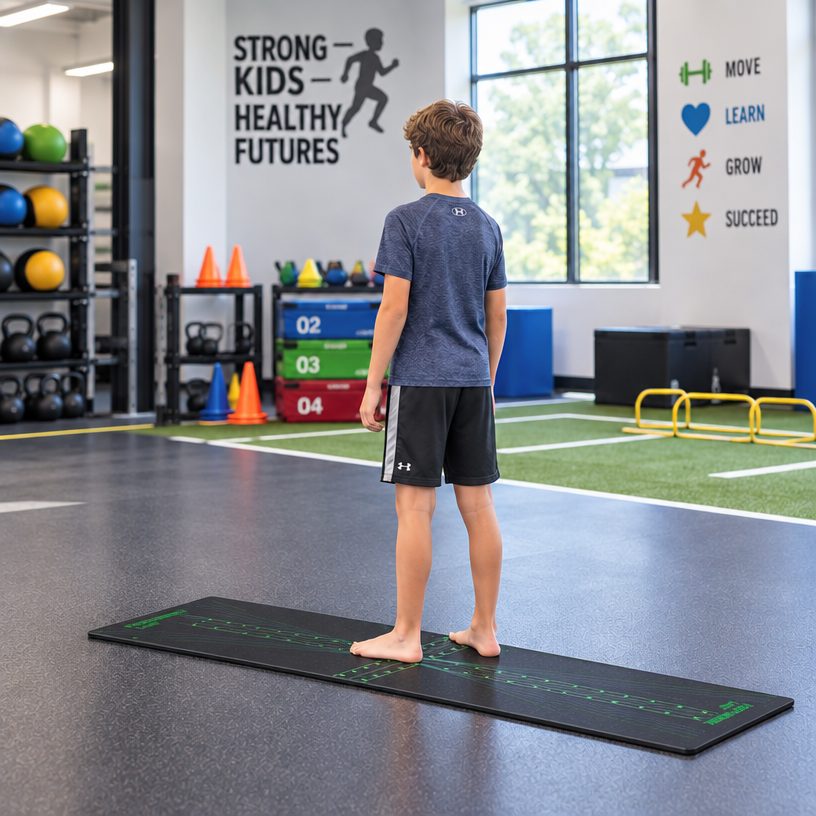
The dynamic record from a crossed walkway holds more than a map. It shows when each region of the foot takes load and for how long, the path of the centre of pressure as the step rolls through, the split between contact and flat phases, and the stance-swing and double-support proportions that only a full-cycle capture can measure. Set beside the video-style alignment views from the cameras, it lets a class connect what the foot did with what the leg above it was doing at the same moment.
For coursework, each parameter supports a different question. Contact phase proportions open a discussion about shock absorption at arrival. Centre-of-pressure paths show roll-over behaviour and asymmetries between left and right. Peak versus mean pressure introduces the difference between how hard a region loads and how long it stays loaded — a distinction that surprises most students the first time they see a long, moderate load produce more complaint than a brief sharp one.
The balance and static sessions round out the syllabus. A quiet-standing record shows how load sits when nothing is asked of the body; the balance record shows how it moves when the body has to hold itself. The three session types use the same sensing area, which is why the F2-PRO suits a lab that runs multiple course modules through one apparatus rather than dedicating a room to a single measurement type.
What the record is for, in a teaching context, is training judgement — not replacing it. Students who leave the course having operated the apparatus, produced records and defended their reading of them have learned a procedure they can carry into clinical, sports or retail settings later. The apparatus is the medium of that training, and the report’s own reference line — data for reference, interpretation to the professional — is part of the lesson, not a formality.
Ordering, support and the questions labs actually ask
Lab buyers ask a narrower set of questions than retailers, and most of them are about continuity. Minimum order for equipment is a single unit, and every unit runs a seven-day test at the plant before dispatch, which matters to a department that cannot tolerate an apparatus arriving unproven. Warranty runs twelve months against non-human damage with free parts, and support runs through a dedicated group with our engineers directly in it — remote assistance for the everyday questions, and over-the-air updates when the software moves forward without a site visit.
The question we hear most from universities is about software: whether the system can be adapted to a course’s own recording sheet or data export. The software system can be customised, and that customisation is quoted and charged separately from the machine — a fact we state early because it changes the budget conversation. A lab that plans its forms and exports before ordering gets a system that fits its timetable; a lab that discovers the option after delivery treats it as an unwelcome surprise, which is nobody’s interest.
Delivery planning is the last practical item. Express transit runs six to seven working days, air freight ten to twelve days and sea freight thirty to thirty-five, and a department scheduling an academic term should work backwards from the first teaching week. The apparatus needs a clear walking line, power at the right spot and a named technician for the first-week familiarisation — three things that cost nothing to arrange early and a lost session to arrange late.
At the Canton Fair stand we keep a simple test for lab buyers: walk across the demo plate twice, then read your own two records. Buyers who notice the differences between their own passes instantly understand what the classroom exercise will teach. It sells the apparatus better than any specification discussion, because it demonstrates the honest version of the product — a measurement that rewards discipline.
Frequently asked questions
Can a full class complete a session in one period?
Yes, with the right structure. Lecturer demonstration first, then students in pairs who alternate between the walking role and the operator role, with the repeat pass included and the closing minutes spent reading reports together. Labs that run a second activity — printed reports at a bench — keep the waiting students working instead of queuing.
What does the extended walkway add over a standard plate?
The F2-PRO captures complete dynamic cycles: the student walks through at a natural pace instead of adjusting a stride to hit a small target. That makes stance phase, swing phase and double-support proportions measurable, alongside the contact and flat phase shares, pressure values, footprint dimensions and centre-of-pressure speed.
Do students need training before operating the apparatus?
No prior training is assumed — the on-screen prompts walk the operator through each pass. What we do recommend is naming one operator per period to own the machine, and a one-page session sheet fixing stance, pace and pass count, so that rotating student operators do not let the routine drift over a semester.
How are records kept comparable across a term?
By holding everything but the person constant: the same stance wording, walking pace, number of passes, camera positions and shoe state, written down and checked against. Records are saved with date, operator and protocol version. The repeat pass each session shows both that the measurement is stable and how sensitive it is to how the step is taken.
Can reports be printed for coursework and marking?
Yes. Reports support online printing and on-site printing, and many labs use both — the file goes to the archive, the paper goes to the bench where a group can read it together. Printing also gives the waiting half of a class something to work on between turns at the plate.
Does the system do anything besides walking records?
It records three session types on the same sensing area: static standing distribution, dynamic walking and balance. The three fit into one course module or three, and because no re-rigging is needed between them, a shared lab room can serve several courses in a week.
What does after-sales support look like for a department?
Support runs through a dedicated group with our engineers directly in it, remote assistance for setup questions and over-the-air updates over a network connection. Warranty covers twelve months against non-human damage with free parts. Software customisation is possible and is quoted separately from the machine, and each unit is tested for seven days before it leaves the plant.
What we would do next
Tell us the timetable, not the specification: how many students per period, how many weeks per term, and what the end-of-term exercise compares. We will map a session structure onto it and flag the floor space, camera positions and protocol sheet the first week needs. The F2-PRO product page lists the system’s functions in the manual’s own wording, and the core technology page explains the sensing and camera side.
For the reading that supports a course, our pieces on pressure plates and the F2-Pro, pressure plate gait records and biomechanical analysis ending in a report each cover a segment of the syllabus in more depth. Order, warranty and transit terms sit on the FAQ page, and the contact page reaches the team directly.
This article is intended for professional and educational reference. It is not medical advice. Foot assessment equipment produces measurements and images; clinical interpretation and any decision about care remain the responsibility of a qualified professional. Certification scope is limited to the documentation we hold: European Union certification and ISO quality system certification.