
A buyer types 3d sole scanner into the search box, and the phrase carries two entirely different businesses inside five words. Sole is the hinge: it can mean the underside of the foot, which points the search at foot assessment, or the underside of a shoe, which points it at footwear design, resole services and shoemaking. Wrapped around the hinge sits 3D, which in search phrases is the market’s shorthand for anything that promises depth — and which deserves clearing up on the first screen of any page that hopes to answer this search, because it is a habit of the market, not a specification of our instruments. Behind each meaning of sole stands a different buyer with different expectations: the foot-sole buyer wants a record of a foot, fast; the shoe-sole buyer wants a record of a shoe or a last, or is simply lost. This article separates the two meanings screen by screen, shows what the foot-sole buyer actually gets from a quick-screening session at a podoscope, and follows the report to its conclusion page — where the words for reference only do more work than any specification on the sheet.
One word, two meanings, and the 3D is only wrapping
Take the wrapping off first, because it causes the most confusion and deserves the least time. Buyers type 3D into device searches the way they type new and best — as a gesture toward depth and quality, learned from category pages and marketplace filters rather than from any instrument they have seen. A page that answers the phrase should acknowledge the vocabulary and then move to what is actually recorded. What our systems capture is pressure against a surface, alignment through cameras, and the analysis that assembles them into a report; shape-scanning shorthand describes a different family of instruments, and the distinction should be said out loud rather than blurred for the sake of a keyword.
With the wrapping off, the hinge word stands alone, and it splits the search cleanly. Sole as the underside of the foot is the older and larger meaning in this context: the plantar surface, the arch, the heel, the ball. Sole as the underside of a shoe is the shoemaker’s meaning: outsoles, midsoles, tread, resoling. Both are legitimate, both have industries behind them, and both surface in device searches because the two trades share a vocabulary and a search box.
The two buyers behind the meanings expect opposite things from the same five words. The foot-sole buyer expects a session about a person: stand here, and the screen shows the plantar record. The shoe-sole buyer expects a session about an object: a last, a finished shoe, a sole pattern captured for design or reproduction. A listing that never separates the meanings serves neither — it reads as a machine that might do either, which is exactly the vagueness that makes buyers leave a page without writing to anyone.
How a supplier answers is therefore a taxonomy exercise, and this article performs it. The foot-sole meaning leads, because it is the meaning our instruments serve, and it gets the depth below. The shoe-sole meaning gets an honest paragraph: what that buyer is really shopping for, and what we would tell him to look for instead. One screen each, as the title says — two meanings, two audiences, one page that refuses to pretend they are the same.
The foot-sole buyer and what the search expects
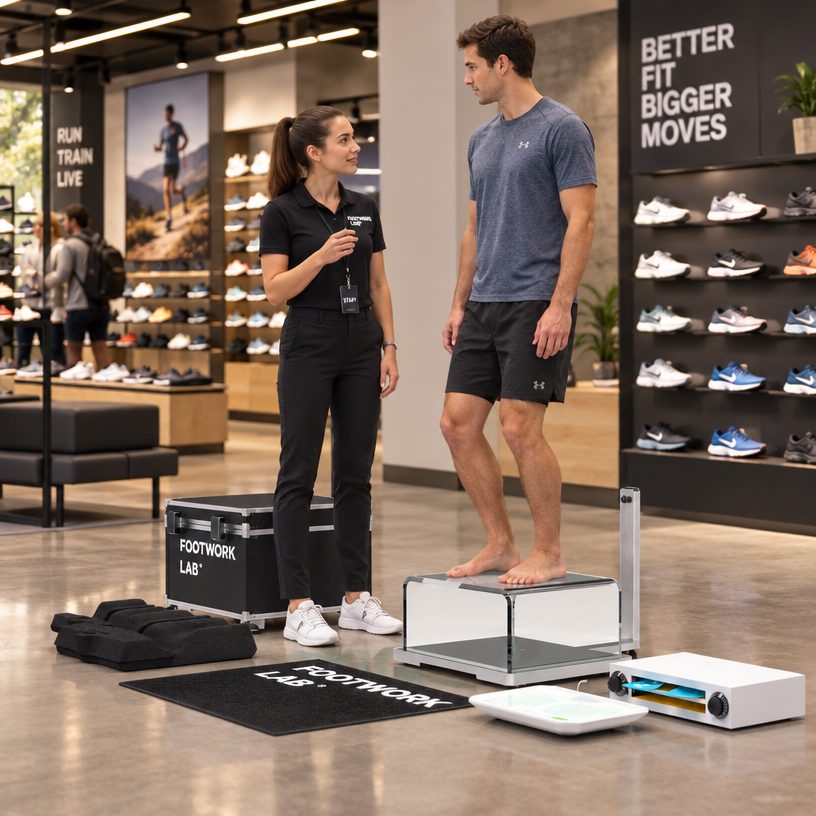
The foot-sole buyer arrives with a session in mind: a person stands or steps onto the instrument, and minutes later a record of the plantar surface exists — arch presentation, load distribution, the shape the foot actually makes when it meets the ground. The expectation is speed and concreteness. This buyer is usually a shoe shop, a foot care counter, a screening service or a clinic front desk, and the question underneath the search is whether a machine can turn a foot into a record quickly enough to serve a customer standing there.
What the record holds is familiar from our other articles: the plantar data — footprint shape, contact area, how load spreads between heel and forefoot — and, where the system carries them, the alignment captures that show how the leg stacks above the foot. The foot-sole buyer rarely arrives asking for cycle-level parameters; the search is a screening search, and the session it wants is measured in minutes, not half hours, because the person being recorded is a customer with somewhere else to be.
Who reads the record decides what the session is worth. At a counter, a trained fitter reads the report aloud in two sentences and walks the customer to a shelf; in a clinic, a professional reads it as the first page of a longer conversation. Both are legitimate, and both depend on the same boundary: the record describes the foot, and the reading of the record belongs to the person qualified to make it. A report that states for reference on its own page makes the boundary easier to hold at a busy counter.
What we do not do is promise the foot-sole buyer outcomes. The screen shows a foot as it is today, not a forecast of what any product will do about it; that line, held from the first reply, is why shops trust the session enough to build a service around it. The buyer who wants the record to sell a fitting gets everything the instrument can give; the buyer who wants it to promise something gets an honest no.
The shoe-sole buyer and what the search expects
Now the other side of the hinge, and the honest paragraph. The buyer whose sole meant the underside of a shoe is shopping in the wrong aisle — not because his business is small but because it is different. He wants the shape of a last or a finished sole captured for design, reproduction or manufacture; the instruments he needs belong to the footwear-production world, and a pressure-based assessment system will not do his job, because it records forces from feet, not geometry from objects.
The kindness is to say so early. A shoe-sole buyer who lands on an assessment page and reads carefully will leave anyway; one who is told in the first screen what this page is for either leaves quickly or — and this happens more often than suppliers expect — turns out to have a second interest. Shoemakers and shoe-shop owners are neighbours in the same market, and plenty of enquiries that arrive as sole-of-shoe searches end as counter-assessment conversations once the distinction is drawn. The screen that separates the meanings is not a wall; it is a sorting desk.
For the buyer who truly wants shoe-sole capture, the useful advice is about vocabulary rather than products: he is shopping for digitising instruments in the shoemaking equipment category, and he should search and verify with that category’s words — lasts, outsoles, moulds — rather than with foot words. That advice costs us nothing, costs him a week of wandering, and earns a kind of credibility that a misplaced enquiry form never will.
What we do not do is chase the shoe-sole meaning with reassurances that our instrument can sort of do both. It cannot, and saying otherwise would put a machine in a workshop where it disappoints everyone. The honest taxonomy keeps our pages readable for both audiences at once: the foot-sole buyer reads on, the shoe-sole buyer reads off, and nobody wastes a message discovering which is which.
What a quick screen records at the counter
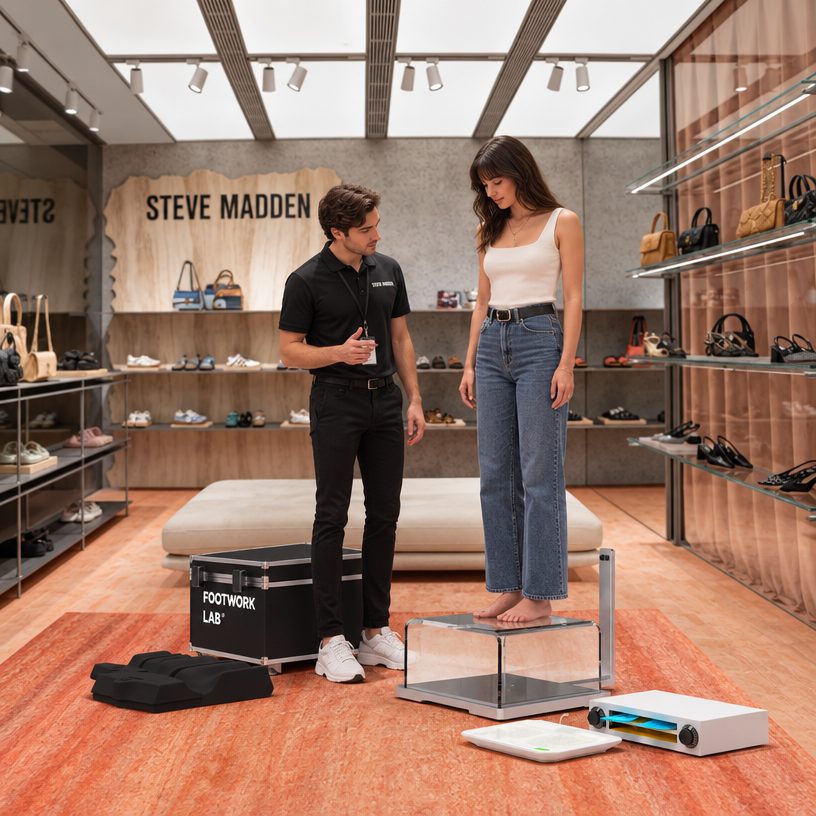
For the foot-sole audience, the session our Q1P was built for runs at the pace of a shop. The Q1P is a foot and ankle quick-screening system in podoscope form: the customer steps up, the instrument captures the plantar surface, the lower-limb alignment and the ankle data, and the report assembles while the customer is still standing there. The whole exchange fits inside the time a customer spends between trying on two pairs of shoes, which is the economy the podoscope form was designed around.
The report’s items read like a screening checklist, because that is what they are: arch type, foot shape, the presence of hallux valgus, heel eversion, tibial internal or external rotation, and the foot’s measured length and width with a shoe-size suggestion beside them. Each item is a recorded value with a defined meaning on the page; none of them is a verdict about the person, and the report’s own wording keeps the two apart. A fitter can read all seven items aloud in under a minute, which is roughly the time the customer will give them.
The alignment items are the ones customers remember, because they can see themselves in them. A photograph of how the heel tracks or how the knee stacks over the foot carries more persuasion at a counter than any number, which is why the session captures them wherever the room allows — and also why the staff script matters: the image describes an alignment as recorded, and what it means for the customer’s choice of support is a conversation the fitter conducts inside the fitting, not a diagnosis the screen announces.
The on-site customisation module rounds out the system for shops that want the full loop: record, fit, and where the range cannot answer, a build made to the specification on the spot. What the module does not do is turn the fitter into a clinician — the customisation follows the record, and the record stays a record. Shops that respect that distinction are the ones whose assessment services still exist a year later, still trusted by the customers they screen.
The conclusion page that leads with for reference only
Every Q1P report ends on a conclusion page, and the most important words on it are printed before any conclusion appears: the results are for reference only, and where medical needs exist, the customer should visit a professional institution. Those sentences are not decoration; they are the boundary of the service, written into the page itself so that it travels with the report even when the fitter who handed it over is not in the room. A screening tool that wrote its own verdicts would be a different and worse instrument.
The wording does real work at the counter, and shop owners notice it in the first weeks. Customers accept a record that calls itself a reference; customers distrust a screen that seems to pronounce. The page thus protects both sides at once — the customer from over-reading a fast session, and the shop from the staff improvising clinical meaning into values they were trained to record, not to interpret. We would rather lose a sale made on a promise than make it, and the page says so in our voice even when we are not there.
Where the record leads somewhere medical, the page points the customer outward, and the shop should treat that as a service rather than a lost sale. A customer sent to a professional institution with a readable record in hand arrives as a better patient and often returns as a better customer, because the shop was the place that took the record seriously. Screening that knows its own limits is what earns a counter the right to run screening at all.
The same humility shapes what we tell buyers shopping for the quick-screen category. Ask any supplier how the report closes; a page that ends without a reference note is telling the buyer what the supplier thinks of boundaries. We hold European Union certification and ISO quality system certification, and we hold the reference note with the same seriousness — paperwork and boundaries are the same kind of promise: they matter precisely when the room is busy and nobody is watching.
One screen, two audiences, one counter routine
Bring the two meanings back together and the practical page designs itself. The first screen names what the instrument records — plantar pressure, alignment, ankle data — and says plainly that the depth in the search phrase is market shorthand, not our specification. The second screen separates the meanings: foot sole, read on; shoe sole, here is the aisle you actually want. From there, each audience gets its own honest answer, and neither has to read past the screen that was not written for it.
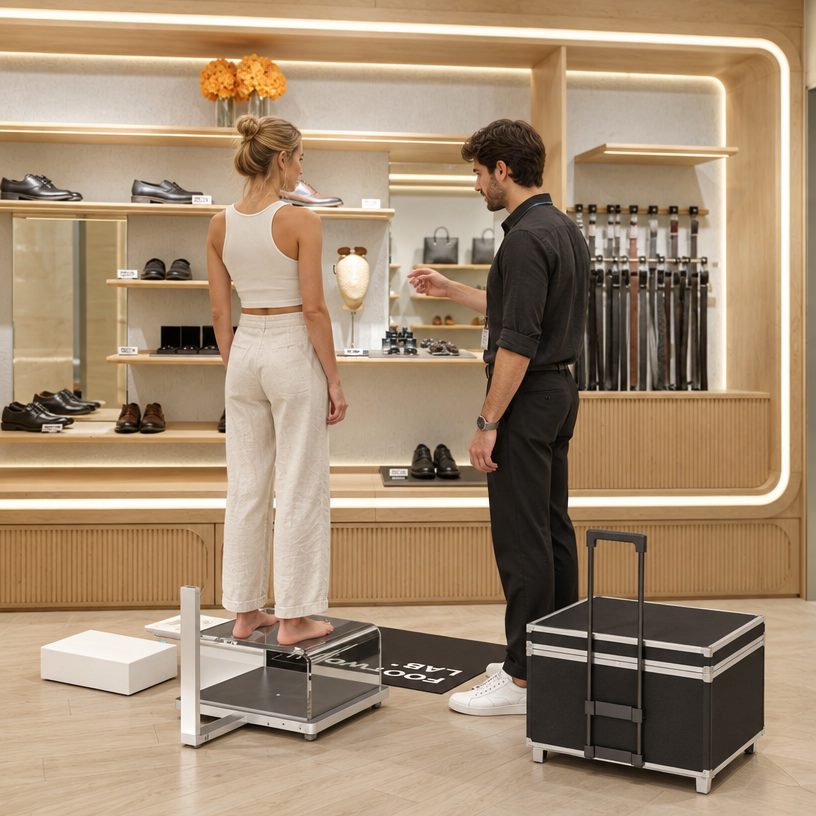
The counter routine follows the same order. Step up, capture, report, read the items in the trained two sentences, hand over the page with its reference note, and walk to the shelf where the fitting conversation continues inside its competence. None of it requires a diagnosis, none of it promises an outcome, and all of it fits inside the minutes the podoscope form was built for. Shops that drill the routine run the same session on a Friday afternoon as on a quiet Tuesday, and the records stay comparable because the script never depends on who is standing at the counter.
The commercial terms belong at the end of the conversation, and they are short. Machines start from a single unit and accept ODM; each unit leaves the factory only after seven days of testing and carries a twelve-month warranty on non-human damage, with parts supplied free within it; after-sales runs through a dedicated WhatsApp group with engineers reachable directly and remote assistance where the connection allows. Delivery moves at six to seven working days by courier, ten to twelve days by air, thirty to thirty-five by sea.
And the phrase that started the search ends up being the best thing about the buyer: anyone who types two meanings into one box is a buyer with a real question, and real questions deserve screens that sort them. Sole is a hinge; the job of a good page is to swing it once, cleanly, so that the foot-sole buyer finds a record and the shoe-sole buyer finds the door. Both leave with something true, which is the only kind of leaving a shop should arrange.
Frequently asked questions
What does the phrase 3d sole scanner actually mean?
Two searches sharing one spelling. Sole as the underside of the foot points at plantar assessment; sole as the underside of a shoe points at shoemaking and design. The 3D is the market’s shorthand for depth rather than a specification, and a good page clears it up on the first screen.
Is your instrument a shape scanner?
No. Our systems record plantar pressure, alignment and ankle data against surfaces and through cameras. The shape-capture instruments the shoe-sole buyer wants belong to the shoemaking equipment category, and we say so rather than stretch our specification to fit the search.
What does a Q1P quick screen record?
Arch type, foot shape, hallux valgus, heel eversion, tibial internal or external rotation, and measured foot length and width with a shoe-size suggestion — captured at podoscope form in the minutes a shop customer will give, with alignment images where the room allows.
Who reads the results?
A trained fitter at the counter, or a professional in a clinical setting. The report records values; the reading belongs to the person qualified for it; and the fitter’s script keeps the session inside a fitting conversation rather than a diagnosis.
What does the conclusion page say?
That the results are for reference only and that customers with medical needs should visit a professional institution. The note travels with every report and holds the boundary of the screening service even when the fitter is not in the room.
What are the machine order terms?
Machines start from a single unit and accept ODM. Each unit is tested at the factory for seven days before shipping and carries a twelve-month warranty on non-human damage, with parts free within it and after-sales through a dedicated WhatsApp group.
How long does delivery take?
Six to seven working days by courier, ten to twelve days by air, or thirty to thirty-five days by sea. A first installation should be planned against the slowest of the three windows rather than the fastest.
What we would do next
Tell us which sole you meant — the foot or the shoe — and, if the foot, where the screen will stand: a shop counter, a screening bay, a clinic front desk. We will answer with the configuration that fits the minutes your customer gives the session, through the contact page. The Q1P product page sets out the podoscope form, the report items and the on-site customisation module.
Four pieces continue the sorting work. A podoscope for the shoe store follows the counter session from the staff side, and a podoscope foot screening takes minutes paces the routine itself. Foot type is a record, not a verdict holds the boundary the conclusion page writes, and podiatry instruments in a clinic room shows where the quick screen sits among its professional neighbours.
This article is intended for professional and educational reference. It is not medical advice. Foot assessment equipment produces measurements and images; clinical interpretation and any decision about care remain the responsibility of a qualified professional. Certification scope is limited to the documentation we hold: European Union certification and ISO quality system certification.