
An enquiry arrives carrying a single word — podiatry — and nothing else: no comma, no second idea, no clue. Someone, somewhere, typed one word into a search box or a contact form and pressed send, and now the reply has to be written. The tempting answers are both wrong: answer the whole field of podiatry and the reply becomes a textbook nobody reads; answer with our own catalogue and the reply assumes the buyer wanted us, when the word covers at least three markets we only serve one of. The one-word enquiry is not noise, though. It is a buyer at the very start of narrowing, standing at the top of a decision tree they have not yet descended, and the seller who helps them take the first step down usually gets the second. This article does that walking: what the three layers behind the word actually are, how a buyer narrows a one-word search into something answerable, what the supply layer looks like concretely — the daily insole shelf, its styles, its size runs, its restock arithmetic — and where the minimum order, the samples and the honesty clauses sit once the word has become a line item.
One word covers three markets
Podiatry, as a word, is a field of practice: the care of feet and lower limbs by people trained for it. As a search term, it collapses three different markets into one small box. The first layer is devices — the chairs, instruments, record systems and screens that clinics equip themselves with. The second is consumables — the things that get used, dispensed and restocked: insoles first among them, but also the padding, covers and fitting materials that keep a service running. The third is services — the clinics themselves, the training, the referral networks. A buyer typing the bare word could be shopping for any one of the three, and sellers answering from different layers will send three genuinely different replies to the same enquiry.
The confusion is structural rather than careless. A person new to the field does not yet know which layer their own question belongs to; a clinic manager refreshing a supply line types the same word as a student researching a career. Search engines flatten the difference because the word is the same, and the results page mixes instruments, insoles and appointment bookings in one scroll. The buyer’s first job, then, is not finding a supplier but finding their layer — and the supplier’s first job is finding out which layer the buyer is standing on before quoting anything.
We sit on the consumables layer, with one foot — as it were — on the device layer that feeds it: we manufacture custom orthotic insoles and the assessment systems that produce the records informing them. We are not a clinic, we do not employ practitioners, and we do not answer the service layer at all; when a one-word enquiry turns out to be somebody looking for care, the honest reply points them to the professionals in their own city. Naming your own layer out loud is the fastest way to help a buyer name theirs, which is why our first reply to the bare word does exactly that before asking a single question.
The three-layer map also explains why the word attracts such different advertising. Device sellers lead with specifications, service providers lead with credentials, and consumable suppliers — us — lead with ranges, grades and restock terms. A buyer who understands the layers can read the advertising landscape in one pass and stop opening tabs that were never their market. That reading skill, more than any single product, is what the rest of this article tries to teach.
Narrowing by the word that follows
The practical method for descending the tree is simple: add the next word and watch the market change. Podiatry plus chair, drill or instrument lands in the device layer’s clinical corner. Podiatry plus supplies, pads or insoles lands in the consumables layer, where the questions become ranges and restock arithmetic. Podiatry plus clinic, course or near me lands in the service layer and belongs to a different reply entirely. Each added word cuts the search space sharply, and the buyer who adds two or three words usually arrives at a phrase a supplier can actually answer with a document rather than a brochure.
The direction of narrowing matters as much as the words chosen. Narrowing from the field toward a device is a specification exercise — what does the equipment record, what does the report contain. Narrowing from the field toward a consumable is a supply-chain exercise — what does the shelf stock, how do sizes run, when does the reorder fire. Buyers often start narrowing in the wrong direction because the advertising they met first pushed them there; a buyer who began reading device listings but whose real need is a stocked shelf wastes weeks before the mismatch surfaces. Asking the buyer what happens in their shop or clinic every morning — what gets used up, what gets dispensed, what gets replaced — reveals the right direction faster than any keyword tool.
One honest restriction applies to our side of the narrowing, and we state it in first replies. We answer the consumables layer concretely — the insole ranges, the grading system, the order terms — and the device layer insofar as our record systems serve a shop or clinic that dispenses. We do not answer the clinical layer: no treatment plans, no referral decisions, no professional judgement of any kind. The equipment and the records support qualified professionals; they do not replace them, and a one-word enquiry that turns out to be a patient looking for help gets redirected with the same politeness as a dealer enquiry gets a quotation.
For the buyer whose next word turns out to be insoles, the narrowing has arrived somewhere this article can serve properly, because the rest of it is about the supply layer in concrete terms: what a daily insole shelf stocks, how the stock is sized, and what the paperwork of restocking looks like. The layers above — devices, services — wait in other articles, linked at the end, for the readers whose tree descends differently.
The supply layer: what a daily insole shelf stocks
Start with the product that the supply layer actually moves in volume: the daily comfort range. It is built for the walking lives most customers lead rather than for any single sport or clinical programme — a pair for everyday walking, a thinner build that sits inside dress and leather shoes without lifting the heel out of the counter, and a standing variant for the customers who spend their working day on shop floors, in kitchens, behind counters. Three jobs, one family, and a shelf that a shop assistant can explain without a manual.
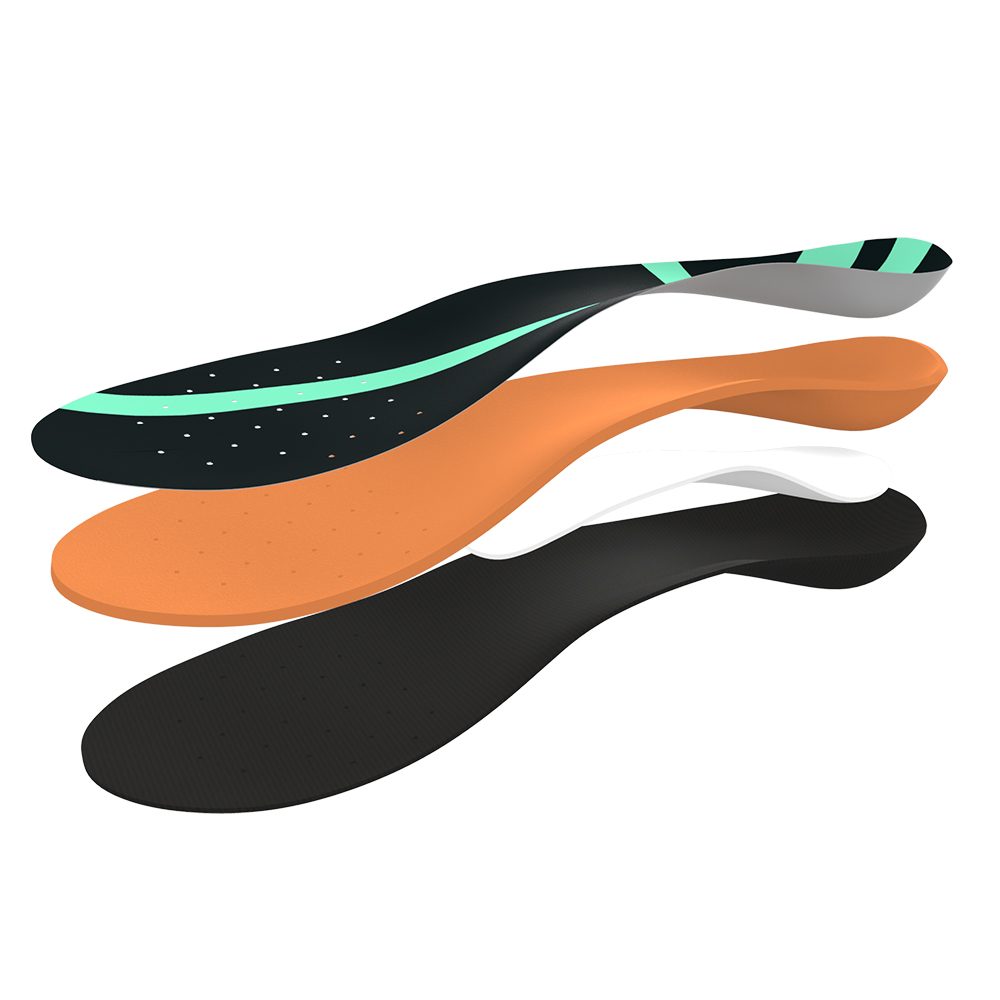
The construction is worth knowing because customers ask, and because it explains what the shelf is selling. The daily leisure build stacks three layers: a mesh fabric top that manages moisture and friction against the sock, an Ortholite cushioning layer beneath it that provides the comfort and the volume that fills the shoe, and an AQ polymer shaping board carrying the contour and resisting the twist. Each layer has a job; the board is what separates a shaped insole from a soft pad, and it is the part the fitter checks when a customer reports that a build has gone flat in wear.
Above the construction sits the grading, which is how the range turns from a product into a system. Every build carries grades on four axes — support level, torsion resistance, cushioning level and propulsion capability — so two daily pairs on the same shelf can legitimately differ in how much support they carry. The grades are chosen, where a record is available, by reading what the assessment shows; the ranges are assessed with the BODYFIT AI evaluation and senthmetic flexible fabric sensing, and they work alongside the X5 detection system where a fuller record is wanted. A shop that keeps the graded range in stock can serve two customers with the same shoe size and genuinely different feet from the same carton — which is the entire argument for stocking a system rather than a pile.
What the shelf should not promise is the part we insist shops hear. The insoles support, cushion and hold contour; they do not diagnose, and they do not promise outcomes for any named condition. Customers who arrive describing pain belong with professionals, and the report pages our assessment systems produce carry a reference line saying exactly that. A shelf that promises relief is a shelf building its own complaint queue; a shelf that records, fits and refers honestly is a shelf that keeps its customers for years.
Stocking arithmetic: styles, sizes, batches
The first stocking decision is styles, and the daily range keeps it deliberately small: walking, dress and standing, with the graded variants nested inside. A shelf that stocks one style per job reads clearly to the customer and simply to the reorder spreadsheet; a shelf that stocks six styles per job reads as confusion and reorders as guesswork. The style decision should follow the shop’s own foot traffic — a shoe store near an office district weights the dress build, a shop beside a market weights the walking build — and the factory side supports the weighting with customisation rather than arguing for the full spread.
Size runs are the arithmetic that makes or breaks the shelf economics. Feet cluster: the middle sizes move several times faster than the extremes, and the extremes are where dead stock accumulates when a buyer orders the full run symmetrically. The sensible first order weights the middle, stocks the edges thin, and lets the consumption tab — kept honestly for a season — pull the depth outward where the traffic actually is. Orders mix freely across styles and sizes, and the minimum order runs at two hundred pairs, a floor set by production efficiency rather than a push toward overstocking; a mixed order of two hundred pairs is a starting shelf, not a warehouse.
Batches close the arithmetic. A reorder must arrive as the same product the customer’s first pair came from — same construction, same grading, same contour — or the shop’s fittings start drifting without anything changing on the shelf. Consistency is checked batch by batch at the plant, and the shop’s half of the discipline is noting the batch against sales so a returning customer can be matched to what they bought before. The daily range is a repeat-purchase product by design; the whole model rests on the second pair matching the first.
Samples sit before all the arithmetic, and they cost three days rather than a budget line: sample pairs ship within three days of confirmation. A sample pair in the owner’s hands answers what no listing can — how the board feels underfoot, how the build sits in the shop’s actual best-selling shoes, how the sizes run against the local population. We would rather a shop ordered late and right than early and full, and the sample turnaround exists to make late-and-right cheap.
The restock rhythm on a retail shelf
Once the shelf runs, restocking settles into a rhythm with three variables: the trigger, the route, and the season. The trigger should be a fraction of remaining stock rather than an empty shelf — reordering when the gap appears means the customer meets the gap first. The route is chosen per reorder: express runs six to seven working days, air freight ten to twelve days, sea freight thirty to thirty-five days depending on destination. The season overlays both — walking builds move differently in a hot month than a cold one, and the shop that notes the pattern once never relearns it.
The plant side of the rhythm is capacity, and it is stated in round words rather than promises: production runs at roughly five hundred to a thousand pairs a day, so a mixed restock of a few hundred pairs is a scheduling note rather than a negotiation. What the shop contributes to the rhythm is the honest tab — consumption by style, size and batch, kept from day one. The tab is unglamorous and it is the single best predictor of whether a shelf stays profitable in its second year, because every stocking mistake shows up in it early, while it is still cheap to correct the ordering rather than the shelving.
What we do not do on the supply side deserves the same visibility as what we do. We do not push volume into reorders — a suggestion to take a bigger mixed carton needs a consumption reason, and absent one, the tab wins. We do not promise exclusive territories; a shop’s advantage is its service and its honesty, not a line on a map. And we do not publish prices in public — the quotation follows the styles, the size runs and the route, and a number in the abstract would be wrong in every particular case that matters.
The rhythm, kept boring, becomes the shop’s quiet competitive edge. Customers return for a second pair because the first matched, the shelf never greets anyone with a gap, and the reorder lands by plan rather than by panic. None of that requires selling harder; it requires the layers beneath — styles kept small, sizes weighted honestly, batches consistent, samples taken seriously — to have been done properly the first time.
When the one word narrows back toward equipment
Some buyers descend the tree and find, halfway down, that their layer is not consumables at all. A shoe shop owner who keeps running out of insoles is describing a supply problem; a shop owner who says customers ask questions the staff cannot answer is describing a record problem, and the narrowable answer is the assessment system that produces the documents the staff can show. We build those systems — the pressure and posture record side that feeds the grading decisions — and the same contact form that carries an insole order carries an equipment enquiry, which is why the first reply to the bare word always asks what happens in the room every morning.
The equipment conversation follows the same honesty rules as the consumable one, and the boundaries repeat because they matter more there. The record systems capture what the foot does — pressure, contact area, alignment images, posture items — and the reports say plainly that reading them belongs to qualified professionals. The equipment does not diagnose; a shop is not a clinic; and the system pages carry the same reference line the insole documentation carries. A shop that wants the machine to tell customers what is wrong with their feet is shopping for something we do not sell, and the first conversation is the cheap place to establish that.
Prices stay off every layer of the conversation, and certification stays exactly as documented. What we hold is European Union certification and ISO quality system certification — that, and nothing grander — and the documents travel with the quotation for buyers who want to see them. The quotation itself follows the configuration: which ranges, which size runs, which route, or which system and which module. A one-word enquiry that survives narrowing all the way to a written quotation has usually taken a few weeks, and every one of them was cheaper than the alternative.
The bare word will keep arriving — podiatry, alone in a form field, with no comma to help. The sellers who do best with it are the ones who treat it as the first step of a staircase rather than as a mistake: name the layers, ask which one the buyer stands on, answer that layer concretely, and hand the honest boundaries along the way. Buyers remember the supplier who helped them descend the tree far longer than the supplier who sent the biggest brochure.
Frequently asked questions
What does a one-word search like podiatry actually cover?
Three markets collapsed into one word: devices the clinics equip with, consumables the services restock — insoles first among them — and the services themselves. The buyer’s first job is finding which layer they stand on, and the supplier’s first job is asking.
How does a buyer narrow the search usefully?
By adding the next word and watching the market change: podiatry plus instruments narrows to devices, plus insoles narrows to consumables, plus clinic narrows to services. Asking what gets used up, dispensed and replaced in your own room each morning reveals the right direction fastest.
Which layer do you serve?
The consumables layer concretely — custom orthotic insoles in graded ranges — with the device layer alongside where our record systems feed the fitting decisions. We are not a clinic and do not answer the service layer at all.
What does the daily insole range consist of?
Three jobs in one family: everyday walking, a thinner build for dress and leather shoes, and a standing variant for long hours on foot. The construction stacks a mesh fabric top, an Ortholite cushioning layer and an AQ polymer shaping board, with grades for support, torsion resistance, cushioning and propulsion.
What are the minimum order and sample terms?
The minimum order is two hundred pairs, mixed freely across styles and sizes; sample pairs ship within three days so the order can be built from a pair fitted in real shoes rather than from a listing.
How should a shop plan restocking?
Trigger on a fraction of remaining stock rather than an empty shelf, weight the middle sizes and let the consumption tab pull the depth outward, and choose the route per reorder — express six to seven working days, air ten to twelve, sea thirty to thirty-five.
Do the insoles promise outcomes for foot problems?
No. They support, cushion and hold contour; they do not diagnose and they do not promise results for named conditions. Customers describing pain belong with qualified professionals, and our own report pages carry a reference line saying exactly that.
What we would do next
Send the bare word back with one sentence of context — a shop, a clinic, a distribution plan, or a search for care — through the contact page. We will tell you which layer your sentence lands on, answer that layer concretely, and say plainly if the answer belongs to somebody else. The insole categories page lays out the three ranges and the four grading axes in the range’s own terms.
Three pieces continue the narrowing. A foot care product line shows a shelf built as a system, orthopedic products sell in order covers the sequence in which a shop’s range should grow, and pedorthic footwear and custom insoles follows the professional side of the fitting conversation.
This article is intended for professional and educational reference. It is not medical advice. Foot assessment equipment produces measurements and images; clinical interpretation and any decision about care remain the responsibility of a qualified professional. Certification scope is limited to the documentation we hold: European Union certification and ISO quality system certification.