
The queue was four deep, the last customer was still putting a shoe on, and the operator called the next name anyway. Nothing about that scene is unusual in a working shop, and nothing about it is compatible with a clean record. The equipment will happily produce a report from a rushed capture; it will simply be a report of a foot that was moving, on a floor that was busy, beside a conversation the customer was half listening to. Most bad records are made by the room, not by the hardware, and most of them are made without anyone noticing at the time. This article is about the conditions a capture actually needs when the space is small and the floor is crowded: the operator’s script and why it must be written down, what arrives on the feet and on the surfaces, what queue pressure does to a session, where to place a walkway when the room has no quiet corner, how to read a record for noise and decide it is worth redoing, and how to train the staff so the standard survives the busiest Saturday of the year.
Most bad records are made by the room
A capture records what feet did under the conditions given to them. Give them a calm room, a rehearsed operator and a still minute, and it records a foot standing and walking as itself. Give them a crowded floor and a hurried minute, and it records the crowd. The instrument does not know the difference, and the report looks identical on the page either way, which is exactly the problem: the record does not come with a note saying it was taken in a hurry.
This is worth stating bluntly because the equipment is usually the first thing blamed. A shop owner looks at a value that does not match the customer’s story and asks whether the machine is accurate. More often, the machine answered accurately a question nobody meant to ask: what the foot does when it is standing on one edge of the marks, having just taken its shoes off beside a queue, while someone talks to it from the side. The hardware did its job on noisy input.
The conditions that matter are few and concrete. The foot must be still when the still capture runs, and walking its own natural walk when the walking capture runs. The approach and exit of the walkway must be clear. The customer must have heard the instructions once, in words they understood, and not be mid-conversation with someone else. Each of those is a condition of the room and the minute, and each of them is under the operator’s control, whatever the floor is doing.
The encouraging part is that a clean capture does not need a clinic. It needs a routine that treats the conditions as part of the session rather than as a luxury the busy days cannot afford. The rest of this article is that routine, built for the floors that actually exist: the shop with two square metres of floor space, a Saturday queue, and a genuine need for the record to be worth the ink it prints on.
The stance script: what the operator says
The script is a fixed set of instructions, in the same words every time: shoes and socks off; stand on the marks; weight even between both feet; look straight ahead; arms relaxed; hold still for the count. The words matter less than the fact that they never change. An operator who improvises produces a different session on every customer, and a routine that changes between customers produces records that cannot be compared with each other, which quietly destroys most of what the equipment is for.
Written down, the script does three jobs. It trains a new operator in an afternoon instead of a season. It survives pressure, because under queue pressure people revert to whatever is written, and if nothing is written they revert to hurry. And it makes the session auditable: when a record looks wrong, the first question is whether the script was followed, and the answer is checkable rather than a matter of opinion.
The script also carries the parts that keep the customer’s cooperation. One sentence on why shoes and socks come off. One on where to stand and what to look at. One that says how long the still part takes, because a customer who knows the count will hold it, and a customer who does not know when it ends starts shifting weight at the moment that matters most. The order of those sentences is part of the script, and it should be rehearsed in that order.
What does not belong in the script is commentary. The operator narrates the instructions, not the machine, and not the customer’s foot. A running commentary about what the values look like mid-session changes the customer’s behaviour, because people adjust their stance when they hear numbers read out about themselves. The session finishes, then the record is explained, and the two parts do not overlap. This is a small discipline and it protects the capture more than any setting on the device.
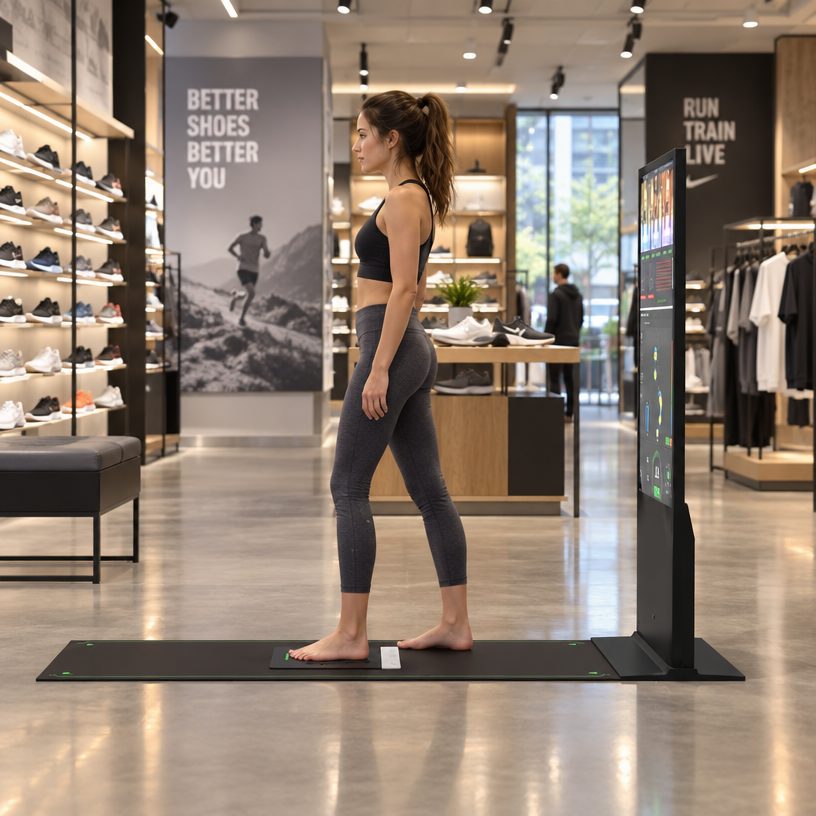
Barefoot, socks and the surfaces feet arrive from
Feet arrive from the street, and everything they walked through comes with them. On a crowded floor the entry is where the room contaminates the capture: wet soles, grit, and a standing surface that was clean at opening and is not at noon. A mat at the door, wipes at the station, and a cloth for the plate or platform between sessions are the minimum kit, and they are kit for the record as much as for hygiene, because grit on a standing surface changes what the foot does on it.
The question of socks is a routine decision, not a moral one, and the only requirement is consistency. Some rooms capture barefoot; some use disposable foot covers for customers who prefer them. Either is workable, and mixing them is not, because the session recorded through a cover is not the same session as the one recorded without. Whatever the room decides goes in the script, on the wall, and in the booking confirmation, so that the customer arrives knowing what will be asked of them.
The surface the customer stands on to remove their shoes deserves a thought too. A bench or chair for the shoe change, with a dry patch of floor beside it, prevents the half-dressed balancing act that produces a customer arriving at the marks already off balance. It also prevents the sock that touches the shop floor and then the customer’s own shoe, which is the small indignity that makes customers decline the session next time.
Betweens sessions, the cleaning is the operator’s job, not the cleaner’s. On a busy floor the gap between customers is a minute, and the wipe happens in it. This is another place where the routine beats the intention: a station that has a wipe within arm’s reach and a bin it belongs in gets cleaned, and a station where the wipes live in the stockroom gets skipped, and the record gets made on whatever the last customer left behind.
Queue pressure and the record it produces
Queue pressure produces a recognisable kind of record, and the operator should be trained to recognise it in themselves before they see it on the page. The stance hold shortens. The second pass of the walk gets skipped because the first one looked fine. The instructions get compressed into a single sentence the customer half hears. Each of these saves seconds, and each of them removes a layer of the routine that the record’s quality was resting on.
The signs of a rushed capture show in the session before they show in the data. The customer hesitates on the marks. The weight is still moving when the capture runs. One foot hangs off the edge of its mark because the marks were never pointed at properly. A record made in those seconds is not a record of a foot; it is a record of a foot in a hurry, and the difference is not annotated anywhere unless the operator writes it down.
The arithmetic that fixes this is simple and worth saying out loud to the team: a redo costs one minute, and a bad record costs a wrong decision. The minute is paid today, in front of a queue that will wait one minute for a competent session. The wrong decision is paid in weeks, by a customer wearing a pair chosen from a record that was never real. Every shop that has lived through one return caused by a rushed capture understands the trade, and every team needs reminding of it during the season when the queues are longest.
There is also a structural answer, which is deciding in advance which hours are capture hours. Some shops take records at all hours and accept the noise; some schedule captures into the quiet ends of the day and use the dense hours for fitting only. Neither is wrong, but the choice should be made deliberately and kept, because the worst configuration is the accidental one, where the routine depends on whether the day happens to be busy.
Placing a walkway in a small or busy space
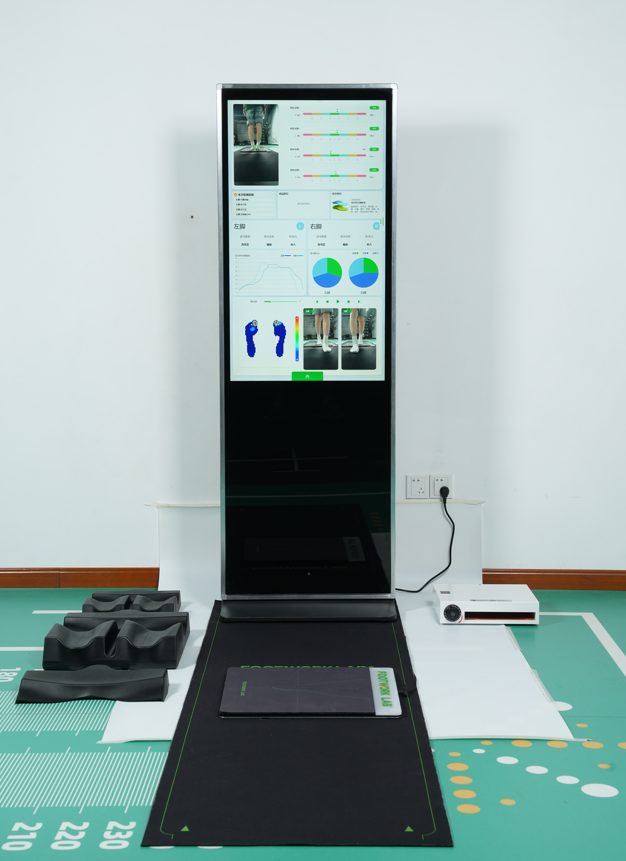
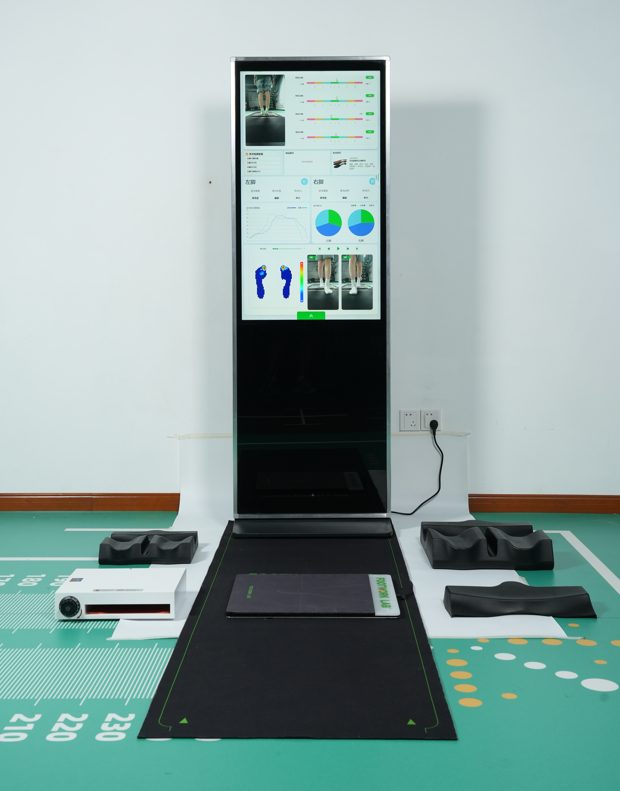
A walkway needs a straight approach, a clear exit, and a stretch of floor where nobody crosses in front of the customer while the walk is happening. In a small shop that is a real demand, and it is met by placement rather than by equipment. The corner of the room usually beats the middle, because a corner gives two walls to approach along and fewer directions for foot traffic to cross. The tape marks on the floor do the rest: where the customer starts, where the device sits, and where the exit lands.
The operator’s sight line matters as much as the customer’s path. The person running the session must be able to see the whole walk, including the steps before the device and the steps after it, because those steps are part of the walk whether or not they are recorded. A station placed behind the counter, where the operator has to lean and squint, produces records of walks nobody watched, and the unwatched step is where the off-balance entry hides.
Foot traffic through the walkway is the quietest destroyer of records. Customers browsing, colleagues carrying boxes, a child running: any of these during the capture adds a reason for the walker’s pace to change. A low barrier, even a rope or a taped line, and a house rule that staff walk around, not through, keep the corridor honest. Staff training on this costs nothing and is the most frequently skipped item on the list, because the rule feels obvious until the busiest afternoon proves it is not.
Space constrained rooms should also fix the device’s position in place for good rather than wheeling it around. Every reposition changes the approach, the lighting and the floor beneath, and a capture station that moves weekly is a routine that resets weekly. Bolt the position down, tape the marks, and let the room learn the station. A walkway that lives in one place produces records that agree with each other, which is the entire point.
Reading noise: how to spot a record worth redoing
Noise in a record has a look, and it is learnable in a week. The standing capture shows weight clearly moving, or one foot partly off the mark, or a value for one side that does not resemble anything the customer’s posture suggested. The walking capture shows a first step that begins before the marks, a pace that changes across the walk, or a walk that visibly avoided something, usually a person standing in the exit lane. None of these require interpretation; they require that someone was watching the session rather than the queue.
Comparing the two sides on one screen does much of the work. A difference between left and right that matches what the operator saw during the session belongs in the record. A difference that nobody saw and the customer cannot account for is a candidate for noise, and the cheap test is a repeat: run the same capture once more, the same way, and see whether the same shape appears. Records that repeat are records; records that do not are photographs of accidents.
Asking the customer is the other half of the reading. One question, after the session and before the redo: did anything about that walk feel unusual to you? Customers answer honestly and often usefully, and the answers sort most ambiguities. The person who says the floor felt slippery has explained the record better than any annotation could. The person who says it felt normal has told the operator the capture is worth keeping.
When in doubt, redo, and redo without apology. The customer loses nothing; the redo takes the same minute the first capture took. Storage is cheaper than a wrong decision in every currency the shop trades in, and the operator who redoes a doubtful capture is doing the job, not doubting the equipment. The sentence “let’s take that once more, the same way” is part of the script, and it should be rehearsed with the rest.
Training the staff so the standard survives the rush
A standard that exists in a training document and not in the operator’s mouth is not a standard. New staff learn the script by running it, under supervision, on people who do not mind a slow session; the staff member’s own feet, a colleague, a willing customer. The supervision matters because the errors that matter, compressed instructions, skipped passes, commentary during the capture, are invisible to the person making them and obvious to the person watching.
Spot checks keep the standard alive after the training. A supervisor watches one session a week without warning, against the written script, and says nothing unless something drifted. This is not surveillance; it is how the routine stays the routine through the season’s attrition of habits. The shops that do it have second records that match their firsts in February; the shops that do not discover in February that their June routine has quietly become six different routines.
Authority should sit with the operator, not the queue. The person running the capture decides whether a record is clean, and no one behind them in the line gets a vote. That decision needs to be explicit in the training, because the social pressure of a visible queue pushes in the other direction by default, and an operator who has not been told they are allowed to redo will not redo. Permission, given in advance, is what the standard is made of.
The last piece is the quiet-hour rule the shop decided on earlier: which hours are capture hours, what happens to captures requested outside them, and who explains the wait. Writing that down finishes the system. A floor that knows its own routine, runs it in the same words, watches its own captures and redoes the doubtful ones produces records that a professional can work from, on a Saturday afternoon, with four people in the queue. That is the test the equipment is actually facing, and the room passes it or fails it, not the machine.
Frequently asked questions
Does a crowded floor really change the record?
Yes, because the capture records what the foot did under the conditions given. A rushed stance, a conversation at the wrong moment or a pace that changed mid-walk all end up inside the values. The report looks the same on the page either way, which is why the conditions are the operator’s job.
What should the operator say during a standing capture?
A fixed script: shoes and socks off, stand on the marks, weight even, look ahead, arms relaxed, hold still for the count. The same words every time, said before the capture rather than during it. Commentary about the values changes the customer’s stance mid-session, so it waits until the capture is finished.
Why redo a doubtful record instead of keeping it with a note?
A note documents a doubt; a redo removes it. The repeat costs the same minute the first capture took, and only a shape that appears twice is a record of the foot rather than a photograph of an accident. Storage is cheaper than a wrong decision in every currency the shop trades in.
How do you place a walkway in a small shop?
Corner placement where possible, a straight taped approach and exit, a fixed position rather than a wheeled one, and a sight line that lets the operator watch the whole walk including the steps before and after. A low barrier or taped line keeps foot traffic from crossing during the capture.
Should captures be taken barefoot?
Either barefoot or through disposable foot covers works; what matters is that the room picks one and keeps it. Mixing the two makes sessions incomparable. Whatever is decided belongs in the script and in the booking confirmation, so the customer arrives knowing what will be asked.
What are the signs of a noisy record?
Weight still moving during the standing capture, a foot partly off its mark, a walk whose pace changes across the pass, a first step that starts before the marks, or a left-right difference nobody saw in the session and the customer cannot account for. The cheap test for any doubt is a redo.
What support terms come with the equipment?
One unit is the minimum order and machines accept ODM. Every unit is tested at the plant for seven days before dispatch, the warranty runs twelve months against non-human damage with free parts, and support runs through a dedicated WhatsApp group with direct engineer access and remote assistance.
What we would do next
Put the script on the wall this week, exactly as the words should be said, and run one supervised session per new operator until the supervision finds nothing to correct. Then fix the capture hours in writing, including what happens to a customer who asks outside them, because a routine that depends on the day’s traffic is not a routine.
The X3 system page describes the walkway unit this routine is written for, and the X3 walkway footprint covers the space question in the equipment’s own terms. Two articles continue the theme: where scanning promises end and measurement begins sets the boundaries of what a record can claim on its own.
This article is intended for professional and educational reference. It is not medical advice. Foot assessment equipment produces measurements and images; clinical interpretation and any decision about care remain the responsibility of a qualified professional. Certification scope is limited to the documentation we hold: European Union certification and ISO quality system certification.