
The build came back from the bench with a thin addition under the heel, and the customer’s first question at the fitting was whether this was going to straighten the foot out. It was not, and saying so plainly is the start of understanding what posting is for. An insole posting wedge is one of the oldest and most ordinary tools in orthotic work: a shaped addition, thicker on one edge than the other, that tilts the surface the foot stands on so that load arrives at the sole from a slightly different direction. It does not move bones, and it does not retrain a foot into a new shape. What it does is more modest and more honest: it changes where the ground pushes, and the foot responds to that change in ways a fitter can observe, adjust and, where the response is poor, take back. This article works through what a wedge under the heel does and what a wedge under the forefoot does, where in the build each one is best made, why more tilt is not more support, how the shoe’s own sole enters the picture, and where the boundary sits between supporting a foot and attempting to rebuild one.
What a wedge actually does: it tilts the ground
Begin with the mechanism, because everything else follows from it. The foot stands on whatever surface is beneath it, and the forces through the sole depend on the angle of that surface. A wedge is a deliberately uneven surface: by making one edge of the standing area thicker than the other, the fitter tips the platform a small amount, and the load that was arriving straight down now arrives along a slightly rotated path. The contact the foot makes spreads differently, the pressure under one side of the sole rises and under the other side eases, and the direction in which the foot is being pushed changes without anything having been done to the foot itself.
That description is deliberately free of numbers, and the omission is a matter of policy rather than caution for its own sake. Fitters speak about wedges in qualitative terms — a gentle tilt, a moderate one, a steep one — because the effect of a wedge is judged in the shoe and on the record, not read off a protractor. Two builds with the same tilt on paper can behave differently in different shoes, on different feet, under different volumes of sock and lacing. The workshop describes what was added and where; the assessment and the fitting decide whether the direction was useful.
The second thing a wedge does is subtler, and it is the reason posting is a support technique rather than a blunt one. A tilt does not only move pressure around; it gives the foot something to lean its own structure against. A sole that is angled gently toward the inside of the foot, for instance, presents a surface the arch side can rest on during standing and walking, and the tissues that hold the arch are asked to do less of the holding alone. That is redistribution, not renovation, and the distinction matters at every later stage of the fitting conversation. What load redistribution structures do, and what they do not takes up the same theme for the build as a whole, and the wedge obeys the same limits as the rest of it.
A wedge under the heel: changing the arrival of load
Posting under the heel addresses the first contact. The heel is where most steps begin, and the direction in which the heel is tilted decides where the step’s load sets off from and how it travels forward through the sole. A wedge that raises one side of the heel tips the arrival of load toward the opposite side, easing the side that has been carrying more and engaging the side that has been carrying less. Fitters reach for it when the record shows a heel contact that sets the whole step off along one edge, and when the complaint that accompanies it is about the feel of that edge — the wearing spot in the shoe, the hardness under one point of the heel.
The heel wedge’s influence extends beyond the heel itself, which is both its value and its risk. Because the rearfoot sets the direction of the whole step, a small tilt at the back is felt at the midfoot and again at the forefoot; a heel posted to ease one side will spread its effect along the entire footfall. This is why heel posting is usually the first wedge tried rather than the last: it works on the step at its origin, where the least material achieves the most, and where the customer feels the change in the ordinary act of walking rather than only in a held stance.
It is also why a heel wedge is chosen carefully rather than generously. The same leverage that lets a small rearfoot tilt travel forward means a steep one travels too far, and the forefoot ends up correcting for a tilt it was never consulted about. The comparison worth keeping in mind is the heel lift, which raises the whole heel evenly and changes something different again: what a small heel rise actually changes covers that cousin technique, and the distinction between lifting the heel and tilting it is one of the first things a fitter should be able to explain at the counter, because customers arrive having heard of one and needing the other.
A wedge under the forefoot: changing the platform the step lands on
Posting under the forefoot addresses the other end of the step, and it works on a different logic. By the time load reaches the front of the sole, the heel’s work is done and the foot is pushing off across the ball, where the toes and the long bones of the midfoot share the job. A wedge under the forefoot tilts that push-off platform, easing the side of the ball that has been overloaded and bringing the other side into the work. Where the record shows the push-off concentrated along one side of the forefoot, and the customer describes the ground as though it slopes under the front of the foot, the forefoot wedge is the tool that answers.
The two postings are not interchangeable, and the record usually makes the choice obvious when the fitter reads it region by region. A heel-heavy record with an orderly forefoot belongs to the first conversation; a heel that lands cleanly with a forefoot that heaps its load on one side belongs to the second. Some builds carry both, and when they do, the interactions have to be walked through rather than assumed, because a rearfoot tilt and a forefoot tilt can agree with each other, oppose each other, or pass each other by, and only the worn record and the fitting session sort those cases out.
Forefoot posting also carries a comfort constraint the heel posting does not, and it comes from the anatomy under the wedge. The ball of the foot is where the metatarsal heads sit close beneath the skin, and material added directly beneath them is felt immediately — as thickness, as a ridge, as a point that was not there before. A forefoot wedge therefore has to be graduated rather than stepped: the thickness fades toward the toe edge so the foot rolls across the addition instead of meeting it. A wedge you can feel as an edge under the ball is a wedge that will be returned, and the fix is in the shaping, not in the customer’s patience.
Built in or added on: where the tilt is made
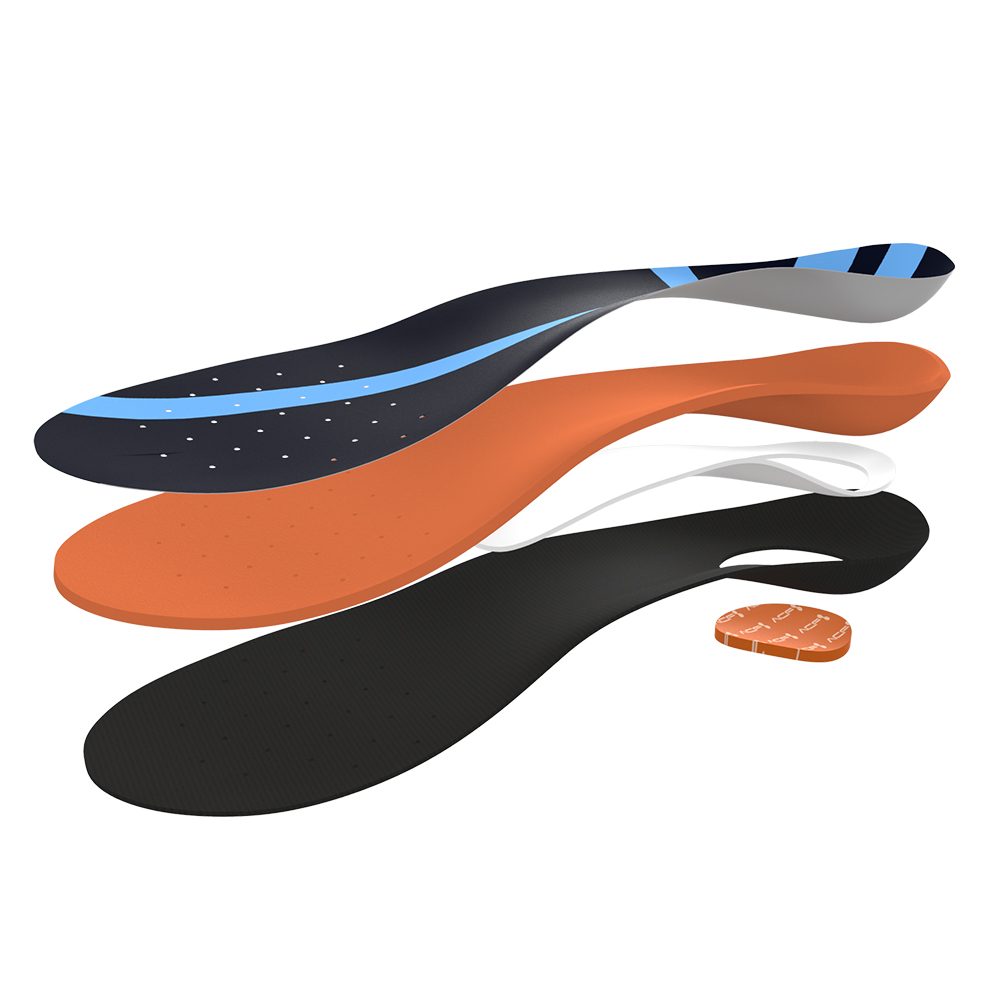
There are two moments at which a wedge can enter a build, and they produce slightly different objects. The first is during formation: the shape is moulded with the tilt already in it, so the wedge is part of the shell itself, continuous with the arch and the heel cup, with no seam and no separate edge. The second is after formation: a finished shell receives a shaped addition, fixed along its underside at the heel or the forefoot. Both are legitimate, and the choice between them is a production and service question as much as a technical one.
A tilt built into the shell is the cleaner object and the harder one to revise. Because the tilt is the shape, nothing about it can be adjusted without reworking the build itself; what the workshop can do is remake the pair with the tilt changed. A tilt added to a finished shell is the more revisable object: the addition can be thinned, reshaped or removed at the bench, and the underlying build returns to its unposted state. The trade-off runs the other way on durability and finish, because an addition has a bond line and an edge where a formed shell has neither, and a bond line is a thing that can eventually be felt or fail where a formed shape simply is.
In practice the rooms we work with tend to make the decision by asking how settled the posting is. A tilt chosen with confidence, against a clear record and an experienced fitter, belongs in the forming. A tilt being tried out — a first direction, a modest amount, a customer whose response is still unknown — belongs as an addition, because the likely outcome of a trial is a revision, and revisions are cheapest where they can be made at the bench. How materials are chosen for a build sets out which additions carry which properties, and the same material logic decides what the addition is made from and how it is fixed.
The cost of too much: what over-posted builds do in the shoe
Every wedge buys its effect with side effects, and the fitter’s craft is keeping the price below the benefit. The first cost of an over-posted build is the new complaint. A tilt generous enough to move load decisively off one side is also a tilt that loads the other side past what it is used to, and the customer returns describing a soreness in a place that was comfortable before the build. That soreness is information, not failure: it says the direction was read correctly and the amount was not, and it is answered by reducing the tilt, not by abandoning it.
The second cost is mechanical. A foot on a tilted surface slides toward the low side until something stops it, and in a shoe the stopping is done by the upper, the toe box or the lacing. An over-posted build turns the shoe into a retention device, and the customer experiences it as the foot pressing sideways into the counter, or the toes finding the side of the box, or the lacing needing to be pulled tighter than the foot actually requires. When that description arrives, the honest reading is that the tilt exceeds what the shoe can hold, and the choice is between reducing the tilt and changing the shoe — the build should not be asked to recruit a shoe it does not fit.
The third cost is quieter and arrives as wear. A tilted foot wears the shoe’s insock and lining unevenly, and an over-posted one wears them quickly, along the edge the tilt created. Some of that uneven wear is the wedge doing its intended work; wear is how load declares itself. The judgement call is speed and concentration: wear that spreads across a season and follows the posted direction is the build functioning, wear that chews one line in weeks is the build over-fighting the foot. Either way, the shoe is the evidence, and the fitter who asks to see the worn pairs at review is reading the build’s own report card.
The shoe’s own sole, and what wear on it means
The wedge works inside the shoe, and the shoe works on the ground, so the outsole belongs to the same conversation. Every shoe arrives with its own tilt already in it: outsoles wear unevenly with use, midsoles compress unevenly with age, and a shoe whose outer edge has worn down presents the foot a mild version of the slope the fitter has just spent the session deciding about. A build posted on a clean bench and then fitted into an old, unevenly worn shoe is a build fitted into a moving target, which is one of the quieter reasons a pair that felt right at the fitting feels different a month later.
The practical habits follow. Look at the outsole wear at the fitting, in the same glance that checks the fit, because the wear pattern says how the shoe has been loading its owner and how the ground has been answering. Ask, at review, which shoes the pair has been living in, and look at those shoes again, because the combination of build and shoe is the thing the customer actually walks on. And when a customer arrives with shoes worn through at one edge, resist the temptation to read the wear as a diagnosis of the foot; wear records the shoe’s history as much as the wearer’s, and reading it that far is as far as it goes. The record from the assessment, taken the same way each time, remains the description the build answers to.
There is a limit to how much the insole can compensate for the shoe, and it is worth stating at the counter because customers arrive hoping the opposite. A shoe whose sole has collapsed or worn badly asks the build to fight the ground on every step, and the build will lose, because it works through the shoe rather than instead of it. The honest advice in that case is about the shoe, not the build: replace the shoe or re-surface it, and then fit the build into something level. Choosing builds by load rather than by name carries the same spirit into the wider fitting decision: start from what the step is actually doing, and let the equipment answer that rather than the label on the box.
Support, not correction: what the wedge is not for
The last section is the boundary, and it should be stated in the same words at the fitting as at the bench. A posting wedge supports. It tilts the surface so that load travels along a more settled path, it gives structures on one side of the sole something to rest against, and it changes what the foot feels during standing and walking. It does not straighten a foot, does not change the shape the foot will have next year, and does not treat anything. Customers who arrive having been told that wedges retrain the foot should hear the plainer version: the wedge changes the ground, and the foot responds while it is on it. That is the whole mechanism, and it is enough.
Framing the work as support also sets the expectations that keep a pair in service. A support build is judged on what the customer feels while wearing it: the spread of pressure, the absence of the old wearing edge, the comfort of the step across a working day. It is not judged on before-and-after photographs of the foot, and a fitter who lets a customer believe otherwise has bought a complaint that no adjustment can settle. The assessment record supports the framing too: it shows where load was travelling, and the comparison after a period of wear shows whether the posting changed the travel, which is the claim a wedge can actually be held to.
The referral habit closes the article where the discipline always closes. The equipment produces measurements and images; choosing whether a wedge belongs in a build, and reading what a customer reports while wearing one, is fitting judgement — and anything the record or the comfort report raises beyond the fitting conversation belongs with a qualified professional. A wedge that has been sized honestly, shaped to fade under the forefoot, tried as an addition before it is committed into the shell, and reviewed against the shoes it lives in, is a modest tool doing a modest job well. That is the standard it should be sold on, and the standard it will meet.
Frequently asked questions
What does a wedge under the heel actually change?
It tilts the surface at the point where the step begins, so load arrives along a slightly rotated path and spreads differently through the rearfoot and beyond. Because the rearfoot sets the direction of the whole step, even a gentle heel tilt is felt at the midfoot and forefoot.
How is a forefoot wedge different from a heel wedge?
A heel wedge works on the arrival of load; a forefoot wedge works on the platform the step pushes off from, across the ball of the foot. The record shows which region the tilt belongs under, and some builds carry both, with the interactions checked at fitting.
Should the tilt be moulded into the shell or added afterwards?
A tilt built into the shell is cleaner and harder to revise; an addition is revisable at the bench but carries a bond line and an edge. Confident posting goes into the forming, and a tilt being tried out usually starts as an addition.
What happens if a build is posted too steeply?
Three costs appear: a new soreness on the side now carrying more, the foot sliding toward the low side until the shoe has to hold it, and fast, concentrated wear along one line. Each is answered by reducing the tilt rather than abandoning the direction.
Does the shoe’s own sole wear affect the posting?
It does. Outsoles and midsoles wear unevenly, so an old shoe presents its own slope to every step. Look at the outsole at fitting and at review, and fit the build into a level shoe; a collapsed sole is a shoe problem the build cannot compensate for.
Will posting straighten or change the shape of the foot?
No. A wedge tilts the surface the foot stands on and redistributes load while the foot is on it. It does not move structures or change the foot’s shape over time, and it should be presented as support rather than correction from the first conversation.
How soon after fitting should a posted build be reviewed?
Within the first weeks of ordinary wear, while the response to the tilt is still fresh, and again against the shoes the pair has been living in. The review reads what the customer reports and how the shoes have worn, and adjusts the tilt where either disagrees with the plan.
What we would do next
Take the last five posted builds out of the file and check how each tilt was made — formed or added — against how settled the decision was at the time, and note where the workshop had to rework a formed tilt that should have started as an addition. Then add one line to the fitting script: the wedge supports, it does not straighten, and say it before the customer asks. The insole categories page sets out the build types an order can draw on, and the FAQ page carries the fitting answers we give most often by message.
This article is intended for professional and educational reference. It is not medical advice. Foot assessment equipment produces measurements and images; clinical interpretation and any decision about care remain the responsibility of a qualified professional. Certification scope is limited to the documentation we hold: European Union certification and ISO quality system certification.