
The invitation went out on a Tuesday: “Free foot screening at the club this Saturday, no booking needed.” By ten o’clock there is a queue along the wall, a folding table, one device on it, and a volunteer handing out paper forms. This is the format most clubs ask us about when they call, and it is also the format most likely to be misunderstood — by the organiser who expects a clinic, and by the visitor who expects a verdict. A quick screen is neither. It is a short, structured look at how a foot stands and carries load, done in minutes, written down in plain words, and honest about its own limits. Done well, it does three things at once: it shows every visitor something true about their own feet, it sorts the queue into who might benefit from a fuller assessment and who needs nothing at all, and it leaves the club with a follow-up list instead of a pile of confusion. Done badly, it becomes five minutes of guesses delivered with too much confidence, and every one of those guesses follows the visitor home. This article is the version we give to clubs and distributors who run screening days on our equipment: what the screen captures, what it deliberately does not do, how the queue actually flows, what gets written on the sheet, and how the day’s real product — the follow-up list — gets sorted once the table is folded away.
Why a club books a screening day in the first place
A screening day is almost never booked because someone at the club noticed a medical problem. It gets booked because a membership team wants a Saturday attraction that feels useful, because a coach keeps hearing the same complaints in the changing room and wants members to take them somewhere serious, or because a sponsor wants something visible at an open day. All three are legitimate reasons, and all three need the same conversation before the date is fixed. The call we ask organisers to have is short: the screen gives every visitor a look at their own feet and a written note; it does not give anyone a diagnosis, and nobody leaves with a condition named. Organisers sometimes push back — surely the device can tell people what is wrong? It cannot, and saying so early is what protects the day. The announcement matters too. We ask clubs to describe the event as a foot check, not a foot test: a check is something you look at, a test is something you pass or fail. The wording sounds fussy until the queue forms. Visitors who arrive expecting a test brace themselves; visitors who arrive expecting a check take their shoes off willingly. Our article on running an open day with a queue at five minutes a visitor walks through the planning side in detail. The rule underneath all of it is the same one that governs every capture room: what the room expects decides how the room behaves. A club that books the day for the right reason, with the announcement phrased honestly, has already done half the work before the first visitor takes a seat.
What the quick screen captures in five minutes
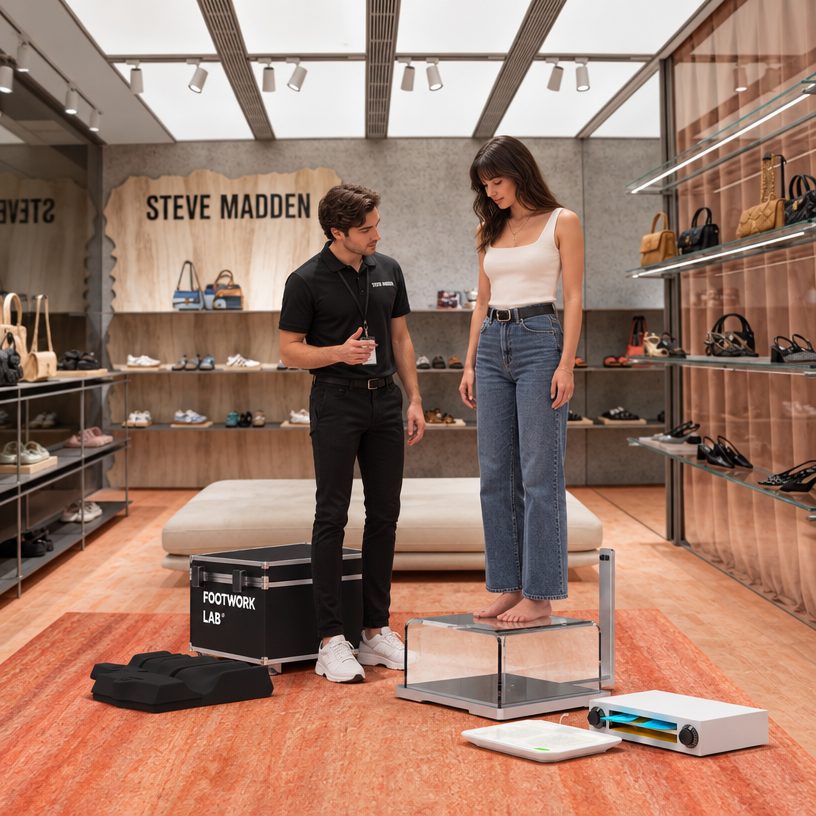
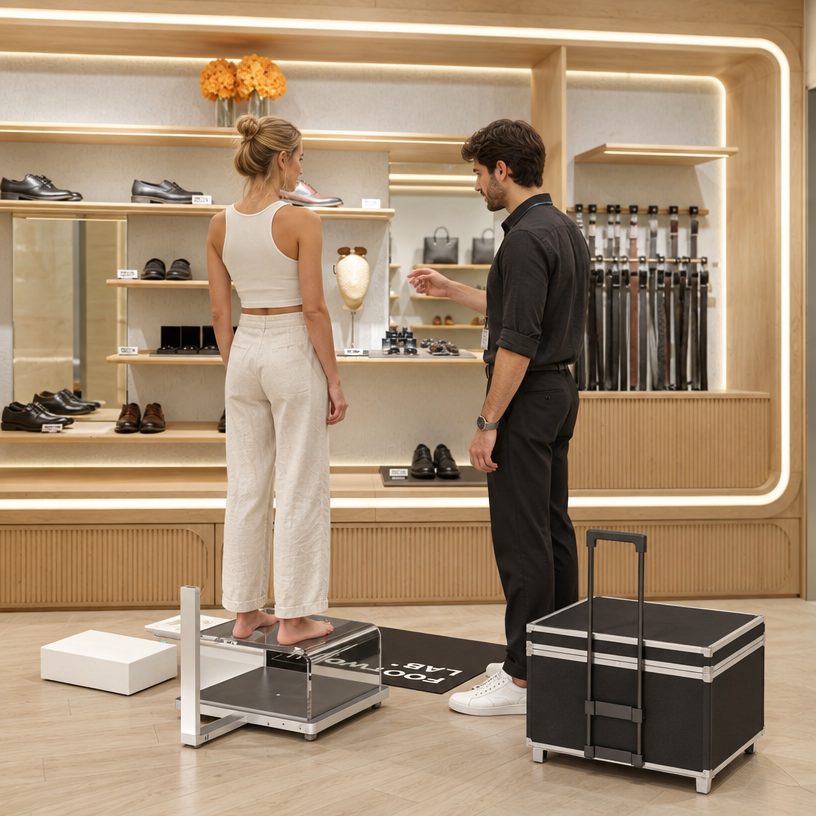
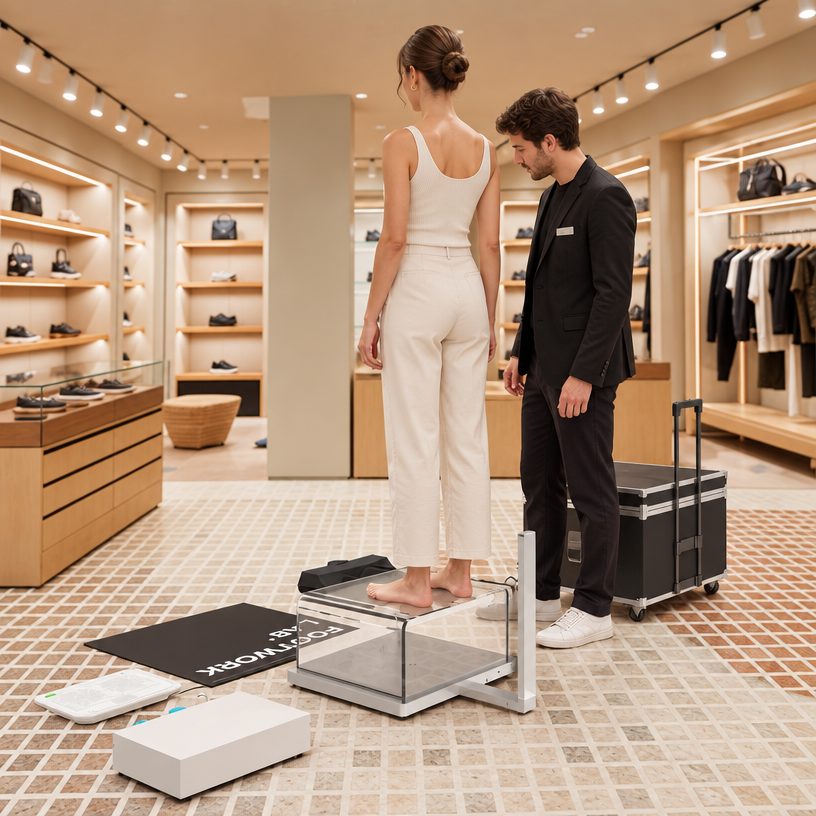
The capture itself stays deliberately simple, because a queue is waiting. The visitor sits on a chair brought to a sensible height, shoes and socks come off, the operator wipes the viewing surface, and the visitor places one foot on the podoscope platform, where the device captures the plantar view: the shape of the contact, the arch presentation, the toes, the heel. Most of the reading happens in the first ten seconds of looking, and most of it is comparison — this foot against its own partner, this contact pattern against the plain textbook shapes every operator learns first. The operator will usually take a second look rather than a first opinion: weight shifted slightly, or the foot lifted and replaced, because a single placement can flatter or exaggerate almost anything. Conditions get as much attention as the foot itself. A visitor who came in from the cold with thick socks just removed presents a colder, tenser foot than the one she has at home, and our article on what a warm footprint board adds covers how temperature quietly changes what a surface shows. A visitor who curls her toes on an unfamiliar surface gets the same gentle rewording any assessment room uses, and the second capture usually reads calmer. None of this turns a screen into an assessment; it turns a rushed snapshot into a fair one. The operator’s working question throughout stays narrow and honest: does this foot look like something the visitor should have looked at properly, yes or no? Everything the five minutes produces serves that one question, and the moment the operator finds himself answering bigger questions than that one, the screen has quietly become something the format never promised.
What a quick screen is not
The limits are the part most worth writing down, because they are the part that gets blurred first in a busy room. A quick screen takes no history: nobody asks about the visitor’s workday, old injuries, or what brought the complaint on, and without history there is nothing to interpret — only something to observe. It captures one moment in one position, and feet are not the same at ten in the morning after a night’s rest as they are at four in the afternoon after a shift on concrete. It involves no diagnosis: the equipment records what the foot presented under the conditions of that capture, and turning that record into a statement about anyone’s health is work for a qualified professional with the full picture in front of them. The sentence we coach staff to use at the table says all of this in one breath: this is a look at how your foot stood today, written down in plain words; if anything here seems worth a second look, the next step is a proper assessment with someone qualified. Visitors accept that sentence far more readily than organisers expect. What they resist is the opposite — an operator who stares at a screen and starts explaining their arch to them in the voice of a clinician. The moment that happens, a five-minute look has quietly become a five-minute claim, and the club owns whatever was claimed. Screening days protect themselves by staying small: small in scope, small in promises, and scrupulous about the boundary between a measurement and a meaning. Every experienced operator we have met keeps that boundary in the front of the script, not the back.
How five minutes actually gets spent
Five minutes is enough, but only if the minutes are spent on purpose. The rhythm that works in real rooms runs like this: greet the visitor by name from the form, take the chair, shoes and socks off while the operator wipes the surface, foot on, capture, foot swapped, capture, then one shared look at the screen — the visitor’s eyes and the operator’s together — and one line of plain description spoken aloud. The spoken line matters more than the capture. Operators who narrate what the visitor can see for herself (“see how this side of your foot carries more than the other”) finish the visit with the visitor’s trust; operators who look silently and write secretly finish with the visitor’s suspicion, and suspicion follows people home. The queue outside needs its own person if the day is busy: someone who fills in the top half of the forms, keeps the line moving, and separates the curious onlookers from the visitors actually waiting. Without that second pair of hands, the operator drifts into crowd control and the captures drift with them. Consistency between whoever runs the table is worth an hour of rehearsal before the doors open — our article on two operators and one protocol covers how rooms keep captures comparable when staff rotate, and the same discipline applies to a volunteer who has never done this before the event. Rehearse the spoken lines too, out loud, twice. The difference between a screening day that feels professional and one that feels like a stall is mostly rehearsal, and it shows within the first ten visitors.
The sheet the visitor carries away
The paper sheet is the product the visitor physically takes home, and it deserves more design thought than it usually gets. The top half is filled in while the visitor waits: name, date, club, and nothing else that smells like a medical record. The bottom half gets written during the visit, in words the visitor can read without a dictionary. Our rule for the description line: write what was seen, not what it means. Contact carried more through the inside edge of the left foot; arch presentation differed visibly between feet; toes gripped on the first capture and settled on the second. Sentences like these survive being read later, and being read by someone else, which is exactly what happens when a visitor brings the sheet to a professional afterwards. The recommendation line then picks one of three honest outcomes: nothing here needs a second look; worth a fuller assessment with a qualified professional; or worth another look in a few months, because feet change and so do the conditions of a single Saturday. Anything more elaborate than that — severity grades, diagrams with arrows, a printed verdict — pushes the sheet from a description toward a claim, and the whole screening format depends on staying on the description side of that line. Clubs that keep sheets simple get fewer arguments and more follow-up calls, because a plain sentence invites the next step while a dramatic one invites either alarm or disbelief, and neither of those brings anyone back through the door.
The questions visitors ask at the table
Every screening day produces the same handful of questions, and the answers decide whether the day ends trusted. “Is my arch collapsing?” is the most common, usually asked while staring at a contact pattern the visitor has never seen before. The honest answer: the screen shows how your foot stood today; arches look different between people and between hours of the same day, and whether anything about yours needs attention is a question for a proper assessment. “Do I need insoles?” comes next, and the answer is that nothing at this table can answer it — a screen is a look, and insoles follow from an assessment and a build process, not from a photograph taken standing still. “Why is my left different from my right?” gets the most interesting honest answer of all: most people’s feet differ from each other, the comparison is worth seeing, and it is exactly the kind of thing a fuller assessment explores properly. “My friend’s looks worse than mine — is she fine?” teaches the most useful lesson of the day, because it lets the operator say out loud that nobody at this table can call anyone fine or not fine from one capture. The operational questions that repeat across events — what visitors should wear, how children are handled, what happens to the sheets — belong on the club’s preparation list rather than in anyone’s improvisation, and we keep the general versions of them on our FAQ page so organisers can hand the link around before the day instead of inventing answers at the table.
After the day: sorting the follow-up
The queue goes home, the table folds, and the day’s real work starts on a sofa with the stack of sheets. Sorting them takes one pass and three piles. The first pile is nothing to note: plain descriptions, recommendation line ticked accordingly, sheets kept by the club in case a member asks about hers later. The second pile is worth a fuller look, and it is the pile the whole day existed for — a short list of members, each with a one-line reason written on the sheet saying what made the operator pause. The club contacts these members privately during the following week, with the same calm wording the sheet used; the follow-up call is an invitation to an assessment, not a warning. The third pile is the re-screen list: visitors whose captures looked unremarkable but whose conditions were poor — cold feet, rushed placement, a queue that would not wait — and who deserve a fair second look before anyone concludes anything at all. What goes back to the club is aggregate and anonymous: how many visitors, how many follow-ups recommended, nothing that could identify anyone, because a screening day must never turn into a mailing list. Handled this way, the day keeps its promises. Members who were told it was a look, not a verdict, got exactly that; the handful who needed a real assessment got pointed to one without drama; and the club learned something about its own membership that no single capture, however good, could have said alone.
Frequently asked questions
How many visitors can one screening table handle in a day?
With one trained operator and one table, the pace settles at roughly five minutes a visitor, and the day’s capacity depends on how long the club keeps the doors open. A second person managing forms and the queue protects the pace better than a second device does. Clubs that plan proper breaks for the operator keep quality steady through to the last visitor of the afternoon.
Is a quick screen a diagnosis?
No. A screen captures how a foot presented under the conditions of a single visit, without history and without interpretation. Naming a condition, explaining a cause or advising on care belongs to a qualified professional working from a full assessment. The screening sheet records plain descriptions, and that boundary is exactly what keeps the format honest.
What should visitors wear on the day?
Shoes and socks that come off and go back on quickly. Tight socks that leave deep marks, and boots that take minutes to unlaced, cost queue time and change the foot’s presentation afterwards. Visitors arriving in from cold weather should be given a few minutes indoors before their capture, because cold feet present differently from settled ones.
Can children take part in a screening day?
Yes, with a parent present for the whole visit. A child’s foot is still changing, so the operator keeps descriptions simple and leans toward the re-screen option on the sheet rather than the follow-up recommendation. A capture repeated later under the same conditions is often more useful than any single record taken on one busy afternoon.
Do we need a nurse or a physiotherapist at the table?
The capture and the plain-language description do not require a clinical qualification, which is why clubs can run these days with trained staff. What a professional adds is interpretation, and the format deliberately leaves interpretation out. Some clubs invite a local professional anyway, so members who want a follow-up conversation can book it on the spot.
What happens to the sheets after the event?
The club keeps them. Follow-up recommendations go to members privately through the club, and the summary returned to the organiser is aggregate and anonymous — visitor numbers and follow-up counts, nothing that identifies anyone. A screening day must not become a mailing list, and visitors should be told before they sit down what happens to their sheet.
What if a capture looks concerning at the table?
The operator describes what was seen in plain words, ticks the fuller-assessment option on the sheet, and does not name or explain anything. Alarm at the table is the fastest way to break the day’s trust. The follow-up system exists precisely so that a pause-worthy capture leads to a proper assessment instead of a hallway diagnosis.
What we would do next
Clubs planning a first screening day should rehearse it once with staff before the announcement goes out, and keep the wording a check, not a test. If the equipment side is the open question, the Q1P foot and leg quick-screening system page shows what a podoscope-based setup looks like in a room, and our team can talk through queue, staffing and sheet design before the date is fixed. Our article on the page the customer takes home goes deeper on what belongs in a printed summary, and the same principles shape the screening sheet. For anything this article has not covered, the FAQ page collects the operational answers we give most often by message, and the questions it does not answer reach us through the usual channels.
This article is intended for professional and educational reference. It is not medical advice. Foot assessment equipment produces measurements and images; clinical interpretation and any decision about care remain the responsibility of a qualified professional. Certification scope is limited to the documentation we hold: European Union certification and ISO quality system certification.