
The referral letter runs to four pages, and the specialist reads the first three lines. Every room that sends patients onward has watched this happen. The report was accurate, the images were carefully chosen, the notes were thorough — and the colleague on the receiving end skimmed the headings between appointments, absorbed a vague impression, and phoned back a week later to ask the one question the whole document was supposed to answer. Nobody failed on purpose. The sender optimised for completeness, the reader needed orientation, and the gap between the two swallowed the referral. This article looks at what a one-page summary can carry and what it cannot, why the first three lines decide whether the rest gets read, which four things belong on that page in what order, what to push into attachments instead, and how to make the page a habit of the room rather than a personal talent of whoever happens to write it.
It is worth saying at the start what the page is for. A summary that travels with a referral is not the record itself; it is the invitation to read the record. The specialist will form a working impression from the page, decide how urgent the case is, and open the attachments if the page gives them a reason to. Everything on the page either sharpens that decision or delays it. Rooms that accept this framing stop arguing about how much to include and start asking a sharper question: if the specialist only ever read one page of this referral, which page would we want it to be?
The stack on the specialist’s desk
Picture the morning of the person who receives your referrals. Twenty-two patients are booked, three of them arrived overnight through the emergency route, and the referral folder holds everything that came in since last week. Between patients, in corridors and at the end of clinic, the folder gets worked through — not read, worked through. Each document gets a few seconds of triage: who sent it, what is being asked, does this need action this week. The professional is not careless. They are rationing attention across a caseload, exactly the way you ration chair time across a morning of bookings. A referral that opens with two paragraphs of practice background before it reaches the patient is competing against eighteen other documents for the same minutes.
What happens to the long report in that pile is predictable, and rooms that have asked their receiving colleagues will recognise it. The headings get scanned. The last paragraph — usually the request — gets read, if there is time. Everything between becomes a blur that the specialist will later describe, honestly, as “I saw the letter, I did not catch the detail”. The detail existed. It was simply placed where a working day would never reach it. Meanwhile the summary that was one page, opened with the patient’s own words, and closed with a specific question, got read twice: once in triage and once before the consultation.
The uncomfortable part for the sending room is that this outcome was decided at the desk, not at the platform. The capture may have been excellent, the record thorough, the images clean — and the referral still failed, because it was written for a reader with unlimited patience. Nobody has unlimited patience. Designing for the reader who has forty seconds is not dumbing down; it is respecting how professional attention actually works, and it is a skill any room can build.
Why length works against the referral
Long documents carry a hidden cost that has nothing to do with reading time. Length signals effort, and effort without an obvious entry point signals work — work the reader will have to do to find the question buried inside. A specialist triaging twenty documents makes a quiet judgement in the first seconds: is this referral going to tell me what it wants, or will I have to excavate? The excavation is exactly what a full clinic day cannot absorb, so the document that demands it gets deferred, and deferral in a busy practice often becomes disappearance. The patient waits, the sender wonders why nothing came back, and the record sits in a folder that was opened once.
Length also scatters responsibility. When a four-page report contains the complaint, the conditions, the images and the request all at once, the reader has to assemble the story themselves — and different readers assemble different stories. The orthopaedic surgeon extracts one thing, the physiotherapist another, and neither extracts what the sender most wanted them to see. A one-page summary does the assembling in advance. It says: here is the complaint as the patient gives it, here is what the capture recorded and under what conditions, here is the specific question we are asking you. The reader arrives oriented instead of lost, and orientation is the single biggest determinant of whether a document gets a second minute.
There is a defensive instinct that pushes rooms toward length, and it deserves naming. “If I write everything, I cannot be blamed for omitting anything.” The instinct is understandable, especially early on, but the protection it offers is illusory. Omissions buried on page three are not read any more than they are forgiven; they are simply not discovered until they matter, at which point the length of the report helps nobody. The honest version of the same protection is a one-page summary that states plainly what was captured, under what conditions, and what remains open — plus attachments that hold the full record for whoever wants it.
The four things the page must carry
Stripped to what a receiving professional actually needs, the page holds four things, in this order. First: the complaint in the patient’s own words, with the conditions the patient attached to it. Quoted, not paraphrased, because a paraphrase smooths away the details that later make sense of everything else. “It goes numb on the outside of the right foot after about twenty minutes of walking at work, in the safety boots” carries surface, footwear, duration and timing; “right foot discomfort on walking” carries almost nothing. Our article on turning the customer’s own words into a build spec makes the same argument for build sheets, and it applies word for word to referral pages.
Second: the conditions of every capture the record contains. Standing or walking, barefoot or through which footwear, what pace, what surface, what time relative to the patient’s working day, and which passes were abandoned and why. This is the line most summaries leave out and most specialists most need, because it tells them what the record can and cannot speak about. A capture taken at midday after a morning on the ward describes a different foot than one taken fresh at opening time, and the receiving professional cannot know which one they are holding unless the page says so.
Third: what the record shows, stated at the level of measurement and nothing further — load distribution across named regions, the path of the centre of pressure through stance, asymmetries between sides, each tied to the conditions above. Fourth: the question. Not “for your opinion”, which delegates the whole task back to the reader, but the specific thing the room wants: whether the pattern warrants an examination, what the colleague would check first, whether a particular pathway is appropriate. A page that carries all four gets answered. A page missing the fourth gets filed.

What stays off the page
Knowing what to exclude is harder than knowing what to include, because everything on the record feels important to the room that produced it. The rule of thumb: anything the reader would only need after deciding to engage belongs in the attachments. Region-by-region tables, full-page screenshots, the software’s numeric readouts, session logs — all of it is genuinely valuable, and none of it helps triage. On the page they function as padding, and padding has a real cost: it pushes the question further from the first three lines, and the question is the part that must survive a skim.
Two things deserve special caution. The first is interpretation. The page should state what the measurements show and stop there. Whether the pattern indicates a condition, what the history means, what should be done — those are conclusions, and conclusions belong to the qualified professional who will examine the patient with the full record in hand. A summary that preemptively concludes strips the receiving specialist of exactly the judgement they were asked to provide, and it also exposes the sending room to defending an interpretation it was never positioned to make. The second is advocacy for one’s own process. Three sentences about the assessment protocol, the equipment and the room’s methodology are courteous; half a page is advertising, and receiving professionals read it as such. They referred to the room because of what the room sends, not because of what the room owns.
What about the images? A single representative capture, small, labelled with its conditions, earns its place — it gives the reader something concrete to anchor the measurement sentences to. A gallery does not. If the specialist wants more images, the attachments hold them, and the page has done its job by making the specialist want them.
How the capture earns its paragraph
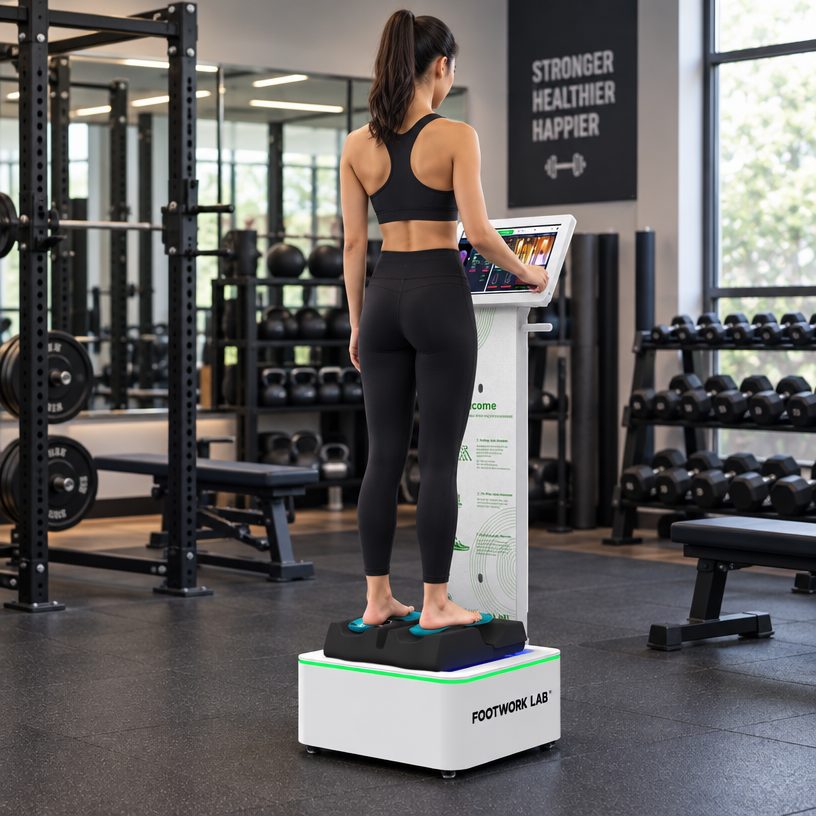
The measurement sentences on the page are only as good as the record behind them, and the record is only as good as the conditions written around it. This is where the platform work and the paperwork meet. A pressure and posture assessment system such as the X5 produces the raw material the page will summarise: static and dynamic captures, load distribution across regions, the path of the centre of pressure through stance, and alignment views that pair what the foot did with how the leg sat above it. What the equipment produces is measurement and images under stated conditions. What those mean for the patient in front of you is a matter for a qualified professional reading the whole record — and the one-page summary is strongest when it holds exactly that line.
In practice, the capture paragraph writes itself if the session sheet was kept properly. Four lines on the sheet — conditions of each pass, what was changed between passes, what was checked when something looked off, what remains open — convert directly into the second item on the page. Rooms that skip the sheet find themselves trying to reconstruct conditions from memory days later, and memory reconstructs confidently and wrongly. Our article on the standing record and the walking record covers how differently the two describe the same foot, which is precisely the kind of condition the page must declare rather than let the reader guess.
One habit strengthens this paragraph more than any other: capture a second pass deliberately aimed at the complaint, when the room can reproduce its conditions. A record holding a natural-pace pass plus one aimed pass gives the page something worth summarising — two named conditions and what changed between them. A record holding one casual pass gives the page almost nothing to declare, and the summary inherits the thinness no matter how well it is written.

Making the page repeatable
A one-page summary produced by talent is fragile; produced by template, it survives holidays, staff turnover and busy weeks. The template is not four elegant sentences — it is four labelled boxes that force the writer to answer the right questions in the right order. Box one: complaint, quoted, with conditions. Box two: captures taken, with conditions of each, including abandoned passes. Box three: what the record shows, measurement only. Box four: the question, phrased so a colleague could answer it in a sentence. Rooms that adopt the boxes report the same two effects: the page takes less time to write than the old report did, because the writer stops deciding what to include and starts filling fixed slots; and the quality of box four improves across the whole team, because a labelled slot makes a vague question visibly vague.
Two disciplines keep the template honest over months. The first is writing box four first. Drafting the question before touching the record forces the room to decide what the referral is actually for, and everything else on the page gets selected for its relevance to that question rather than for its general interest. The second is a monthly read-back: pick one sent referral, ask the receiving side what they used from it and what they went looking for elsewhere, and adjust the boxes once. The template is a hypothesis about what readers need; the read-back is the experiment that keeps it calibrated. Our article on keeping a platform’s data tidy makes the wider point that records are written for future readers, and a referral page is the most-read future reader a room ever has.
What the template must never become is a straitjacket on the record itself. The boxes summarise; the attachments carry; and when a case genuinely needs a different shape — a trauma referral, a second opinion after a long history — the room should feel free to break the template and note why. A template that staff are afraid to deviate from produces pages that fit the template and not the case, and receiving professionals notice within weeks.
When one page is not enough
Some referrals will not compress, and pretending otherwise produces pages that lie by omission. A patient with a long, multi-practitioner history cannot be summarised to four boxes without losing the thread the specialist needs. A case with conflicting captures — where a second pass was aimed at the complaint and changed the picture — needs more room to explain what was done and why. In these cases the honest structure is a cover page plus a structured attachment: the one page still opens with the quoted complaint and closes with the question, but boxes two and three become pointers — “captures and conditions: see sheet A”, “record summary: see page two” — and the attachment holds the substance in the same order the boxes promise. The reader still gets orientation in the first three lines; the depth is one deliberate click away instead of scattered through prose.
The test of whether a long case was structured well is whether the specialist can reconstruct the story from the page alone and verify it from the attachments without phoning. Every phone call a receiving professional makes to clarify a referral costs the relationship a little, not because colleagues mind helping, but because the call was preventable and both sides know it. Rooms that audit their sent referrals for preventable calls usually find the same three causes: conditions of capture missing, the question vague, and measurements presented without their conditions. All three are one-page problems, all three are fixed on the template, and none of them require shorter cases — only a clearer front door.
The last word belongs to the patient’s file, not the page. Whatever shape the summary takes, the full record — every pass, every condition, every abandoned attempt — stays intact in the room’s own system. The page is a letter about the record, never a replacement for it, and the day a specialist asks to see everything is the day the attachments prove the room’s discipline.
Frequently asked questions
How long should a referral summary be?
One page, four labelled sections: the complaint quoted in the patient’s own words with conditions, the captures taken with the conditions of each, what the record shows at the level of measurement, and the specific question. Anything the reader needs only after deciding to engage belongs in attachments, not on the page.
Should the pressure map images go on the summary page?
One representative capture, small and labelled with its conditions, can earn its place by giving the reader something concrete to anchor the measurement sentences. A gallery does not. The full image set lives in the attachments, and the page’s job is to make the specialist want to open them.
Who decides what goes in the question section?
The sending room does, before writing anything else. Drafting the question first forces the room to decide what the referral is for, and every other line on the page gets selected for relevance to it. A vague question produces a vague reply, and “for your opinion” delegates the whole task back to the reader.
What if the capture conditions were not ideal?
Write the conditions as they were. A record that states it was taken at midday after a morning of work, in footwear, is a record a professional can use; a record that hides its conditions forces the reader to guess. If the room can reproduce the complaint’s conditions, take a second aimed pass and declare both.
Should the summary include my own interpretation of the measurements?
No. State what the measurements show — load distribution, the path of the centre of pressure, asymmetries — and stop. Interpretation belongs to the qualified professional who examines the patient with the full record. A summary that concludes in advance strips the receiving specialist of the judgement they were asked to give.
How do I keep the page consistent when different staff write it?
Use a fixed template with the four labelled boxes, write the question box first, and run a monthly read-back with the receiving side: what did they use, what did they hunt for elsewhere. Consistency comes from the boxes and the read-back, not from any individual writer’s talent.
What if the case is too complex to fit one page?
Use a cover page plus structured attachments. The page still opens with the quoted complaint and closes with the question; boxes two and three become pointers to numbered attachments that hold the substance in the same order the boxes promise. The full record stays intact in the room’s own system either way.
What we would do next
Take the next referral the room sends and rebuild it against the four boxes: complaint quoted with conditions, captures with their conditions, measurements without interpretation, and a question a colleague could answer in a sentence. Then keep the page next to the old report for a month and watch which one gets responses. The FAQ page collects the operational answers we give most often by message, including the session-sheet lines that feed box two directly.
The question we would put to rooms that already summarise this way: when a specialist phones back asking for something the page did not carry, what was it — and do you add it to the page, or decide it belonged in the attachments all along? The answer tells you whether your template is drifting toward completeness again, which is the direction every summary drifts until someone pulls it back.
This article is intended for professional and educational reference. It is not medical advice. Foot assessment equipment produces measurements and images; clinical interpretation and any decision about care remain the responsibility of a qualified professional. Certification scope is limited to the documentation we hold: European Union certification and ISO quality system certification.