
Silicone is the material buyers associate with softness, and that association hides the fact that silicone in an insole is almost always a component rather than a product. It appears as heel pads, metatarsal domes, forefoot inserts and grip zones, bonded into a build whose structure comes from something else. Understanding that distinction is what separates a specification from a shopping decision.
In sports insoles the question becomes sharper, because the loads are higher and the tolerance for a material that migrates or compresses is lower. A silicone pad that feels excellent in a fitting room can become a pressure point after a month of training if it is bonded badly or sized against the wrong region.
FOOTWORK LAB produces custom orthotic insoles in our own plant in Ruichang, Jiangxi Province, including builds with silicone components, alongside the assessment equipment that supplies the data behind them. This article covers where silicone earns its place in a sport build, how to specify it, and what to check before a production order turns into a batch of returns.
Silicone as a component, not a category
Silicone is an elastomer. It is chemically stable, it tolerates temperature, it does not support microbial growth readily, and it returns to shape after deformation better than most foams. Those properties make it a good candidate for parts of an insole that need to be soft, durable and predictable.
What it is not good at is carrying structural load. A silicone layer thick enough to hold an arch would be heavy, expensive and vague under the foot. So in practice silicone appears where the brief calls for local cushioning, grip or a soft interface, and the shell underneath does the structural work.
That division of labour is worth stating plainly at the counter, because customers arrive with the opposite assumption. They have felt a silicone pad in a shop, liked it, and concluded that more silicone means more support. The product that follows from that assumption is usually heavy and structurally useless.
Where silicone pads work in a sport build
Heel pads are the most common application. The calcaneus takes a concentrated load at heel strike, and a silicone pad spreads it across a wider area while damping the impact. The pad is small, its job is defined, and its contribution is easy to explain.
Forefoot pads follow a similar logic under the metatarsal heads, particularly in sports with repeated loading of the ball of the foot. The pad spreads pressure and reduces the sensation of a hard surface, while the shell above it maintains the shape of the insole.
Grip zones are the third application and the least discussed. A silicone insert at the heel or under the forefoot can reduce movement of the foot inside the insole, which matters in sport where a sliding foot wastes energy and creates friction. The effect is mechanical and modest, and it is real.
A fourth application is the soft edge: a silicone rim or spot where the shell would otherwise create a hard boundary. This is a repair for a geometry problem as much as a comfort feature, and it is worth specifying where the recording shows a concentration at the edge of the shell.
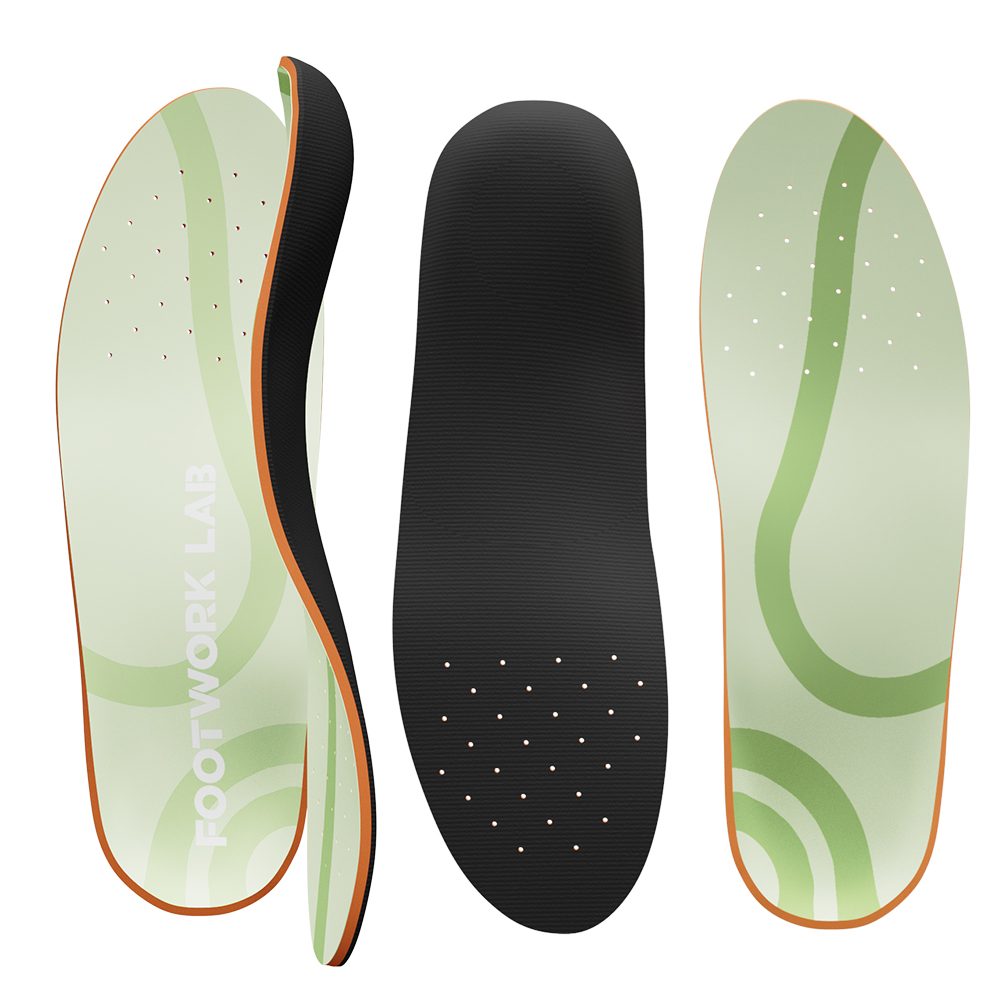
What a sport insole is actually asked to do
Sport is not one activity, and the brief changes with the activity. A training shoe that absorbs repeated straight-line loading has different requirements from a court shoe that has to cope with lateral movement, and both differ from a walking shoe used for long distances at a slower pace. A pad specified for one will not necessarily suit another.
That matters for silicone because the pad is a local intervention. A heel pad that helps in a running shoe may be irrelevant in a court shoe where the load concentrates at the forefoot during changes of direction. The recording at assessment shows where the load goes; the sport tells you when it arrives.
The practical consequence is that a supplier should ask what the insole is for before quoting a build. A catalogue organised by material rather than by use case forces the buyer to do that translation alone, and the translation is where most specification errors happen.
Silicone, gel and foam in the same brief
The three materials are often presented as alternatives and are better understood as a vocabulary. Silicone is durable and stable, and it holds its shape; gel is softer and damps more; foam is lighter and cheaper and can be tuned across a wide range of densities.
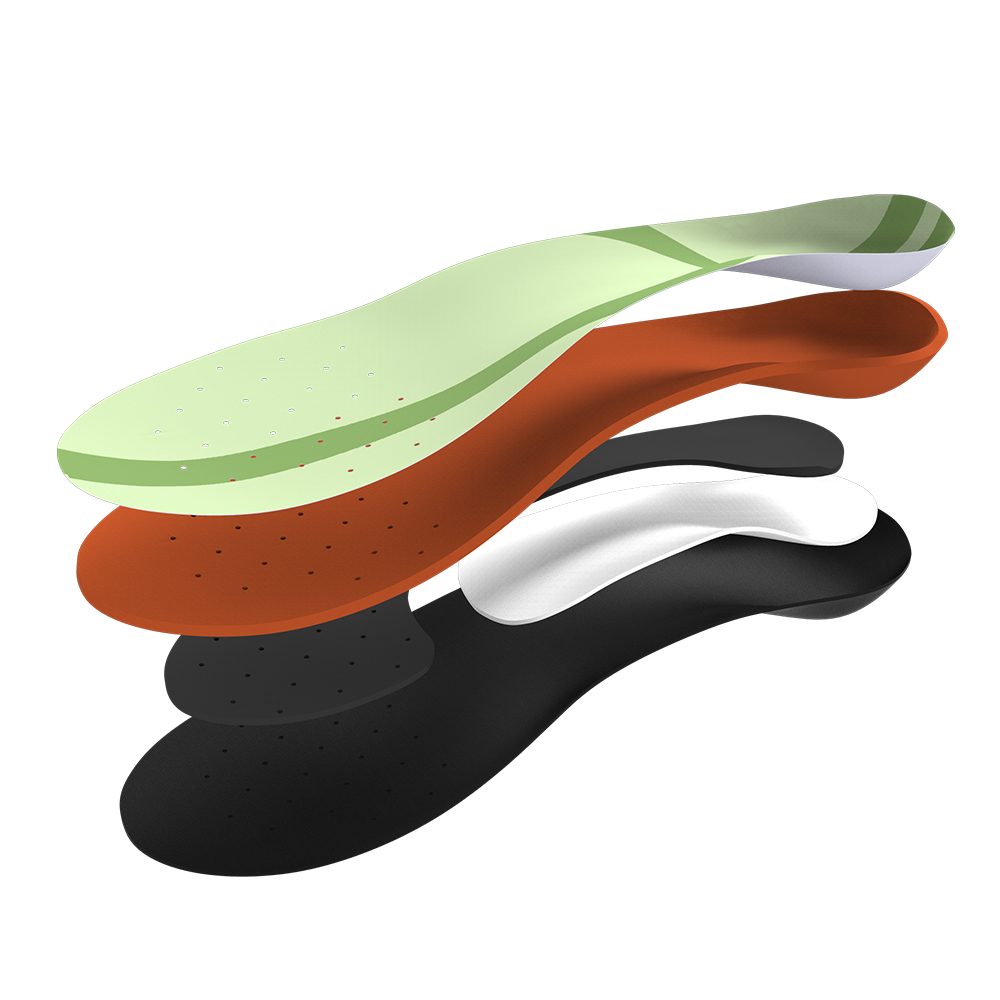
In a sport insole the common arrangement uses foam for the bulk cushioning, silicone for a durable local pad, and a shell for structure. That combination uses each material where its properties are strongest, and it is usually cheaper than building the same behaviour from a single material.
The mistake is choosing one material and regarding it as the answer to every part of the brief. A product made entirely of silicone is heavy and structurally vague; one made entirely of foam loses its shape under repeated load. The specification is about distribution, not allegiance.
Weight, and why athletes notice it
Silicone is dense. A pad that feels modest in the hand adds mass at the end of the leg, and in running and court sports that mass is swung thousands of times. Some athletes notice it immediately; others never do. Neither reaction is wrong, but the specification should acknowledge the trade-off rather than pretend it does not exist.
The usual solution is to keep the pad small and to place it where the cushioning is needed rather than across the whole heel. A localised pad adds grams; a full-length silicone layer adds enough that the shoe feels different. If a brief calls for cushioning across a wide area, a foam layer is usually the better instrument and the silicone is reserved for the part that takes the most concentrated load.
Ask what the finished pair weighs and compare it against the product it replaces. It is a simple question that few buyers ask, and the answer often explains a customer comment that would otherwise be attributed to fit.
Durability, cleaning and the realities of sport
Silicone resists wear well, but it is not indestructible. Thin sections can tear at the edge where they are bonded, and a pad that is loaded at a sharp transition will eventually fail there. The design decision that prevents this is a gradual transition rather than an abrupt one.
Cleaning matters more in sport than in everyday use, because the insole sees sweat, heat and repeated drying. Silicone tolerates washing better than most foams, which is one reason it appears in builds intended for heavy use. The rest of the insole still has to survive the same routine, so a washable pad inside a non-washable build is not an advantage.
Heat is the other reality. An insole left in a car or a kit bag reaches temperatures that accelerate the aging of every component, and the pad is often the first thing to show it. A specification that ignores storage conditions is a specification written for a laboratory rather than a training ground.
Specifying hardness, thickness and footprint
A silicone specification has four parts: the material type, the hardness, the thickness and the footprint. All four need to be written down, because a pad described as a heel insert can be produced across a range that behaves entirely differently.
Hardness is expressed on a scale that most buyers have never used, which is why it is often replaced with a word. Replace the word with the number and keep the number in the specification. The supplier’s own designation is better still, because it survives translation between factories.
Footprint decides whether the pad feels like cushioning or like a lump under the foot. It should sit under the region the brief identified and stop before the area where the foot needs contact with the shell. A pad that spreads beyond its purpose changes the fit of the whole insole.
Thickness interacts with hardness and with the shoe. A thick soft pad in a shallow shoe lifts the heel and changes the fit; a thin hard pad does very little. The footwear record in the brief is what sets the ceiling.
Bonding and retention
A silicone pad that moves is worse than no pad. Retention depends on the surface it is bonded to, the adhesive system and the geometry of the cavity if there is one. Silicone is famously difficult to bond, which is why suppliers use primers or mechanical retention rather than relying on a general-purpose adhesive.
Ask how the pad is held. A pad placed in a moulded cavity and bonded at the perimeter behaves differently from one laminated across its whole face. The first can lift at the edge; the second can trap air. Neither is wrong, and both need to be specified.
Then ask what happens at the edge after a season of use. This is where a build either holds or fails, and it is the question a sample pair cannot answer. A factory that has been producing the build for years will know; one that has just added it to a catalogue will guess.
Sampling, and what a sample can prove
A sample pair can prove that a build is possible. It cannot prove that a batch will be consistent, and it cannot prove how the pad behaves after a season. Buyers who take the sample as the end of the evaluation often discover the difference at the first reorder.
A more useful trial runs a small number of pairs with real users for a defined period and inspects them afterwards. Ten pairs worn for a month will reveal migration, edge failure and cover wear that no fitting-room session can show. The cost is small and the information is worth more than a second sample.
Ask the supplier whether they will support that kind of trial, and what they want to know from it. A factory that is genuinely interested in how its build behaves in the field will ask for photographs and measurements; one that is only interested in the order will ask when it can ship.
Sourcing at volume
At volume, the material questions become batch questions. Is the silicone compound the same between orders? Is the hardness checked on incoming material or assumed from the supplier certificate? Is there a record linking a batch of pads to the pairs they went into?
Those records are what allow a factory to answer a complaint six months later. Without them, every return is a conversation about opinion. With them, a return is a data point that either confirms the specification or reveals a batch problem.
Our own terms are simple: two hundred pairs minimum for insoles, mixed across models and sizes; samples dispatched within three days of specification approval; ODM and OEM both available; production capacity around five hundred to one thousand pairs a day. Shipping runs six to seven working days by express, ten to twelve by air and thirty to thirty-five by sea.
What to say at the counter
A silicone pad is a cushioning and grip component. It is not a structural element, and it is not a substitute for assessment. That sentence covers most of what a customer needs to understand, and it prevents the expectation that a softer product is a stronger one.
The second sentence is about time. A pad will feel different after a month of use, and the customer should know that the change is normal rather than a fault. Products that are described honestly at the point of sale generate fewer complaints than products that are described enthusiastically.
Our own description follows the same rule. We build insoles to a specification derived from measurement, we describe what the components do, and our certification scope is limited to the documentation we hold: European Union certification and ISO quality system certification. Nothing in this article should be read as a clinical claim, because it is not one.
Frequently asked questions
Is a silicone insole better for sport than a foam one?
They do different jobs. Silicone is durable and stable for local pads and grip zones; foam is lighter and better suited to bulk cushioning across a full-length build. Most good sport insoles use both.
Will a silicone pad move inside the insole?
Not if it is specified and bonded properly. Retention depends on the surface, the adhesive system and the cavity geometry. Ask how the pad is held and what happens at its edge after a season of use.
Can silicone pads be replaced?
In most builds they are bonded into the structure, so replacement is not a service item. Where a pad is a wear component, the specification should say so and the supply should include spares.
How is hardness specified?
By the material supplier’s own designation plus the measured hardness figure, not by a word. Words like soft and firm do not survive translation between factories.
What is the minimum order?
Two hundred pairs for insoles, mixed across models and sizes, with samples dispatched within three days of specification approval.
Do you supply pads or materials separately?
We supply finished insoles built to a specification. Our commercial scope is the finished product and the assessment equipment that supports it, and we are explicit about that boundary.
How long does delivery take?
Six to seven working days by express, ten to twelve by air freight and thirty to thirty-five days by sea, depending on destination and clearance.
What we would do next
Start the specification from the load pattern rather than the material. Our article on sports insoles for different activities covers how the brief changes between walking, training and competition, and the piece on Poron covers the foam side of the same build.
For samples, minimum order, OEM and ODM, see the FAQ page. To have a build reviewed, contact our team, or see the plant where the pairs are produced.
This article is intended for professional and educational reference. It is not medical advice. Foot assessment equipment produces measurements and images; clinical interpretation and any decision about care remain the responsibility of a qualified professional. Certification scope is limited to the documentation we hold: European Union certification and ISO quality system certification.