
“Medium support” is the most expensive phrase in the insole trade. It appears in clinical notes, purchase orders and catalogue descriptions, and it means something different in each of those places. When it travels from a clinic to a factory without translation, the pair that comes back is a guess — and guesses are what a support scale is supposed to eliminate.
The problem is not that the words are wrong. Soft, medium, firm and rigid describe something real about how an insole behaves under load. The problem is that they describe a sensation rather than a construction, and a production team cannot build a sensation.
This article proposes a shared vocabulary: four levels, each defined by how the product behaves and by what changes in the build to produce that behaviour. It is written for clinics specifying insoles, for distributors describing a range, and for factory teams receiving briefs that use the language loosely.
Why the phrase fails in an order
A support level is a relationship between three things: the load the foot applies, the stiffness of the material, and the geometry that distributes that load. Change any one and the sensation changes. A shell of the same material feels firmer on a lighter person and softer on a heavier one, in a stiff shoe and in a soft one.
Clinicians know this intuitively, which is why the phrase is used with a gesture: a hand pressed into an arch, a thumb into a shell. The gesture carries the meaning that the word does not. In a written order the gesture is lost, and what remains is a word that a production planner has to interpret.
Factories respond to the ambiguity in predictable ways. They default to the middle of their range, because the middle is the least likely to generate a complaint. The result is a product that is acceptable to everyone and distinctive to nobody, and a clinic that cannot explain why its insoles feel like a catalogue item.
The remedy is not more adjectives. It is a scale with defined thresholds, so that “firm” has a construction behind it and two suppliers produce comparable products from the same word.
A four-level scale defined by behaviour
The scale below is the one we use when a brief arrives with a word instead of a specification. It is deliberately behavioural: each level describes what the product does under load, then what construction produces it.
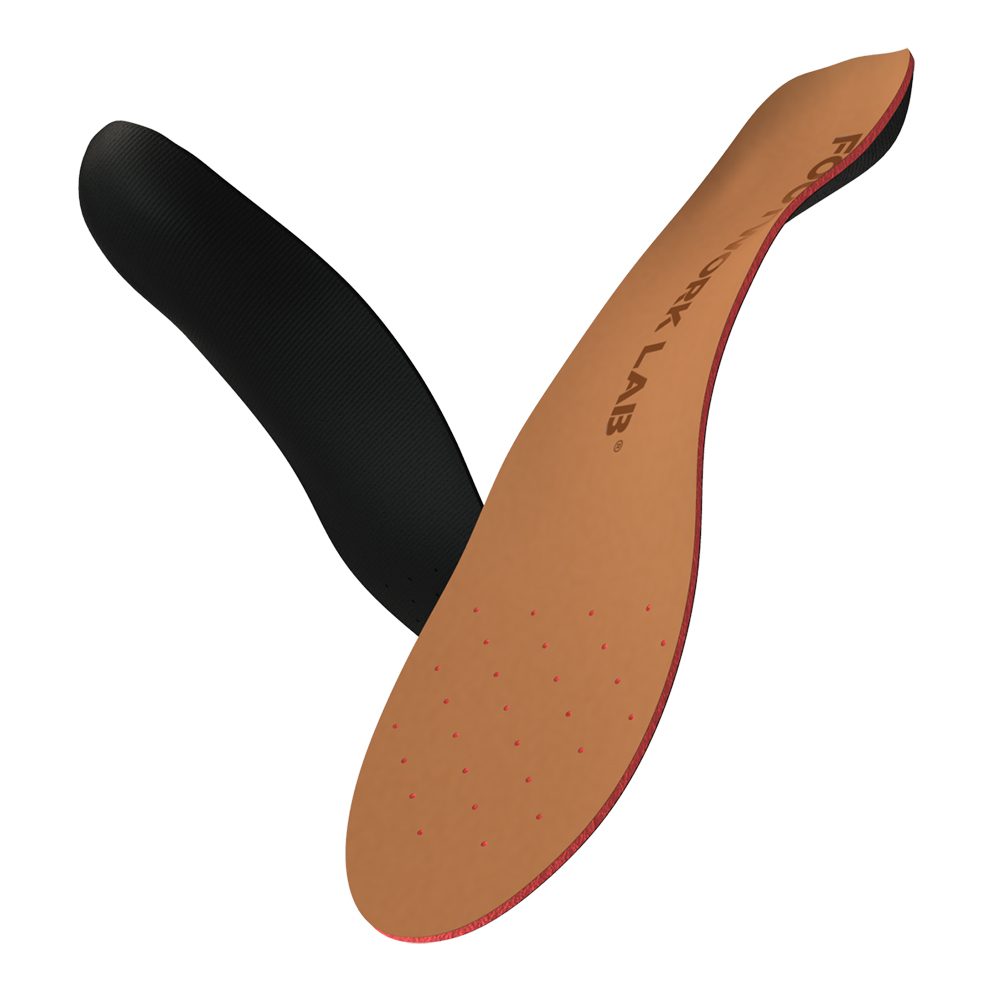
Level one — cushioning. The product conforms readily under body weight and its main job is to soften the interface between foot and shoe. Deflection is visible when the insole is pressed by hand. Construction is usually a single resilient foam or gel layer with a shallow arch contour and no separate shell.
Level two — guided support. The product holds a contour under load without resisting the foot’s own motion strongly. It feels supportive when standing and forgiving when walking. Construction is typically a thin formed shell with a cushioning layer over it, an arch contour that follows the measurement, and a heel cup that holds rather than grips.
Level three — controlled support. The product resists deflection in the midfoot and transmits load across a broader area. Pressed by hand it gives slightly, then holds. Construction is a stiffer shell, a defined medial arch fill, a deeper heel cup and a forefoot element that is specified rather than assumed.
Level four — rigid shell. The product does not deflect under hand pressure and its purpose is to control the interface precisely rather than to cushion it. Construction is a thin, stiff shell, often with posting, and a cushioning layer whose job is comfort rather than support.
What actually changes between the levels
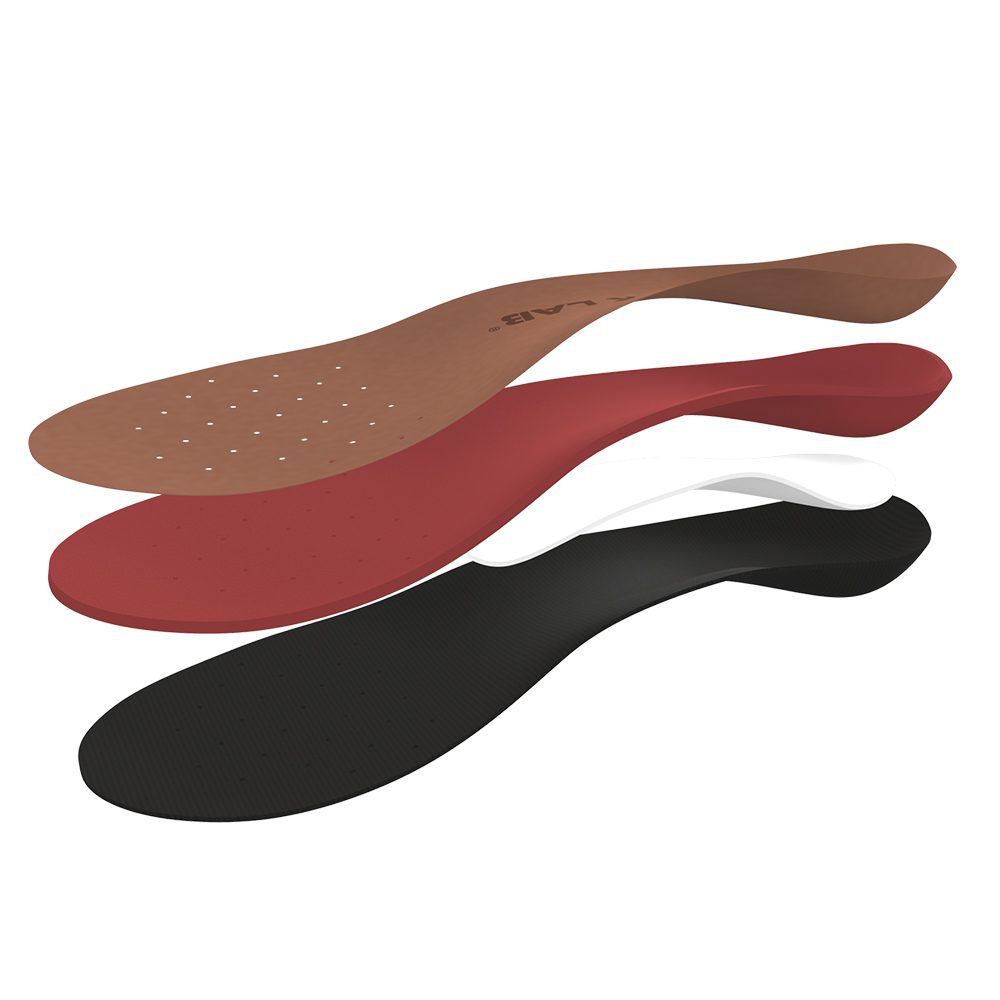
Six construction variables move as the level rises, and understanding them is what allows a clinic to write a brief that a factory can build without a conversation.
The first is material stiffness, expressed as a grade rather than a feeling. Every supplier has a range, and the grade is the single largest determinant of behaviour. A brief that names a grade is a brief that will be reproduced.
The second is shell thickness and its distribution. Uniform thickness is easier to produce; variable thickness is what allows a shell to be stiff in the midfoot and flexible in the forefoot. Level three and four products usually depend on that variation.
The third is arch fill and its extent. Fill adds support by occupying volume under the arch; extent decides how far forward that support continues. Two products of the same material can feel a level apart purely because of fill.
The fourth is heel cup depth and width. A deeper, narrower cup holds the heel more firmly and increases the perception of control. It also increases the risk of discomfort if the fit is not checked in the shoe.
The fifth is the forefoot element: a posting, a wedge or a reinforcement. This is where levels three and four diverge most, and where vague briefs produce the widest variation between suppliers.
The sixth is the top cover and cushioning layer. These change comfort more than support, but they change the perception of support substantially, which is why a customer can describe a level-two product as firm if the cover is thin.
Translating between the clinic and the factory
The translation is a short document, and it is worth building once. On one side, the clinical language a practitioner uses: what the foot does under load, what the aim of the insole is, what footwear it must work in. On the other side, the construction language: grade, thickness, fill, cup, posting, cover.
The bridge between them is the behaviour statement. Instead of writing “medium support”, write what medium support is supposed to achieve for this foot in this shoe — for example, “hold the arch contour under standing load without restricting forefoot motion in a trainer”. That sentence can be built. The adjective cannot.
It also gives the clinic something to check at fitting. If the behaviour statement was about holding a contour while standing, the fitting check is a standing check, in the right shoe, with the customer’s own sock. The check follows the brief rather than the habit of the practitioner.
Factories benefit from the same document in the opposite direction. A production team that knows which variable is the point of the order can protect it during a material substitution or a scheduling change, instead of protecting the average of everything.
One more line earns its place in every specification: how the level was agreed. If it was agreed in conversation, record the sentence that settled it. If it was agreed from a sample, record which sample and keep it. Six months later, that note is the difference between a reorder and an argument about what was originally intended.
Where the scale breaks down
No scale survives contact with footwear unchanged. A level-three shell in a soft, deep shoe behaves differently from the same shell in a firm, shallow one, because the shoe contributes to the support and changes how the foot loads the insole.
Body weight is the second modifier. The same construction feels firmer under a lighter load and softer under a heavier one, which is why a product that suits one customer can feel wrong for another of the same foot shape.
Activity is the third. A construction that behaves well for standing and walking can feel restrictive in sport, where the foot needs to move through a wider range. Sport-specific briefs therefore usually sit one level lower than the standing brief for the same foot.
The honest conclusion is that the scale describes the product, not the outcome. Two customers can receive level-three products and experience them differently, and that is not a failure of the scale — it is a reason to record the footwear and the activity alongside the level in the specification.
Writing a support level into a purchase specification
A usable specification has six lines. They fit on a page, and they eliminate most of the ambiguity that produces re-makes.
Line one: the support level, named from the scale. Line two: the behaviour statement, in one sentence, including the footwear. Line three: the material grade and thickness range for the shell. Line four: arch fill — how much, and how far forward. Line five: heel cup depth and the intended fit tension. Line six: the top cover and cushioning layer.
Two optional lines are worth adding for clinics that order repeatedly: the intended activity, and the review interval. Both make the second order faster and the comparison over time meaningful.
The specification should also state what the product is not for. A level-four shell is not a comfort product, and a level-one cushion is not a support device. Writing the boundary prevents the product from being judged against a job it was never given.
When we receive a brief, this is the format that allows us to quote without guessing. When a brief arrives as a single adjective, the first reply is usually a question, and the question costs a week.
Handling expectations across levels
Customers do not buy levels; they buy an experience. A customer who expected cushioning and received control will describe the product as hard, regardless of how well it was built. The mismatch is a communication problem that starts before the assessment.
The practical approach is to describe the level in the customer’s terms at the point of specification, not at the point of delivery. “This will hold your arch when you stand and give a little when you walk” is a level-two description that a customer can evaluate. “Medium support” is not.
It also helps to describe the adaptation period honestly. A firmer product usually takes longer to feel normal than a softer one, and a customer who was told that in advance is far less likely to return the pair in the first week.
Finally, it helps to explain what a change of level would mean. A customer who understands that the next level up would be stiffer and less forgiving is a customer who can participate in the decision rather than receive it.
Buyers ordering ranges rather than single pairs should also define the scale at the range level, not per product. A catalogue in which firm means one thing in one model and something else in another trains the market to distrust the words entirely, and it makes the clinic’s own recommendations harder to explain to customers who compare models on a shelf.
Reviewing whether the level was right
The review appointment is where the scale earns its keep, because it is the only point at which the specification, the product and the experience can be compared. Three pieces of information make that comparison possible: the recorded level and behaviour statement, the wear pattern on the returned pair, and the customer’s description of how it felt in the shoes they actually wore.
Wear pattern is under-used. Compression set in the cushioning layer, polish marks on the top cover and edge wear all indicate where load went, and they can confirm or contradict the original intent. A pair that shows heavy forefoot compression on a level-two brief is telling you the foot loaded differently than expected.
The useful output of a review is not a verdict but a documented adjustment: keep the level, raise it, lower it, or change the footwear assumption. Written down, that adjustment makes the next pair faster and better, and it builds the kind of record that a catalogue product cannot compete with.
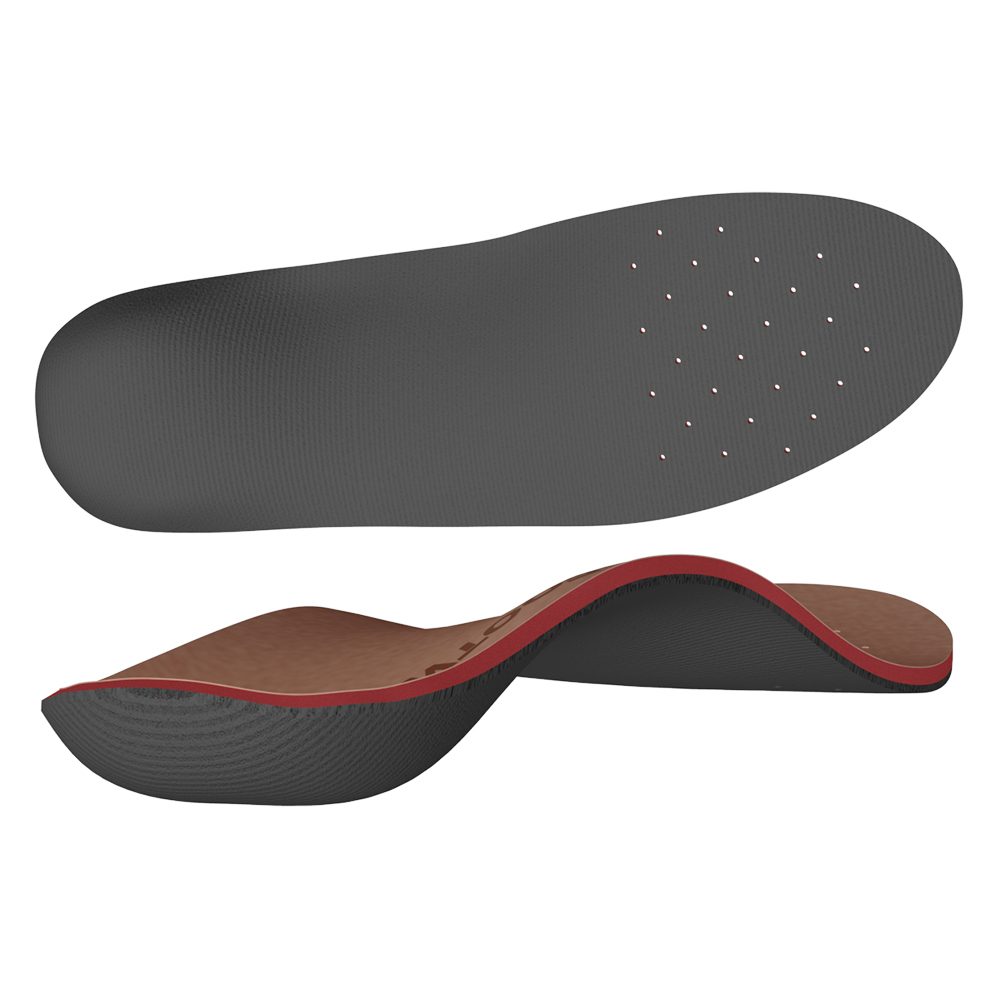
The strongest version of this discipline is a reference pair kept for each level. Four pairs on a shelf, each labelled with its level and construction, settle more internal disagreements than any document, because they can be handled. When a new member of staff joins, the reference pairs are the training material; when a supplier changes, they are the comparison.
Frequently asked questions
What do soft, medium, firm and rigid mean in an order?
They describe behaviour under load, and each should have a construction behind it: material grade, shell thickness, arch fill, heel cup and forefoot element. Without those, the words are a sensation rather than a specification, and two suppliers will interpret them differently.
Can you tell the support level from a photograph of an insole?
Only roughly. Thickness and geometry are visible, but material grade is not, and grade is the largest single determinant of behaviour. A photograph is useful for confirming shape; a specification is what confirms support.
Does a higher support level mean a better insole?
No. It means a different product for a different aim. A level-four shell is a poor choice for a customer who wants comfort in a soft walking shoe, and a level-one cushion is a poor choice where control of the interface is the point of the order.
What is the minimum order for a specified build?
Two hundred pairs for insoles, and the quantity can be mixed across models and sizes. Samples are dispatched within three days of specification approval so the level and the construction can be checked before a production run.
Do you accept ODM and OEM work on insoles?
Yes, both. ODM covers designs developed from our existing ranges; OEM covers production to a buyer’s own specification and branding, including a support scale defined by the buyer.
How do I keep two suppliers consistent at the same level?
By specifying the construction rather than the adjective, and by keeping a retained reference pair from an approved batch. The reference pair is the standard that both suppliers can be compared against, and it settles arguments faster than any description.
What happens if the level turns out to be wrong at fitting?
Record the adjustment and the reason, then read it as information rather than a failure. A documented adjustment makes the next order faster, and a pattern of adjustments usually reveals that the footwear assumption in the brief was the part that was wrong.
What we would do next
Take your three most common orders and rewrite each one as a behaviour statement with a material grade, an arch fill and a heel cup depth. If the exercise is difficult, that difficulty is the ambiguity your supplier has been absorbing. Our insole categories page shows the ranges we produce, and the FAQ page covers minimum order, sample timing and ODM terms.
This article is intended for professional and educational reference. It is not medical advice. Foot assessment equipment produces measurements and images; clinical interpretation and any decision about care remain the responsibility of a qualified professional. Certification scope is limited to the documentation we hold: European Union certification and ISO quality system certification.