
The podoscope is the oldest idea in the room and still one of the most useful — provided everyone agrees on what it is. A podoscope shows the sole: the contact pattern, the arch region, the weight distribution as the client stands on a viewing surface. It shows; it does not measure. That one-sentence boundary is the whole sourcing conversation, and yet most buyer confusion in this category comes from suppliers who blur it.
We build screening equipment, including the Q1P quick-screening configuration, and we also build the pressure systems that sit next to podoscopes in the same rooms. So this article comes from a specific position: a factory that sells both the viewing instrument and its measuring neighbour, and has an interest in buyers understanding the difference rather than collapsing it.
What follows is a sourcing guide: what the instrument does, what it never did, how it combines with pressure mapping, and the supplier questions that apply to this category specifically. Read it before the first quotation arrives and the quotations will read differently.
It helps to begin with a little history, because the podoscope’s age is not a weakness. The idea of looking at a sole through glass predates every electronic instrument in the category by generations, and it has survived precisely because the question it answers — what does the contact pattern look like — never stopped being useful. Instruments that survive that long earn a specific kind of trust, but they also attract vocabulary inflation from newer products that want the same credibility. This article is partly an effort to let the old instrument keep its own name and its own honest limits.
What a podoscope actually shows
The classic podoscope is elegantly simple. The client stands on a glass or transparent surface; a mirror or camera below captures the sole’s contact pattern from underneath; a screen or eyepiece presents the image upright. What appears is the footprint in real time — where the sole touches, how the arch region sits, whether the load is distributed the way the client and the professional expect.
That image has real clinical and commercial value. It is immediate: the client sees their own sole while standing, which turns an abstract conversation into a shared one. It is continuous: the image updates as the client shifts, so balance and posture changes are visible as they happen. And it is simple to operate: no sensors to calibrate, no software to learn, a device a new staff member can use on their first morning.
The image also has boundaries, and honest suppliers state them. A contact pattern is not a pressure record: it shows where the sole touches the glass, not how hard. It is not a measurement of load, not a timing record of walking, and not an archive that can be compared session over session unless the system adds capture and storage. A podoscope answers “what does the sole look like right now”. Everything beyond that question belongs to a different instrument.
Suppliers who describe a viewing device in the vocabulary of measurement systems — maps, indices, pressure values — are either confused or hoping you will be. The vocabulary test is the first filter in this category, and it costs one sentence: “does this device report pressure values, or display the contact pattern?”
A note on the image quality conversation that usually follows: resolution questions in this category are mostly misdirected. The useful properties of the image are brightness, contrast and the visibility of the regions a screener actually reasons about — the arch area, the heel, the forefoot, the toes. Ask to see the image with the room lights on, the way it will actually be used, rather than in a dimmed demonstration booth. An image tuned for a dark room and a quiet floor will disappoint in a bright one with a queue, and the disappointment is preventable with one honest look.
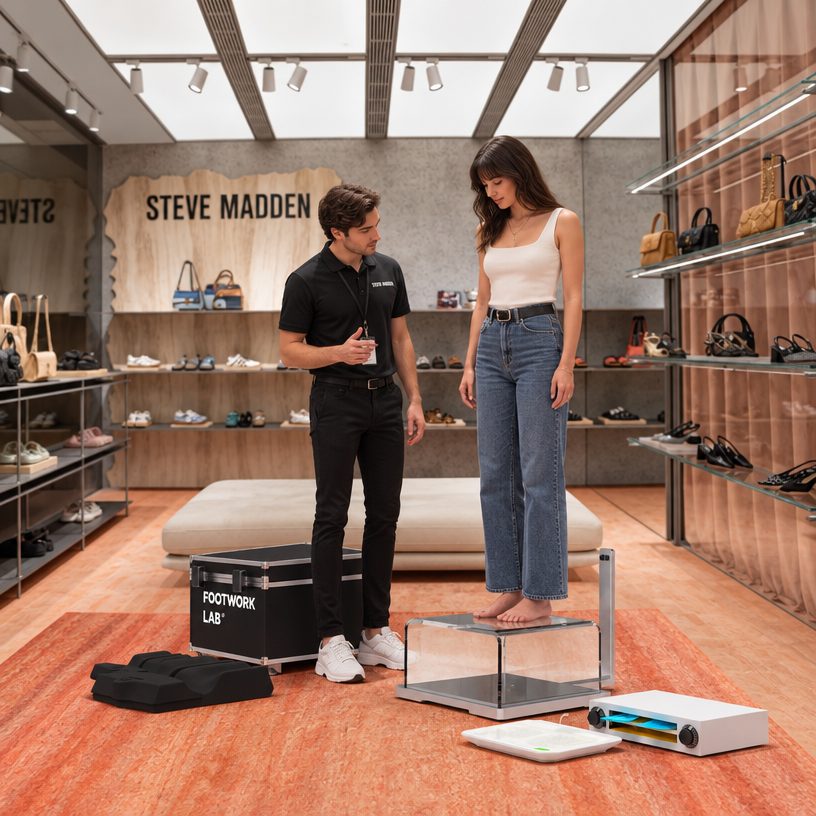
Where the podoscope fits in a room
The instrument earns its floor space in three settings. Screening environments — retail, wellness fairs, occupational health days — use it as the first look: fast, visual, comprehensible to the person standing on it. Education settings use it to show clients what the professional is describing, because a sole seen from below persuades in a way words do not. And clinical rooms use it as a quick qualitative check between fuller assessments: a glance at the contact pattern before deciding whether a pressure session is worth booking.
Our Q1P configuration was built for exactly that quick-screening role: a foot and leg screening system that presents the sole view alongside a posture capture, so the person screening sees the contact pattern and the general alignment in one short session. It is deliberately positioned as a first instrument, not a laboratory — the point is speed and comprehension, and the honest output is an image and a record, not a verdict.
The combination logic matters when you plan a room. A podoscope alone supports conversation. A pressure system alone supports records and comparison. Together, the quick view triages who needs the full session, and the full session produces what the archive needs. Rooms that buy one instrument expecting both behaviours end up using it for neither well. Rooms that buy the pair in the right order — often the viewing instrument first because it is simpler, the measurement system when the records demand it — get a workflow instead of a shelf.
Budget the workflow, not the device. The viewing instrument is the cheaper half, which is exactly why it is often bought alone and blamed for not being the other half. Write down what each instrument in the room answers, and the gaps become visible before they become purchases.
Staffing deserves a sentence as well. The quick-screening role is usually given to the newest team member, which is a sensible placement — the instrument is easy to learn — but it makes the supplier’s training material part of the purchase. Ask what a new operator learns from: a written protocol, a guided mode, a video, or nothing. The rooms where the screening instrument thrives are the ones where the first week has a script, and the script usually comes from the supplier whether or not it was promised.
What a supplier of viewing instruments should answer
The question list for this category is short and concrete. First: what exactly does the client see — a live sole image, a still capture, or a composite with posture? Second: is the image recorded, and in what form? A screening conversation gains a lot when the session leaves a file the client can keep, and the file needs somewhere to live.
Third: how does the surface survive public use? A glass surface stood on by hundreds of strangers a month is a maintenance item; ask about the material, the load rating in ordinary language, and what replaces a worn surface. Fourth: what does the supplier mean by “screening”? If the word arrives attached to promises about findings or conditions, read that as the supplier’s vocabulary problem and ask for the instrument’s actual outputs in writing.
Fifth: where is it built, and by whom? The same factory questions from every equipment category apply here, simplified. A viewing instrument is a mechanical and optical device; the supplier questions are about build consistency, spare surfaces, the light source’s life, and what the warranty covers. Ours is a twelve-month warranty on non-human damage with free parts, a seven-day test before dispatch, and support through a dedicated WhatsApp group with engineer access — the same frame we apply to our larger systems, because the buyer’s service years look the same from either side of the invoice.
Sixth: can the supplier show the instrument in use with the client population you serve — children, older adults, athletes? A surface that suits a standing adult may need different ergonomics for a six-year-old or a client with limited mobility. Ask what the demonstration covers and who it is demonstrated by; the answers reveal how much the supplier knows about the rooms the instrument actually lives in.
One question belongs to the category specifically: how does the supplier describe the instrument to your customers? If you run a retail or screening operation, your staff will repeat the supplier’s sentences to the public, and the sentences need to be honest in your language, not only in the factory’s. Ask for the description the supplier would put in your own brochure, and read it the way a sceptical customer would. Suppliers who write careful boundary sentences — shows the contact pattern; does not measure pressure; supports professional judgement — are suppliers whose other documents can be trusted too. The habit of precise language is a factory-wide trait, and it shows up everywhere once you look.
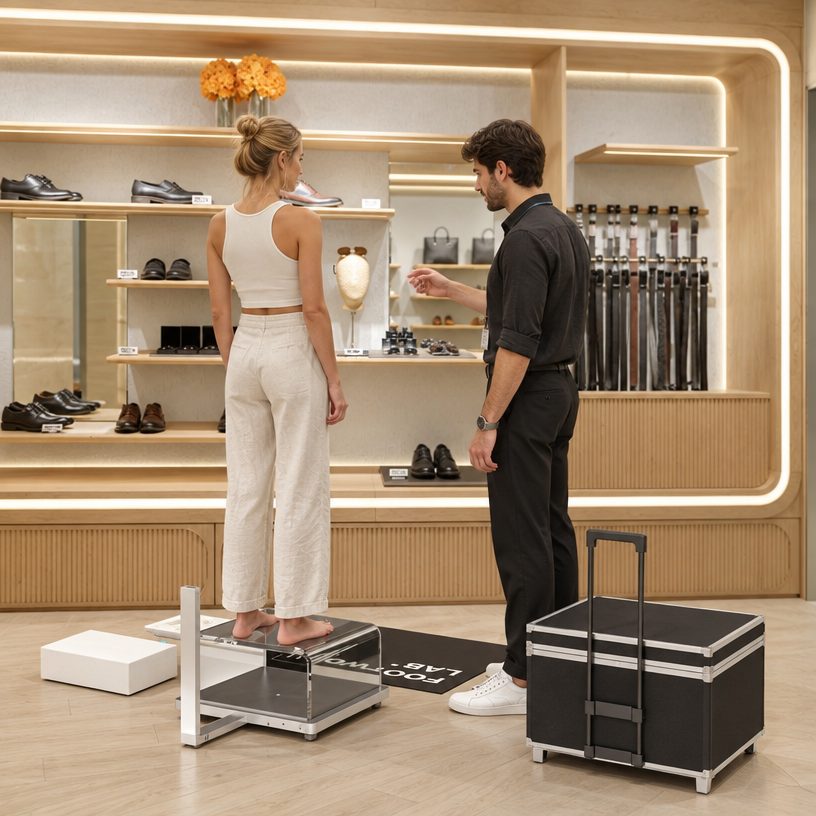
Combining the view with the record
The strongest rooms run the two instrument families in sequence, and the sequence is worth specifying at purchase rather than improvising later. Session one: the quick view — sole image, posture glance, a conversation. If the conversation suggests a record would help, session two: the pressure capture, standing and walking, archived properly. The first session is fast enough for walk-in traffic; the second is scheduled enough for quality.
The data question is whether the two sessions share a client file. In our workflow they do: the screening record and the pressure record live under the same client, so the file a professional opens next year shows both the first look and the full measurement. Rooms that run two instruments from two vendors with two archives quietly lose this — the quick look ends up in a drawer and the record ends up in a system nobody cross-checks.
For distributors and clinics planning a product line rather than a single room, the combination extends to insoles: the screening conversation leads to assessment, the assessment to a design, the design to production. That is the full chain our plant runs — screening equipment, pressure systems, and insole production at five hundred to a thousand pairs a day with a two-hundred-pair mixed minimum. The chain works because the instruments were chosen to work together, which is the argument for buying the sequence from one place.
A word on pacing the purchase, because rooms rarely buy both instruments on the same day. The common sequence is the viewing instrument first: it is simpler, it starts conversations immediately, and it teaches the team what clients ask about. The measurement system follows when the room’s records need to become comparable — different clients, different months, the same honest basis. Buying in that order also spreads the training load: the team absorbs one workflow at a time, and by the time the second instrument arrives, the archive habits that make it valuable are already in place.
Buying the simple instrument well
Simple products are bought casually and resented loudly. The podoscope’s simplicity is real, but the buying questions are not optional: what is seen, what is kept, how the surface survives, what the warranty names, and who answers when a light fails. A supplier who answers these in one call is worth more than a longer feature list from one who cannot.
Check the practical geography before the order, the same as any instrument: floor space, the height the client steps up, visibility of the screen from where the professional stands, power access. These constraints eliminate more purchases in practice than any feature comparison, and they are all checkable with a tape measure and five minutes in the room.
Then place the instrument honestly in its sequence. Buy it as the first look, staff it with the newest team member, and let it feed the fuller assessment rather than replace it. Managed that way, the oldest idea in the room does exactly what it has always done best: it starts the conversation that the rest of the equipment is designed to finish.
Finally, plan the small logistics that never make the brochure. Where the client steps up and steps down; how the surface is cleaned between strangers; whether the screen is visible from the position where the professional stands; what happens to the queue when the instrument is briefly out of service. None of these questions is difficult and none of them is technical, which is exactly why they are skipped — and they are the ones that decide, months later, whether the instrument sits at the centre of the room or against the wall.
Frequently asked questions
Does the podoscope measure pressure?
No. It displays the sole’s contact pattern from below — where the foot touches the viewing surface. Pressure values, timing and load records belong to a pressure measurement system. The two are complementary, and rooms that understand the split buy the right instrument first.
What is the Q1P designed for?
Quick screening. It pairs a sole view with a foot and leg posture capture in a short session, so a screener gets the first look fast. The output is an image and a record for the client file, not a clinical verdict — interpretation stays with the professional.
Can the session be saved for the client?
Yes. Sessions are captured and stored under the client’s file, so a later full assessment can sit beside the first screening in the same record rather than starting a separate archive.
What is your minimum order and delivery time?
Machine orders start at one unit. Every unit passes a seven-day test before dispatch; transit runs six to seven working days by express, ten to twelve by air and thirty to thirty-five by sea.
What does the warranty cover?
Twelve months on non-human damage with free replacement parts. Support runs through a dedicated WhatsApp group with direct engineer access, remote assistance where the site allows, and over-the-air updates for connected units.
Can the surface be replaced after heavy public use?
Yes — ask us for the replacement arrangement for your market when you order, and budget it as a consumable rather than a surprise. Screening surfaces that serve hundreds of people a month are maintenance items by design.
Do you offer ODM or OEM on this equipment?
We accept ODM on equipment, with OEM negotiable case by case. Branding and packaging changes are simplest when raised at the first conversation, before the order is confirmed.
What we would do next
See the quick-screening configuration on the Q1P product page and compare it with the measuring side of the range on the X3 pressure platform and F2 system pages. The FAQ page carries the commercial terms in writing, and foot scanner or podoscope: choosing between two views of the same foot covers the pairing question in more depth.
This article is intended for professional and educational reference. It is not medical advice. Foot assessment equipment produces measurements and images; clinical interpretation and any decision about care remain the responsibility of a qualified professional. Certification scope is limited to the documentation we hold: European Union certification and ISO quality system certification.