
Every shoe comes with an insole, and the word hides the fact that the two products on either side of it are different industries. A shoe insole is a component: cushioning, fit, comfort, replaced when it wears. An orthotic is a device: built from a measurement, specified like an order, expected to hold its shape and do its job for its whole life. The search phrase shoe insole orthotic exists because buyers stand exactly on that border, wondering where one product ends and the other begins — and the border, once you can see it, changes how you buy both.
We manufacture on the orthotic side of the border: custom insoles built from measurement records at five hundred to a thousand pairs a day, plus the assessment equipment that produces the records. This article maps the border honestly — what a standard insert does well, where its design reaches its limits, what changes when a product crosses into custom work, and how to decide which side of the line your need is actually on.
The map matters because both sides get unfair criticism. Standard inserts are blamed for not being things they never claimed to be; custom orthotics are called expensive by people whose need never left the standard side. Precision about the border is a kindness to both products.
What a standard shoe insole is designed to do
A standard insert is an engineer’s answer to a statistical question: what does the average foot in this size range need from the space inside a shoe? The answers are real — cushioning under the heel, a modest contour, a surface that manages moisture, materials that survive washing and months of flexing. For a wearer whose feet sit near the average and whose days are ordinary, the standard insert does its job quietly and well.
Its design reaches its limits exactly where individuality begins. Averages work until the foot in question is not one: arch geometry away from the curve, load patterns that concentrate where the insert has no strategy, a daily life — hours, surfaces, footwear — that the statistical model never met. At that point the insert is not failing; it is answering a question nobody asked it.
The second limit is structural. A component that must fit any shoe of its size cannot be shaped to one foot’s contour, because the contour that guides one foot misfits the next. Standard inserts therefore stay deliberately mild — comfort geometry, not steering geometry. When a listing promises standard-insert simplicity with custom-orthotic behaviour, it is promising two products at one price, and the buyer should ask which one ships.
The third limit is accountability, and it is the subtlest. A standard insert has no specification: nothing written about what it does for whom, nothing to check it against, nothing to reorder faithfully. That is not a defect — it is the cost structure of a mass product. But it means the moment your need becomes specific enough to describe in a sentence, you have crossed into the territory where specification exists — the orthotic side of the border.
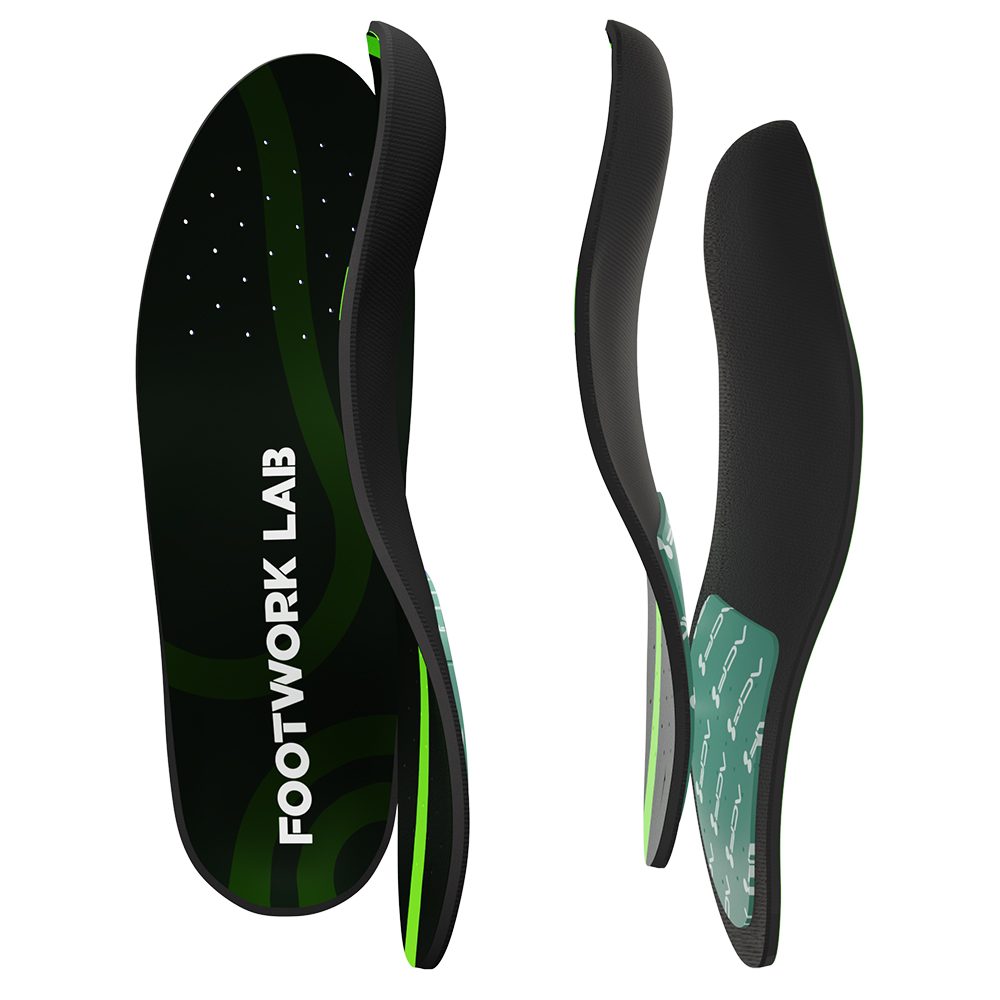
A moment of sympathy for the confusion is useful before the checklist, because the border is genuinely hard to see from the buyer’s side. The packaging vocabulary overlaps deliberately: both products promise support, both show feet, both borrow the language of comfort without ever leaving compliance-safe ground. The industries even share factories in some cases. The difference is not visible in the product photograph; it is visible in the questions the product can answer — which is why the checklist below is built entirely from questions, the only instrument that penetrates packaging.
The border, stated as a checklist
Five questions locate any foot on either side of the line. First: is the need comfort or behaviour? Comfort — softer, drier, warmer — is standard territory. Behaviour — how load distributes, how the arrangement above it sits — is measured territory. Second: does a specific person’s record exist? If yes, the orthotic side can use it; if no, that is the first thing the border asks you to acquire or accept living without.
Third: does the footwear cooperate? Custom devices need depth and shape from the shoe; a fashion sneaker with a millimetre of spare depth starves any device, custom or not. Fourth: is there a professional in the loop? The orthotic side assumes a professional who takes the record, decides the design and follows up — a service, not a purchase. Fifth: does the need justify specification? A sentence like “load concentrates in this region during these hours in these shoes” is a specification being born. If you cannot write that sentence, the standard side is probably still your friend.
Notice what is not on the checklist: price. The border is defined by need, and buyers who cross it for reasons of prestige or marketing routinely end up disappointed — not because the orthotic underperformed, but because their need never required one. The reverse mistake is equally common: staying on the standard side for years while describing, in every complaint about tired feet and worn-out inserts, a need that crossed the border long ago.
Between the two sit the hybrids — sized products with contours, kiosk-selected shapes, “customised” inserts trimmed at fitting. They are honest products with honest labels when described as configured, and they confuse everyone when described as custom. The checklist applies to them too: no record, no specification, no individual answer — configured territory, whichever the label says.
The checklist has a time dimension that buyers often miss: the border can be crossed in either direction over a life. Feet change, activities change, footwear changes, and the need that lived comfortably on the standard side for years can arrive at the line in a season. The professionals who serve clients longest see the border as a place they walk clients across when the sentence test says so — not a one-time judgment. Buyers should expect their provider to revisit the question periodically; a provider who never re-asks is servicing the record, not the person.
What changes when a product crosses the line
The first change is the record. Custom work starts from a documented measurement — a pressure map under stated conditions, a posture capture, dimensional data — because the device’s design decisions must come from somewhere checkable. The record is the orthotic’s birth certificate: without it, the product is a configured insert with a better story; with it, every subsequent decision has an author.
The second change is specification. Our orders carry a design summary — regions, per-side differences, material families, the named footwear — confirmed in writing before production. This is the document that makes the product checkable on arrival and reproducible on reorder. Standard inserts have no equivalent because they need none; the moment a product promises individual behaviour, the writing becomes the product’s second body.
The third change is production. A component industry runs on molds and size ladders; a custom industry runs on build sheets, station tolerances and traceability. Ours produces at five hundred to a thousand pairs a day with a two-hundred-pair mixed minimum — cadences that only exist because every pair travels documented steps. The factory change is invisible on the finished product and decisive inside it: it is why the tenth pair matches the first and why a reorder next year matches this year.
The fourth change is the professional. The orthotic side assumes someone who takes the record, weighs it against the client, signs the design and follows up after fitting. The device supports load distribution as designed; what that means for the person is professional work. Buyers crossing the border without the professional half of it are buying half a product.
Cost deserves an honest paragraph on the standard side of the border. A mass-produced insert carries the efficiencies of its industry: molds amortised across thousands, materials chosen for cost curves, no design conversation because no design decision. Those efficiencies are why the standard side can serve needs at a fraction of custom pricing — and buyers who cross the border should understand what they are buying instead: a conversation, a specification, a production run of one design. The comparison only stings when the two products are read as substitutes rather than as neighbours. Priced correctly, both are fair purchases; compared carelessly, both look like cheats.
Where the two products meet inside one shoe
The border is not a rivalry, and the most common real-world arrangement uses both sides. A client wears standard inserts in everyday shoes and a custom device in the shoes where their specific need lives. A retailer stocks standard inserts for the walk-in trade and refers the described need to a professional service. A clinic builds its custom practice on the vocabulary of comfort that standard products taught the market. The two industries are neighbours, and the border between them is where well-run businesses put their referral handshake.
For professionals, the handshake has a practical form: describe the standard side honestly — what a good insert does and does not attempt — and the clients whose needs have crossed the line will identify themselves, because your honesty gave them the vocabulary. For retailers, the same honesty converts returns into referrals: the customer whose complaint exceeds the insert’s design is not a refund; they are a specification being described to you in their own words.
Our own business sits deliberately on the custom side of the handshake, with equipment that gives professional rooms the record their service needs. The standard side of the market is served by fine companies at price points we do not attempt, and this article is not a case against them. It is a case for knowing which side of the handshake you are standing on when you buy.
One more border marker, visible in the first five minutes of any supplier conversation: what does the supplier ask you? A standard-side seller asks about size and preference. A configured-product seller asks about arch height and firmness. A custom-side operation asks about footwear, hours, activity and history — and asks for a record. The questions are the quickest fingerprint of which side a business actually lives on, more reliable than any label on any box, because businesses sell what their questions reveal they can use.
Deciding your side: the practical sequence
Start with the sentence test. Describe your need in one sentence, aloud, without the words “comfortable” or “better”. If the sentence describes sensation — softer, cooler, drier — you are on the standard side, and the market there is mature and inexpensive; enjoy it. If the sentence describes behaviour or structure — load, hours, footwear, a region — you have crossed, and the next step is a record, not a purchase.
Then follow the crossed sequence in order: the record under documented conditions, the professional conversation, the design summary confirmed in writing, the production run with its tolerances, the fitting with its follow-up. Each step is small; the sequence is the product. Buyers who compress it — record skipped, summary unsigned, follow-up forgotten — get the price of the custom side with the accountability of the standard side, which is the worst seat in the house.
And keep the border in mind on the reorder side, where it pays longest. Custom products live on their records: the design summary, the material map, the session reference. A year later, the reorder that matches is built from those documents — ours included. The standard side has no such memory, which is exactly why it can be cheap. Memory is a product feature, and it is one of the quiet things you are paying for when you cross the line.
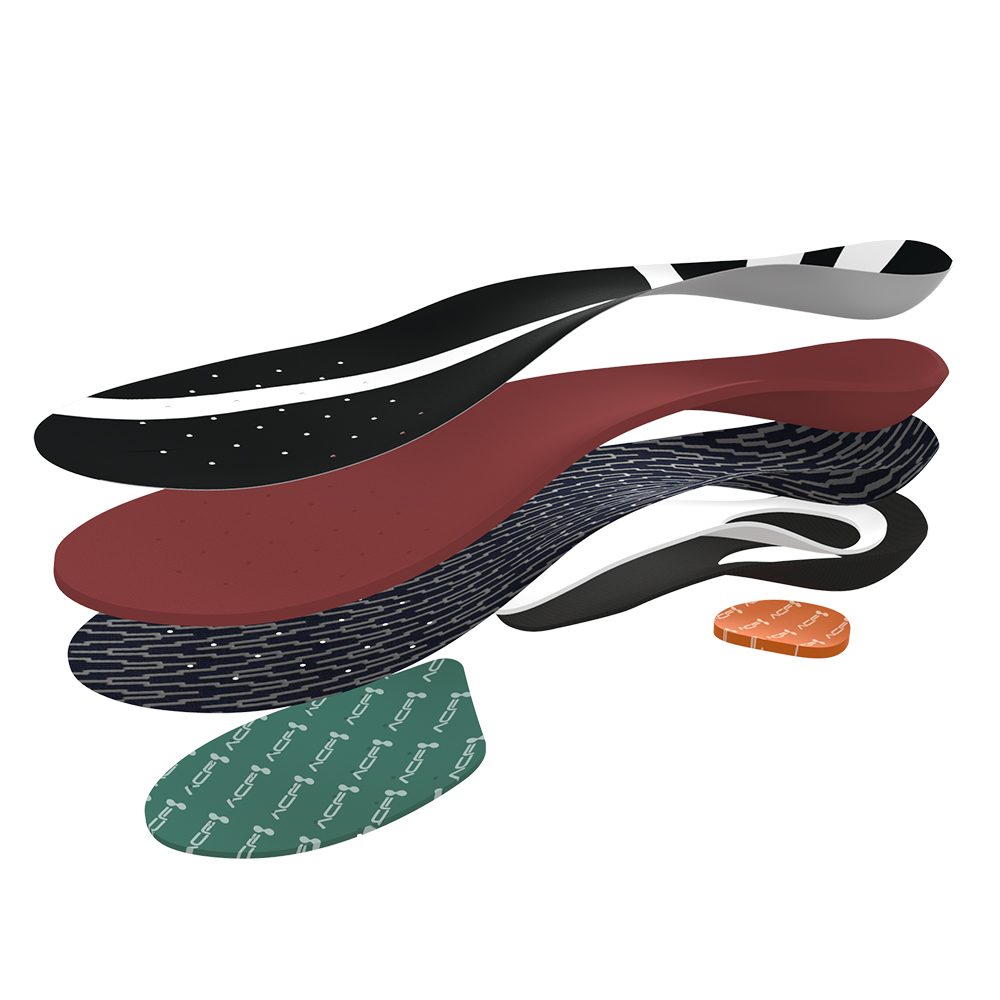
A closing word for each side of the border
To the buyers on the standard side: your product is honest and your instinct is sound. Buy the good ones, replace them when they flatten, and cross the border only when your sentence test says so. To the professionals and buyers on the custom side: the border’s credibility is yours to keep. Describe what the device does and does not claim, keep the records that make it checkable, and refer back across the line the clients whose needs never crossed it. The category grows on both sides when the border is drawn clearly — and this article is our contribution to the drawing.
Frequently asked questions
Can I just buy a better standard insert instead of a custom orthotic?
If your need is comfort — softer, drier, cooler — yes, and the standard market is mature and inexpensive. If your need describes behaviour or structure, such as where load concentrates during specific hours in specific shoes, that sentence is a specification, and it belongs on the custom side of the border.
What is the real difference between a configured insert and a custom orthotic?
A record and a specification. Configured products offer choices from a range; custom products are built from a documented measurement into a written design summary, produced to tolerances and kept on file for faithful reorders. The paperwork is not bureaucracy — it is the product’s second body.
What do you need to start a custom order?
A pressure record with documented conditions — standing and, where possible, a walking pass — posture capture, and a short context sheet: named footwear, activity, hours, goals. Geometry-only records limit what the design can honestly do, and we say so at quotation.
Can I use custom orthotics in every shoe I own?
Usually not, and the shoes decide. Custom devices need depth and shape from the footwear; tight shoes compress the device until its geometry is present but idle. Our context sheet names the shoes for this reason, and many clients run standard inserts in some shoes and the custom device where the need lives.
What is the minimum order and sampling time?
Two hundred pairs, mixed across styles and sizes. Samples leave within three days of design confirmation, made with production materials, so the specification can be felt before volume.
How long does production and delivery take?
Capacity runs five hundred to a thousand pairs a day. Transit is six to seven working days by express, ten to twelve by air and thirty to thirty-five by sea after production.
What if the pair does not match its specification?
A remake caused by a production fault is ours; a remake caused by a changed design decision is a new order. The division is written into the order documents before anything ships, which is what keeps the conversation short if it ever happens.
What we would do next
Explore the custom side of the border at your own pace: the insole categories page for the product families, the FAQ page for the commercial frame in writing, and the F2 plantar pressure system page if your service wants to own the record side. For the retail view of the same border, foot scanners in shoe retailing covers what width data and fitting rooms can and cannot promise.
This article is intended for professional and educational reference. It is not medical advice. Foot assessment equipment produces measurements and images; clinical interpretation and any decision about care remain the responsibility of a qualified professional. Certification scope is limited to the documentation we hold: European Union certification and ISO quality system certification.