
A standing pressure map and a walking record are often filed as though they were the same document taken at two moments. They are not. One describes how load sits under a foot that is still; the other describes how load travels through a foot that is moving, and the second contains events the first cannot show at all. A clinic that plans around a single capture usually discovers the gap later, when a question arrives that the record on file cannot answer, and the appointment has to be rebuilt from memory in front of the person who asked it.
The F5-LAB dynamic gait platform is built for the second kind of capture. It combines a pressure sensing surface, a camera that records posture and alignment, and software that holds the record for review and comparison. Nothing in that description is a conclusion. The platform measures and records; what a record means is decided by the professional reading it, in the context of the person who produced it and the question the clinic was asked when the appointment was first booked by a referring colleague. That sentence is the one worth repeating to a buyer who expects the software to answer the clinical question for them.
What follows sets out what each capture can support, how the two protocols differ in daily practice, and where a record stops being evidence and becomes interpretation. It is written for the buyer who has to justify a purchase to a clinical lead, and for the clinical lead who has to justify a protocol to a buyer, because those two conversations tend to happen in different rooms, at different times, and with a different vocabulary on each side of the building. Both readers need the same facts, arranged so that neither has to translate for the other.
Two captures answer two different questions
The standing capture answers a question about distribution. Where is load sitting under this foot while the person is still, and how does that compare with the other side? The walking capture answers a question about transfer. How does load move from the point of contact to the point of release, how long does each part of that journey take, and does the path differ between the two feet? Those are separate questions, and neither capture can be stretched into an answer for the other one without the answer becoming unreliable. The distinction sounds like vocabulary, and it changes what a purchase can honestly be justified for.
Clinics default to the standing capture for understandable reasons. It is faster, it needs less space, it is easier to repeat, and it produces an image that a patient can read without training. A walking capture takes more room, more passes and more discipline from the operator, and it asks the person to walk in a room that is not a corridor. The trade is worth making only when the question is about movement, and a clinic that captures walking for every visitor without a walking question is collecting files rather than information it can use.
Neither method is more accurate than the other, and treating them as a hierarchy is the most common conceptual error in this category. A standing record cannot be extended into a claim about gait, and a walking record cannot tell you where a person rests, because a person at rest is not walking. The honest position is that a clinic needs both protocols available and a written rule about which one a given question requires, agreed between the clinical lead and the operator before the person takes their shoes off. Without that rule, the choice of protocol is made by whoever is holding the appointment book that week.
What a standing capture records
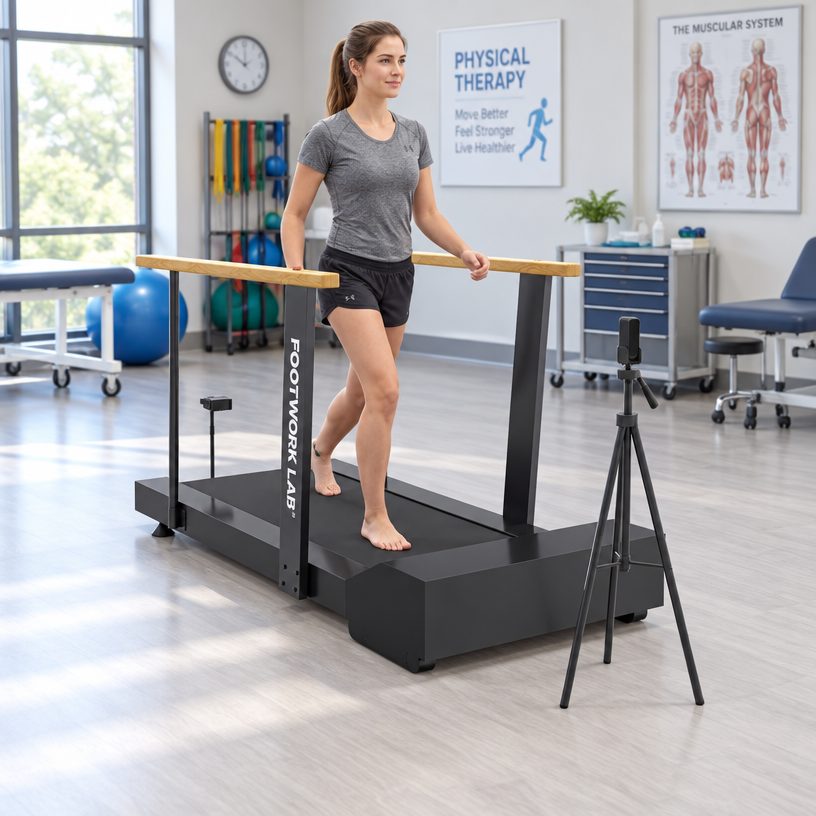
A standing capture records the distribution of load across the plantar surface while the person holds still. The software presents it as a map, and the map shows where load concentrates, how much contact area exists, and how the two feet compare when the person stands on both. The camera adds a second channel of its own: the position of the trunk, the pelvis and the knees at the same moment, which is what makes the word alignment usable rather than decorative in a written report that a colleague has to read later. Recorded together, they describe a moment rather than a movement, which is the whole of what a static capture can claim.
The conditions decide the value of the record. Whether the person stands barefoot or in socks, where the operator places the feet, whether the gaze is forward, whether the arms hang or are folded, and how many times the capture is repeated all change the image. A clinic that keeps those conditions constant gets records it can compare across visits. One that changes them between visits gets two images and a long argument about which of them is real, usually held in front of the person whose feet are on the surface.
What a standing record supports is a baseline. It describes resting load, it gives a comparison point for a later visit, and it gives the professional something concrete to discuss with the person in the chair. What it does not support is any statement about how load behaves once the person moves, because standing still removes the very events that a walking question is about. That limit should be stated plainly at the point of sale rather than left for the buyer to discover in month three of ownership, when the first difficult question arrives.
What a walking capture adds
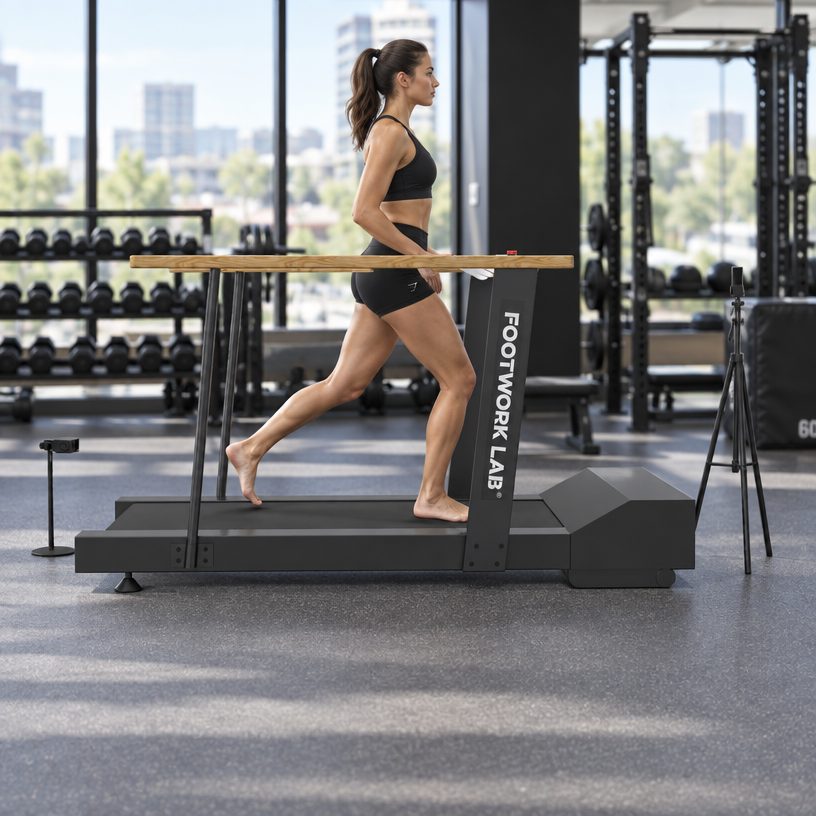
A walking capture adds time. As a person crosses the sensing surface, the platform records a sequence rather than a snapshot: contact at the heel, the roll of load along the lateral border, the transfer across the forefoot, and the push that ends the stance phase. Each of those moments has a shape and a duration, and the durations are as informative as the shapes, because a foot that spends a long time in one part of the sequence behaves differently from one that passes through quickly. Those events are why a walking record and a standing map of the same person can look like two different patients.
The second thing it adds is a path. The center of pressure is the single point where the body’s load is, at any instant, concentrated on the ground, and across a step that point travels. Its route from the heel toward the forefoot, and the way it crosses the metatarsal region before release, describes how load was handed on rather than merely where it landed. Two feet can produce almost identical standing maps and visibly different paths, which is exactly the case a standing record cannot distinguish at all. That comparison is the practical argument for keeping both protocols in a clinic of any size.
The third thing it adds is asymmetry in time. A standing map shows both feet at once and averages their differences into a single picture. A walking record keeps the left and right passes separate, so a difference in stance duration or in the shape of the path becomes visible as a difference rather than as a shading on a map. Whether that difference matters is a clinical judgement, and the record is what makes the judgement possible in the first place rather than a matter of impression. A difference seen once is a curiosity; a difference that repeats across passes is the thing worth writing down.
Following load through a gait cycle
The gait cycle is the unit that makes a walking record readable. It begins when one foot contacts the ground and ends when the same foot contacts again, and the stance portion runs from contact through midstance and terminal stance to the moment before the foot leaves the surface. Naming those phases gives the operator a shared vocabulary with the referring professional, and it gives the software a way to cut a continuous stream into segments that can be set beside each other in a report. Without those names, two operators can describe the same record in two vocabularies and neither version can be compared.
Force-line alignment is the phrase that connects the pressure channel with the camera channel. The pressure record shows where load is; the posture capture shows where the segments of the body are at the moment that load passes. Read together, they describe a relationship rather than two separate findings, and that relationship is what a report can describe without stepping into a conclusion the platform is not entitled to make on its own authority, however suggestive the picture looks. A pressure map alone answers where, and the camera answers where relative to what, which is the question a report usually has to answer.
What a single pass cannot tell you is variability. One crossing of the surface is one sample, and a person who is watching their feet, aiming for the centre of the mat or walking more slowly than usual will produce a record of that behaviour rather than of their ordinary walking. Repeats are not a formality. They are how the operator separates a habit from an artefact, and a record without them should be read with caution, whatever the image looks like on the screen. A clinic that records one pass has a photograph of a moment, not a description of a habit.
Setting up a walking protocol that repeats
A walking protocol is a set of decisions written down so that the next operator makes the same ones. Where the platform sits in the room, how many steps a person takes before reaching it, whether the approach is straight or turned, what footwear is worn, what instruction is given at the start, and who collects the record. Each of those decisions changes the numbers, and a protocol exists so that a change is a deliberate act rather than an accident of the day. Written down, the protocol also survives a change of staff, which is the event that quietly resets most clinic baselines.
Repeats belong in the protocol as a fixed practice rather than as a response to a strange result. Several passes, with the first one discarded because it usually records a person learning where the surface is, is a workable habit for most clinics. The instruction matters as much as the count: a person told to walk normally will walk differently from one told to walk at a comfortable pace, and neither will walk like a person who has been told nothing at all. Both instructions are reasonable, and mixing them across visits is what makes a series useless. Pick one instruction and write it into the protocol.
The protocol should also record its own conditions inside the file. Barefoot or shod, the footwear type, the approach, the number of passes kept and the operator’s name. Without that line, two records taken a year apart cannot be compared honestly, and the comparison is the whole point of keeping a record in the first place. The software holds the numbers; the protocol note is what makes the numbers mean the same thing on two different days. A reader who was not in the room should be able to reconstruct the conditions from the file alone.
Reading a record without turning it into a conclusion
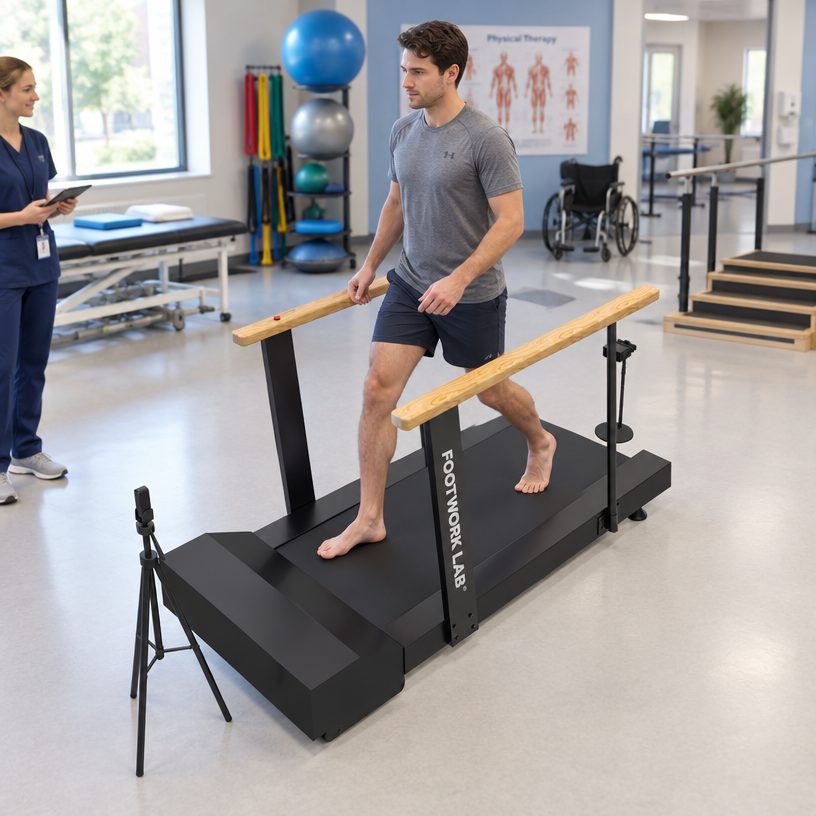
There is a line between observation and interpretation, and it is worth drawing explicitly in a report. Load concentrated under a region of the forefoot during a particular pass is an observation. The statement that this concentration explains a person’s symptoms is an interpretation, and it belongs to a qualified professional who has examined the person rather than only the file. The platform supports the first sentence and has no business producing the second one on its own. Keeping those two sentences apart is what allows a clinic to defend a report if it is ever questioned. Blur them and the report becomes an opinion with a chart attached to it.
We describe our equipment as a measurement system, and we mean that literally. It senses pressure, it captures posture with a camera, and it presents both for review. It does not diagnose, and we would rather say so on the page than let a buyer assume otherwise and then have to walk the assumption back in front of a patient. That limit is not a shortcoming of the platform; it is the boundary of what any measurement can honestly claim. The equipment is honest about what it does, and the clinic should be equally precise when it explains the output to a patient.
The useful discipline for a clinic is to write the observation first, then the question, then the action. Observation: load sits here, and the path runs this way. Question: does that match what the examination found? Action: refer, review, or specify a device. A report built in that order is defensible, it teaches the next reader how to read the record, and it keeps the equipment in the role the equipment was built for rather than in a role it cannot fill. Written that way, the report can be read by a colleague who never met the person and still be understood.
Keeping records comparable over time
A record is only useful if the next one can be set against it. That requires the same protocol, the same operator habit and the same conditions, which is why the protocol note matters more than the software feature list. A clinic that changes its mat position, its approach or its instructions between visits has effectively started a new series, and the earlier files become history rather than comparison, however complete they look in the folder. That is a bookkeeping problem rather than a technology problem, and bookkeeping is cheaper to fix before the files pile up.
Storage and export belong in the purchase conversation. A clinic that changes systems in three years needs its records to leave in a format a colleague can open, and that question is easier to ask before signing than after. Connected units can receive software updates over the air, and an update that changes a screen should be announced rather than discovered, because a team that has built a habit around one layout needs warning before the layout moves under them. The practical test is to ask what happens to the records if the clinic moves to another system in three years.
The last piece is a review habit. A record read once, at the appointment, is a document; a record read again at the next visit, beside the previous one, is evidence. That second reading is where the platform earns its cost, and it depends on nothing more elaborate than a naming convention, a protocol note and someone who opens the older file before the newer one is saved to the same folder. A clinic that reviews once a year has a folder; a clinic that reviews every visit has a series, and the series is the asset. Build the habit early, while there are two files to compare rather than twenty.
Frequently asked questions
Do we need a walking capture if we already take a standing one?
Only if the question is about movement. A standing record describes resting distribution and gives a baseline for comparison across visits. It cannot describe how load transfers through a step, so a question about timing, sequence or the path of the center of pressure needs a walking capture as well as the standing one.
How many passes should we record?
Several, with the first one discarded because it usually captures a person learning where the surface is. Consistency matters more than the count: the same number of passes, the same approach and the same instruction on every visit, so that records can be set beside each other honestly.
Can the platform tell us what a record means?
No. It measures pressure, captures posture with a camera and presents both for review. Interpretation stays with a qualified professional who has examined the person. We state that limit plainly rather than letting a buyer assume the software produces a conclusion it was never designed to produce. The record supports a conversation; it does not replace one.
Does footwear change the record?
Yes, and so do the approach, the walking speed and the instruction given at the start. That is why the protocol note belongs inside the file: without it, two records taken months apart cannot be compared honestly, and comparison is the reason for keeping them in the first place.
What does the camera add to a pressure record?
It records posture and alignment at the moment load passes, so the pressure channel and the posture channel can be read as one relationship. A pressure map alone says where load is; the camera says where the body was while that load was travelling through the step.
Can we compare a record taken a year ago?
Only if the protocol was documented the same way. Same position, same approach, same conditions, same operator habit. Ask before purchase how a record leaves the system, because a clinic that changes systems needs to take its history with it. Confirm the export format in writing at the point of order, not at the point of leaving.
What support comes with the platform?
A twelve-month warranty against non-human damage with free replacement parts, installation training, a dedicated WhatsApp group with our engineers, remote assistance and over-the-air updates on connected units. Units are tested for seven days before dispatch, and a single unit is a valid order. Support continues after installation for as long as the unit is in service.
What we would do next
If your clinic is deciding between a standing protocol and a walking one, describe the questions you actually get asked through our contact page and we will tell you which capture those questions require, including the cases where a walking record adds nothing to the decision. That answer is more useful before an order than after it, and it costs nothing to ask.
The F5-LAB platform is supplied with installation training, a dedicated WhatsApp group with our engineers in it, remote assistance and over-the-air updates on connected units. Units are tested for seven days before dispatch and carry a twelve-month warranty against non-human damage with free replacement parts, and a single unit is a valid order for a clinic that wants to start small.
This article is intended for professional and educational reference. It is not medical advice. Foot assessment equipment produces measurements and images; clinical interpretation and any decision about care remain the responsibility of a qualified professional. Certification scope is limited to the documentation we hold: European Union certification and ISO quality system certification.