
A podiatrist types “3D foot scanner for podiatrists” into the search bar, and every result promises a machine. What the phrase actually describes is a family of capture methods that record the shape of the foot — its outline, its surfaces, its dimensions. Shape is one question. How load behaves under that foot while standing and while walking is a different question, and it is the one our equipment was built to answer. The X3 foot pressure and force line system records foot pressure, foot arch type and lower-limb biomechanical alignment, and it closes the session with on-site insole customization. It does not capture foot shape, and we do not present it as if it did. This guide is for podiatrists deciding which record their room is actually missing — and what each record lets them do next.
The manual names the X3 a Foot Pressure And Force Line Detection Insoles Customization System. Its core functions are foot arch detection, lower limb biomechanical alignment detection, static foot pressure detection, dynamic gait detection, back-and-forth gait video recording and insoles customization. Over a session it builds a foot and ankle health database from foot-sole images and alignment images, a large model analyses the recorded data, AI-assisted report generation lays the results out, and the supporting customization equipment produces an insole on site. None of that involves shape capture — which is exactly why the search phrase needs untangling before it turns into a purchase order.
What “3D foot scanner for podiatrists” is shorthand for
The market uses “3D” as the label for a class of devices that record the geometry of the foot: contact moulds, optical surface captures, structured light — different methods, one shared output. A buyer who searches for a 3D foot scanner for podiatrists is usually picturing that output: a model of the foot they can rotate, measure and file. It is a useful thing to have, and clinics buy it for fitting footwear, documenting dimensions, and feeding positive forms into manufacturing. Nothing in this article argues against it.
The confusion starts when the phrase is read as covering everything a foot room does. At one Canton Fair booth a podiatrist walked up to our plate and asked, in the first minute, whether the machine “does 3D”. We drew two columns on a pad instead of answering straight away. The left column was what the foot looks like — outline, arch height as geometry, shoe size. The right column was what the foot does — where load lands when standing, how it transfers when walking, how the knee and ankle line up above it. He looked at the columns, said his room already had the left one covered, and asked to see the right one. That conversation repeats at almost every show, in almost identical words, which is why we put the clarification at the top of this article: a shape record and a pressure-and-alignment record answer different questions, and buyers searching the 3D phrase deserve to know which one they are shopping for.
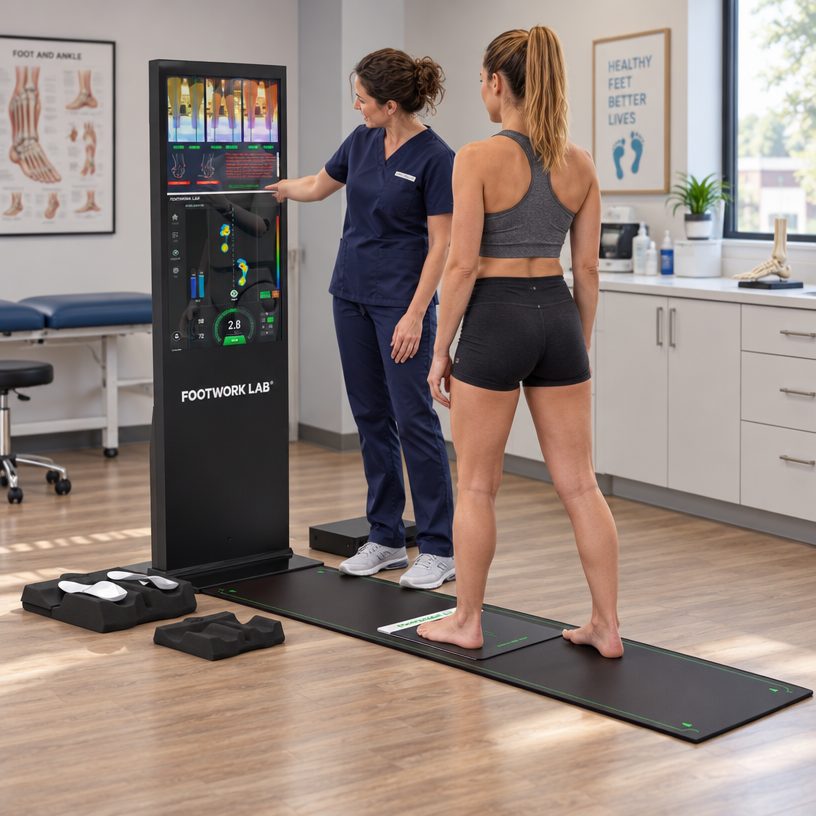
What a shape record answers, and what a pressure-and-alignment record answers
A shape record answers questions about fit and form. How long and how wide is the foot? Where does the surface rise and fall? Will this shoe accommodate it, and what positive form does a workshop need to build against? Those are static questions about a static object, and shape-capture devices answer them well. A clinic documenting footwear fit, or a lab that needs a digital model to manufacture against, gets real value from that capture.
A pressure-and-alignment record answers questions about behaviour. Under standing load, where does pressure concentrate — across the forefoot, under the heel, through the midfoot? What arch type does the foot present when it is weight-bearing, rather than suspended? During the walking sequence, when does each region take load and for how long? And above the foot, how does the lower-limb line track — where the alignment sits relative to the references printed beside it? These questions do not exist in a shape file, because a shape file holds geometry without load. The same foot can look identical in two shape records while behaving very differently under weight, which is the entire reason both records exist.
Neither record replaces the other, and we say that plainly even though we only sell one of them. A podiatrist who needs to document geometry for a footwear decision should get a shape capture. A podiatrist who needs to understand load distribution, arch behaviour under weight, and lower-limb alignment in a weight-bearing position needs what the X3 records. Buyers in pre-sales calls often ask us to recommend one; we ask instead which question the room cannot currently answer, because the equipment decision follows from that question, not from the search phrase that brought them to us.
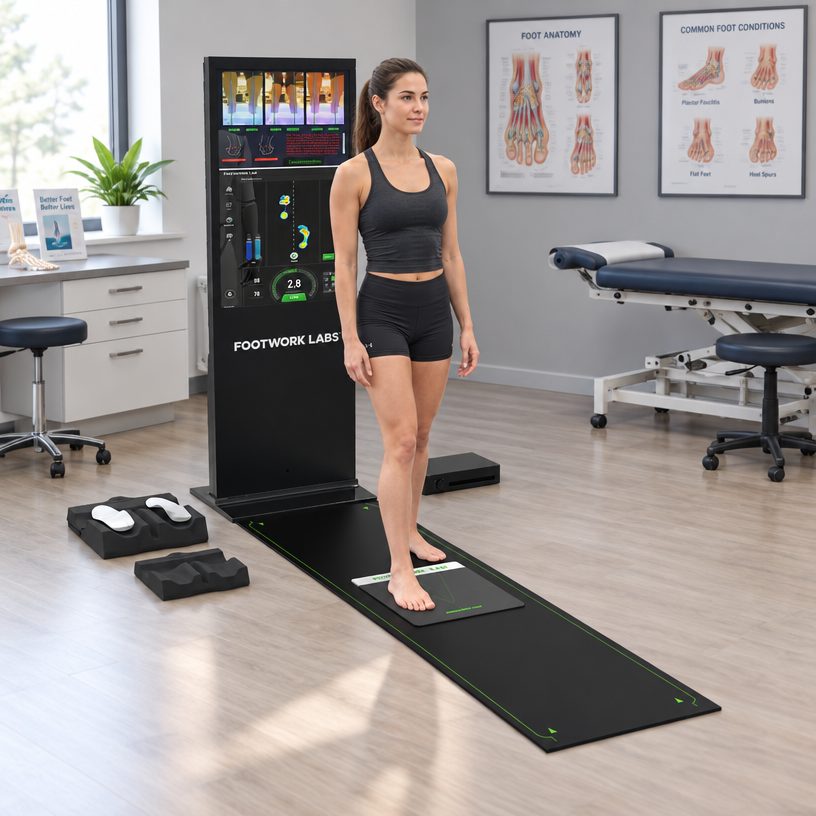
What the X3 records in one session
A session runs in a fixed order. The patient stands on the pressure plate for the static record, using the armrest to settle into a steady stance; the plate reads the standing pressure distribution and the arch behaviour under load. Then the patient walks the plate for the dynamic record, and the system also captures a back-and-forth gait video, so the movement can be replayed beside the pressure data instead of being reconstructed from memory. In parallel, the system captures the lower-limb alignment images and the foot-sole images that feed the database. The screen walks the operator through each step with prompts, which matters in a busy clinic where the person running the session is not always the person who bought the machine.
The report is where the session becomes usable. AI-assisted report generation arranges the findings — arch type, pressure distribution, force-line alignment, the pressure curve across the phases of contact — into a layout a professional can read with the patient. The report reaches the patient three ways: by scanning a QR code, by filling in an email address, or by printing it on site. It also carries a printed line that the data is for reference only, which is our own framing of the boundary between a measurement record and a clinical read: the machine records, the professional interprets.
Two functions deserve specific mention because buyers routinely misread them. The first is the AI shoe recommendation: the system recommends shoe models based on the shoe product information entered into it. In pre-sales calls we keep hearing the assumption that recommendation works out of the box; it does not. The shoe catalogue has to be entered and maintained, and the stores that treat that entry work as part of the workflow get the most from it, while the ones that skip it see empty recommendation screens. The second is insole customization: the supporting equipment — a set of shaping pillows and a heating box — produces a biomechanical insole on site, so the record that opened the session can close with a product in the same appointment.
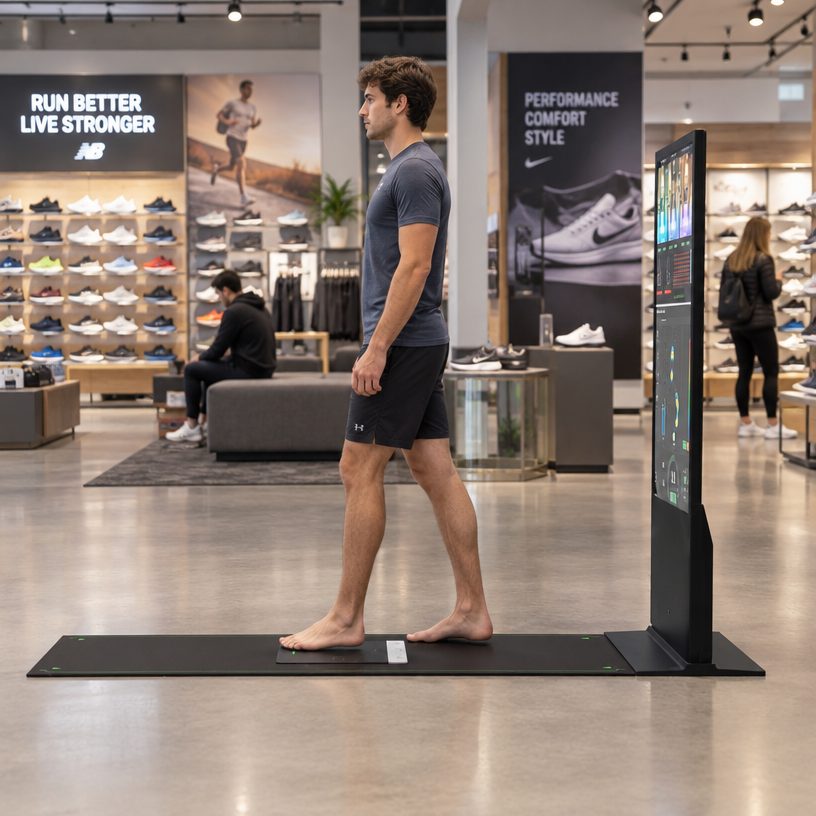
How the two records combine in a clinic room
For a podiatrist who already owns shape capture, the X3 is the second half of the picture: geometry on file, behaviour on the plate. The two records read together answer questions neither answers alone — a foot whose shape looks routine but whose walking record shows load concentrating where the shape said it should not. For a podiatrist deciding what to buy first, our advice is the same whichever way the search started: buy for the question the room cannot answer today. If that question is fit and form, buy shape capture. If it is load, arch behaviour and alignment, the X3 covers it — and covers the insole step in the same room, since the customization module turns the record into a product chairside instead of sending the patient away to wait.
Consistency between visits is where support calls earn their keep. Our engineers, on a WhatsApp support call, recently walked a clinic through why their follow-up records looked nothing like their baselines: the walk-through pace differed between operators, and the armrest was being used in one session and skipped in the next, which changed how the patient settled onto the plate. The fix cost nothing — one written routine for the walking passes and the video capture, applied by every operator. The hardware had not changed; the discipline around it had. That is the kind of issue a support call resolves, and it is included in what follows delivery: a dedicated technical and product team, a WhatsApp group with our engineers, remote assistance where a screen can be shared, and over-the-air updates for connected units. Where a clinic needs a particular report layout or workflow, the software can be customised, and that work is quoted separately from the equipment.
The database is also where the record compounds. Because each session adds foot-sole and alignment images to the same foot and ankle health database, a clinic that runs the X3 across a season of patients — or across repeat visits from the same patients — ends up with a series it can read, not a folder of one-off prints. A children’s fitness institution uses that series to watch how a young foot’s arch behaviour and alignment track over months of growth; a foot therapy centre uses it to compare how a returning client’s load pattern sits against their earlier visits. The value is in the second record and every one after it, which is why the capture routine matters more than any single impressive picture.
Frequently asked questions
Is the X3 a 3D foot scanner?
No. “3D” is the market label for devices that capture the shape of the foot. The X3 is a Foot Pressure And Force Line Detection Insoles Customization System: it records static and dynamic foot pressure, foot arch type, lower-limb biomechanical alignment and a back-and-forth gait video, and it customizes insoles on site. It does not capture foot shape, and we do not present it as a shape scanner.
What does the back-and-forth gait video add to the pressure record?
The pressure plate shows where and when load lands; the video shows the movement that produced it. Because the X3 records the patient walking back and forth on video alongside the pressure capture, a professional can replay the exact passes behind the data — useful when explaining a finding to a patient, and useful when two operators need to check that the same walking routine was followed.
How does the AI shoe recommendation work?
The system recommends shoe models based on the shoe product information entered into it. The recommendation is only as good as the catalogue behind it, so a store or clinic has to enter and maintain its shoe list. Buyers who plan for that catalogue work from day one get steady value from the feature; those who skip the entry step see little from it.
How does a patient receive the report?
Three ways: the patient scans a QR code to retrieve the report, fills in an email address to receive it, or the clinic prints it on site. The report itself notes that the data is for reference only — the machine produces a measurement record, and clinical interpretation belongs to the professional.
What does the on-site insole customization module include?
The customization kit ships with a set of shaping pillows and a heating box, alongside the X3 machine, pressure plate, armrest and floor mat. With it, a clinic produces a biomechanical insole on site in the same appointment as the assessment, so the record that justified the insole is the record the insole was built from.
Which rooms does the X3 suit, and what support comes after delivery?
The manual lists podiatry clinics, shoe stores, children’s fitness centres and foot therapy centres. Pre-sales consulting runs before the order; after delivery, a dedicated technical and product team takes over through a WhatsApp group with our engineers, remote assistance where a screen can be shared, and over-the-air updates. Software customization for a particular report layout is available and quoted separately.
What we would do next
Write down the two columns from the section above — what the foot looks like, what the foot does — and mark which column your room cannot currently answer. If the right column is the gap, send us the list together with your floor dimensions and who will operate the machine, and we will confirm what the X3 covers in your space, including the walk path the dynamic passes and gait video need. Our X3 foot pressure and force line system page carries the system overview, and our FAQ page lists the order, warranty and delivery terms in full.
If you already run shape capture and are weighing a pressure-and-alignment record alongside it, tell us what your current reports stop short of. We will show you a sample X3 report and walk through which fields map to the questions your room asks. Contact details are on the contact page.
This article is intended for professional and educational reference. It is not medical advice. Foot assessment equipment produces measurements and images; clinical interpretation and any decision about care remain the responsibility of a qualified professional. Certification scope is limited to the documentation we hold: European Union certification and ISO quality system certification.