
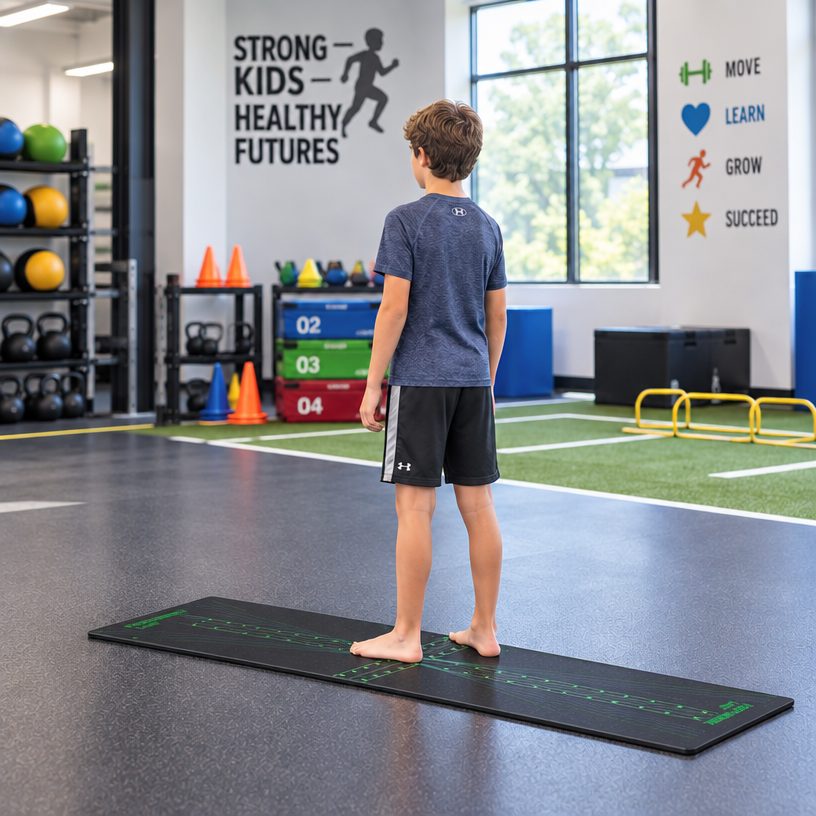
The first customer of the day stands on the assessment area at nine, and the floor beneath it has not been crossed since yesterday afternoon. The room is cold. Nobody has spoken yet. The customer takes off shoes that were tied in a hurry, steps up, crosses, and the record that comes out is quiet, tidy and — if you have been running sessions long enough — somehow unlike the records you get at half past two. Not better. Not worse. Different, in a way that is easy to feel and hard to write down. This piece is about that difference: why the first gait record of the morning rarely resembles the afternoon ones, what the room and the customer each contribute to it, and what you can hold constant so an early record can be compared fairly with everything else in the file.
The nine o’clock foot and the eleven o’clock foot
By nine you have switched everything on, made the coffee and taken the first name off the list. By eleven you have settled into the rhythm of the day, and so have your customers. The two captures that come out of those hours are measurements of the same kind of walk, yet experienced clinicians will tell you the files do not feel alike. Part of that difference belongs to the customer, whose body is also starting its day. Part of it belongs to the room, which has spent the night empty and cool. Neither part is an error. Both belong in the file.
Start with the customer. For most people, the walk into your room is the first sustained walking they have done all day. The shoes were tied in a hurry, the feet came out of slippers an hour ago, and the first few hundred steps of anyone’s day are not made the way the four-hundredth step is made. A customer who arrives at four in the afternoon has been walking, standing and shifting for hours before they reach you. The same person at nine is, in a very real sense, walking a version of themselves you will not meet again until tomorrow.
Then the room. A quiet, cool, uncrossed floor is a different surface to walk across than a busy, warm, repeatedly crossed one, and the air on bare skin differs too. A record taken in that state is an honest measurement — but it is a measurement of a specific morning, and mornings differ from afternoons in ways worth managing rather than ignoring. The rest of this article is about how to manage them without turning your first appointment into a smaller version of a laboratory protocol.
The room has been waiting overnight
An assessment corner that sits idle overnight is not the same environment at nine as it is at midday. The air has cooled. The floor has cooled. Even in a well-heated building, corners near doors and windows drift overnight, and the first hour of trading is spent warming the space back up with customers inside it. None of this is dramatic. All of it is the kind of slow, ordinary drift that never announces itself in a single record and only becomes visible when you compare files taken across a day.
The equipment is usually the steadier part of the picture. Modern assessment hardware runs its own start-up routine and behaves consistently once it is running; what drifts is everything around it — the surface the customer crosses, the air they cross it in, the state of the feet themselves. It follows that the useful morning routine is not mainly about the machine. It is about giving the room time to reach its ordinary working state before the first customer steps onto it.
Make it a fixed sequence rather than a feeling. Heating on, lights on, equipment switched on at the same point every day, doors closed, and the first capture not scheduled before the room has arrived at the state it will occupy for the rest of the day. We have argued before for a fixed settling window before any capture (The First Two Minutes: Letting Feet Settle Before a Capture); the same logic applies to the room itself, and we have also written about what a warm versus cool contact surface contributes to a footprint (The Warm Mark on a Footprint Board: What Temperature Adds). A routine that treats the room as one more thing that needs settling costs almost nothing and removes one whole category of doubt from every early file.

The customer’s morning matters more than yours
Two customers, both booked at nine. One walked to the station, stood on a crowded train and climbed the steps to your floor. The other drove from a garage straight to your door and has been seated since breakfast. By the time each takes off their shoes, their feet have done completely different work — and no two first records of the morning are therefore taken under quite the same conditions, even in the same room, on the same equipment, minutes apart.
You cannot standardise a commute. You can only ask about it. Two questions at greeting do the work, and they belong in the script, not in small talk that evaporates: “How did you get here today?” and “How long have you been up and moving?” The answers take fifteen seconds, and they turn the nine o’clock record from an unexplained outlier into a documented measurement of a documented morning.
Some customers will volunteer more without being asked: that their first hours on their feet feel different, that mornings are when they notice things, that they chose the early appointment deliberately for that reason. Write down what they say, in their words. It is not a finding, and a platform will not measure it — but it is context that changes how the measurement should be weighed, and it travels badly if it only lives in the conversation. The sheet is where context survives the week.
What to hold constant before the first capture
The first thing to hold constant is the settling routine, and it should be identical for the nine o’clock customer and the three o’clock one. Shoes and socks off, a few minutes seated, a couple of informal crossings of the room, and only then the first formal pass. When everything downstream of arrival is the same, the time of arrival itself stops contaminating the comparison, because what you are really comparing is like with like: two captures that each followed the same runway.
The second thing is the room, and the practical tool for it is embarrassingly small: a card by the switch panel. On the card, the opening sequence — heating, lights, equipment, door — and a note that the first capture waits until the room has reached its usual working state. Two different practices will draw the line in different places, and that is fine. What matters is that your line is written down and drawn in the same place every day, so the early file from January and the early file from June were made in rooms that had been treated the same way.
The third thing is honesty about what cannot be held constant. The commute, the breakfast, the state of the customer’s day — none of it is controllable, and pretending otherwise turns the intake conversation into a ritual that produces no information. Record it instead. A worksheet column headed “how they got here” does more for the fairness of cross-day comparisons than any amount of scheduling discipline applied to the parts of the morning you cannot touch.
Comparing early records fairly
The tempting comparison is the one the calendar makes easy: this month’s nine o’clock record against last month’s three o’clock one, because those were the slots that were free. If the question the assessment is for concerns change over months, that comparison starts life compromised. Whatever difference shows up between the two files contains, mixed into it, the difference between a cold early room and a warm afternoon one, between a first-walk-of-the-day foot and a well-warmed one. The feet may have changed; the conditions certainly did.
When the diary forces a mismatch, the conditions travel with the record. Write them next to it, on the same page, in plain words. A record is a measurement of a specific crossing, on a specific day, under specific conditions — and the conditions include the clock. A file reader who can see “early slot, cold start, customer walked twenty minutes before arrival” can weigh the record intelligently; a reader who sees only a clean pattern cannot.
There is a working rule worth adopting in team meetings: before anyone concludes anything from a difference between two records, check the conditions columns first. A surprising share of apparent change between files taken at different hours dissolves once the arrival times, settling windows and room states are laid side by side. The remaining difference is the one worth thinking about, and it is usually smaller than it first looked — which is itself a useful thing to know before any further conversation happens.
What the sheet should carry about the morning
Four short lines make a morning record portable. Line one: the arrival time and whether it was the first capture of the day. Line two: how the customer got here and how long they had been up and moving — one plain sentence, “walked from the station, up about two hours” is exactly right. Line three: the room state, “usual start” or “unusual, note what differed”. Line four: anything the customer volunteered about their early hours, in their own words.
The point of the four lines is the next reader of the file, which may be a colleague, a referrer, or you in three months. A file that says “quiet contact pattern” means one thing on its own and a different, better-defined thing next to “first capture of the day, cold start, customer drove in”. The pattern did not change between those two readings; the weight it should carry did. Documentation is how the weight travels with the measurement instead of being re-invented — or lost — by whoever opens the file.
Keep the wording descriptive and plain. “Early slot, cold start, customer said mornings feel different” is a record. “Suggests a problem” is a conclusion, and conclusions belong to the qualified professional reading the whole file, not to the sheet that carries it. The same discipline applies here as everywhere else in documentation: write what happened and what was said, and leave the interpretation to the person holding the complete picture.
When the early slot is exactly the right slot
Having spent this long treating the morning as a condition to manage, it is worth turning the framing over. For some assessments the early hour is not a nuisance at all — it is the point. If the question a session is meant to answer concerns how this person walks in the first hours of their day, then the nine o’clock record is not a compromised version of the afternoon one. It is the representative one, and the afternoon record would be the artefact.
That is why the intake question matters more than the schedule. “What is this assessment for?” decides which slot is fair. A practice that knows its own diary can book deliberately: early slots for the questions that belong to early hours, later ones for everything else, and the sheet records which was chosen and why. What it must never do is pretend the two slots are interchangeable, because the customer’s own account of their day is usually the first thing to contradict that pretense.
Through all of it, the equipment’s part stays deliberately small. A plantar pressure and posture system such as the F2P will record a nine o’clock crossing and a three o’clock crossing with the same indifference; deciding what the difference between them means, if it means anything, is the qualified professional’s work and not the machine’s. The tool records. The room, the clock and the commute are context. The file that keeps all three together is the one that can still be read honestly a year later.
Frequently asked questions
Why does the first record of the morning look different from afternoon records?
Two conditions differ at once. The room has spent the night empty and cool, and the customer is taking their first sustained walk of the day. Neither is an error; both are context. A fixed settling routine for the room and the customer removes most of the gap, and whatever remains should be documented rather than ignored.
Should I stop booking early appointments and keep everyone until midday?
No. Early slots are useful, and for some assessment questions they are the most representative option. The goal is not to avoid mornings but to treat them consistently: the same room routine, the same settling window and the same worksheet lines, so an early record can be compared fairly with other early records.
How long should a customer settle before an early capture?
Long enough that the sequence is identical to your afternoon one. Shoes off, a few minutes seated, a couple of informal crossings, then the first formal pass. The exact duration matters less than the fact that it is the same sequence for every customer, at every hour.
Does the equipment itself need warming up before the first customer?
Follow the start-up routine the manufacturer specifies and keep it identical every day. The steadier part of the picture is usually the hardware; what drifts overnight is the room around it — air, floor surfaces and the state of the customer’s feet. Direct your routine at the room and the settling sequence.
Can I compare this month’s morning record with last month’s afternoon record?
Only with the conditions written next to both. If the question concerns change over months, compare like with like wherever the diary allows. When a mismatch is unavoidable, record arrival time, settling, room state and the customer’s own account of their day, and weigh the comparison accordingly during interpretation.
What exactly should I write on the sheet about the morning?
Four lines: arrival time and whether it was the first capture of the day; how the customer got here and how long they had been up; the room state, noted as usual or unusual; and anything the customer said about their early hours, in their own words. Plain description, no conclusions.
Is a cold-start record a poor-quality record?
No. It is an honest measurement of a walk taken in a specific room at a specific hour, and it can be genuinely representative when the assessment question concerns early hours. It becomes misleading only when its conditions are lost — which is why the conditions belong on the sheet beside the record.
What we would do next
Two changes this week, neither of them expensive. First, the card by the switch panel: the room’s opening sequence written down, with a line stating when the first capture of the day may happen. Second, the four morning lines added to the worksheet, asked at greeting in the same flat script every time. Between them, the two changes turn the nine o’clock file from a feeling into a documented measurement of a documented morning.
The wider habit behind both is the same one that governs every other fairness question in this work: the clock is one more condition that travels with a record, exactly like the number of passes behind it (Walk In, Walk Across: How Many Passes Make a Fair Record). Conditions on the sheet, measurement in the file, interpretation left to the professional holding the whole picture.
And a question for the rooms that run early slots every day: if your own morning files and afternoon files look reliably different, which one earns its place in the comparison — and does your worksheet currently carry anything that would let the next reader tell why the choice was made? We would genuinely like to hear how other practices handle it.
This article is intended for professional and educational reference. It is not medical advice. Foot assessment equipment produces measurements and images; clinical interpretation and any decision about care remain the responsibility of a qualified professional. Certification scope is limited to the documentation we hold: European Union certification and ISO quality system certification.