
A foot analyzer in a workshop produces a record, and a record is not an order; the gap between the two is a workflow that most installations leave unwritten. The capture takes seconds, the design takes minutes, and the handover between them is where pairs get lost, specifications get assumed and remakes get born.
Workshops that produce in-house discover this in the first month. The machine works, the software works, and the pair that arrives does not match the conversation that produced it — because the conversation was never converted into fields.
This article describes the handover in detail: what the analyzer records, what has to be added before production, who owns each step, and how to check the loop closes. We build assessment systems and produce insoles, so both sides of that handover are described from our own process.
What the analyzer contributes
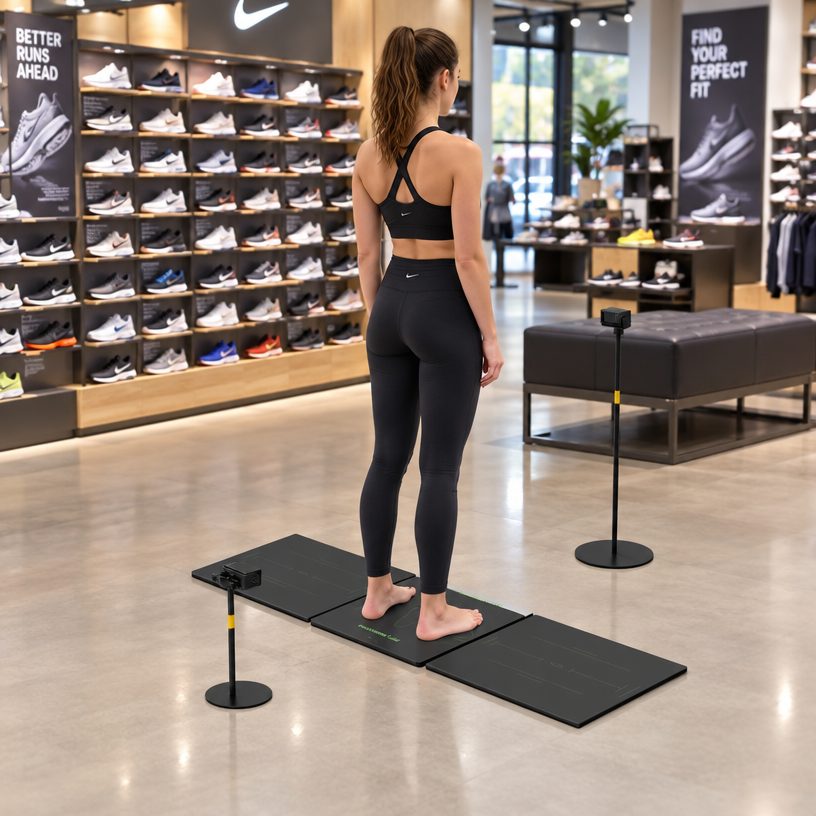
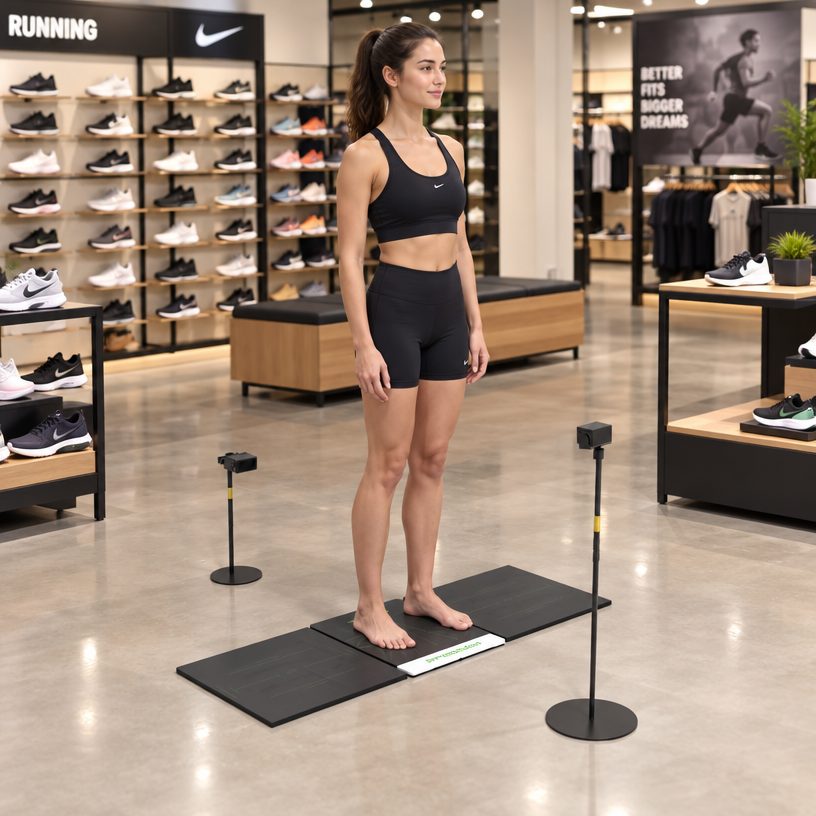
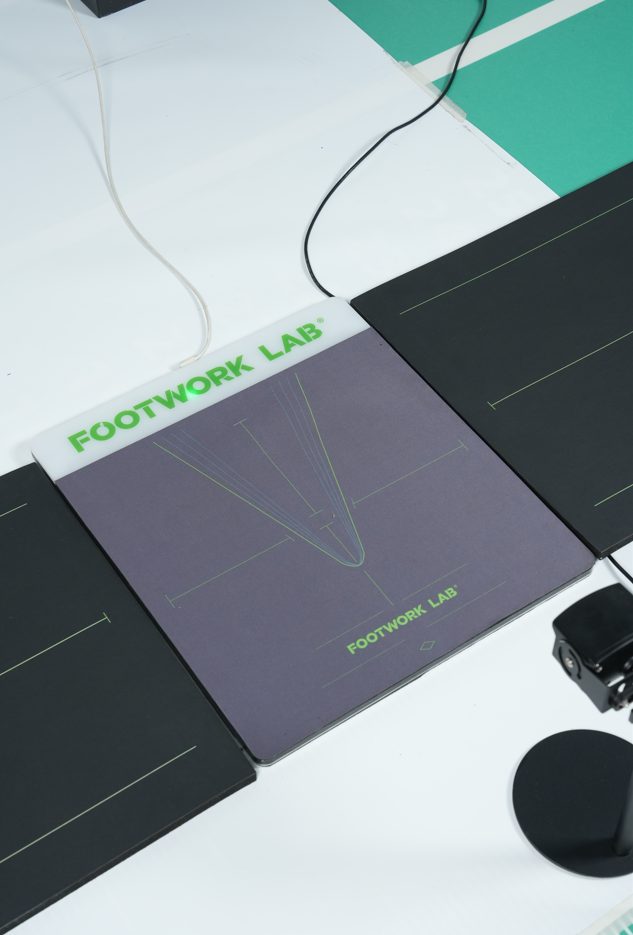
A foot analyzer records load distribution and, in many systems, alignment or posture. It produces a measurement and a set of images that a client can understand and a technician can act on. That is a substantial contribution and it is not a specification.
What the record gives the workshop is the starting point for geometry: where load sits, how the contact area is shaped, whether the two feet differ, and how the alignment above the foot looks. It gives direction, not dimensions.
The distinction matters because a design built directly from a pressure map tends to reproduce the map rather than to address it. A map shows load as it is; a design has to decide what to change and by how much, which is a judgement informed by the map rather than derived from it.
So the analyzer’s output is an input, and the workshop’s first task is to add the judgement that turns it into a brief.
It is worth separating what the record shows from what the client sees. The technician reads regions and timings; the client reads a picture and a sentence. A system that serves both in one screen shortens the appointment, and one that serves only the technician lengthens the explanation.
The four fields the record cannot supply
Design intent: one sentence describing what the pair should do, in behaviour terms. Support the medial region during daily wear; cushion the forefoot for long standing; accommodate a prominent navicular. The record cannot write that sentence.
Arch geometry in buildable terms: height, width, apex position, blend. The record informs all four, and none of them can be read off a map without a decision about direction.
Shell stiffness family and cover: a choice tied to the wear context and the shoe. The record says nothing about either, and both change how the pair behaves in use.
Footwear context: the target shoe, its volume, whether its footbed is removable. This is the field most often missing and most often responsible for a pair that is right in the hand and wrong in the shoe.
It also helps to write the intent sentence before looking at the map. A designer who looks first tends to design towards the picture, which is the most common way a specification becomes a copy rather than a brief.
There is a useful discipline for the handover: write the intent sentence before the design software is opened. A designer who starts with the file tends to follow it; one who starts with the sentence tends to use it, and the difference is visible in the finished pair.
It is worth writing down what the record is not allowed to decide. A pressure map should not select a shell, a cover or a stiffness family on its own, because those choices belong to the brief and to the shoe, and a workflow that lets the picture decide will produce consistent-looking pairs that satisfy nobody.
Who owns each step
The capture is owned by whoever runs the appointment, and their responsibility is the protocol: position, footwear, repeat captures where needed, and the naming convention for the record. A capture without a name is a capture that will be lost.
The design is owned by whoever writes the specification, and their responsibility is the brief: intent, geometry, materials, shoe. This is the step that requires experience, and it is the step most often compressed to save time.
Production is owned by the workshop, and their responsibility is fidelity: the pair matches the specification, the checks confirm it, and the deviations are recorded. Production does not own the design, and workshops that let it do so drift towards whatever is easiest to form.
Checking is owned by someone other than the producer where possible. A second pair of eyes on the finished pair against the field list catches the errors that the producer has already accepted as normal.
The form should also carry the client’s own words. A sentence describing what they notice — where it feels hard, when it happens, which shoe — is often the most useful line on the page, and it is the line that disappears first when the process is compressed.
It is worth writing the ownership on the form itself, with a name beside each step. Ownership written on a process document is a habit; ownership written on the form is a decision that survives a busy week.
Writing the handover form
Six fields close most of the gap: client reference, capture date and protocol, design intent, arch geometry, shell and cover, target footwear. One page, filled at the capture and completed at the design review.
The form is not administration. It is the artefact that makes a remake a correction rather than an argument, because it records what was asked for at the time rather than what is remembered afterwards.
It also makes the workshop faster. A designer receiving a completed form spends minutes on a pair instead of reconstructing context from a conversation, and the time saved on the second hundred pairs is the real return on the first page.
Our own specification sheet follows that structure, which is why we ask for the target shoe alongside the arch width. It is one question that prevents a category of failure.
It is worth adding a seventh field, optional but useful: the previous pair. What was worn before, what worked and what did not. The answer saves a designer from repeating a mistake and gives the client confidence that the history is being used.
The form should also record who approved the design. A name against a specification is what turns a remake conversation into a review of a decision rather than a search for a culprit, and it takes a signature line.
Where the loop usually breaks
The most common break is at the design step, when the record is treated as the brief. The design then reproduces the current load pattern, the client reports no difference, and the workshop concludes that the equipment is limited rather than the specification.
The second is at the shoe. A pair designed for a firm walking shoe is delivered for a soft trainer, and the fit fails for reasons nobody recorded. Naming the shoe in the form is the fix, and it takes one line.
The third is at checking. When the producer checks their own work, deviations are normalised. A separate check against the field list takes two minutes and catches the small errors that accumulate into a reputation.
The fourth is at follow-up. A workshop that never records what the client reported cannot improve its intent sentences, and the intent sentences are where the workshop’s expertise accumulates.
A fifth break is at the naming convention. Two files called by the client’s first name and a date in different formats are two files that will be confused within a month. A convention that nobody has to remember because it is built into the form is the one that survives.
It is worth adding one more break that is easy to overlook: the machine’s own calibration. A workshop that never checks its surface will produce designs from a record that has drifted, and the drift is invisible because every record looks plausible.
What in-house production changes commercially
In-house production changes the promise. A workshop that captures, designs and produces can offer a shorter cycle, a fitting conversation and a remake route that does not involve a third party. That is a genuine service advantage in most markets.
It also changes the cost structure. Machine time, material, labour and checking all sit inside the workshop, which means the break-even point is volume-dependent. Workshops that under-price the design step tend to discover it in the third month, when the remakes arrive.
Our own production numbers are useful as a reference point: two hundred pairs minimum when ordering from us, roughly five hundred to a thousand pairs a day of capacity, samples within three days. A workshop building its own line should expect its first months to be slower than those figures by a wide margin.
The commercial argument for in-house is not cost per pair at low volume; it is control over the cycle and the relationship. Workshops that understand that price accordingly, and they tend to keep the service rather than lose it to a cheaper competitor.
In-house production also changes what the workshop can promise about adjustment. A pair produced on site can be modified on site, which is a service a factory order cannot match, and it is worth naming in the market’s language rather than leaving implicit.
It is worth noting what in-house production does not change: the need for a specification. A workshop with a machine and no fields produces faster versions of the same uncertainty, and speed makes the uncertainty more expensive rather than less.
It is worth modelling the workshop’s break-even before the machine is ordered. With design time, production time and checking time included, the number of pairs needed to cover the month is usually higher than the first estimate, and knowing it early changes the price list rather than the equipment.
A first-month routine
Week one: capture only, no production. The goal is a protocol that two people can follow and a naming convention that makes records findable.
Week two: design reviews on paper. Take five records and write the six fields for each, without producing anything. The reviews expose which field is habitually missing in your workflow.
Week three: produce a small batch and check every pair against the form. Record the deviations in categories rather than sentences, so the pattern becomes visible.
Week four: change one thing based on the deviations, and rewrite the form if a field was consistently unclear. That loop, repeated monthly, is what turns a machine into a production capability.
The routine should end with a written note of what changed and why. Twelve notes a year make a small manual, and the manual is what allows a second workshop to be opened without relearning everything from the beginning.
The monthly loop should also revisit the form itself. Fields that nobody fills are fields that should be removed or reworded, and a form that is refined three times in the first year tends to survive the second year unchanged.
The routine should also include a short review of the client’s report. What they noticed, what changed, and whether the intended effect appeared. Three lines per pair build a body of experience that no specification sheet can replace.
It also helps to keep a sample pair from each month on a shelf with its form attached. A physical archive of approved pairs is the fastest answer to the question of what the workshop was producing six months ago, and it takes a shelf rather than a database.
Frequently asked questions
What does a foot analyzer measure?
Load distribution under the foot and, in many systems, alignment or posture. It produces a measurement and images; it does not produce a design specification on its own.
Can we produce insoles directly from the record?
Not reliably. The record needs a design intent, arch geometry in buildable terms, a shell and cover choice, and the target footwear. Without those, production reproduces the current load pattern rather than addressing it.
Do you supply both analyzers and insole production?
Yes. We build assessment systems and produce custom insoles, which allows the record and the specification to come from one supplier with one handover form.
What are your production terms?
Two hundred pairs minimum for insoles, mixable across models and sizes; samples within three days; capacity of roughly five hundred to a thousand pairs a day; transit by express, air or sea.
How do we avoid remakes?
Record the six handover fields, have someone other than the producer check the pair against them, and keep the client’s report with the record. Remakes usually trace back to a missing field rather than a production error.
What support comes with the equipment?
A dedicated WhatsApp group with an engineer, remote assistance for capture and workflow questions, and software updates delivered over the air to connected units. Machines carry a twelve-month warranty against non-human damage.
Can the analyzer be used for fitting as well as production?
The record supports the fitting conversation — a client can see the load pattern and the alignment image — but the fitting decision remains with the person trained to make it.
What we would do next
Write the six-field handover form before the first pair, and have someone other than the producer check against it. The F2 and FMP pages describe the analysis systems we build, and Our Factory covers the production side of the same loop.
The article on workshop setup covers the room and services that surround an in-house line; the two decisions are usually made in the same month.
This article is intended for professional and educational reference. It is not medical advice. Foot assessment equipment produces measurements and images; clinical interpretation and any decision about care remain the responsibility of a qualified professional. Certification scope is limited to the documentation we hold: European Union certification and ISO quality system certification.