
Orthotic sport insoles are ordered by sport, not by size. A size tells a factory which shell to cut; a sport tells it what the shell has to survive. Buyers who brief by sport — running, court, field, cycling — end up with a range that holds up on the shelf and under the customer. Buyers who brief by size table end up with one design in many lengths, and the returns that follow. This article is about briefing by sport, and what that changes at the factory.
Running loads a foot differently from basketball, and both differ from cycling. The runner’s foot absorbs repeated impacts that accumulate over kilometres; the court player’s foot brakes, cuts and re-accelerates inside the shoe; the cyclist’s foot presses a narrow pedal with the forefoot doing most of the work. One shell cannot serve all three honestly. When a retailer explains this on the shelf, the sale becomes an act of matching rather than persuasion — and matching is what repeat business is made of.
Established in 2014, we manufacture custom orthotic insoles and the foot assessment equipment that feeds them, with our own plant in Ruichang, Jiangxi in production since 2018 for clinics, retailers and distributors across export markets. The sport range is described here from the production floor: what each sport’s brief changes in the design file, how materials bound the outcome, and how a smaller dealer can test a sport assortment without betting a season. Where a claim would outrun the product, the article says so plainly.
Why size-led sport ranges fail
A size grid answers two questions: how long and how wide. Sport asks a third question that the grid cannot hold — what does the foot do for a living during this activity? A runner’s foot repeats one pattern thousands of times per session; a court player’s foot cycles through braking and cutting in every direction; a cyclist’s foot is clamped to a pedal while the forefoot takes the hour. A single design stretched across sizes inherits the weakest compromise of all three, and customers feel the compromise within a week of wear — and a return follows soon after.
The failure mode is predictable. Cushioning tuned for a runner’s stride feels unstable to a court player who needs a firm edge to push against during a cut. The firmer shell that steadies lateral movement feels dull under a runner’s repeating step. A cyclist, meanwhile, wants a platform under the forefoot and little else — heel cushioning meant for running is mass where the cyclist has none. None of these are defects of the designs; they are defects of the briefing, and the briefing is written by the buyer, not the factory. Naming the sport in the brief removes the guess.
A sport-led brief is short to write. It names the activity, the weekly hours, the surface or court type, the shoe the insole must live in, and the intensity the customer actually trains at rather than aspires to. Five lines carry more production value than a full size chart, because they let the factory choose shell stiffness, cushioning thickness and top cover against a real workload instead of a generic one. Our specification template carries those fields on its first page, and dealers who fill them in get designs that survive their customers’ seasons. The template ships with every quotation.
Running: repeated impact under a rising workload
Running is the most briefed sport in our workshop and the easiest to get wrong. The load signature is repetition: the same heel-to-forefoot sequence, thousands of times per week, with the workload climbing as a training block progresses. An insole that feels right during an easy week can feel flat once the mileage climbs, because the cushioning was chosen for a moment rather than for the ramp. The brief that works states the training phase too — base building, race preparation or return from a layoff — so the design targets the load the customer will actually place on it.
In the design file, a running brief moves several regions at once. The heel cushioning layer thickens against the landing, the forefoot keeps enough resilience for push-off, and the shell stiffness sits in the middle family — firm enough to hold the arch through a long session, forgiving enough that it does not argue with the foot on every step. The top cover matters more than buyers expect: a running insole moves inside the shoe, so the cover’s friction against the sock decides whether the foot drifts or stays seated over a long session. Friction complaints usually start there.
For a retailer, the running column of the shelf should segment by something the customer can answer in one sentence: easy running versus faster training, road versus trail, weekly volume in broad bands. A customer who hears their own week described back to them trusts the recommendation in a way no size chart achieves. And because running customers return — for shoes, for socks, for the next pair when training ramps — a running insole that matched honestly becomes the quiet engine of the whole footwear department’s repeat trade. The matching conversation, done well, is the product itself.
Court sports: cutting, braking and the lateral edge
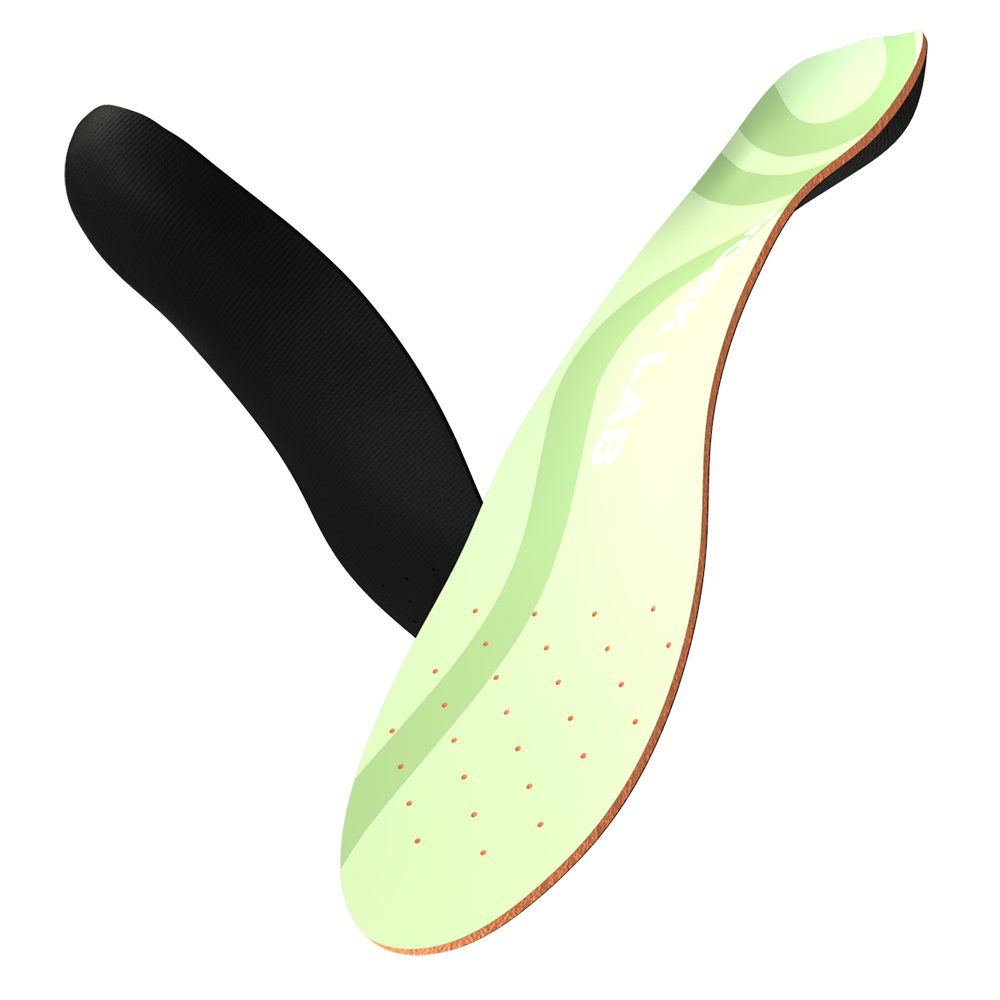
Court sports write a different brief. The defining load is lateral: the foot plants, brakes, and re-accelerates sideways, often with the body’s weight riding the outer edge of the forefoot. The insole’s job is to hold its shape under that edge loading instead of folding, which pushes shell stiffness up and cushioning thickness down relative to a running design. Height inside the shoe matters too — court footwear is cut low for ankle movement, and a design that assumes running-shoe volume will lift the foot until the shoe refuses to close. Briefing the shoe model avoids that failure.
The design decisions follow directly. The shell takes a firmer family with a cradle through the midfoot, so lateral force meets structure rather than foam. The forefoot region widens slightly to spread the braking load across more of the platform. The top cover favours grip over glide, because a foot that slides inside a cutting shoe loses its edge at the moment the point depends on. Cushioning is concentrated under the heel for landings and kept thin elsewhere, preserving the court feel that players notice within their first session. Every one of these choices traces back to the sport named in the brief.
On the shelf, court products sell through scenario talk rather than spec sheets. Ask which surface the customer plays on and how many sessions a week, then describe what the design does during a cut — that sentence closes more sales than any hardness number printed on a hangtag. Clubs and academies order in bulk and reorder by season, which makes the court column a wholesale opportunity as much as a retail one. A dealer who can brief us directly on their club’s surface and season gets a design matched to exactly that workload. That is the ODM conversation working as intended.
Field sports and cycling: two patterns worth separating
Field sports sit between the two. A footballer runs like a runner and cuts like a court player, on ground that may be soft, hard or waterlogged within the same month, and in footwear fitted close enough that spare volume barely exists. The insole for that brief stays low-profile, puts its cushioning where the stud pressure concentrates, and keeps the shell slender because the boot allows little thickness anywhere. Dealers who file field sports under running discover the mismatch when boots come back with insoles that crowd the toe box. The boot brief and the runner brief are different documents.
Cycling inverts the picture. The shoe’s sole is stiff by design, so the insole does not flex with the foot the way it does in running or court shoes; the load concentrates under the forefoot against the pedal, session after session, while the heel barely participates. A cycling design therefore builds its platform forward — a shaped forefoot that spreads the pedal load, a modest arch contour that keeps the foot seated on the insole rather than the shoe, and minimal heel cushioning because the heel carries almost none of the ride. Thin is not a compromise here; it is the specification.
The cycling column sells through a channel of its own — bike shops know their customers’ position on the bike and can brief precisely, which makes them ideal ODM partners for a cycling line. Segment by ride style: long steady road rides, indoor sessions, mixed commuting. Each places the forefoot under load differently, and the design can honour that without multiplying the range. A cycling line of three designs covers more honest ground than a dozen generic ones, because each design was written against a load pattern instead of a price point. The same logic holds for every sport column on the shelf.
How materials decide what a design can do
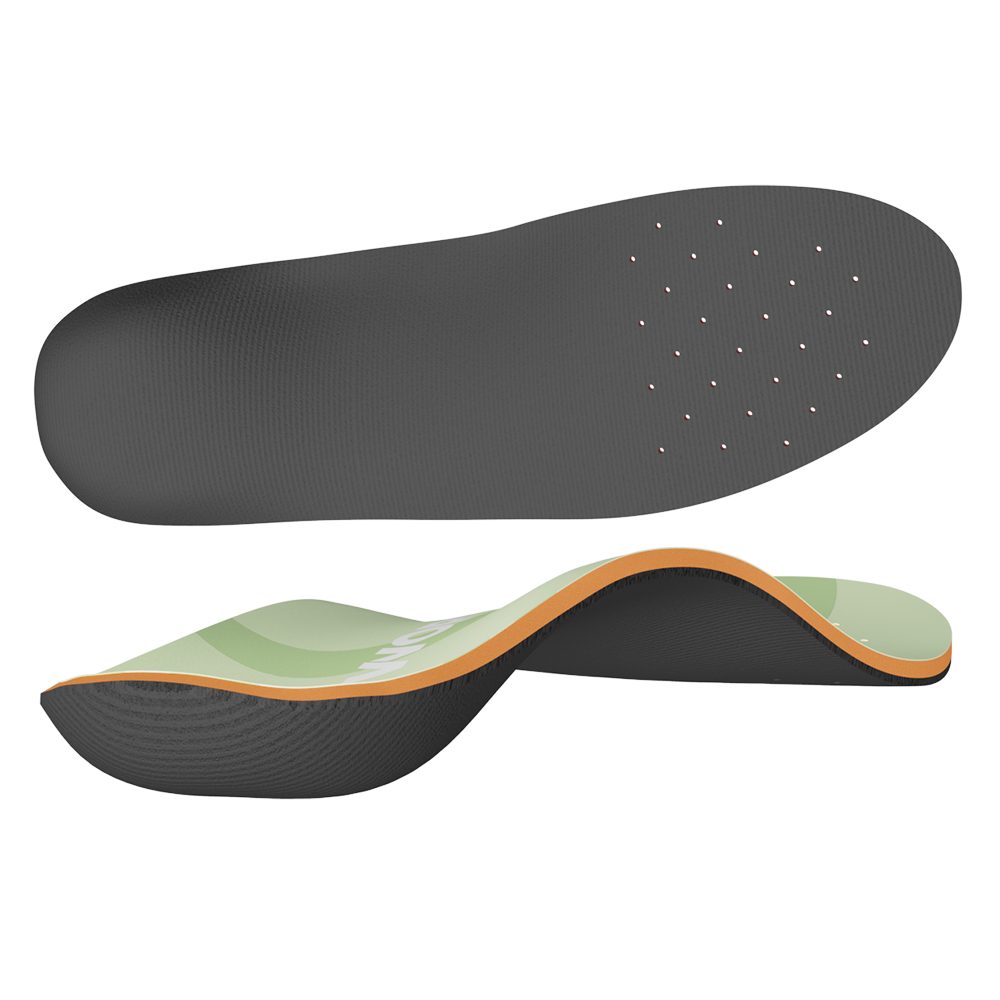
Every sport brief eventually lands on materials, and materials decide what the design can honestly deliver. The shell comes in stiffness families: softer shells flex with the foot and suit high-repetition running, while firmer shells hold geometry and suit court and field work where lateral force meets the insole edge. Choosing the family is a design decision, not a cost decision — the wrong family fails in the field no matter how well the rest of the file is written. Our catalogue carries the families explicitly so buyers can brief against them. Ask any supplier to state theirs in the quotation.
The cushioning layer carries its own trade-offs. Denser foams keep their shape through a season of high-mileage use but transmit more of the landing; lighter foams feel generous on the first wear and settle sooner. There is no foam that wins both, and a supplier who claims otherwise is describing a sample worn for an afternoon. In production we match the foam to the brief’s workload — a trail running pair and a court pair can leave the same line with visibly different cushioning stacks, each one suited to its sport. The specification decides, not the sample.
The top cover is the smallest material decision and the one customers touch first. In sport, the cover works against the sock: too smooth and the foot drifts inside the shoe during cuts; too grippy and it drags during a long stride. Sport covers also face moisture, laundering and the abrasion of a shoe that moves, so the material must survive the season rather than the fitting room. We offer cover options by wear scenario, and the brief’s daily-hours field is what tells production which option to fit. That field is on the first page of the template for a reason.
Building a sport shelf that holds up
A sport insole range succeeds or fails at the shelf, and the shelf should be organised by sport before anything else. Four columns — running, court, field, cycling — each holding two or three designs, explain themselves faster than any poster. Size runs live inside each column. Signage should carry the wear scenario in one line: what the design is for, which sport it matches, and what shoe type it expects. A customer standing in front of four labelled columns self-selects in seconds, and the staff conversation starts from matching instead of persuasion. Matching conversations return; persuasion conversations end.
Staff readiness is the second pillar. The questions that matter at the counter are simple: which sport, how often, which shoe. Staff who can explain why the court design is firmer than the running design — and why that firmness would feel wrong under a runner — sell across columns with confidence. The honest boundary belongs in the same training: sport insoles shape how load is distributed inside the shoe; they do not change the structure of the foot. Dealers who state that boundary to customers report fewer returns and stronger repeat relationships. The boundary protects the sale as much as the customer.
Sequencing beats scale when the range is new. Start with the two columns your customer base actually asks for — for most shoe retailers that is running first, court second — and hold the others until the first columns prove their sell-through. Samples ordered before the first wholesale order tell you how the designs wear before your customers wear them. This is exactly why our minimum structure exists: a range can be tested in the market without the commitment of a full-line launch, and expanded column by column on evidence rather than optimism. Evidence-led expansion is how durable ranges get built.
Records first, then design — and terms that make testing possible
For sport customers, the strongest workflow runs record first, design second. A plantar pressure assessment shows where load actually lands during the customer’s own movement — and in sport, that map surprises people often, including the professional. A runner whose heel complains on long sessions may show forefoot concentration on the record; a court player convinced the heel does the braking may show the outer forefoot doing it instead. The brief written from a record matches the design to the foot as it performs, not as the customer imagines it. Our assessment systems exist to feed briefs like these.
The record travels to production through the specification, not around it. Fields a professional selects — pressure regions, standing and walking observations, the shoe context — feed the design file, and the professional decides what the factory receives. Our equipment is a foot assessment system in the measurement sense: pressure sensing plus camera posture capture plus analysis software, producing records that professionals read and annotate. Interpretation stays with the clinic or the fitter; the factory builds to what is written. That division of labour is stated in our manuals because it is what keeps records trustworthy across visits.
The commercial terms make small-range testing realistic. Our insole minimum is two hundred pairs, mixed across models and sizes, so a dealer can hold four sport columns without committing a warehouse to any one of them. Samples ship within three days; production runs in the hundreds of pairs per day; equipment ships after seven days of factory testing with a twelve-month warranty and a WhatsApp support group with an engineer on the line. We exhibit at trade fairs including Canton Fair and shows in Dubai, Vietnam, Brazil and Hong Kong, where these terms are discussed face to face.
Frequently asked questions
Why order sport insoles by sport instead of by size?
Size decides which shell length a customer wears; the sport decides what the shell must survive. Running, court, field and cycling load the foot in different patterns, and a design briefed by sport matches those patterns instead of averaging them. Sizing stays inside each sport column.
What is your minimum order for sport insoles?
Two hundred pairs, mixed across models and sizes. The structure lets a dealer hold several sport columns and test a new one without a full-line commitment. Mixed orders mean running, court and cycling designs can share one production run. Details are published on our FAQ page.
Can we get samples before the bulk order?
Yes. Samples ship within three days of agreement. The useful test places the sample in the target shoe under the target sport, then records what the production order should keep or change. Most dealers order a sample set across their planned columns before the first wholesale order, which shows how the designs wear before customers wear them.
Can we sell the insoles under our own brand?
Yes. Custom insoles are available as ODM and OEM, covering design to specification, branding and packaging, all agreed in writing before production begins. Sport columns work well under OEM because the wear scenario can be stated on the packaging. Sample pairs carry your branding too.
Can the equipment link to the insole orders?
Our foot assessment systems produce pressure and posture records that feed insole specifications. The professional selects which fields travel to the design file; the record does not order the insole by itself. Records export for follow-up visits, and the same specification works with any workshop that accepts written briefs.
What support comes with the equipment?
A dedicated WhatsApp group with an engineer, remote assistance for software questions, over-the-air updates for connected units, seven days of factory testing before shipment, and a twelve-month warranty. Support terms are stated in writing in every quotation. The same group stays open after installation.
Are you a factory or a trading company?
We are the manufacturer. Our plant in Ruichang, Jiangxi has produced custom insoles and assessment equipment since 2018, with insole capacity in the hundreds of pairs per day. Buyers are welcome to verify capacity and terms directly with our production team.
What we would do next
Tell us which sport columns your shelf is missing and we will return a design proposal against the brief fields above, with a sample plan and the two hundred pair mixed minimum stated in writing. Samples ship within three days of agreement, so a test range can be wearing within a fortnight.
If the assessment side is the gap, our foot assessment systems capture the pressure and posture records that turn sport briefs into specifications. Our FAQ page lists minimums, transit times and after-sales terms, and our contact page reaches the team directly.
This article is intended for professional and educational reference. It is not medical advice. Foot assessment equipment produces measurements and images; clinical interpretation and any decision about care remain the responsibility of a qualified professional. Certification scope is limited to the documentation we hold: European Union certification and ISO quality system certification.