
A customer books one appointment and leaves with more than a report: the assessment happens, the pair is moulded, and the finished build sits in her shoe before she walks out. That single-visit shape — feet analysed, alignment recorded, insoles formed on the bench at the back of the room — is what buyers usually mean when they ask for assessment and customisation in one room, and it is a timetable question before it is a hardware question. An hour has to hold the static, dynamic and balance records, the whole-body alignment items, the reading of the report, and the customisation bench, and something always gives when the hour was never planned. This article walks through that timetable on the FMP, a foot pressure and posture detection system with an on-site customisation module built into the same workflow. It covers what the foot record holds, what the whole-body alignment items add and where they stop, how the heating box and shaping pillows slot into the hour without stealing it, what genuinely leaves the room finished, and the limits we state to buyers before the room is fitted out — because one room doing three jobs needs to know, in advance, which job gets the minutes.
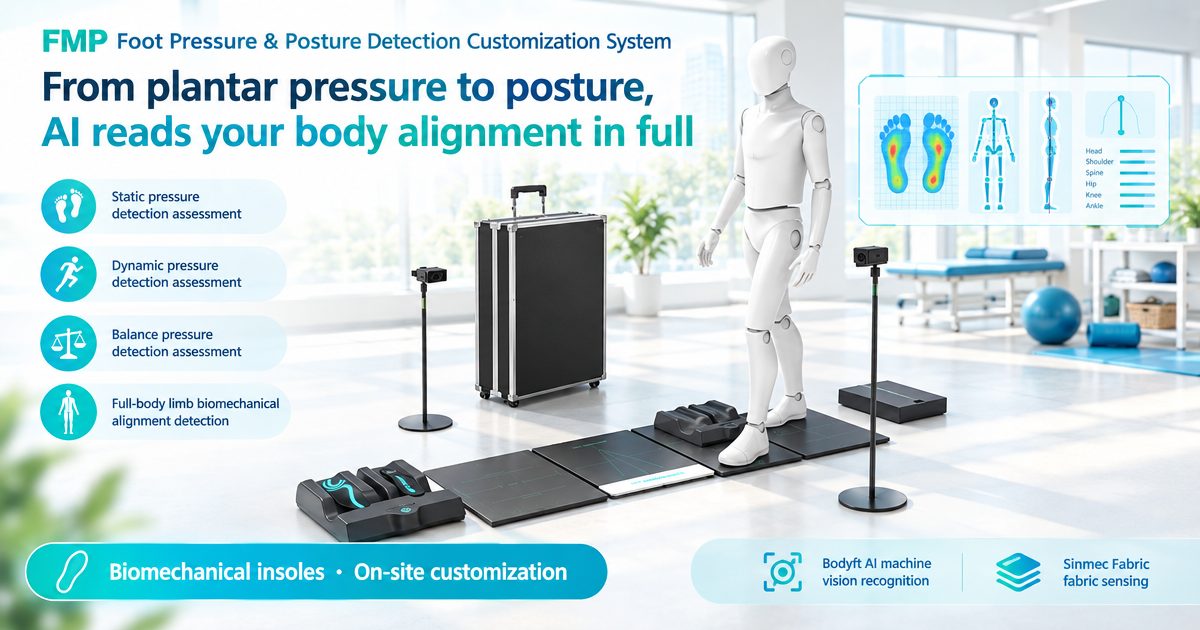
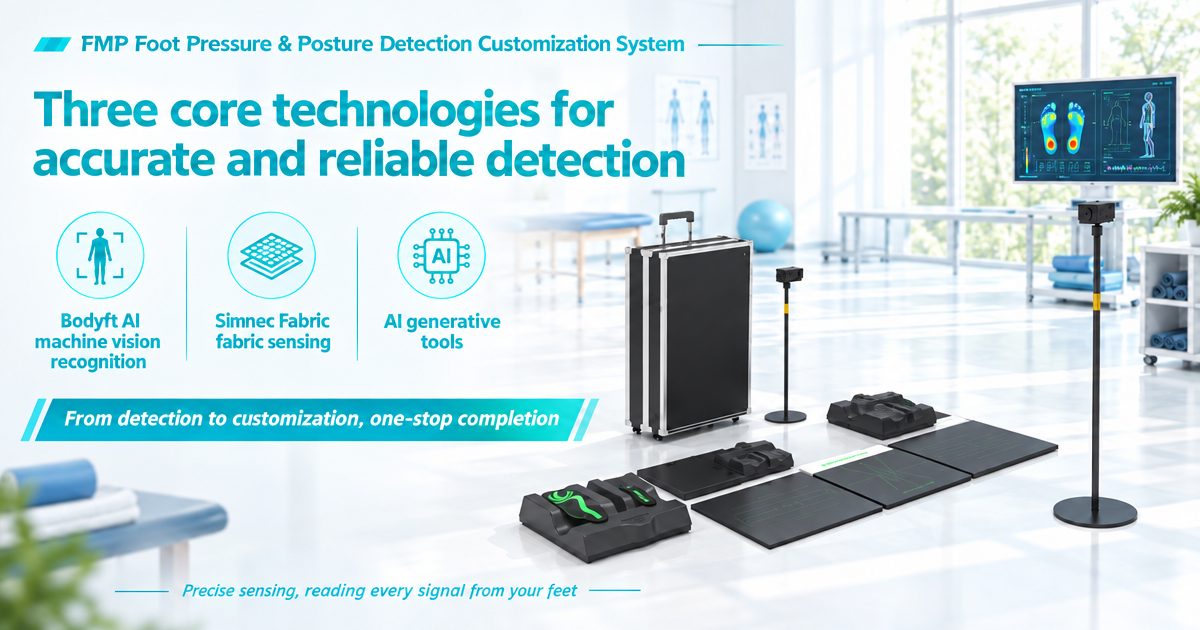
The platform first. The FMP is a foot pressure and posture detection system that records static, dynamic and balance states, adds whole-body limb biomechanical alignment to the foot data, and carries an on-site customisation module: a heating box, shaping pillows for adults and children, and the auxiliary pieces the bench work needs. The whole system travels in a carrying case, which is why the model appears in rehab hospitals, sports training institutions, sports venues, shoe stores, podiatry clinics and gyms — rooms that share a desire for the assessment and the fitting to happen in the same visit, and differ in almost everything else.
The room, the appointment, and what one visit can honestly contain
One room doing three jobs — capture, reading, bench work — lives or dies on the timetable written before the first customer arrives. The capture needs a quiet stretch: shoes and socks off, the on-screen prompts followed, the cameras seeing the customer from their marked positions. The reading needs a table and undivided attention. The bench needs heat, hands and time, and none of those compress well. A room that improvises the order each hour will produce records of varying quality and customers of varying satisfaction, and the two always move together.
The honest capacity of a single visit is: one complete assessment, one reading, and one pair formed and checked. What one visit cannot honestly contain is the second visit’s work. A pair that needs adjusting after the customer has walked on it for a week comes back — that is a feature of the process, not a failure of it — and the booking system should leave room for the return before the first appointment is made. Rooms that promise everything in one hour and no returns discover the promise costs more than the return visit ever would.
Portability changes the room question in a useful way. Because the system packs into a carrying case, the room does not have to be a fixture: a visiting session in a sports venue, a corner of a clinic borrowed for a day, a shoe store’s fitting table all work, provided the same discipline travels with the case. The floor marks, the prompt routine and the bench sequence belong to the kit, not to the furniture, and a mobile session that keeps them produces records that compare with the ones taken at home base.
The foot record: static, dynamic and balance in the same session
The static record opens the capture, and it rewards stillness more than anything else. Load resting under each sole at rest: the footprint length and width, the contact area, the distribution across the foot, and how the two sides compare. It is a pose, and the operator treats it as one — a snapshot of what the foot does when nothing is asked of it, taken barefoot, with the customer looking ahead rather than down at the plate.
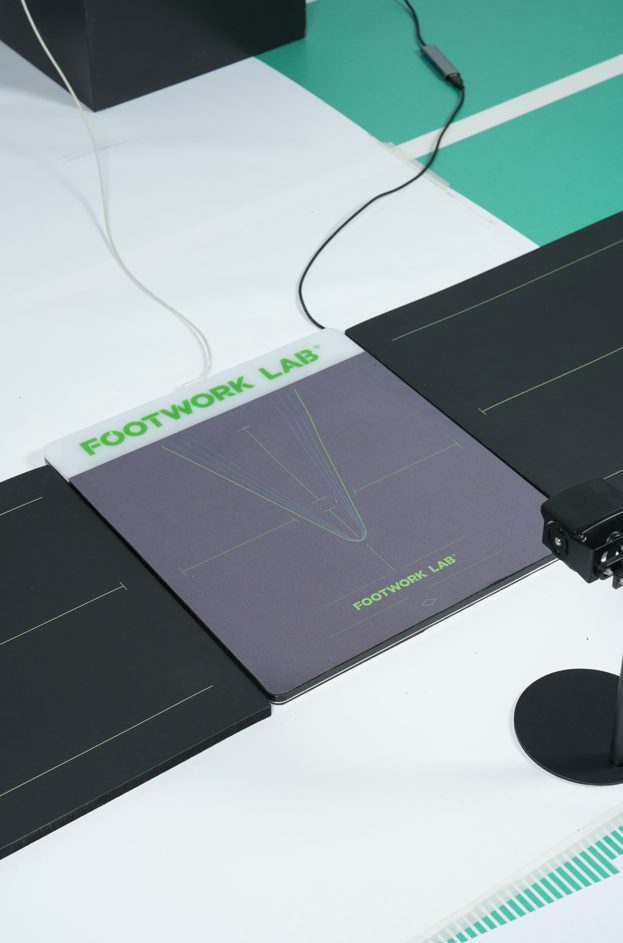
The dynamic record follows, and it is where the appointment earns its depth. The customer walks the plate a set number of passes, and the deck records where load travels under the sole through each contact: the foot axis angle, the shares of the contact and flat phases, peak and mean pressure, and the pace at which the centre of pressure moves forward. A crossing or two are thrown away first, because the opening pass is almost always a performance. The dynamic record describes a sequence rather than a pose, which is precisely the part a shelf of ready-made insoles can never see.
The balance record closes the capture, and busy rooms skip it more often than they should. Arms relaxed, the room quiet, the customer holding still while the plate records how the stance holds. It takes minutes and adds a dimension the other two cannot: how the person organises herself when the ground is the only task. Rooms that keep the balance record consistently have an extra column in every later comparison; rooms that improvise it per customer have a column they cannot fill at the retest.
The whole-body alignment items: what they add to a foot session
The alignment layer is what separates a foot record from a body record. Alongside the pressure capture, the system records how the limbs and trunk stack above the feet: the alignment of the knees and hips relative to the ground, the posture of the pelvis, the carriage of the shoulders, the tilt of the head. Cameras do the capture, the software lays the angles out, and the report shows the foot findings and the alignment findings on the same pages — which is the only way either set makes full sense.
Why it matters to the bench work is concrete. A pair formed under an arch while the knee tracks inward on the same side is being specified against half the picture. The alignment items do not tell the fitter what to build — that remains the professional’s reading — but they show the fitter what the foot is doing inside a body that is compensating around it, and the difference shows up in where the build carries its support and how aggressively the board resists roll. Fitters who work with the alignment pages visible during bench work make different, and in our experience better-placed, decisions about the same foot.
The limits of the layer deserve the same clarity as its uses. The recorded angles are quantities — where things sit, how they compare — and naming what an angle means for a particular person belongs to a qualified professional. A shoe store fitter reads the alignment record to fit a build; a rehab clinician reads it as part of a clinical picture. The same record serves both, provided neither reader pretends the record handed them a diagnosis. The report carries its for-reference line for exactly this reason, and we keep the line on the page even when buyers ask us to remove it.
The customisation bench: heating box, shaping pillows, and the order of the hour
The bench work starts from the record, not from the shelf. The fitter writes the specification while the customer is still at the reading table: where the contour sits, how much the board resists torsion, what the cushioning carries, which cover suits the shoe the pair will live in. Writing it down before the bench heats is the step rooms skip when the hour runs tight, and skipping it is how a pair made from a good record still ends up ambiguous — nobody can later say what the bench was asked to make.
The heating box and the shaping pillows are the bench’s tools, and their order matters. The blank is heated to working temperature, formed over the shaping pillow chosen for the customer — adult or children’s sizing, positioned according to the specification — and held while it takes the contour. The auxiliary pieces come out only when the specification calls for them. Rushing the forming is the classic bench error: a contour that has not fully set reads differently underfoot by the end of the week, and the remake lands exactly when the customer has started trusting the pair.
The fitting check closes the bench work, and it happens in the room, on the customer, in the shoe she came in. The pair goes into the shoe, the shoe closes properly, the customer stands and walks on the floor, and the fitter asks what the pair feels like rather than telling her what it should feel like. Where a plate is at hand, a short recheck under the same conditions as the capture shows load sitting where the specification intended. That recheck is the single most persuasive minute of the whole appointment, and the one most often cut when the queue is long.
What leaves the room finished, and what comes back for a second look
What leaves finished: the report, the pair fitted to the shoe, and one honest sentence about what the record showed. The report belongs to the customer and travels with her — a clinic she visits later starts from a record instead of a blank page. The sentence is the operator’s description, not a promise: where load sat, how the sides compared, what the build was asked to do. Customers repeat accurate descriptions to friends more often than they repeat offers, and the mechanism only works because the sentence is true to the record.
What comes back: the pair that a week of real floors has questioned. A pressure point the room’s carpet never reproduces, a shoe the pair sits differently in than the fitting table’s pair, a customer whose first week was harder than the fitting predicted. The return visit is shorter than the first: the record exists, the specification is written, and the adjustment is a bench task rather than a fresh assessment. Rooms that book the return lightly at the first appointment convert a potential complaint into the second act of the same service.
When the return visit reveals something the record should have caught, the honest response is to look at the conditions first. Was the capture rushed, the forming incomplete, the specification ambiguous? The fault-finding runs on paperwork, not on memory, which is why the written specification from hour one gets its value at week three. Rooms that audit their own returns against their own files get better quickly; rooms that treat every return as a customer problem repeat the same bench errors for years.
What we tell buyers about the limits of one room
The first limit is the one printed on the report: the system produces measurements and images, not diagnoses. The foot record, the alignment angles and the generated report are quantities for a professional to read, and nothing in the room — the plate, the cameras, the bench — decides what is wrong with anyone or what should be done about it. We say this in the first conversation with every buyer, because the single-visit format can make the room look more authoritative than it is, and a room that overreaches does damage that no equipment manual can repair afterwards.
The second limit concerns search terms, because buyers arrive through them. People type phrases like 3D foot scanner into a search bar and sometimes expect a surface model of the foot at the end of the capture — a mesh a workshop could carve from. Our systems record pressure, alignment and posture; they do not capture surface geometry, and we do not make shape-scanning or laser scanning hardware. The pair is specified from a pressure record, an alignment record, a shoe and a conversation, which is a different craft from carving, and a buyer whose plan depends on geometry should hear that before the order rather than after delivery.
The third limit is the promise we decline: we do not promise outcomes, and we do not put production figures into a buyer’s business plan on their behalf. What we can point to is the shape of the workflow itself — one record, one specification, one pair, one recheck — and the terms behind it: the machine carries a one-unit minimum order, every unit is tested at the plant for seven days before dispatch, and the warranty covers twelve months against non-human damage with free parts. Buyers who wanted the room to behave like a clinic door adjust within a month; buyers who understood the room as a workshop with a record at its centre are, without exception in our experience, the ones still running it a year later.
Frequently asked questions
Can assessment and pair-making really fit in one appointment?
Yes, with a written timetable: capture first, reading second, bench work third, recheck last. The hour holds one complete assessment, one reading and one pair formed and checked. A return visit for adjustments should be booked lightly at the first appointment rather than promised away.
What does the whole-body alignment layer add?
Angles for how the limbs and trunk stack above the feet — knee and hip alignment, pelvic posture, shoulder carriage and head tilt — reported on the same pages as the foot findings. Fitters read them to place support and set the board’s behaviour; the naming of what they mean belongs to a qualified professional.
How is the pair actually formed on site?
The fitter writes a specification from the record, heats the blank in the heating box, forms it over the shaping pillow sized for the customer, and holds it while the contour sets. The fitting check happens in the room, in the customer’s own shoe, before she leaves.
Is the report a diagnosis?
No. Every report carries a line stating the data is for reference, and interpretation belongs to a qualified professional. The room produces records; it does not name conditions or decide care, and the staff are briefed to describe rather than interpret.
Can the system travel between venues?
Yes. The whole system packs into a carrying case, and mobile sessions work in sports venues, borrowed clinic corners and store fitting tables — provided the floor marks, prompt routine and bench sequence travel with the kit so the records stay comparable with those taken at home base.
What if the pair needs adjusting after a week?
Book the return lightly at the first appointment. The record and the written specification are on file, so the adjustment is a bench task rather than a fresh assessment. Returns audited against the room’s own files make the room better; returns treated as customer problems repeat the same bench errors.
What are the supply terms for the system?
The minimum order is one unit, every unit is tested at the plant for seven days before dispatch, and the warranty covers twelve months against non-human damage with free parts. After-sales runs through a dedicated WhatsApp group with direct engineer support, remote assistance and over-the-air updates on connected units.
What we would do next
Draw the hour on one page before the first appointment: capture order, pass counts, reading minutes, bench sequence, fitting check, and the lightly booked return. Send it through the contact page and we will read it against the workflows we have installed — the gaps show up quickly on paper. The FMP system page lists the capture types and the customisation module in the manual’s own wording.
For the travelling version of the same workflow, a foot pressure plate that travels follows the portable logic further, and heat moldable orthotic insoles covers what the heating bench is actually doing to the blank when it forms a contour.
This article is intended for professional and educational reference. It is not medical advice. Foot assessment equipment produces measurements and images; clinical interpretation and any decision about care remain the responsibility of a qualified professional. Certification scope is limited to the documentation we hold: European Union certification and ISO quality system certification.