
A buyer sent us three marketplace screenshots last month, all advertising the same category under four names. One said pressure mat. One said foot pressure plate. One said, in a compound word that has started appearing in search bars, a matpress foot scanner. All three listings pointed at the same underlying thing — a floor instrument that records how load moves across the sole — and all three left out the details that decide whether the purchase works: what the report contains, whether the same person measured twice produces comparable files, what the software insists on, and what happens to the session when the network drops. This article decodes the wording first, then walks the verification checklist we give buyers at exhibitions: repeatability, the report, the software’s workflow, and the offline question. Along the way it maps each check onto what our own X3 system does, not as a boast but as a worked example — because a checklist is only useful when you can see it filled in once.
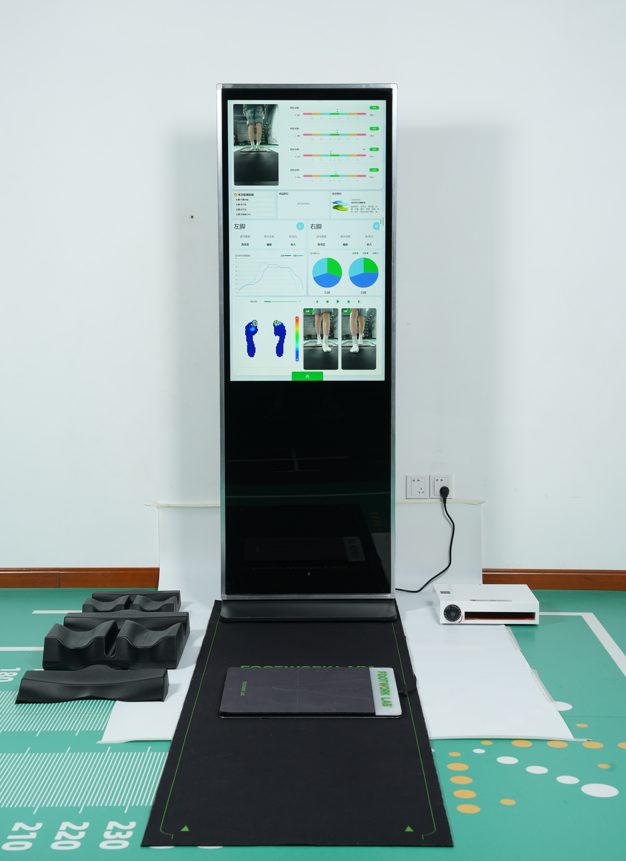
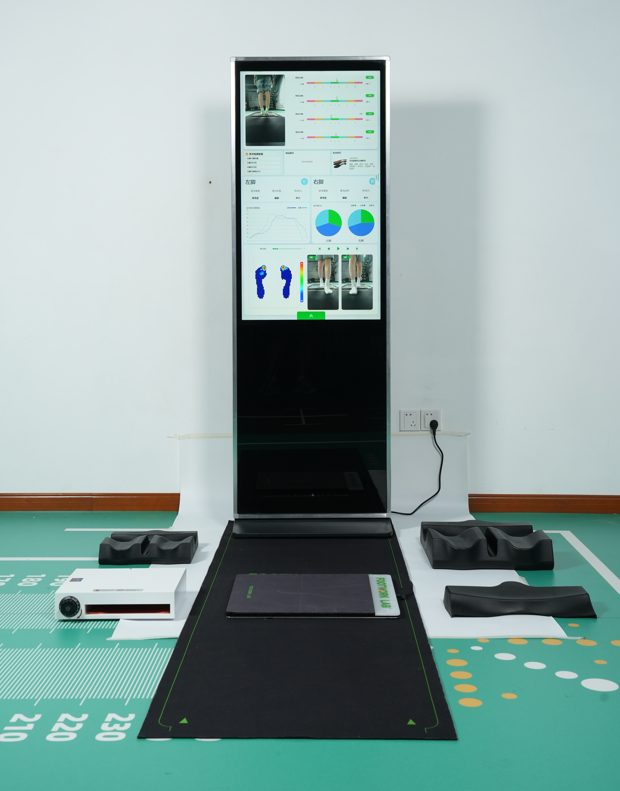
The X3 is a foot pressure and force-line detection and insole customisation system: arch detection, lower-limb force line, static pressure records, dynamic gait records, a walking video that plays forward and back, and an insole customisation step on the same console. Its natural rooms are children’s fitness centres, podiatry clinics, shoe stores and foot therapy centres — places where a record has to end in something the customer can see, keep, and act on.
Mat, plate, scanner: one category wearing four names
Marketplace vocabulary grows by accident. A floor mat that senses pressure gets listed as a pressure mat; a rigid plate under the same sensors becomes a pressure plate; add software and a report and the listing upgrades itself to a foot scanner; and somewhere along the way the search terms merged into composites that no factory ever printed on a crate. The buyer’s task is not to find the true name — there isn’t one — but to read every variation as pointing at the same question: what does this instrument record, and what comes out the other end?
That reading habit matters because the names carry unintended implications. A “mat” sounds disposable and soft, so buyers expect low durability and are surprised when the sensing layer is a serious piece of fabric electronics. A “scanner” sounds dimensional, so buyers expect a shape file at the end — and here the honest listings have to part company with the optimistic ones, because a pressure instrument records force and time, not surface geometry. If a listing promises a mould-ready mesh, the buyer is looking at a different category of hardware, and the word scanner in the title is doing marketing work the sensors cannot back up.
The composite words are useful to buyers in one way: they mark the searchers who want the whole workflow, not just the sensing surface. Someone typing a compound word is usually looking for capture, analysis and output in one purchase — which is exactly the conversation worth having, and exactly why the checklist below starts with what the report needs rather than what the sensor is called.
Our own preference, stated plainly: we sell plantar pressure detection systems. The phrase is longer than the marketplace favourites and it says what the instrument does without borrowing authority from the word scanner. Buyers who need the search vocabulary to find us are welcome to it; the specification sheet is where the vocabulary ends and the facts begin.
What a listing should state, and usually leaves out
The first omission is the record types. A serious listing states whether the instrument takes static records, dynamic records and balance records, because these are different tasks with different demands on the room — the static pass wants stillness, the dynamic pass wants a few honest walking crossings, the balance record wants quiet. An instrument that does only one of the three can still be the right purchase, but the listing should say so rather than let the photograph imply the rest.
The second omission is the camera story. Pressure under the foot tells half the story; how the leg stacks above the foot tells the other half, and that half comes from cameras, not sensors. A listing that mentions cameras at all usually buries them, yet the number of capture angles, whether the posture view is included, and how the images line up beside the pressure findings in the report — these change the session more than any single sensor specification.
The third omission is the report itself. What does the customer actually leave holding? The honest answer should name the items: footprint length and width, contact area, pressure distribution, the foot axis angle, arch type, percentages of the contact phases, the speed of the centre of pressure. Listings that stop at “detailed analysis report” are asking the buyer to imagine the deliverable, and imagination is generous. The report is the product the customer experiences; the sensor is the plumbing behind it.
And the fourth omission is the sentence at the bottom of every report we generate: the data is for reference, and the reading belongs to a qualified professional. A listing that shows a report cropped to hide that line is telling you something. The line is not decoration; it marks the boundary between a measurement and a diagnosis, and a supplier who treats it as an embarrassment will treat other boundaries the same way.

The first check: repeatability, measured in person
Repeatability is the property that makes records worth keeping, and it is checkable in one demonstration. Ask the supplier — or better, ask the machine in a showroom or a working site — to record the same person twice, under the same instructions, an hour apart, and lay the two reports side by side. A system in good order shows the same person in both: the same footprint outline, the same arch behaviour, the same pressure pattern with the small variation that living feet always carry. A system that shows two different strangers was recording conditions, not people.
What breaks repeatability is almost never the sensor; it is the routine around it. Stance instructions that change between operators. A walking approach that starts from a different mark each time. A plate nudged half a step by the morning cleaner. This is why the demonstration matters more than the specification sheet: the specification cannot tell you whether the supplier trains operators in a fixed routine, and the routine is where repeatability lives or dies.
The buyer should also ask what the report says about its own conditions. A file that records the session’s settings — which passes were taken, under what instructions — can be compared honestly at the retest. A file that remembers only the findings cannot, because nobody can reconstruct afterwards whether the second visit was measured the same way as the first. Ask to see this in the demonstration, not in the brochure.
One practical tip from exhibition floors: bring your own feet. The best way to test a demonstration unit is to be measured twice yourself, with a break between passes, and read the two reports the way a customer would. Suppliers who welcome this are confident in their routine; suppliers who steer you back to the sample gallery are confident in their gallery.
The same test, asked of references, travels well. Ask the supplier for one working site in your own country or a neighbouring one, and put two questions to whoever answers the phone there: how long did the team take to run sessions consistently, and what broke first. The answers — measured in weeks, not in adjectives — tell you more about the instrument’s first year than the listing ever will. A supplier with installations to show names a site in a day; the silence afterwards is also information, and it is cheaper to collect before the order than after.
The second and third checks: the report and the software
The report check is a reading exercise. Ask for a complete sample report — not the summary page — and read it against three questions. Does it carry the quantities a professional needs: distribution, contact area, the phase percentages, the axis angles? Does it carry the images beside the numbers, so the reading does not depend on memory? And does it carry the reference line stating the data is for professional interpretation? A report that fails the third question fails the session, whatever its charts look like.
Delivery format belongs to the same check. On the X3, the finished report leaves the console three ways: a code the customer scans to keep the file on her own phone, an email send for the customers who prefer an inbox, and an on-site print for the rooms where a paper in the hand still ends the visit best. Three routes matter because rooms differ — a children’s fitness centre lives on phone scans, a clinic on filed prints — and a system that offers only one route quietly narrows the room it can serve.
The software check is a workflow walk-through. On the X3 the workflow has a step that surprises first-time buyers and delights them once explained: before the AI shoe recommendation runs, the store enters its own shoe inventory into the library, so the recommendation speaks the shop’s actual stock rather than an abstract catalogue. Ask any system you evaluate what its recommendation step is standing on. A recommendation that cannot name its own reference list is a decoration; one built on the store’s own inventory is a sales tool the staff can defend.
The customisation step sits at the end of the same workflow. On the X3 the record — arch type, force line, pressure pattern — feeds an insole customisation order placed on the same console, which turns the assessment from a report into an object the customer takes home. Buyers evaluating listings should ask where that step lives in the software: a bolted-on order form is not the same as a customisation module that reads the record it follows.
The fourth check: what happens when the network drops
The offline question is the one buyers forget until the day it matters. Every modern system promises connectivity, and over-the-air updates, remote assistance and cloud archives are genuinely useful — we provide all three on connected units. But a session happens on a shop floor, and shop floors have dead corners, router reboots and internet outages on the busiest Saturday of the year. The question to ask a supplier is precise: which functions keep running when the connection does not?
The honest answer is usually a division. Capture and the local record should run on the machine itself; a session that cannot be taken because the router is down is a session lost. Delivery — email, scan-to-phone, cloud sync — needs a connection, and a report queued during an outage should send when the connection returns rather than vanish. Updates and remote diagnostics need the network too, and that is fine: those are maintenance tasks, not customer-facing minutes. A supplier who has thought through this division will answer in seconds; a supplier who has not will say “it needs internet” and move on, which is itself an answer.
The rest of the order terms sit beside this check rather than inside it. A machine carries a minimum order of one unit; ours is tested at the plant for seven days before dispatch and warranted for twelve months against non-human damage with free parts. Support runs through a dedicated WhatsApp group with engineers directly reachable, with remote assistance over the connection and over-the-air updates for connected units. Shipping, for planning purposes, runs six to seven working days by express, ten to twelve days by air, and thirty to five-and-thirty days by sea — the difference between the three is usually the difference between a launch date and a season.
Put the four checks together and the listing question answers itself: a mat, a plate or a scanner by any name earns its place when the same person can be measured twice and get the same person back, when the report carries quantities, images and its reference line, when the software’s workflow ends in something the room can sell, and when a dead router costs the shop nothing but a minute. Everything else in the listing is weather.
Frequently asked questions
Are pressure mats, pressure plates and foot scanners different products?
They are mostly the same category under different names — a floor instrument that records how load moves across the sole, with software and a report behind it. The differences between actual products live in the record types, the cameras, the report and the software workflow, which is what the verification checklist is for.
Does a pressure system produce a shape file of the foot?
No. A pressure instrument records force and time — distribution, contact area, phase percentages — not surface geometry. A listing that promises a mould-ready mesh is describing a different category of hardware, and the word scanner in its title is doing work the sensors cannot back up.
How do I test repeatability before ordering?
Ask for the same person to be recorded twice under the same instructions, then read the two reports side by side. Better still, be measured twice yourself at a demonstration. What you are testing is the routine as much as the hardware: stance instructions, walking marks and operator discipline are where repeatability lives.
What should a complete report contain?
The quantities a professional reads — pressure distribution, footprint length and width, contact area, arch type, phase percentages, axis angles — with the images beside the numbers, and a line stating the data is for professional interpretation. On the X3 the report leaves the console by scan code, email or on-site print.
What does the software do before recommending a shoe?
On the X3, the store first enters its own shoe inventory into the library; the AI recommendation then draws on the shop’s actual stock rather than an abstract catalogue. Ask any system you evaluate what its recommendation step stands on — a recommendation that cannot name its reference list is a decoration.
Which functions keep working without a connection?
That is a question to put to every supplier. The sensible division: capture and the local record run on the machine; delivery formats and cloud features need a connection; updates and remote assistance are maintenance tasks. A session that dies with the router is a session lost, and the supplier should be able to say in seconds which side each function sits on.
What are the order and delivery terms?
Minimum order of one unit, seven days of plant testing before dispatch, a twelve-month warranty against non-human damage with free parts, and support through a dedicated WhatsApp group with engineer access, remote assistance and over-the-air updates for connected units. Shipping runs six to seven working days by express, ten to twelve days by air, and thirty to five-and-thirty days by sea.
What we would do next
Take the four checks — repeatability, report, software, offline — into the next supplier conversation, including ours, and ask each one aloud. If a supplier cannot answer in a sentence, that is the answer. When you want the checks run against a working system instead of a listing, the X3 system page describes the record types, the report routes and the customisation step in the manual’s own wording, and the demonstration question is one message away through the contact page.
Bring your own feet to the demonstration. It remains the most honest test in the category, and no listing, however well worded, can replace it.
This article is intended for professional and educational reference. It is not medical advice. Foot assessment equipment produces measurements and images; clinical interpretation and any decision about care remain the responsibility of a qualified professional. Certification scope is limited to the documentation we hold: European Union certification and ISO quality system certification.