
An enquiry arrives with the subject line foot insolation scan, and the first instinct of anyone who reads English carefully is to file it under nonsense. Insolation is a meteorology word — the measure of solar radiation a surface receives — and it has nothing to do with feet. And yet the sender, a shop owner writing in careful, slightly irregular English, has a real question: he wants a device and a stock range for assessing feet at his counter and selling insoles against what the assessment finds. The word got mangled somewhere between his language, a translation tool and ours, and the garble that survived is now the most precise thing we know about him: he is real, he is in the market, and he found us despite the dictionary. This article takes garbled foot words seriously, because behind every one of them stands a buyer who is easier to help than to decode. It works out what foot insolation scan most plausibly means, sets out the other manglings we meet and how to read them, describes the two kinds of buyer who send them, and then follows the honest version of what the buyer wanted: the scan-recommend-restock loop that turns a counter assessment into a repeatable product line.
What a foot insolation scan most plausibly means
Start with the mechanics of the garble. Insolation sits close in spelling to insulation, and insulation sits close in sound to insole — in several languages the words for insole and insulation overlap or borrow from each other, because both involve a layer between a person and a surface. A buyer whose first language is not English, running his phrase through a translation tool, gets a plausible-looking English sentence back with the wrong word in the middle of it, ships the message, and never knows. The tool answered the question he typed, not the question he had.
So the phrase decodes, with reasonable confidence, into insole: a foot insole scan — a search for the assessment-and-insole combination that shoe shops, foot care counters and clinics all run in one form or another. The scan half is ungarbled and tells us the buyer expects a machine or at least a structured assessment; the insole half tells us he expects a product to sell at the end of it. That is a complete business sentence in two mangled words, and it is the most common shape of enquiry we receive.
The confidence is reasonable rather than absolute, and honesty about that matters. A minority of such enquiries mean consultation — a foot consultation scan, someone looking for a service rather than a product — and a few are simply keyboard slips that no rule explains. The way to resolve the residue is not cleverer guessing but a reply that describes, in plain words, what we make and asks one question back. A real buyer answers within a day; a scraped address does not answer at all.
What we do not do is treat the garble as a signal of seriousness either way. Some of the most organised distributors we serve write three-word enquiries full of slips; some of the least serious write flawless paragraphs. The spelling tells you where the buyer is writing from and in which language he thinks; it tells you nothing about whether the order will happen. Reply to the meaning, not the spelling.
A field guide to garbled foot words
Once one garble has been decoded, the family becomes readable, because translation errors follow habits. Whole-word substitutions are the commonest: a word from the buyer’s language that resembles an English word gets printed as the English one — insulation for insole, as above, or the measure of sunlight standing in for the layer inside a shoe. Compounds split wrongly come next: phrases that are one concept in the buyer’s language arrive as two English words joined in the wrong pair, so an assessment device becomes a foot machine or a foot measurer.
Spelling drift is the third habit, and it is the easiest to read because the drift is phonetic. Words arrive missing letters, doubled letters or carrying the spelling of the sound rather than the standard — pressure words that lose a syllable, scanner words that gain one. The keyboard slips form the fourth group and carry no meaning at all: a letter transposed, a space missing. The discipline is to fix the slip, decode the habit, and then verify the whole reconstruction with a single plain question rather than building a quotation on a guess.
Two decoding rules keep the process honest. First, decode the noun that carries the business — insole, scanner, assessment, machine — and leave the rest alone; a garbled adjective costs nothing to ignore. Second, prefer the boring reading: when a phrase could mean an exotic device or an ordinary counter assessment, the ordinary reading wins more often than not. Buyers are, overwhelmingly, trying to buy things that already exist.
Suppliers can reduce the garble at the source, and the measures are unglamorous. Write enquiry forms with tick-boxes rather than free text for the product category; keep a short glossary page that shows the words for the things we make in the markets we serve; and answer every garbled enquiry with a one-paragraph description of our categories plus a single question. Each measure trades a little elegance for a great deal of clarity, and clarity is what the buyer needed all along.
The two buyers behind the garble
Strip the spelling away and the senders sort into two kinds. The first is the restocking buyer: a shop already selling some form of foot care product, whose enquiry is really a supply question — he wants a better range, a steadier source, a supplier who will hold a curve of sizes in stock and ship it whole. He may or may not want the assessment device; often he wants to see whether the device would lift his sell-through before he commits counter space to it.
The second is the first-equipment buyer: a shop or clinic adding an assessment service for the first time, whose garbled phrase usually contains the word scan or measure. He needs the workflow explained before the hardware: what a session takes, who runs it, what the report shows, what the counter says while the customer reads it. His risk is not choosing badly between suppliers — it is buying a device into a shop with no routine to run it, which is the most common way this equipment ends up under a cover.
The two need opposite first replies, and a supplier who sends the same catalogue to both serves neither. To the restocker: the range, the case structure, the reorder rhythm, the terms. To the first-timer: the session routine, the report, the training, the stock that the routine will generate. The garble in the subject line rarely tells you which you are talking to; the second message always does, which is why the first reply should be short enough that sending a second one costs nobody anything.
Both buyers share one requirement that garbles especially easily: continuity. They are not buying a pair, they are buying a line — the same builds, the same sizes, the same names, month after month, so that the customer who liked March’s pair can reorder it in September. Continuity is where a factory differs from a trading desk, and it is the part of the conversation we answer most concretely, because it is the part we control.
The scan half: what a counter session records
The scan half of the loop is a short, structured session, and shortness is the design point. A customer at a counter will give the assessment minutes, not half an hour, so the routine runs a standing pass, a walking pass and, where the system allows, a balance trial, and the report assembles itself while the customer waits. Standing gives the footprint’s shape and contact area, the distribution of load across the sole and the arch presentation at rest; walking adds foot axis angle, the proportions of contact and flat phase, peak and mean pressure, and the speed at which the centre of pressure travels forward.
Cameras extend the record to the alignment picture — how the heel tracks, how the leg sits above the foot — which is the half of the session that sells the service, because customers can see a knee or a shoulder in a photograph but cannot see a pressure number. A compact system in a shop corner runs the whole routine in the time a customer spends removing a shoe; the constraint is the room, not the technology, and the room’s limits should decide the configuration before the brochure does.
Two boundaries keep the scan half honest, and both go on the counter script. First, the report records values; it does not reach conclusions. Arch type, load pattern, alignment images — these are measurements for a professional or a trained fitter to read, every report says the data is for reference, and the staff script should say the same. Second, the scan half does not promise anything about anyone’s condition; what it supports is a fitting conversation and a specification, which is a different and defensible thing.
The report’s last page is the commercial one, and it is worth designing deliberately: the record on the left, the recommended build on the right, the reorder code at the bottom. A customer who leaves with a readable page comes back with the page; a customer who leaves with a verbal recommendation comes back with a vague memory and a different shop. The scan half earns its keep only if its output can be found again — which is the hinge into the restock half.
The recommend half: from record to a build on the shelf
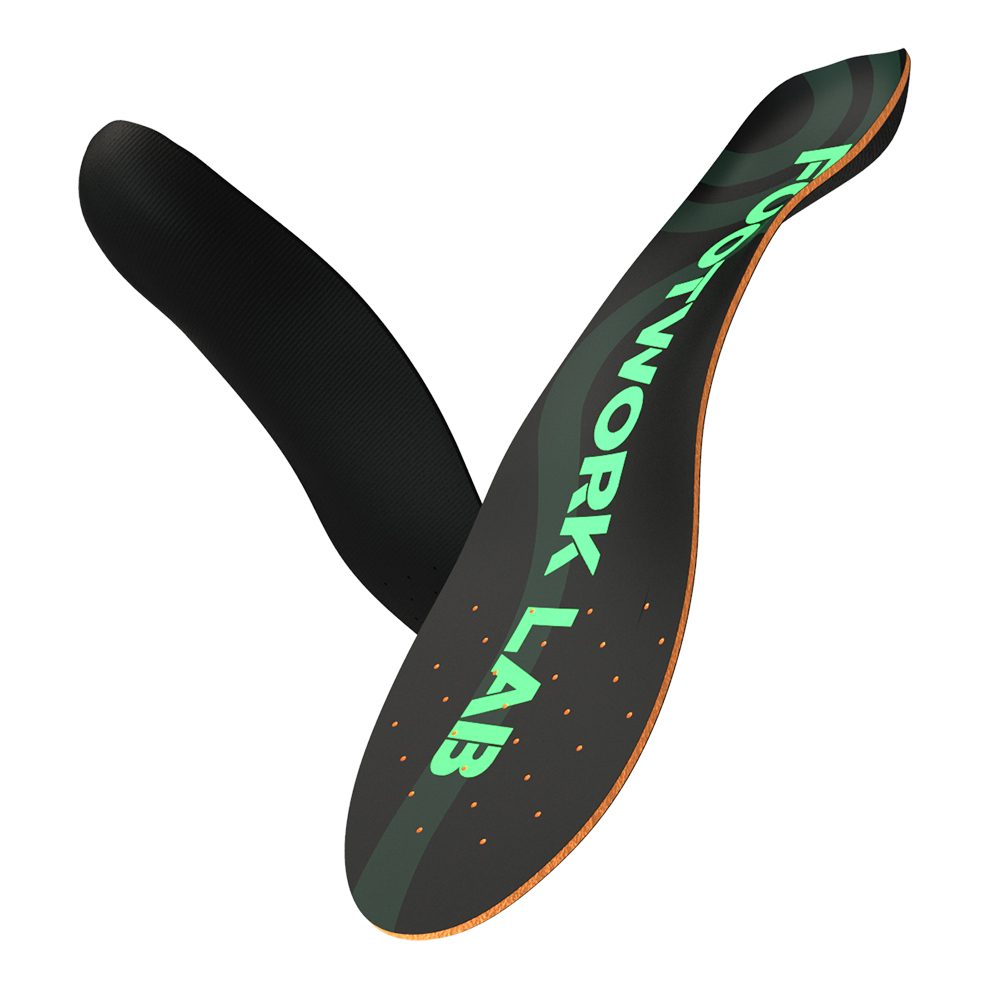
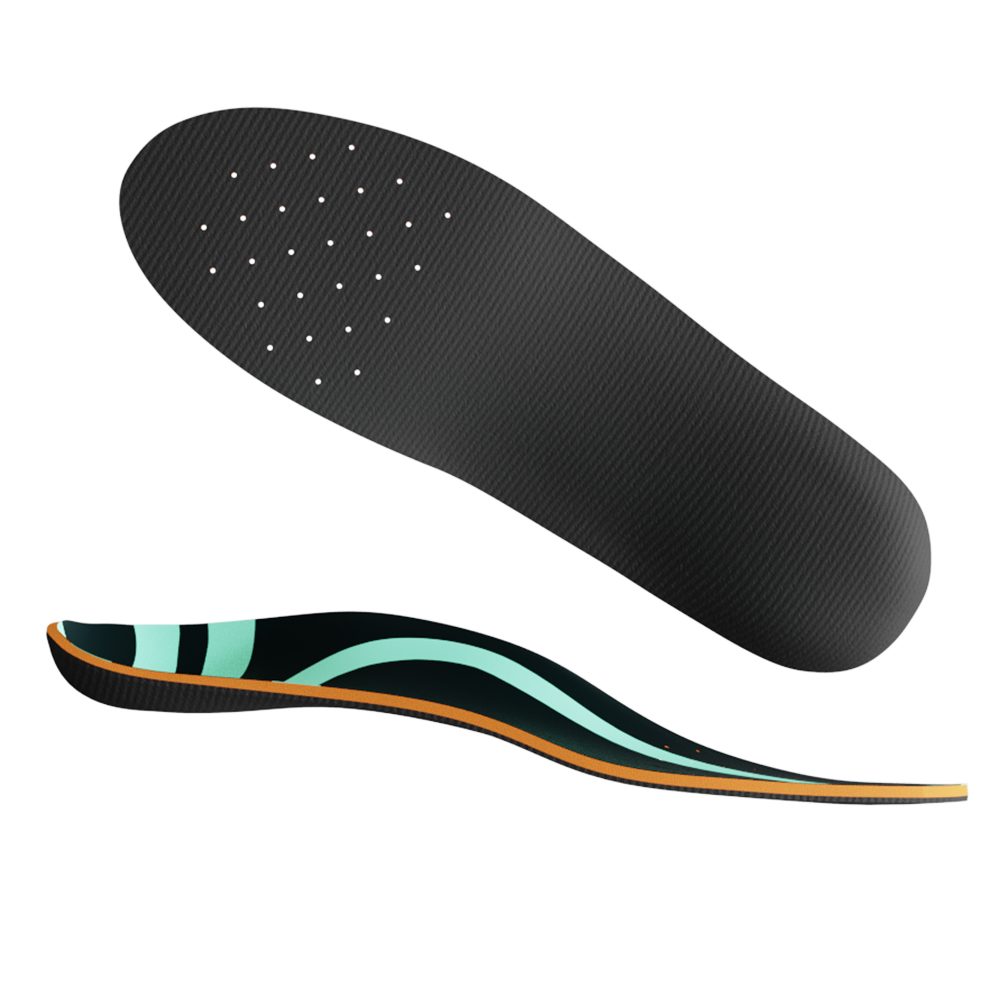
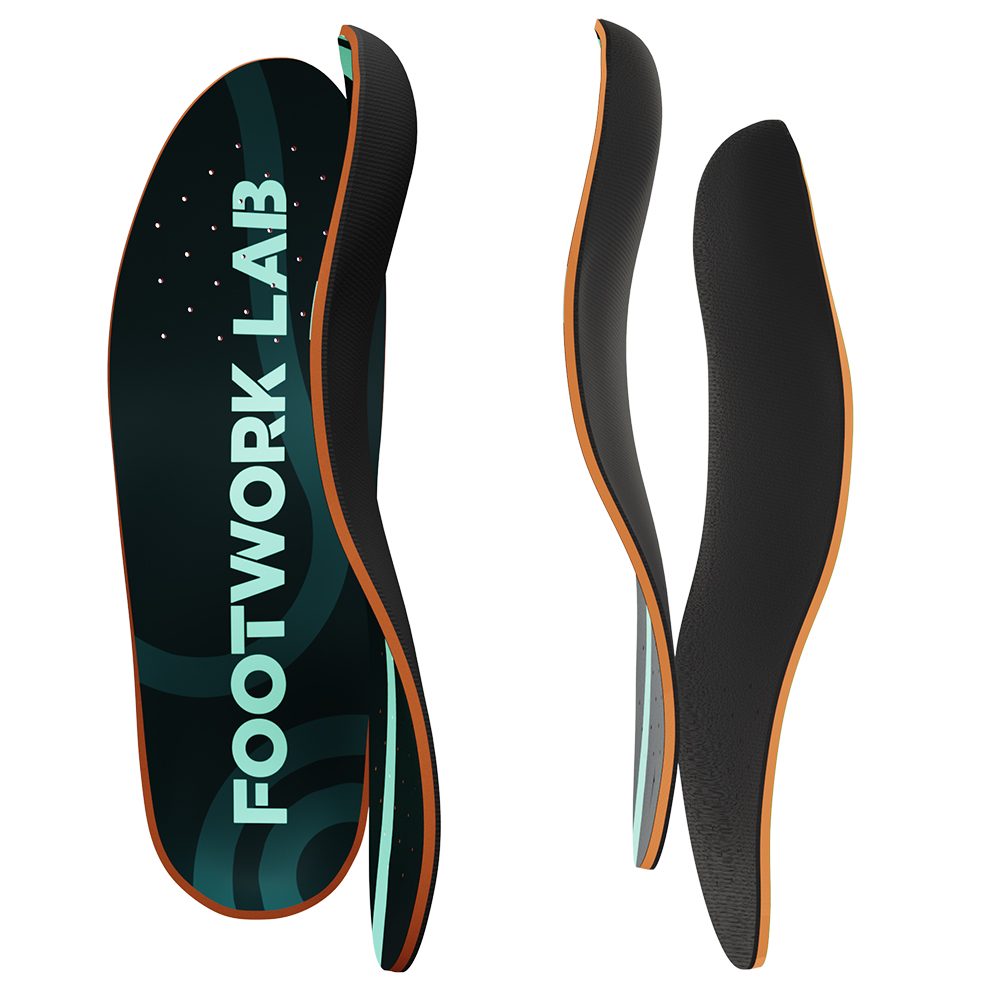
The recommendation step is where the record becomes a product, and it works best when it is constrained. Our range is arranged so that a record maps onto a build through a small number of named choices: the family — daily comfort for ordinary walking and standing work, care for feet that need load spread off sensitive zones, sport for the training population — and, within the daily builds, the structure does the defining: a mesh fabric layer over an orthopaedic textile layer over a shaped polymer plate, graded for how much support and cushioning the construction carries.
Counter staff make this mapping in a sentence, not a monologue, and the training we supply is aimed at exactly that. The fitter reads two or three items off the report, names the family, names the size from the measured foot rather than the shoe label, and hands the customer the pair with the page. What the staff should not do is improvise beyond the map — reading medical meaning into values, or promising what a build will do about a complaint. The record describes the foot; the build matches the record; the professional judges what it means. That sentence, drilled, keeps the counter inside its competence.
The recommendation is also where honesty pays visibly. A daily build that matches the record sells itself a second time at the next visit, because the customer can feel whether the fit conversation was real. A range sold by enthusiasm alone — the build the staff like, pushed at every foot — produces exactly the returns and the tired regulars that make shop owners stop believing in assessment. The map from record to build is not a sales technique; it is the difference between a product line and a shelf.
Where the shelf cannot answer the record — an unusual size, a care build the shop does not hold — the honest counter answer is a factory order rather than a substitute pair. Our custom line exists for that residue: a pair made to the written specification, shipped within the same window as the restock. Shops that offer the special order rather than the wrong stock convert the awkward case into the deepest customer they will ever have.
The restock half: a daily range that arrives whole and reorders itself
The restock half is unglamorous and decisive, and its terms should be stated once and plainly. The minimum order is two hundred pairs, mixed across styles and sizes, which lets a shop open a real curve — a couple of daily builds, a care build, the sizes the counter actually measures — rather than two hundred of one thing. Samples ship within three days, so a buyer can hold the structures before committing. Production runs at roughly five hundred to a thousand pairs on a working day, and delivery runs six to seven working days by courier, ten to twelve by air, thirty to thirty-five by sea; a first order should be placed against the slowest of those three, not the fastest.
The reorder rhythm comes from the counter’s own evidence, not from the supplier’s suggestions. After a month of sessions, the report stack shows which builds and which sizes the foot traffic actually consumes; the reorder becomes arithmetic against the shelf, and the conversation with the factory becomes a one-line message in the same thread as everything else. Our after-sales runs through a dedicated WhatsApp group with engineers reachable directly for the equipment and the same channel carrying the restock — one thread, one history, no lost context when a size curve needs adjusting.
Continuity closes the loop. The builds a shop stocked in March are the builds it reorders in September, under the same names, in the same sizes, because the product line — not the shipment — is what the customer’s reorder code points at. We keep that stability deliberately: insoles accept both ODM and OEM from the two-hundred-pair minimum, and we will build a shop’s own specification, but we hold the standard range fixed so that a record taken this season still maps onto a shelf next season. A product line that changes names every year is a shelf, not a line.
The loop, end to end, is then honest about what it is: a scan that records, a recommendation that maps, a restock that arrives, and a reorder code that ties the three together across visits. Nothing in it diagnoses, nothing promises, and nothing depends on the buyer’s spelling. The enquiry that began as foot insolation scan ends as a working counter — which is what the sender meant, however the words arrived.
Frequently asked questions
What does the phrase foot insolation scan most likely mean?
Most plausibly a foot insole scan — an enquiry about assessing feet at a counter and selling insoles against the assessment. Insolation is a translation artefact: the word sits one step from insulation, which sits one step from insole in several languages.
How do you handle garbled enquiries?
Decode the noun that carries the business, prefer the boring reading, and verify with one plain question rather than a quotation built on a guess. The spelling says where the buyer writes from, not how serious he is.
What does a counter session record?
A standing pass for footprint shape, contact area, load distribution and arch presentation; a walking pass for foot axis angle, contact and flat phase proportions, peak and mean pressure and centre-of-pressure speed; and alignment images from the cameras where the system allows.
Who reads the results?
A qualified professional or a trained fitter. Every report states that the data is for reference, and the counter script should match: the record describes the foot, the build matches the record, and judgement about what it means stays with the professional.
How does the record become a sale?
Through a constrained map: the family — daily comfort, care or sport — and the size from the measured foot, named off the report and handed over with the page. The report’s last page carries the reorder code that brings the customer back.
What are the restock terms?
A minimum of two hundred pairs mixed across styles and sizes, samples shipped within three days, production at roughly five hundred to a thousand pairs a working day, and delivery in six to seven working days by courier, longer by air or sea.
Can the shop order its own builds?
Yes. Insoles accept both ODM and OEM from the two-hundred-pair minimum, and the custom line covers the sizes and builds the shelf does not hold. The standard range stays fixed, so a record still maps onto the shelf next season.
What we would do next
Send us the garbled phrase — deliberately, in quotation marks, exactly as your customers or your own enquiries wrote it — together with one line on the shop: what the counter sells today and what it wishes it sold. We will reply with the decoded reading and the piece of the catalogue that matches, through the contact page. The insole range page lists the three families and the daily build’s structure, which is the vocabulary the decoded enquiry usually ends up in.
Four pieces continue the loop. A footscan assessment at the counter runs the session from the staff side, and a footwear store that fits by record follows one shop through the changeover. A foot care product line shows how the shelf is arranged to answer the record, and what a scanner adds to an orthopedic insole business takes the equipment half of the decision on its own terms.
This article is intended for professional and educational reference. It is not medical advice. Foot assessment equipment produces measurements and images; clinical interpretation and any decision about care remain the responsibility of a qualified professional. Certification scope is limited to the documentation we hold: European Union certification and ISO quality system certification.