
The enquiry lands in the inbox with a grammar error that says more than the greeting does: we are sourcing physical therapy equipments for gait training, please send your catalogue. The plural — equipments, not equipment — is the tell. Nobody admiring a category writes it in the plural; a person copying line items from a department plan writes it in the plural, because their document has a column for quantity and a column for room. This buyer is not shopping for a thing. They are shopping for a list, and the list is the procurement sheet for a gait-training corner in a physical therapy department. Reading the phrase that way changes the whole reply: instead of pitching one machine, the useful answer walks their room in the same order their sheet will be approved in — what the training corner needs first, where the record device sits among the training hardware, who plans the programme, and what the quotation should cover. This article follows that order. It unpacks what the plural signals, what a gait-training corner orders first and why, where our own dynamic gait system fits on that list and what it records, what it deliberately leaves to other suppliers, and how a record keeps the training honest from baseline to retest.
The plural gives the buyer away
Search phrases carry fingerprints, and plurality is the loudest. A therapist curious about gait writes in the singular and lands on articles; a procurement officer pasting from a plan writes in the plural and lands on catalogues. The equipments plural — a slip in most varieties of English — appears constantly in enquiries from buyers whose first language has no countable-equipment distinction, and it clusters around genuine purchase lists: department setups, tender documents, room-fit plans. Rather than correcting the grammar, the useful move is to read it as data. The buyer behind the plural has a spreadsheet, a budget line, and somebody above them who will ask what each item is for.
The same enquiry usually carries a second tell: the phrase gait training sits inside it, doing the work of a room name. Gait training is not a device; it is a corner of a physical therapy department where patients practise walking under supervision — parallel bars, harnesses, steps, rails, the furniture of relearning. The buyer’s list therefore mixes two families of purchase that catalogues habitually blur: the equipment that helps a patient practise, and the equipment that documents what the practice is achieving. A reply that reads the phrase correctly answers for both families and marks the boundary between them, because the boundary is where budgets are wasted.
There is a third tell worth naming, because it changes who should reply. A list-shaped enquiry usually means the writer is not the clinician who will run the corner; they are the person who buys what the clinician specified. The questions they can act on are questions about delivery, installation, training, warranty and support — not questions about protocols, which will be decided by the professionals in the room long after the crate is unpacked. Answering a procurement officer with a clinical essay wastes their time; answering them with an itemised, room-ordered breakdown earns the reply a forward to the clinical lead, which is exactly where the next conversation should happen.
So the reading order for the phrase is: a plural, naming a list; a list, furnishing a corner; a corner, planned by professionals; a plan, needing a record somewhere in it. The rest of this article walks that reading in sequence, and the equipment that anchors it — the record side — comes second, deliberately after the question of what the corner is for.
What the gait-training corner orders first
Ask a physical therapy department what the training corner consumes most and the answer is not hardware — it is documentation. Therapists plan sessions against a baseline, report progress against numbers, and justify continued treatment to a payer or a supervisor against something in the file. The corner therefore needs a record device before it needs another rail: a system that captures how the patient actually walks today, so that every session after it has something to be measured against. Departments that buy the training furniture first usually buy the record later under pressure, and by then the baseline they needed on day one has already walked out of the room unrecorded.
What the record needs to capture is shaped by the corner’s caseload. A rehabilitation department relearning steps after a stroke needs the stride cycle and its phases; a sports medicine room needs what happens at speed, including running; a general physical therapy floor sees both, plus the long middle of patients who simply need their walking documented before and after a programme. The record device that serves all three captures static standing, dynamic walking and the transition between them — which is why the specification question to ask any supplier is not what the machine is called but what the report contains, item by item, in the supplier’s own vocabulary.
The honesty boundary goes here, in the middle of the purchasing argument, because it decides which family the record device belongs to. A record system documents; it does not train, assist or move the patient, and it does not decide what the training should be. Reading the record — deciding what the phases and pressures mean for a named patient and what the programme should do about them — belongs to the physical therapists who own the plan. A department that expects the machine to set the training is buying the wrong family, and we say so in first replies rather than discovering it at the demonstration.
One more argument for record-first ordering survives contact with reality: the retest. Training programmes run in blocks — weeks of sessions, a review, a decision. The review is only as good as the two records it compares, and both must be taken under the same conditions or the comparison is theatre. Buying the record device first forces the department to set those conditions — same instructions, same speed settings, same crossings — while nothing is yet in motion, which is far easier than retrofitting discipline onto a corner already full of patients.
Where the F5-LAB sits on that list
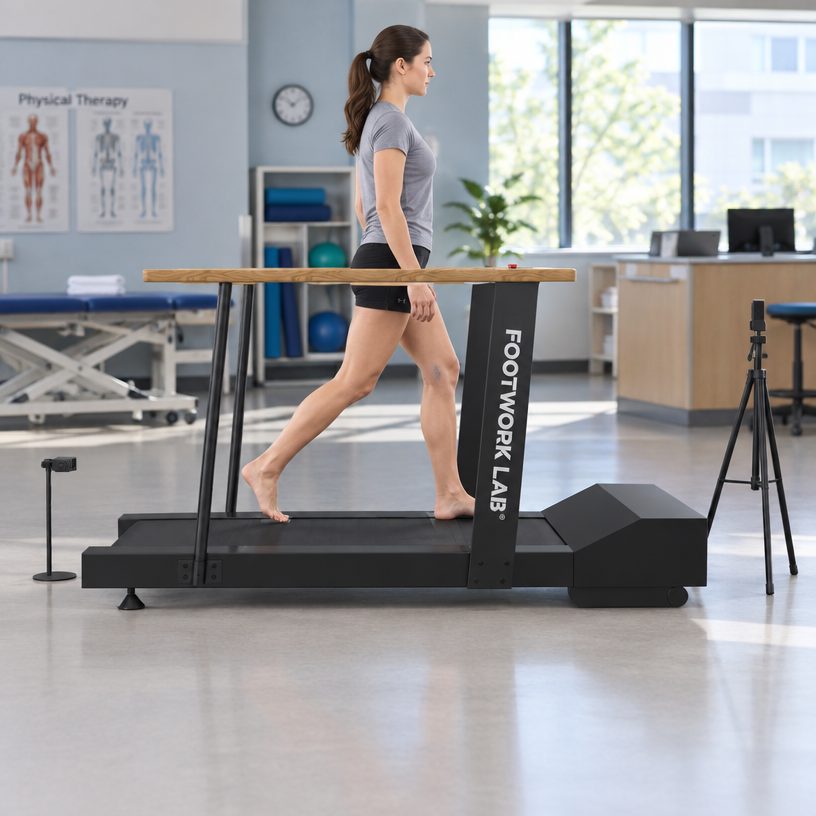
On the record side of the list, our entry is a dynamic gait detection system built in treadmill form: a main unit that looks like a serious walking machine, two cameras on brackets, and a hub that ties the capture together. The form factor is a deliberate answer to the corner’s space mathematics — a walkway needs a corridor, a plate needs a fixed installation, and a treadmill-form platform needs one floor spot and a power point, which is what most physical therapy rooms actually have to offer.
What the system records is the walking and running cycle itself. In walking mode it captures the gait cycle, movement posture, dynamic pressure through the stride and the double-foot butterfly trace — the crossing pattern of how the two feet’s pressure centres travel. In running mode it does the same at speed, which is the part most rehabilitation-form platforms cannot do and the reason sports-medicine rooms reach for it. The two modes on one machine mean a department with mixed caseload does not have to choose which half of its list the record device serves.
The report is the deliverable, and it is worth describing in the equipment’s own terms rather than in adjectives. The patient’s stride lands on the screen as phases and pressures: how long the foot stays in contact, how load moves from heel through midfoot to forefoot, how the two sides compare, how the butterfly trace sits for this person on this day. The document then travels — to the therapist planning the block, to the file, to the review meeting where the retest will be set beside it. A demonstration that cannot produce this document, printed or on screen, is demonstrating a screen rather than a system.
Where the system sits on the shopping list, then, is a single line with a clear job description: the record position. It does not support the patient, it does not assist the step, and it is not the corner’s therapy hardware — those lines belong to other suppliers, which is the next section’s subject. What it does is give every line below it something to be measured against, and it earns its floor spot by being the one purchase in the corner that improves with every session the others deliver.
The training equipment is somebody else’s shelf
Here is the part of the reply that surprises buyers who expected one vendor to fill the list: we do not make the training hardware, and we think a department should hear that early. Parallel bars, body-weight harnesses, steps, rails, resistance gear — the equipment a patient physically practises on is its own industry with its own specialists, and a record company pretending otherwise sells a worse version of both. Our catalogue stops deliberately at the record boundary, and the honest quotation marks that boundary rather than blurring it into a bundle.
The split of roles, stated plainly, has three parts. The training hardware supports and challenges the patient while the therapists run the session. The professionals plan the programme, choose the progression, and decide what the sessions are working toward — that judgement never leaves the room. And the record system documents the walking, so the plan and the progression have numbers to stand on. Three roles, three purchases on the sheet, and the mistake departments make is collapsing the three into one expectation: buying a record system and hoping it trains, or buying training hardware and hoping it documents. Either collapse shows up within the first programme block as a gap somebody has to explain at review.
The collapse usually happens at the demonstration stage, and it is worth arming the buyer against it. A seller who shows a record platform running a patient through a session is demonstrating theatre — the patient performs for the screen, the screen applauds, and neither the baseline nor the retest survives scrutiny. The demonstration to demand is quieter: one person, three records, fixed conditions, two of the records taken minutes apart and compared. That demonstration tests the only thing the record line of the shopping list actually promises, which is comparability.
For the department writing the sheet, the practical consequence is a line-item note rather than a purchase: where the record device ends, the training hardware specification begins, and the two specifications should be written by different people — the record line with the supplier who can show reports, the hardware line with the therapists who will run the sessions. A list written that way survives the tender process, because every line on it has a defensible answer to the question tenders always ask eventually: what is this item for.
Reading the record beside the training plan
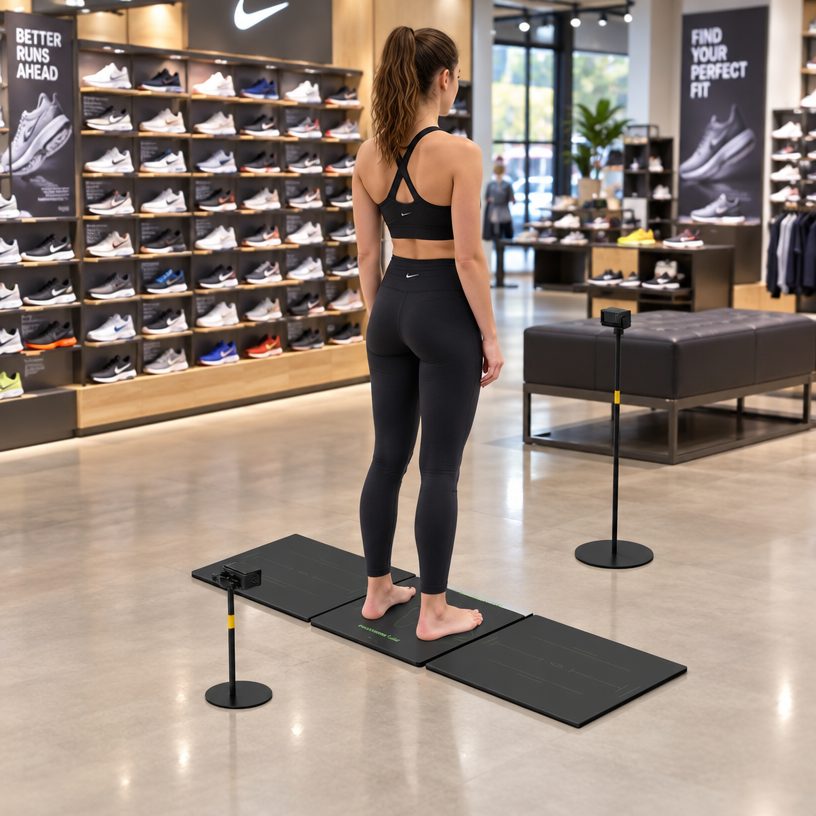
Once the corner runs, the record earns its keep in the conversation between sessions. The therapist working from the document has quantities to steer by: the phase proportions of the stride, the symmetry between the two sides, the shape of the butterfly trace against where it sat at baseline. None of these numbers decides anything on its own — the decision is the therapist’s, made with the patient in front of them and the plan in the file. But steering a training block with the record beside it differs from steering by impression the way navigation differs from guessing: the same journey, with a great deal less arguing about where you are.
The comparability discipline deserves its own paragraph because it is where the value lives or dies. Records taken at different speeds, with different instructions, or after different warm-ups are not comparable, and a department that lets the conditions drift has effectively stopped keeping records while still paying for the machine. The fix is unglamorous: the capture protocol written down, the settings logged with each record, the retest taken the same way as the baseline. Departments that keep this discipline produce review meetings that take minutes; departments that do not produce review meetings that take opinions.
The record also changes the conversation with the patient, which departments underestimate until they see it once. A person shown their own baseline butterfly trace and then the trace after a training block understands the programme in a way no verbal summary reaches; the document does the persuading, and the therapist does the interpreting. That dynamic — machine shows, professional explains, patient decides — is the healthy version of every technology conversation in this field, and it is the version our reports are built to serve.
What the record should never be asked to do is carry the plan itself. No phase proportion prescribes the next block; no symmetry number announces that a patient is ready to progress. Those calls belong to the physical therapists, who weigh the record against everything else they know about the person. The equipment produces the measurement; the professional produces the meaning. Departments that keep that sentence true have no trouble explaining their corner at any review, because every number in the file already has a named human decision wrapped around it.
From shopping list to quotation
When the sheet reaches the quotation stage, the fixed terms on our side are short enough to state and stable enough to plan around. The dynamic gait system starts from one unit — a corner does not need a fleet — and the machines accept ODM for departments integrating into a larger installation. Every unit is tested at the plant for seven days before dispatch, the warranty runs twelve months against non-human damage with free parts, and after-sales runs through a dedicated WhatsApp group with engineers reachable directly, remote assistance when a capture misbehaves, and over-the-air updates where the unit is connected. Installation and staff training complete the line item, because a record system that arrives without training arrives half-delivered.
What we leave off the quotation is as deliberate as what sits on it. No prices in public — the quotation follows configuration and destination, because a number in the abstract is a number that misleads. No exclusive territories — a physical therapy department’s advantage is its caseload and its discipline, not a map. And no claims beyond the record: the system documents walking, it does not judge it, and the phrase we put in writing is the same one this article keeps repeating. A procurement officer who wants those boundaries in the tender document is welcome to paste them.
The plural enquiry, read properly, ends where it began: with a list that furnishes a corner and a budget line for each item. The version of that list we argue for has the record line first, the training hardware specified by the therapists who will run it, and the boundary between the two written where the approver can see it. The departments that build their corners that way get the boring outcome everyone actually wants — sessions that run, reviews that compare, and a file that answers questions without a meeting.
Frequently asked questions
What does the plural equipments signal in an enquiry?
A shopping list rather than a single-product search. Buyers writing in the plural are usually pasting from a department procurement plan, which changes the useful reply: a room-ordered breakdown of items and boundaries instead of a pitch for one machine.
What should a gait-training corner order first?
The record device, before additional training hardware. Therapists plan and report against a baseline, so the document needs to exist from the first session onward — and buying the record first forces the capture discipline to be set before patients fill the room.
What does the F5-LAB record?
Walking and running: the gait cycle and its phases, movement posture, dynamic pressure through the stride, and the double-foot butterfly trace of the pressure centres. Walking and running modes sit on one treadmill-form system with two cameras and a hub.
Does the record system train the patient?
No. It documents; it does not support, assist or move anyone, and it does not decide what the training should be. Those belong to the training hardware and to the physical therapists who run the programme.
Do you supply the training hardware itself?
No. Parallel bars, harnesses, steps and the rest of the practice furniture are another specialist’s shelf, and we mark that boundary in the quotation rather than bundling. The record line and the hardware line are specified separately, by different people.
How do retests stay comparable?
By fixing the capture conditions: the same instructions, the same settings and the same routine for baseline and retest, with settings logged beside each record. Departments that keep this discipline produce reviews that take minutes instead of opinions.
What are the order and support terms?
One unit is the minimum order and machines accept ODM; every unit is tested for seven days before dispatch; the warranty covers twelve months against non-human damage with free parts; support runs through a dedicated WhatsApp group with direct engineer access and remote assistance.
What we would do next
Send the shopping list — the real one, plural and all — through the contact page with a line on who runs the corner and what the review cycle looks like. We will mark which line items we answer for, name the ones we do not, and say plainly if the record belongs on your sheet at all. The F5-LAB system page lists the two capture modes and the report items in the equipment’s own terms.
Three pieces extend the argument. Gait training protocols on the F5-LAB shows the record working beside a training block, what a gait analysis system is made of unpacks the platform layer by layer, and gait physical therapy starts with a record makes the baseline case from the therapy side.
This article is intended for professional and educational reference. It is not medical advice. Foot assessment equipment produces measurements and images; clinical interpretation and any decision about care remain the responsibility of a qualified professional. Certification scope is limited to the documentation we hold: European Union certification and ISO quality system certification.