
The map came off the screen looking wrong in one specific place: a clean hollow under the toe line, as if the front of the foot had never touched the surface at all. The operator frowned, the customer asked whether something was broken, and the first instinct in most rooms is to suspect the machine. It almost never is. A hollow under the toes on a standing pressure record usually means the toes were doing something at the moment of capture, and the most common something is curling. Customers grip the platform. They do it on unfamiliar surfaces, they do it when told to stand still, they do it more on the second pass than the first, and a few do it on every visit without ever noticing. The result is a pressure map with a hole in the middle of the forefoot pattern that no sensor fault could produce and no anatomical explanation quite fits. This article walks through how experienced operators spot a curled-toe pass, how they separate it from a genuine feature of the foot, what they say in the room to relax the toes, and how they write the session down so the gap is never mistaken for a finding it is not.
What a curled-toe pass looks like on the map
The signature is easy to learn once it has been seen a few times. On a standing record, load under the toes normally arrives as contact that continues forward from the ball of the foot, fading through the toe pads with edges that soften gradually. A curled-toe pass breaks that pattern: contact stops abruptly somewhere behind the toe line, leaving a hollow where the pads should be, while a thin band of pressure from the curled tips sits higher up, disconnected from the rest of the forefoot. Between those two marks runs the empty gap that gave this article its name.
Two details separate it from sensor doubt. First, the hollow has a shape that follows the toe line: it is not rectangular, not uniform, not aligned to any grid of sensing elements, which is what a dead zone in hardware tends to look like. Second, it repeats inconsistently. Ask the customer to step off and back on, and a curled pass is often followed by a settled one; the gap moves, shrinks or disappears. Hardware faults do not negotiate. A quick way to settle the question in any room is to record a second pass with attention on the toes, and the comparison on screen does the rest of the talking.
Operators who have run rooms for years also read the rest of the map for supporting signs: the heel often carries more than usual, because a gripping toe pulls weight backwards, and the centre of pressure line may sit unusually far back through stance. None of these alone proves anything. Together they let the operator say with confidence, before any retest, that the hollow describes the pass, not the platform.
Why customers curl their toes on the platform
Curling is a balance behaviour, not a habit of strange feet. When the body is asked to stand still on a surface it does not know, the toes participate in the corrections automatically; they flex and press as part of the small adjustments nobody notices in daily life. Under observation, those adjustments get bigger, and the instruction that makes everything worse is the one most rooms open with: stand still. The customer tries, the toes clamp, and the map records the clamping faithfully.
Several customer types curl for their own reasons. The first-timer curls because the whole situation is unfamiliar. The cautious older customer curls because the platform feels narrow underfoot. The cold-footed customer curls as part of drawing the foot in. And there is the customer who has been told somewhere, sometime, that gripping the floor with the toes is how one stands properly; that one curls with commitment. The operator’s job is not to diagnose any of these. It is to notice the behaviour, name it out loud in a friendly way, and give the toes something better to do.
Telling the artifact from the foot
Every so often the hollow is real. Some customers present reduced toe contact as a genuine feature of their foot’s resting posture, and the map is doing honest work when it shows that. Distinguishing a curled-toe pass from a true presentation takes one deliberate procedure, and it fits inside the same session.
First, watch the foot rather than the screen during a pass. A curl is visible from the side of the platform: the toes draw down against the surface, and the tendons on top of the foot stand out. A resting posture shows no such movement. Second, compare the standing record with a walking pass. In gait, the toes load in sequence as the step rolls forward, and a foot with genuinely reduced toe involvement shows it consistently across every step, while a gripping customer’s dynamic record usually reads far more ordinary. Third, place the foot on a glass or footprint board beside the platform, if the room keeps one, and look at what the toes actually do when nobody is measuring: our article on what a printed footprint on glass still shows covers this comparison in detail. Consistency across methods points to the foot. A hollow that appears only in one quiet-standing pass points to the grip.
The rule the comparison enforces is an old one in assessment rooms: no single image decides anything. The pressure map is one measurement among several, and the curled-toe hollow is the clearest everyday demonstration of why. A room that files the first pass and moves on will eventually describe a grip as a feature of a foot; a room that cross-checks will not.
The phrases that settle a toe
Curing a curled-toe pass is mostly a matter of rewording the instruction. Stand still fails for the same reason it fails everywhere else on the platform: it gives the customer a task to perform, and performance reaches the toes first. The working alternatives move attention and loosen the foot without ever mentioning stillness.
The phrases that work in real rooms are short. Let your toes lie flat and wide, like you are at the beach. Or: imagine standing in warm sand and let your feet spread. Or, for the customer who keeps pressing: soften your knees a fraction and let your weight settle through the whole foot, front and back. Some operators hand the customer something light to hold, because occupied hands stop assisting. Others start an ordinary conversation about the weather and watch the toes release mid-sentence. The common thread is that attention leaves the feet, and once it does, the grip dissolves on its own.
One caution belongs in the script: do not tell the customer that something is wrong with her toes. The honest framing is that the machine caught the toes helping with balance, which they do for almost everyone, and that the room will simply take the picture again with the feet relaxed. Customers hear the difference between curiosity and diagnosis immediately, and the relaxed third pass that follows is the reward for choosing the right words. How operators phrase capture instructions generally, and why the script belongs to the room rather than to whoever is on shift, is treated at length in our piece on capturing a record when the customer cannot stand still.

When the curled position is the finding
Some feet present a curled or retracted toe posture at rest, and after the cross-checks above have ruled out a grip artifact, the map is showing something true about how that foot contacts the ground. At that point the operator’s job changes from removing the pattern to recording it honestly and labelling it, because a retracted toe changes load distribution in ways that matter to whoever reads the report: contact may shift backwards along the toe line, the metatarsal heads behind it may carry more, and the hollow in the map sits exactly where a reader will look first.
What the room should not do is convert the observation into a conclusion. Naming a toe posture, explaining its origin, or advising on it belongs to a qualified professional, and the equipment’s contribution is the measurement and the image under stated conditions. The session sheet carries the difference: toes observed retracted at rest, confirmed on glass and in gait, recorded as presented. That line is a description. It is not a diagnosis, and the report should never be arranged so that a reader could mistake it for one.
There is a practical follow-through as well. A customer whose toes retract on the platform will often do it inside everyday footwear too, where the toe box decides how much room the toes have to lie flat. Rooms that pass that observation along in plain language, as a description of what was seen, give the professional downstream something usable; rooms that stay silent about it waste the one thing the session was for. The measurement is the room’s product, and honest labelling is what makes the product worth carrying.
The walking pass as the cross-check
Standing capture is where curling does most of its damage, because a quiet stance gives the toes nothing to do except participate in balance. The walking pass changes the picture entirely: during gait the toes have a job, loading sequentially as the body passes over the foot, and a customer who grips during stance usually relaxes within the first few steps of the walk. That contrast is the cheapest diagnostic tool in the room, and it costs nothing but a few extra metres of walking.
The comparison also serves the report. A standing record and a dynamic record from the same session, read side by side, let the reader see whether the hollow under the toes appears in motion or only at rest, and that single distinction settles most of the questions that arrive later. Rooms that keep the two records aligned in time and conditions make the comparison defensible; our article on building a left-and-right comparison you can defend extends the same logic to paired feet on one screen.
Timing matters for a different reason: the same foot measured at three points in a working day does not produce three identical records, as our article on the same foot at three points in a working day sets out. If the standing pass was taken cold and the walking pass after several minutes of standing around, part of any difference belongs to the day, not the foot. The session sheet should say when each pass was taken, or a curled-toe hollow discovered on a later re-read becomes a question nobody in the room can answer anymore.

What this map cannot be read as
One misreading needs guarding wherever curled toes appear: the temptation to read the hollow as a functional finding about the customer’s foot, complete with a sentence about weakness or poor toe engagement written into the report on the spot. The map does not support that sentence. A single standing pass with a curl in it describes one moment of one capture, and the moment was shaped by the room, the instruction and the day as much as by the foot.
The honest division of labour, which we also state to buyers during demonstrations: the equipment produces measurements and images of how load distributes under the stated conditions; interpretation of what those measurements mean for the person belongs to a qualified professional, working from the full record, the conditions and the person in front of them. A gap under the toes is data with a question mark attached until someone qualified closes it. The session sheet, the retest, the glass print and the walking pass all exist to give that professional a record worth interpreting rather than a puzzle to guess at.
Rooms sometimes ask whether a recurring curl means the platform is at fault. The reverse reading is more common in practice: when every customer on every visit produces a curled pass, the instruction, the lighting, the spot where customers are asked to stand, or the absence of something to look at across the room is doing the gripping. The machine records behaviour; the room produces it. Fixing the room is faster than doubting the hardware.
Frequently asked questions
Is a hollow under the toes always a capture artifact?
No. Most hollows under the toe line come from curling during the pass, but some feet genuinely present reduced toe contact at rest. Watch the foot during capture, repeat the pass, and compare with a walking record. If the hollow persists across all methods, it is a presentation to describe and label, not an error to delete.
How do I get a customer to stop gripping the platform with their toes?
Replace stand still with an instruction that moves attention off the feet: let the toes lie flat and wide, settle the weight through the whole foot, or start an ordinary conversation while the pass runs. Avoid telling the customer something is wrong. Most grips release by the second or third pass.
Can I file a pass where the toes were curled?
Yes, if it is labelled. A curled pass filed silently beside settled passes is a mislabelled page. Note on the session sheet that toes were observed gripping during that pass, and file a settled pass alongside it where possible. Nothing needs to be deleted; the conditions decide how the record is read.
Does toe curling show up in the dynamic record too?
Usually far less. During walking, the toes load in sequence as part of the step, and most customers who grip in stance relax within a few strides. A hollow that appears only in quiet standing and not in gait is strong evidence that the standing pass caught a grip rather than a feature of the foot.
What should I write on the sheet about a curled-toe pass?
One line: that toe curling was observed, on which pass, and whether a settled pass was filed instead or additionally. If the retracted posture was confirmed across methods, say so, because that changes the record from a pass condition into a consistent presentation the reader can rely on.
Does a curled-toe hollow mean the customer has a foot problem?
The equipment cannot answer that. It records load distribution under stated conditions; interpreting what a hollow means for the person belongs to a qualified professional with the full record in hand. One gripping pass says as much about the room and the instruction as about the foot.
Why does the gap look different between two visits?
Toe behaviour varies with attention, surface and the day, so a customer who curled on one visit may settle on the next. Records taken under the same labelled conditions are the ones worth comparing across visits. Where conditions changed, the difference belongs to the conditions, and the session sheet should say so.
What we would do next
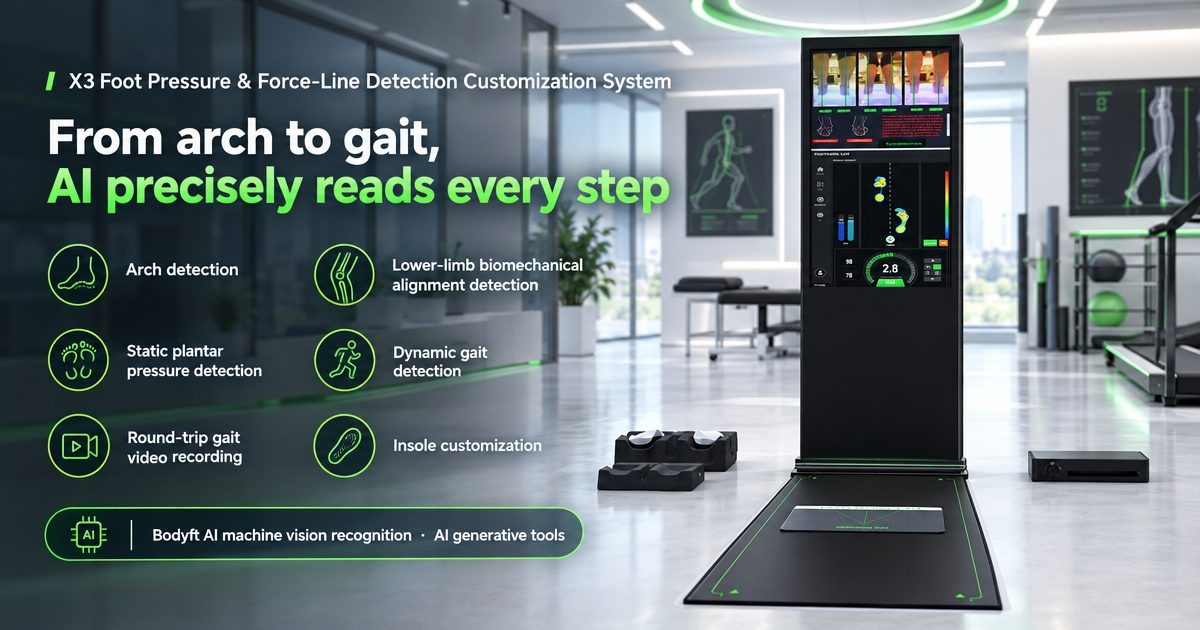
Give the room one habit this week: before any standing pass is filed, look at the toe line on the map and ask whether the toes are present where they should be. If the hollow is there, watch the foot, reword the instruction, and take the pass again; then write one line on the sheet about what was observed. Our article on capturing a record when the customer cannot stand still covers the same pass-by-pass discipline for the whole capture, and what a printed footprint on glass still shows explains the offline cross-check that settles doubtful toe patterns fastest. For the equipment side, the X3 pressure and force-line system page describes how standing and walking records sit side by side in one session, and the Q1P podoscope page covers the close-up view of toe contact that some rooms add alongside pressure. Operational answers we give most often by message are collected on the FAQ page.
This article is intended for professional and educational reference. It is not medical advice. Foot assessment equipment produces measurements and images; clinical interpretation and any decision about care remain the responsibility of a qualified professional. Certification scope is limited to the documentation we hold: European Union certification and ISO quality system certification.