
Most 3D laser foot scanner listings are decided by a specification sheet
that has very little to do with how the machine behaves on a Tuesday afternoon. Two systems
can quote similar capture technology and similar resolution, then produce completely different
working days, because the thing that changes a clinic is not the scanning method. It is everything
around it: how repeatable the capture is, how long one patient occupies the plate, what comes out of
the software at the end, and who is still answering questions two years later.
This checklist is written from the manufacturing side. FOOTWORK LAB has built foot assessment
equipment since 2014 and has run its own plant in Ruichang, Jiangxi Province since 2018. We sell
direct, and we spend a lot of time answering questions from clinics, rehabilitation centres, footwear
retailers and orthotic workshops. What follows is the list of checks we would run ourselves, ordered
by how much each one tends to change the working day.
What a laser foot scanner settles, and what it does not
The first check is the least exciting one: decide what you need the device to output, then confirm
the listing actually produces it. A 3D laser foot scanner captures the surface geometry of the foot.
It records the shape of the medial arch, the outline of the foot in a defined loading position, and
the relationship between the forefoot and the rearfoot. Depending on the build, the same enclosure
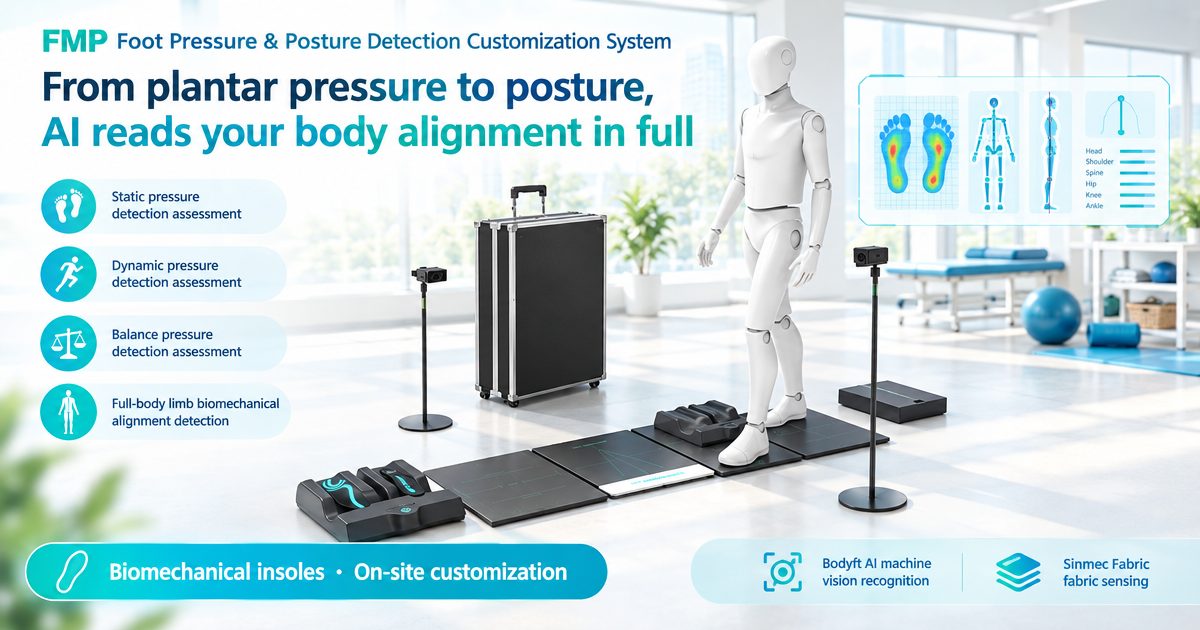
may also hold a pressure plate, a camera channel for lower-limb alignment, or a posture capture unit
— but those are separate measurement channels, not a consequence of the scanning method.
Sellers often blur this distinction. A device described as a laser scanner may be a pure geometry
device, or it may be a modular platform with several measurement modules inside one frame. Both are
legitimate products. They are not the same purchase. If your plan depends on load distribution data,
ask directly which module produces it and whether that module is included in the configuration you
are being quoted, rather than in a sibling model.
What no configuration settles is interpretation. A scanner produces measurements and images.
Reading those measurements, deciding what they mean for a particular person, and choosing what to do
next are professional judgements that stay with the clinician. Equipment that implies otherwise is
promising something the hardware cannot deliver, and a buyer who expects a decision engine ends up
disappointed by a perfectly good measurement tool. That is a commercial problem as much as a clinical
one: buy the wrong class of device and it will underperform in your setting no matter how well it is
made.
A useful way to sort the market is to write down, in one line, what you intend to do with the
output. Footwear retail usually needs an efficient capture and a clear visual summary. A podiatry
clinic usually needs repeatable geometry plus a report it can store — for the arch profile, static
stance and structural presentations such as flat feet that bring people through the door. A
rehabilitation or sports setting usually needs to observe movement, which is a different class of
device altogether. An orthotic workshop needs raw geometry that downstream production can accept.
Once that line is written, half of the feature list stops being interesting. There is a broader
overview in our buyer’s guide to foot scanning machines for clinics if you
want the landscape before narrowing down.
Repeatability is the specification that never reaches the brochure
If one property separates a machine you will still trust in three years from one you will quietly
stop using, it is repeatability: whether two captures of the same foot, taken minutes apart, agree
with each other. You will not find it printed on a datasheet, because it depends on the operator, the
person being scanned and the device together, and a single figure could not describe it fairly. It
still decides whether the reports in your system mean anything.
Why it drifts
Repeatability is affected by how the foot is positioned relative to the capture sensor, whether
the foot is loaded or unloaded, how steadily the person stands, and how often the device is checked
against a reference. A machine that gives no positional guidance will produce different geometry from
two staff members on the same afternoon. A machine without a calibration routine has no way to tell
you when it has moved.
How to test it in a demonstration
Ask the supplier to demonstrate repeatability rather than describe it. A reasonable request is to
capture the same foot twice in the same session and overlay the results. If the two contours sit on
top of each other, the positioning method and the calibration are doing their job. If they visibly
diverge, ask what causes it — the answer is often instructive.
Then ask two follow-up questions. First, what is the recommended calibration procedure, and how
often should it be run? Second, does the software flag drift, or is it up to the operator to notice?
A device that asks to be re-calibrated on a schedule, and tells you when, is easier to keep honest
than one that never mentions the subject. This matters more in some settings than others: a retail
counter scanning feet for sizing can tolerate more variation than a clinic producing geometry for
custom work. But no buyer is well served by a device whose two outputs disagree, and this is exactly
the kind of weakness that a glossy specification sheet is designed to hide.
Scan time is a staffing decision, not a hardware decision
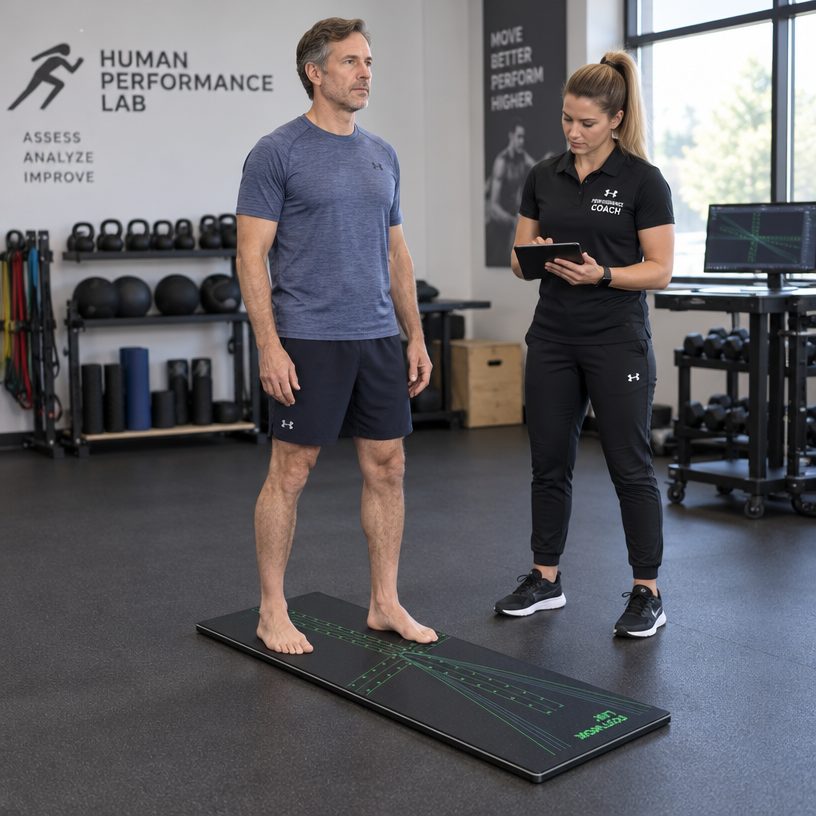
Buyers compare capture speed as if it were an engine size: faster is better. In practice the
capture is rarely the slow part of the appointment. What occupies the room is preparation,
positioning, explanation, the software handling after the capture, and the cleaning between people.
Ask about all of it, not just the flash that lasts a moment.
Time one real appointment
The honest test is to ask the supplier to walk through a complete transaction, from the patient
sitting down to the report being saved. Ask how long the capture itself takes, how long the operator
spends in the software afterwards, and whether the report is generated automatically or assembled by
hand. Add the cleaning step. That total, multiplied by your daily patient volume, is the number that
actually affects your operation.
How many people does it take
Some systems need one operator and are designed so the clinician can stay in conversation with the
patient. Others need a second person to position and hold the foot, which quietly halves your
throughput. Ask which one you are buying, and ask what the workflow looks like when the device is
occupied and another patient is waiting.
Speed also interacts with repeatability. A faster capture that produces less consistent output
does not save time — it creates re-scans, which cost more than the seconds it saved. When two machines
are close on price, the one that produces a usable result on the first attempt is usually the faster
machine in a real clinic.
One more practical question: does the device need a dedicated workstation and a dedicated space,
or can it share the room with the rest of your equipment? The answer changes both the staffing plan
and the layout, and it is much cheaper to discover before installation than after. Buyers who map the
full appointment rather than the capture alone tend to choose very differently from those who compare
a single number.
The report is the product your patients and customers actually receive
Whatever the hardware captures, what leaves the room is a report. For most buyers this is the
under-examined part of the purchase, and it is where cheap configurations quietly cut corners.
What should be in the output
A usable report typically shows the captured geometry — arch profile, foot outline, the
forefoot-to-rearfoot relationship — and, where the configuration includes pressure measurement, a
view of load distribution across the sole. The report is a record of what the device measured. It is
not a verdict, and it should not be worded as one. A report that reads like instructions for the
person being assessed is overstepping what measurement equipment can support.
Language, branding and layout
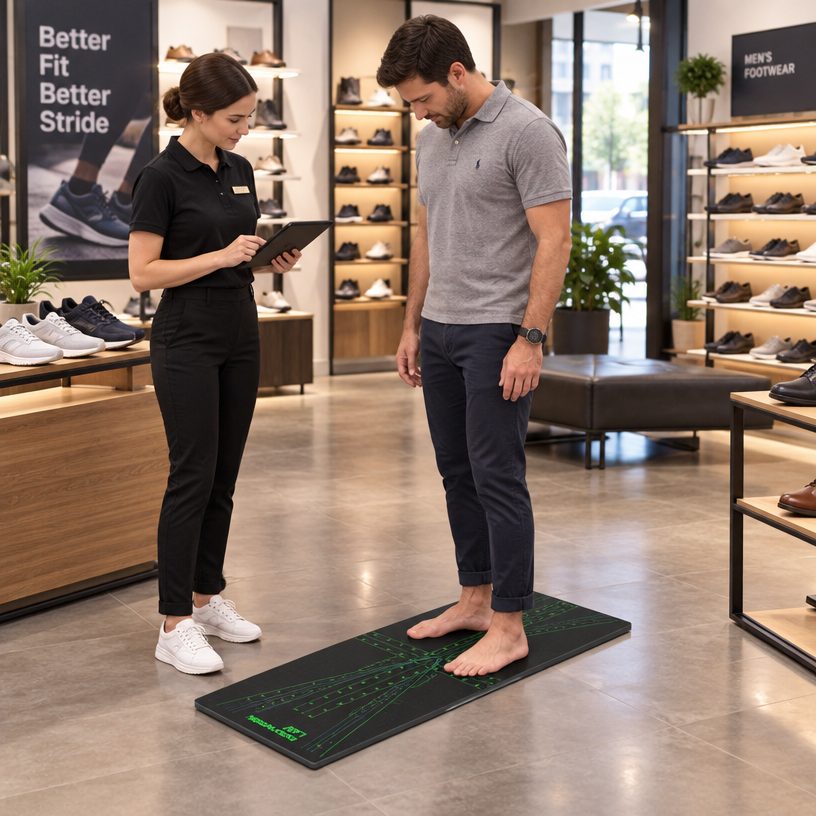
Ask whether the report can be presented in your language and whether it can carry your own
branding. For a clinic this is a small professional detail; for a retailer or an orthotic workshop it
is often part of the customer relationship. Ask how much of the layout is set in advance and how much
can be configured, and ask to see a real report rather than a marketing screenshot.
Where the data lives, and who can see it
This is the question buyers ask too late. Is captured data stored on the machine, on a local
computer, or in a cloud account? Who owns it? Can it be exported in a format your downstream process
accepts — the geometry file a milling or moulding workflow needs, for example — or is it locked
inside the reporting tool? For an in-house orthotic service, being unable to get the raw geometry out
is a functional limitation, not a cosmetic one.
Access is a related question. If several staff members scan and one clinician reads the reports,
the software needs to support that division of roles without everyone sharing a single login. Ask how
records are searched, and what happens to the data if the device is replaced. The kind of case a
clinic records varies — arch profile and static stance in some settings, dynamic load distribution in
others — and the device simply stores what it measured. Deciding what to do with that record remains
with the professional reviewing it. Buyers should be comfortable that the report is a measurement
record first and a formatted document second.
Modular build, spare parts and the update path
Hardware fails. The purchase decision is not whether something will eventually need attention, but
how much of the system goes down with it and how quickly it comes back.
Modularity
Ask whether the device is built from replaceable modules, or whether a fault means returning a
large assembly. A modular platform lets a single component be changed without shipping the whole
machine across a border. FOOTWORK LAB builds our machines this way specifically because our buyers are
overseas and a full-unit return is impractical for everyone involved. It is a reasonable benchmark to
hold other suppliers to, not because every supplier must work that way, but because any supplier
should be able to describe their own structure clearly.
Consumables and wear items
Some components are expected to be replaced during the machine’s life: surface coverings on a
pressure plate, calibration references, cables, and in some designs the capture sensor itself. Ask
what is expected to be replaced, over roughly what period, and how those items are ordered. A device
with an unclear consumable path becomes quietly expensive, and a device with no spares channel has a
working life limited by its first serious fault.
The software update path
Software ages faster than hardware. Ask how updates are delivered — over the air while the machine
is online, by installer file, or by a technician visit — and what happens when the operating system
the software depends on reaches end of life. A machine with no update path has a working life measured
in a few years regardless of how well the frame is built. Our own machines accept over-the-air
updates when connected, which keeps an installed base on a current version without arranging a site
visit.
The unglamorous checks
Before ordering, confirm what documentation comes with the machine: a manual, a calibration
procedure, a software reference. Confirm who provides first-line fault diagnosis and how a technician
troubleshoots from photographs and video. Our own process is a seven-day test cycle before dispatch,
a twelve-month warranty covering non-human-caused failures with free parts in that period, and a
per-customer after-sales group that puts the buyer, the sales contact and an engineer in the same
conversation. Where the machine is connected, remote assistance is possible with the buyer’s consent.
The vagueness of a supplier’s answer here tells you as much as its content.
What moves the price, and why this article will not quote one
We do not publish prices, and we will not put an amount in this article. That is not evasion; a
single figure would mislead. The same enclosure can be configured into very different machines, and a
number quoted for one configuration tells you nothing about another. What we can do is explain what
the number is made of, so that two quotes become comparable.
The factors that actually change the figure
- Measurement channels included. A geometry-only configuration and a platform
carrying pressure and alignment modules are different products built in the same frame. Which modules
are present is the largest single factor. - Software scope and licence model. Whether the analysis and reporting software is
included, whether it is a one-time licence or a subscription, and whether custom report fields or
additional languages are part of the deal. - Support and training level. Installation, staff training, a spare-parts kit, and
the depth of the after-sales arrangement are commercial choices that carry real cost. - Documentation and certification scope. Full technical documentation, and the
certification that applies to the market you sell into. - Order volume and shipping method. One machine and a fleet are priced differently
per unit, and express, air and ocean freight carry very different costs and timelines.
Notice that none of these is a specification you can read off a datasheet. They are scope
decisions. The practical consequence is that a lower headline figure means nothing until two
configurations are described in the same terms — the same modules, the same software, the same
support, the same documentation. The general shape of what influences equipment budgets in this
category is covered in our foot scanner price guide, which describes the same factors without
pretending to a single number.
How to compare quotes fairly
Define your scope first — the workflow, the output, the number of operators, the in-house
production plans — and only then ask each supplier for a configuration-specific figure. Ask what is
included and what is priced separately, because a quote that leaves out training, spares or software
licensing is not a cheaper machine, it is a shorter list. We are happy to walk through that scope with
a buyer before any number is discussed; it saves both sides a wasted round.
Frequently asked questions
Are you a manufacturer or a trading company?
We are a manufacturer. FOOTWORK LAB has been developing and producing foot assessment equipment
since 2014, and has operated its own production plant in Ruichang, Jiangxi Province since 2018.
Development and production are done in-house.
Can I buy a single machine, or is there a minimum order?
For machines, the minimum order is one unit. We would rather a buyer start with a machine they can
actually use and expand later than commit to a fleet they cannot deploy yet.
Does a laser scanner also measure plantar pressure?
Not by itself. Surface geometry and plantar pressure are two different measurement channels. Some
of our platforms combine both in one frame, and some are geometry only. When you ask for a quotation,
confirm which modules are included in that configuration rather than in a related model.
How is the machine tested before it ships?
Every unit goes through a seven-day testing period before dispatch. We run the machine and check
its functions, and we check insole output where the order includes insoles, before the unit leaves the
factory.
What happens if a part fails after delivery?
The machine carries a twelve-month warranty covering non-human-caused failures, with free parts
during that period. Our machines use a modular design and the software includes remote-control
functionality, so in many cases we can identify and resolve an issue from video and photographs, or
through remote access given your consent. Each customer also has an after-sales group including our
engineer for direct support.
Can the software be customised, and do you offer OEM or ODM?
Yes. Because we develop the software ourselves, custom report fields, languages and analysis
outputs are possible; these are quoted separately because the scope varies between projects. We accept
ODM for machines. Machine OEM requires a different commercial arrangement because the enclosure and
branding change, so it is discussed case by case.
How long does delivery take?
Insole samples ship within three days, and standard machine production runs at roughly three to
five units per day. Express delivery typically takes six to seven working days, air freight ten to
twelve, and ocean freight around thirty to thirty-five.
What we would do next
Before you request a figure from anyone, write the one line we mentioned at the start: what will
you do with the output, how many people will operate the machine, and is in-house production part of
the plan. Then run the checks above in order — output first, repeatability second, appointment time
third, report and data path fourth, service structure fifth. That sequence tends to remove the models
you never needed and leave two or three real candidates.
If it would help, send us your setting and requirements and we will tell you which configuration
fits and, just as usefully, which parts of our range you do not need. The F2 platform and its
configuration options are described on the
F2 / FMP gait and pressure scanner page, commercial terms are covered on
the FAQ. To talk through a specific clinic or workshop layout, the
contact page reaches the team directly.
This article is intended for professional and educational reference. It is
not medical advice. Foot assessment equipment produces measurements and images; clinical
interpretation and any decision about care remain the responsibility of a qualified professional.
Certification scope is limited to the documentation we hold: European Union certification and ISO
quality system certification.