
A running gait analysis platform earns its place only if the record you walk away with answers the question you brought the runner in to answer. Picture the flow we run at every demonstration: a short demo on the belt so the operator sees what the two cameras and the sensing surface capture together; a recorded session in walk and run modes; that same session repeated a few weeks later and lined up next to the first; then a follow-up where the change is read against a fixed capture protocol instead of memory. The F5-LAB is built around that loop. It is a treadmill-form device where two cameras record posture and biomechanical alignment while the walking surface records pressure and the path the centre of pressure travels — the butterfly line. This article follows that flow node by node, in the manual’s own terms, and notes where clinics, sports facilities and distributors have tripped over assumptions that were never about the hardware.
At the demo: what shows up the moment someone steps on the belt
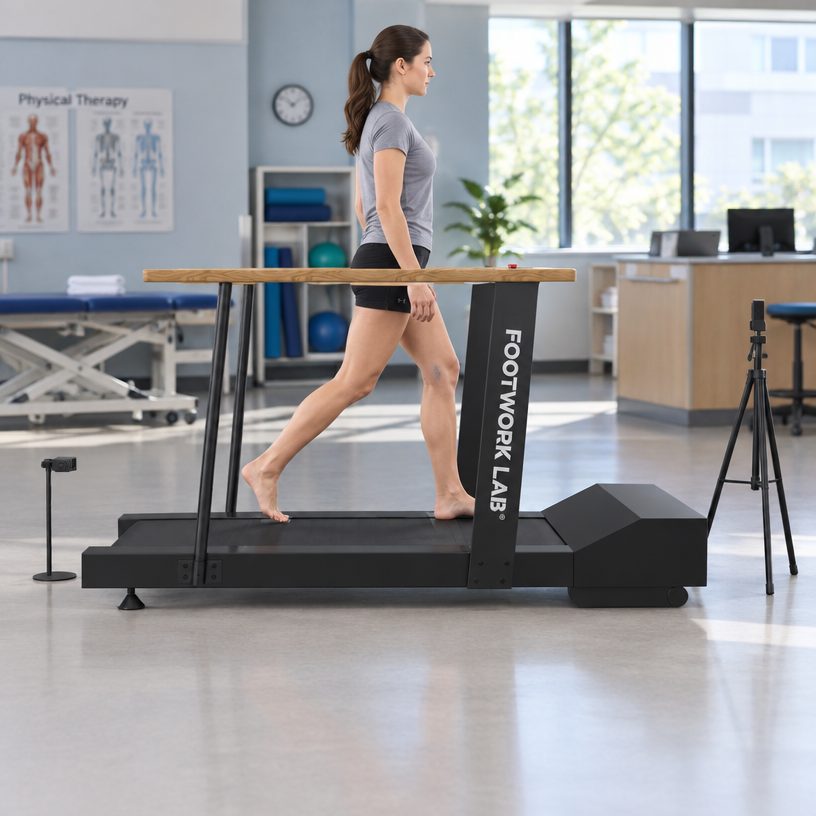
At a demonstration the first thing an operator notices is that the F5-LAB does not ask the person to walk a long corridor. The belt keeps them in place, two cameras frame the body, and the sensing surface under the feet starts recording as soon as they move. In the manual’s terms this is the F5-LAB Dynamic Gait Detection System — a treadmill-form device that measures and analyses pressure distribution and body posture during walking and running, automatically identifies the gait pattern, and provides clinical gait parameters for medical rehabilitation, sports scientific research and customised-shoe work.
The capture rests on two named technologies. BodyftAi machine vision recognition runs the posture and step identification; Sinmec Fabric fabric sensing carries the pressure record; and an AI-assisted report generation step turns the captured record into a readable report. We point these out because buyers often assume the “smart” part is a black box. It is not — it is two specific means of capture and a reporting step, and knowing which is which changes how you read the output.
At one Canton Fair booth, a running coach traced the butterfly-line view with his finger and asked whether the left-right gap meant his athlete was injured. The honest answer was that the line records where pressure travels under each foot; what that means for that athlete is the coach’s and the clinician’s call, not the software’s. That single exchange is why we open every demo by separating the record from its interpretation.
Recording a session: what the system actually captures
The manual lists four core functions, and each names a different slice of the same movement. Gait cycle detection and evaluation is the foundation: the F5-LAB records the gait cycle in two modes, walking and running, and automatically identifies the steps as the person moves. A walking gait and a running gait are different events — the flight phase, the stance share and the rhythm all shift with speed — so a platform that records only one of them misses the other. The device records both, and the report treats them as separate captures.
Assessment of motion posture is where the second camera earns its place. While the belt and the sensing surface record foot load, a body-posture camera records how the trunk, hips and limbs line up — the person’s biomechanical alignment through the stride. The two streams are captured together, so a moment of high load on one foot can be read beside the alignment at that same instant rather than rebuilt from memory.
Dynamic stress assessment and analysis is the pressure side: how load is distributed across the foot while moving, how it shifts through the cycle, and where peak load sits. The Sinmec Fabric sensing surface produces a live pressure picture rather than a static outline. Dynamic bipedal butterfly line analysis and evaluation then presents the dual-foot pressure trajectories — the path the centre of pressure traces under each foot across the cycle, drawn for both feet so left and right sit on the same view.
Reading the butterfly line is simpler than the name suggests. Each foot leaves a trace — the path its centre of pressure travels through the contact phase and on to the next step — and the two traces are drawn as a mirrored pair, which is where the name comes from. A symmetrical pair proves nothing on its own and an asymmetrical pair condemns nothing on its own; what it gives the reader is a place to look. We show operators to start by checking whether the two traces cover a similar spread and end in a similar position, then to carry any repeated left-right difference over to the posture stream, where the camera record shows what the trunk and the limbs were doing at that same instant.
The walking and running modes are kept as separate captures for a practical reason: the same person can look like two different movers. At walking speed, load transfers from heel to forefoot across a cycle where one foot is on the belt for most of the time, so the record is dominated by that transfer. At running speed the cycle compresses, the load concentrates under fewer zones at any given moment, and the posture cameras record a body leaning into the movement instead of riding above it. An operator who records only the walk misses the distribution the runner actually trains in; an operator who records only the run cannot show a client what their everyday gait does. Recording both, under one written protocol, is what makes the pair of records worth comparing.
In our pre-sales calls we keep hearing gyms ask for a single “gait score” they can print and file. We tell them the F5-LAB does not produce one. It produces a gait-cycle record, a posture record and a butterfly-line record, and the value is in comparing them across sessions, not in collapsing them into a number. A device that promised a single verdict would be selling a conclusion it was not built to support.
Comparing across visits: how running records stay readable month to month
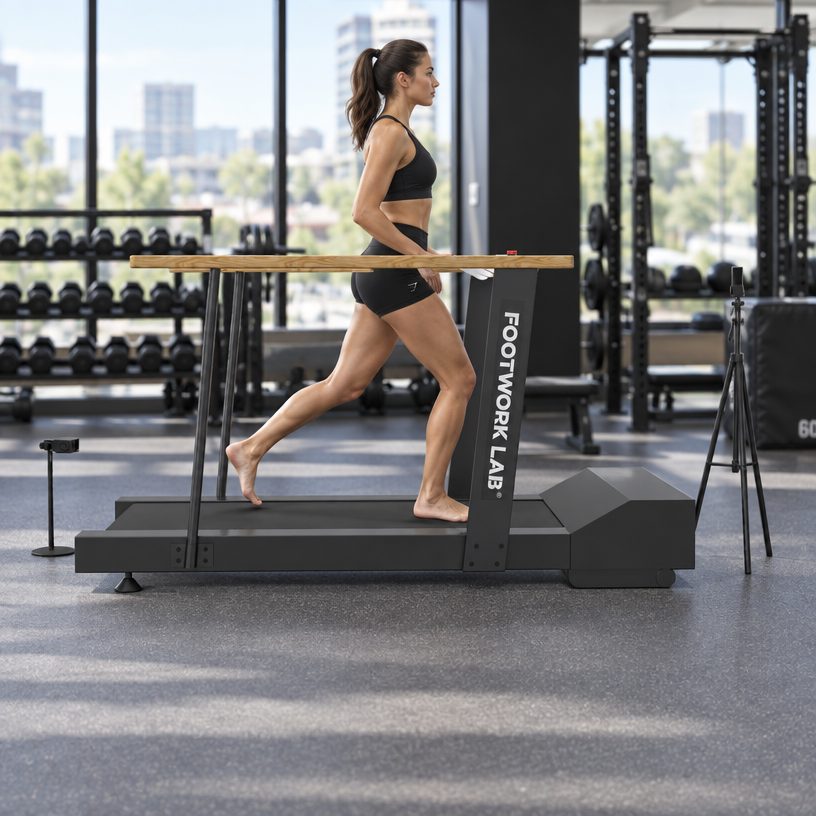
A gait record collected once is a snapshot. The point of a platform like this is the second and third record, read against the first. The F5-LAB holds the walking and running captures as separate records, each carrying the step identification the system produced, and the dynamic pressure view shows how distribution changes through the cycle while the butterfly line places the two feet side by side for a left-right comparison at any visit.
The part that decides whether those comparisons mean anything is the capture protocol. Barefoot versus shod, a fresh session versus one after training, one operator’s wording versus another’s — each of those moves the numbers, and a folder of clips captured under different conditions is just a folder. Our engineers, on a support call, walked a clinic through writing a one-page protocol: same shoes, same time of day, same operator instructions. That single page is what turned two months of records into something a professional could actually read across visits.
We keep the software’s annotations deliberately hedged. When a phase sits outside a usual range, the sentence that follows suggests a possible reason and leaves the judgement open, because a reference band describes a population, not the person on the belt. The report is an assessment record — it documents gait cycle, posture, dynamic load and the butterfly-line path, and notes biomechanical alignment at each captured moment. It does not convert those into a diagnosis, and the conclusion page is written to be read that way.
Follow-up and where the device fits the room
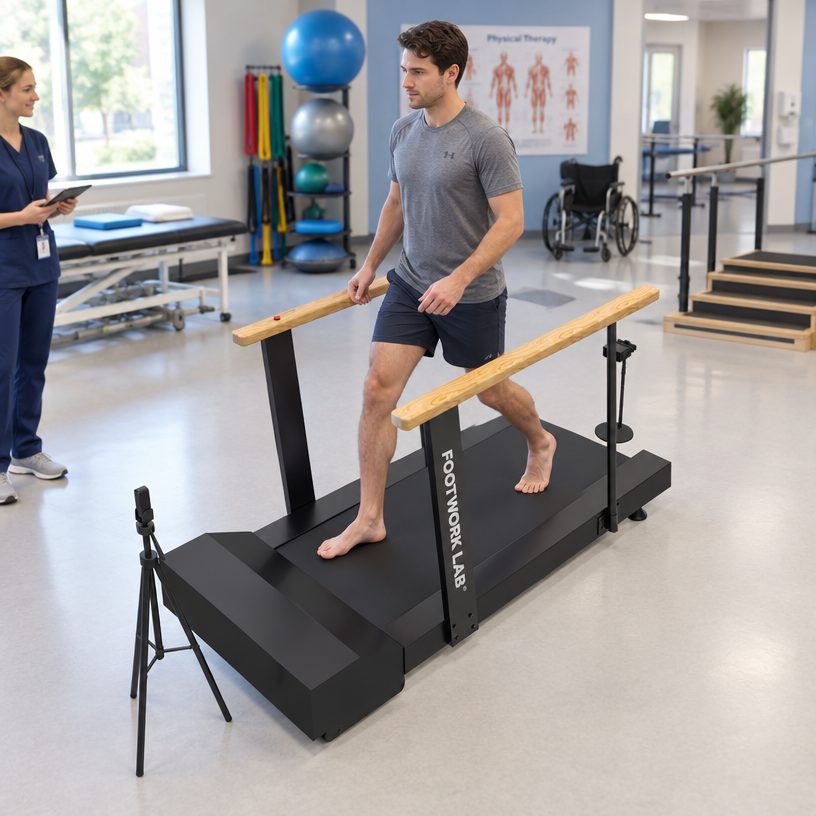
The manual names four settings, and each reflects work the room already does. A rehabilitation hospital is tracking change across weeks of recovery. A sports venue or a running programme is looking at load under a specific movement at speed. A podiatry clinic is relating foot function to the rest of the lower limb. A gym is often catching the first signs of imbalance before they become a recurring complaint. The F5-LAB serves all four because they share one need: a repeatable, comparable record of gait while the person is actually moving.
One strand of thinking in foot care deserves a calm note. A widely read reference work on foot correction in sport argues that lasting change comes first from functional training and load management rather than from an insole alone. We would not dispute that — good movement habits and sensible load are the foundation. Where an insole is discussed at all, we present it as an auxiliary support a professional may use alongside training, not as a substitute. We do not evaluate individual treatment plans, and we do not set our product against that body of work.
For a distributor weighing this against other forms, the practical line is straightforward. The F5-LAB is a treadmill platform built for clinical and training rooms; a shoe store wanting a few-minutes foot screen and an on-site insole is usually better matched to a podoscope-form device such as our Q1P. We point shops to the right form rather than let the F5-LAB be judged as a retail tool it was not built to be.
Frequently asked questions
What does a running gait analysis platform capture that a treadmill doesn’t?
A treadmill records speed, distance and sometimes heart rate. A running gait analysis platform such as the F5-LAB adds the synchronized record of how the person actually moves: two cameras capture posture and biomechanical alignment while the sensing surface captures foot pressure and the centre-of-pressure path, the butterfly line. The treadmill gives you the workout; the platform gives you the gait record, and the two streams are captured at the same instant so load and alignment can be read together.
How are running records compared across sessions?
The F5-LAB holds the walking and running captures as separate records, each with the step identification the system produced, and the dynamic pressure view and butterfly line let a later visit be lined up beside an earlier one. The comparison only holds when the capture conditions match — same shoes, same time of day, same operator instructions. We advise writing that protocol down before the first session; without it, two records describe two different moments rather than one person’s change.
What movements can the F5-LAB record?
The manual specifies two modes: walking and running. The F5-LAB is a treadmill-form device, so the person walks or runs in place on the belt while the gait cycle, posture, dynamic load and butterfly line are recorded. It records gait while moving at those two speeds; it is not built for stair, squat or tiptoe captures, and we say so rather than imply a movement it does not record.
Who uses the F5-LAB — clinic only or also sports?
Both. The manual names rehabilitation hospitals, sports venues, podiatry clinics and gyms. A rehabilitation hospital tracks recovery across weeks; a sports venue or running programme looks at load at speed; a podiatry clinic relates foot function to the lower limb; a gym catches early imbalance. All four share the need for a repeatable, comparable record of gait in motion.
What is the minimum order and how is it supported?
The minimum order for equipment is one unit. Every unit is tested before dispatch and carries a twelve-month warranty with free parts. Support runs through a dedicated engineer channel, remote assistance where a screen can be shared, and over-the-air updates for connected units. The software system can be customised, and that customisation is quoted separately from the equipment.
Does the platform prescribe a training plan?
No. The F5-LAB records gait cycle, posture, dynamic load and the butterfly-line path; it does not write a training or care plan. The plan belongs to the running coach, clinician or other qualified professional who reads the record. We keep the software’s wording hedged so it supports their judgement rather than substituting for it.
What we would do next
If you are specifying a gait platform, write down the sessions you intend to run — walking, running, or both — and the room each one needs, including the review step where the synced record is actually read. Send us that list with your floor dimensions and the operator’s role, and we will tell you whether the F5-LAB covers your space or whether a plate-based system would fit better. Pointing you to the right form matters more to us than placing the most expensive one.
If you already own a pressure plate and the records are not being compared across visits, the fix is usually a written capture protocol rather than new hardware. A short, fixed protocol is what turns a set of clips into a series that can be read across months, and it costs an afternoon to write. See the F5-LAB product page for the full specification, or compare forms on the F2 and FMP systems and the Q1P podoscope.
This article is intended for professional and educational reference. It is not medical advice. Foot assessment equipment produces measurements and images; clinical interpretation and any decision about care remain the responsibility of a qualified professional. Certification scope is limited to the documentation we hold: European Union certification and ISO quality system certification.