
Ask ten buyers what makes a good orthotic insole for flat feet and most of them reach for the same word: firm. Firm shell, firm arch, firm everything — as if the arch were a wall that had fallen down and needed propping back up with the hardest material available. The request arrives in that shape at nearly every show we attend, and it explains why a flat-foot pair so often comes back as a complaint about pressure under the arch rather than about support. The FX Rehabilitation Care series does not work that way. It is a biomechanically assessed custom insole, specified along four build grades — support, anti-torsion, cushioning and starting ability — and the flat-foot direction is one of four inside that series. This guide is for clinic owners, shoe-store buyers, distributors and sports-facility managers who are deciding what to put under a flat-foot customer, and for anyone who has been told that harder means more medical.
The series carries four directions rather than one: flat foot, pressure relief, hallux valgus and plantar fasciitis. What separates them is the lay-up — which shaping board, which cushioning stack, which zones of the sole the surface is shaped to meet. Every build is described along the same four grades, and reading them is the job before a pair is ordered.
Stiffness is a material property; the grade is a design decision
The word that arrives first in almost every enquiry is firm. But firmness only describes how a piece of material behaves when you bend it. It says nothing about where the surface sits under the foot, how much of the midfoot it touches, or what the wearer feels at the end of a shift. Two insoles can be equally firm and behave nothing alike, because one follows the arch and the other presses on it.
The four grades answer four different questions:
- Support — how much of the load the arch region carries and holds. It sets how far the surface rises under the midfoot and where it meets M1 to M3 and MF. A flat-foot build leans on this grade hardest.
- Anti-torsion — resistance to twist along the length of the foot. It governs how much the shell rotates between heel and forefoot when the shoe flexes, and therefore how much of that twist reaches the foot.
- Cushioning — how impact at the heel and the forefoot is damped. This is a separate axis from stiffness: a firm shell can sit on a soft stack, and for a walking customer it usually should.
- Starting ability — how the forefoot platform responds at push-off. It matters in sport and very little to someone walking to the bus stop.
Read as a set, the four explain why the hardness rule collapses. A flat-foot build leans on the first two grades and keeps the third moderate, because the heel still has to land on something. Push all four upward and the wearer gets a rigid object under a foot that is trying to move — and the quotation looks stronger while the experience gets worse.
At a Canton Fair booth a clinic owner picked up one of our stiffer samples and told the visitor beside him that this was the medical one. The visitor stood on it for a minute and said it felt like standing on a stone under the arch. The shell was fine; it did not follow his midfoot, so load arrived at one patch. He kept returning to the softer, shaped build, because it met more of the sole. Some version of that happens at most shows we do, in Dubai and Vietnam as much as in Guangzhou.
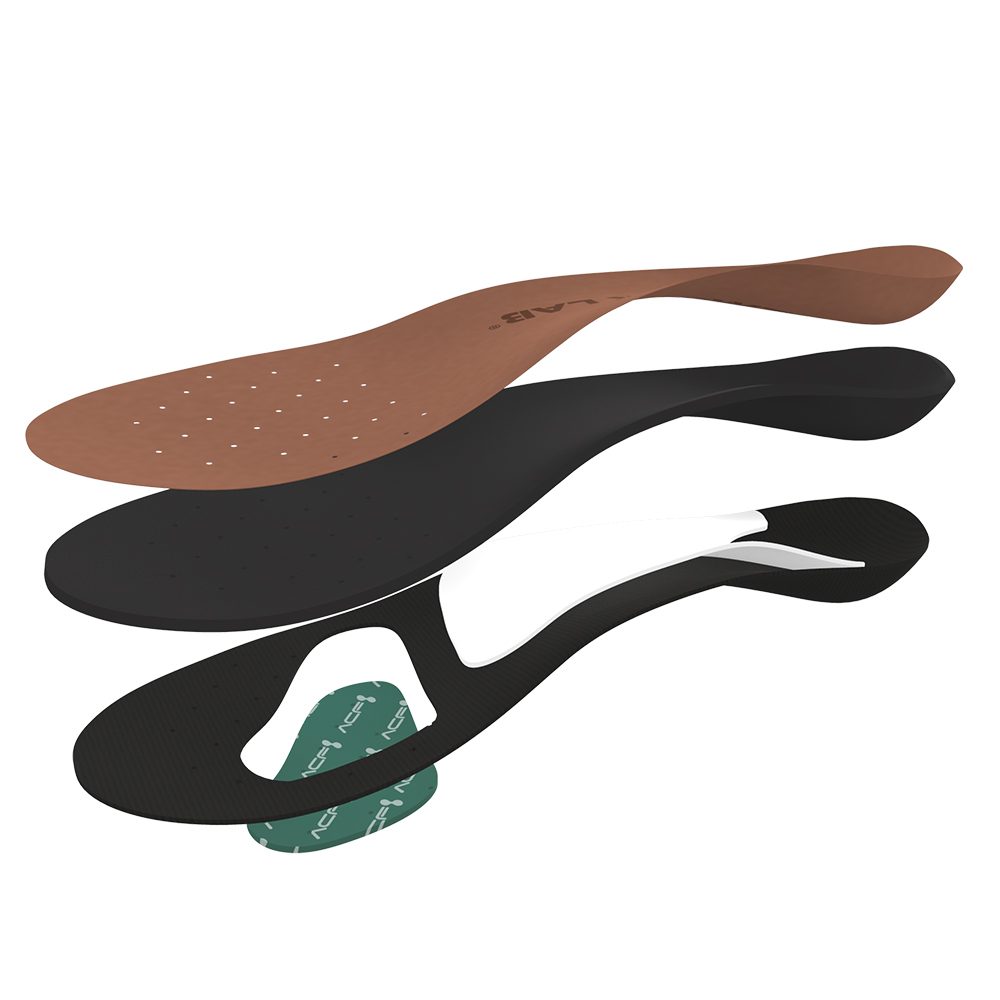
How an orthotic insole for flat feet is built in the rehab series
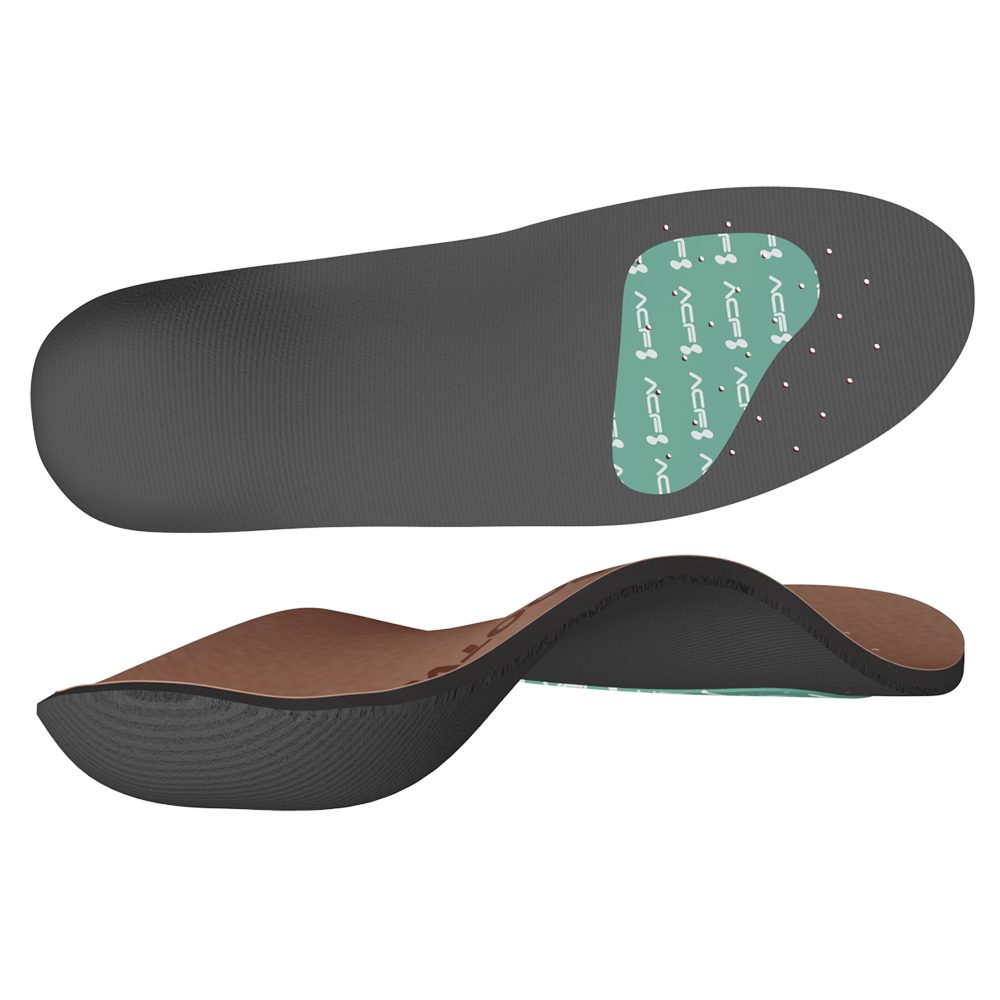
The flat-foot build is not the general rehab build with a different label. Its top surface is a black reverse-suede anti-slip layer over mesh, beneath which sits a red Osolite cushioning layer and an AQ polymer shaping board. The board is the part that carries the grade. The stated job of the build is midfoot support: during standing and walking it is designed to reduce the ground reaction force reaching the sole and to keep the foot’s joints in their aligned position, rather than to push the arch upward.
That is where many flat-foot products part company with ours. A build that tries to lift an arch puts a ridge under the middle of the foot, and the wearer feels a lump. A build that supports the midfoot spreads contact across M1 to M3 and MF, and takes work off the band of tissue carrying it. The design notes concentrate on those zones, treat HL and HM — the heel’s outer and inner edges — for lateral stability, place cushioning over the high-pressure areas, and keep the top surface breathable, because a warm foot slides inside a shoe.
The data path behind the pair matters as much as the lay-up. The FX line is specified from BODYFIT AI detection and evaluation together with senthmetic flexible-fabric sensing technology, and the manual describes customisation as running on specific equipment from data features. In practice that equipment is the X5 foot assessment system, which records the sole, the lower-limb alignment and posture in one session. Buyers often arrive searching for a “3D insole”, the market’s name for a way of capturing foot shape; shape is one input, but the build is set from how load behaves while someone stands and walks. An outline alone says nothing about where the pressure sat.
On the line in Ruichang the shaping board is formed first and the cushioning stack is bonded to it afterwards. Once the board is formed, the arch height is fixed, and no extra top cover will change where the surface meets the foot. It is also why a build cannot be re-graded at the counter by swapping a cover — the assumption behind many sample requests that reach us. A pair worn daily lasts four to six months before the stack and the board need replacing.
What each room asks for, and where the reading goes wrong
In a podiatry clinic, the pressure sits on the record rather than on the product. A screening record showing load under the midfoot is a starting point, and the moment it is handed over as an answer, the insole has to carry a claim it cannot support. The decision that earns its keep is narrower: how much of the load the build should take, and which shoe the person will actually wear it in. A deep, shaped build in a dress shoe with no volume lifts the heel at every step, and the wearer blames the pair.
In a shoe store, the wrong turn is treating firmness as a price tier. The premium pair on the wall is usually the stiffest, so the assistant reaches for it the moment a customer mentions flat feet, and the complaint arrives on the second day: pressure under the arch. A store is better served by matching the build to shoe volume and to the hours the customer stands, and by saying out loud that the first week is a gradual introduction rather than a test of endurance.
For a distributor, the compression happens on the shelf. One flat-foot SKU at medium firmness gets called the safe stock item, and then the range cannot answer the clinic that needs a firmer anti-torsion build or the store that needs a softer one. The four grades exist so a market can be served in slices, and the order terms make that practical: the minimum run is two hundred pairs, mixed styles and sizes are accepted, samples ship within three days, and daily capacity runs in the high hundreds of pairs.
At a sports facility, the rehab flat-foot build often gets handed to athletes because the word rehabilitation sounds protective. It is the wrong trade. The starting-ability grade is what a running or court athlete needs from a forefoot platform, and a rehab lay-up is not built around it. An athlete who needs midfoot support and forefoot response is a two-question order, and the two answers rarely come from the same build.
In pre-sales calls one pattern repeats. A distributor will ask for the hardest build for hospitals and the softest one for retail, as though the sales channel decided the specification. It does not. The split runs along how long the wearer is on their feet, what shoe the pair goes into, and what the foot does at push-off. Two clinics in one city can need opposite ends of the range.
When the insole is not the first move
A body of thinking puts the insole second, and it deserves a fair hearing rather than a rebuttal. In the approach associated with Pierre Brigaud’s writing on foot orthoses in sport, the useful unit is the functional foot — a foot that organises itself around the load it meets — and dynamic joint alignment describes the ankle and subtalar joint finding their position under load. We do not speak for him. What we take from the work is narrower: capacity and load management come first, and a device sits underneath them.
For a flat-foot customer it produces a few questions before any order. Does the foot have the capacity to control the arch under load, or does it run out of range by mid-afternoon? Is the complaint tied to hours of standing, to one particular pair of shoes, or to a jump in training volume? If the answer is capacity, the first move is a loading and strengthening programme, and the insole is a support while that work happens. If the answer is hours and shoe volume — a nurse on a hard floor, a fitter in steel-toe boots — then the build is doing work that training cannot do in the time available.
Support calls show the same split from the other end. A wearer who had been given a shaped build rang in after three days to say it was unbearable, and nothing in the record looked unusual — the pair had simply been worn for a full shift from the first morning. The manual’s own instruction is to extend wearing time gradually, and once that was followed the same pair became unremarkable. A clinic on a separate call paired the build with a loading programme and brought the wearer back for a second record; the comparison gave them something to discuss at the next appointment instead of a yes-or-no.
An orthotic insole for flat feet is not a correction applied from below, and it is not a substitute for capacity. It changes where load lands during the hours a person is on their feet, and it earns its place when the shoe, the hours and the load line up.
Frequently asked questions
Is the FX flat-foot build the same insole as the other rehab directions?
No. The four directions share the series platform but not the lay-up. The flat-foot build uses a full shaping board under a cushioning layer with a midfoot focus, while the pressure-relief direction is built around a heel cup and a different cushioning arrangement, and the hallux valgus build shifts its cushioning toward the forefoot.
Which of the four grades should a flat-foot customer care about most?
Support and anti-torsion carry most of the specification, because they decide how much of the load the midfoot takes and how much twist the shell passes back into the foot. Cushioning should stay moderate, since the heel still needs somewhere to land. Starting ability matters mainly to athletes.
Does a harder insole hold an arch better?
Hardness is a property of the material, not a measure of support. What holds an arch is where the surface sits and how much of the midfoot it contacts. A hard plate that does not follow the midfoot concentrates load on a small area, which the wearer feels as pressure rather than support.
Can a distributor order a mixed run across the four rehab directions?
Yes. The minimum run is two hundred pairs, mixed styles and sizes are accepted within it, and ODM and OEM work is available. Samples ship within three days, and daily capacity runs in the high hundreds of pairs.
How long should a daily-wear pair last?
A pair worn daily is expected to last four to six months. High-intensity sport use shortens that span and reduces the support and cushioning the pair delivers, which is worth saying at the counter rather than leaving the customer to discover it.
Do I need an X5 to order FX insoles?
The manual pairs the FX line with the X5 detection system and describes the customisation as running on specific equipment from data features. A buyer already running an X5 has the natural path. A buyer without one should plan the two together, because an insole ordered from an outline alone leaves the load pattern out of the specification.
What we would do next
If you are building a flat-foot offer, write down three things before you ask for a quote: the shoe types the pair will go into, the hours the wearer stands, and what your records show about where the load sits. Send that list and we will tell you which of the four directions fits, and which grade pair would be wasted on your customers. The insole categories page lists the full range, the rehabilitation directions included.
If you already stock a flat-foot insole and the returns cluster around arch pressure, the answer is usually a build change rather than a price change. Ask for a sample pair in two grades and put them on the same few wearers before you commit to a run. Samples leave within three days, and the comparison settles in a week what a catalogue cannot.
This article is intended for professional and educational reference. It is not medical advice. Foot assessment equipment produces measurements and images; clinical interpretation and any decision about care remain the responsibility of a qualified professional. Certification scope is limited to the documentation we hold: European Union certification and ISO quality system certification.