
“We are building out our ankle joint rehabilitation pathway — where does a foot-and-ankle data record actually sit in it? Before the assessment, inside it, or after?” That question, in one phrasing or another, is the most common one we take from rehabilitation buyers in pre-sales calls about the Q1P. The device behind it is a podoscope: a screening instrument that captures plantar data, ankle data and lower-limb biomechanical alignment in a few minutes per person, then produces an AI-assisted report. This article answers the question the way we answer it on calls — by walking through what the Q1P records, which step of an assessment pathway the record belongs to, and what a retest comparison needs in order to mean anything. It is written for rehabilitation centres, clinics and retailers weighing whether a rapid screener earns a place in their room.
One boundary frames everything below. Ankle joint rehabilitation is a clinical programme directed by qualified professionals; the Q1P does not run that programme and does not promise outcomes of any kind. What it contributes is the record: a documented, repeatable capture of foot and lower-limb measurements that sits at a specific point in the pathway — and that point, plus the discipline of retesting under the same conditions, is the whole subject of this article.
Where a foot-and-ankle record sits in ankle joint rehabilitation pathways
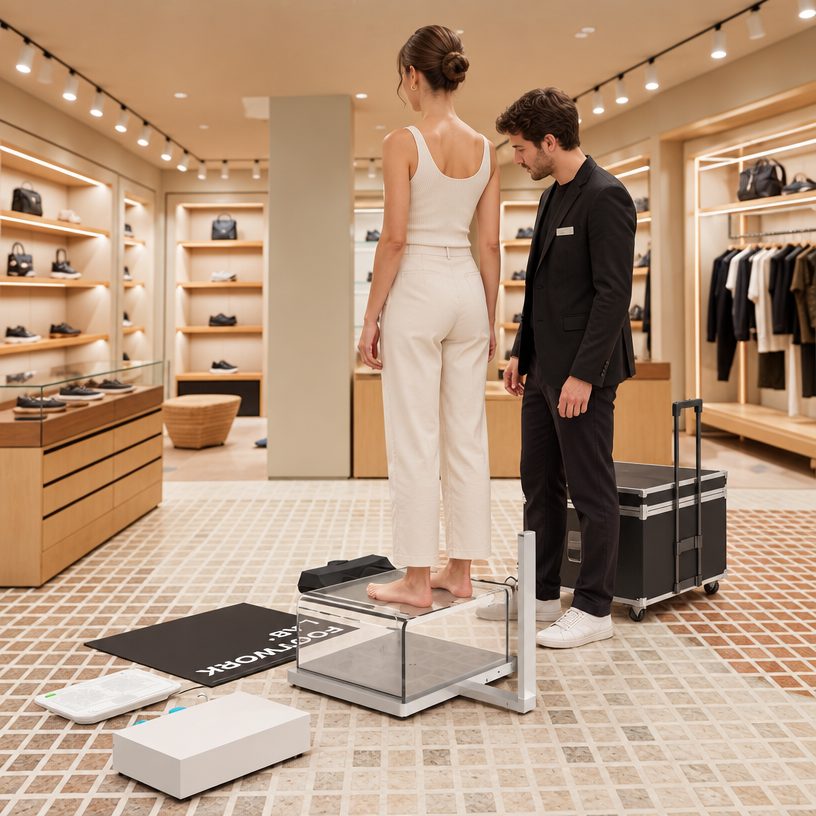
A rehabilitation pathway for the ankle typically moves through stages: the person arrives, the professional assesses, a programme is decided, and progress is reviewed over time. The Q1P belongs at the front of that sequence, at the documentation step — the moment the centre writes down what the foot and lower limb look like before anything else happens. A screening session on the podoscope captures plantar data, ankle data and lower-limb biomechanical alignment, and the report returns foot arch type, foot shape, hallux valgus and calcaneal status, tibial rotation, foot length and width with a size recommendation. Those are measurements, taken while the person holds a series of defined standing and bending poses that the software walks them through one by one.
Why documentation first, rather than somewhere later? Because every later step reads better with a written starting point. The professional who assesses an ankle has a session’s worth of observations to make; handing them an archived baseline of arch type, alignment angles and pressure-relevant foot data means the assessment starts from a record instead of from memory. And because the Q1P completes a screening in minutes, it can sit at intake without slowing the room down — which is the same reason footwear retailers use it at the counter, and the reason we will come back to when we talk honestly about where the manual places this device.
What the Q1P records in one screening session
The manual names the system a Foot & Leg Detection Insoles Customization System, and lists three detection functions: plantar data detection, lower-limb biomechanical alignment detection, and ankle data detection. The capture runs on BodyftAi machine vision recognition with an analysis system that produces the report through AI-assisted report generation. In practice, a session moves the person through a short pose sequence — standing straight, bending into a half-squat, lifting the toes, bending down — and the cameras record each position. The poses are not arbitrary: each one exposes a different piece of the picture, from resting arch shape to how the heel and lower leg line up under load.
The report that comes back keeps those threads separate. It states the foot arch type and foot shape classification, the status of hallux valgus and calcaneal position, tibial internal or external rotation, and the foot length and width measurements that feed a shoe-size recommendation. A concluding analysis section describes the pressure distribution and centre-of-gravity behaviour observed during the session. And the report closes with a sentence the manufacturer wrote deliberately: the analysis is for reference only, and anyone with medical needs should visit a professional institution for further examination. That sentence is not boilerplate — it is the clearest statement of what a screening record is, and we advise every buyer to keep it intact in their own localised report.
The concluding analysis section deserves a closer look, because it shows how the record is framed. It describes the pressure distribution observed between the two feet and across the front and rear of the foot, the direction and speed of the centre of gravity as it moved during the session, and the overall posture balance the capture suggested — always in the language of observation rather than verdict. Where a measurement sits outside the usual range, the analysis names the region and describes what that pattern of load shift is associated with, and stops there. A rehabilitation team reading the report therefore receives a structured description they can agree or disagree with in their own notes, not a conclusion they have to override. That framing is exactly why the record survives contact with a clinical workflow: it claims less than an assessment, which is what lets it sit beside one.
A note on what the record does not contain. It does not include a diagnosis, a prognosis, or a rehabilitation plan. It does not grade anyone’s recovery. It documents how the foot and lower limb present, on the day, under the poses the protocol defines. A rehabilitation centre that keeps that boundary intact gets a documentation tool; one that lets the report drift into interpretation gets arguments with the clinical team — and the clinical team is right.
A shoe-store screener in a rehabilitation room: what it earns and where it stops
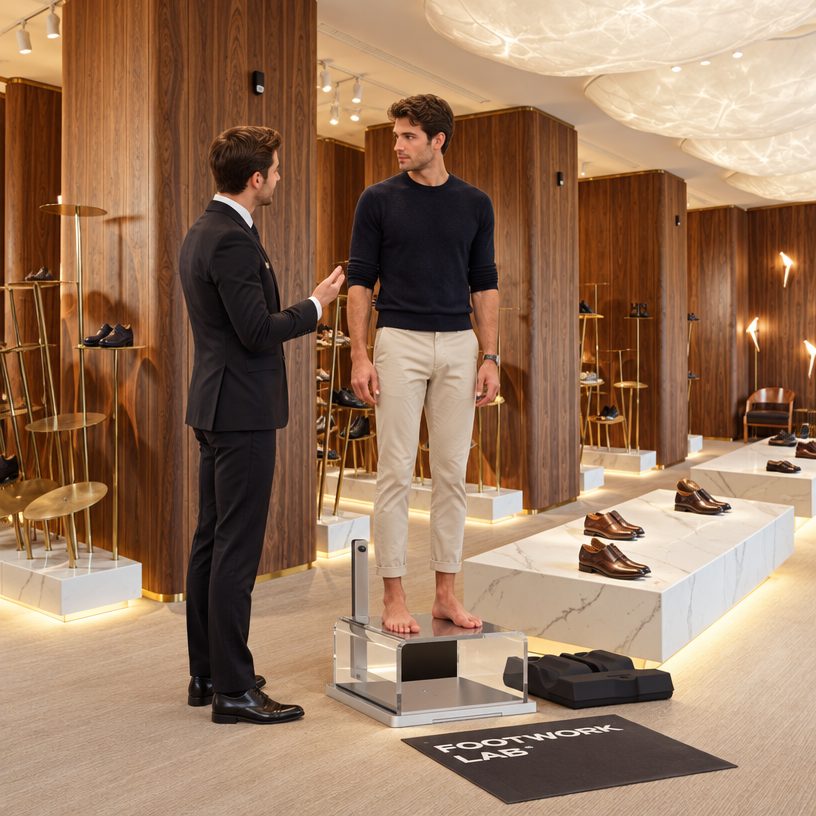
Honesty about the product’s origin helps here. The Q1P manual lists one application scenario: the shoe store. It was designed as a rapid screening and on-site customization device for retail — a customer steps on, the screening takes minutes, and the fitting conversation starts from measurements instead of guesses. Rehabilitation buyers who see the podoscope at a trade fair often assume it is therefore not for them. Our answer is that the scenario label describes where the product is most deployed, not a ceiling on where the record is useful; a device that captures arch type, alignment and ankle data in minutes answers the documentation question at intake just as well as it answers the fitting question at the counter. The buyer decides which job they are hiring it for, and configures the workflow around that decision.
What it earns in a rehabilitation room is speed and consistency at the documentation step, where a full assessment would be too slow and a questionnaire too thin. What it stops short of is everything after that step. The Q1P does not measure joint range of motion, does not replace the professional’s hands-on assessment, and does not track a rehabilitation programme’s milestones — those belong to the clinical team and their own instruments. At a trade fair in Dubai, a physiotherapy buyer put this well after trying the podoscope herself: she said the screening gave her intake staff something concrete to file before the clinician ever saw the patient, and she was careful to add that she would never let the report speak for the assessment. That is precisely the division of labour we recommend.
Retests that can be compared: same poses, same instructions, same record
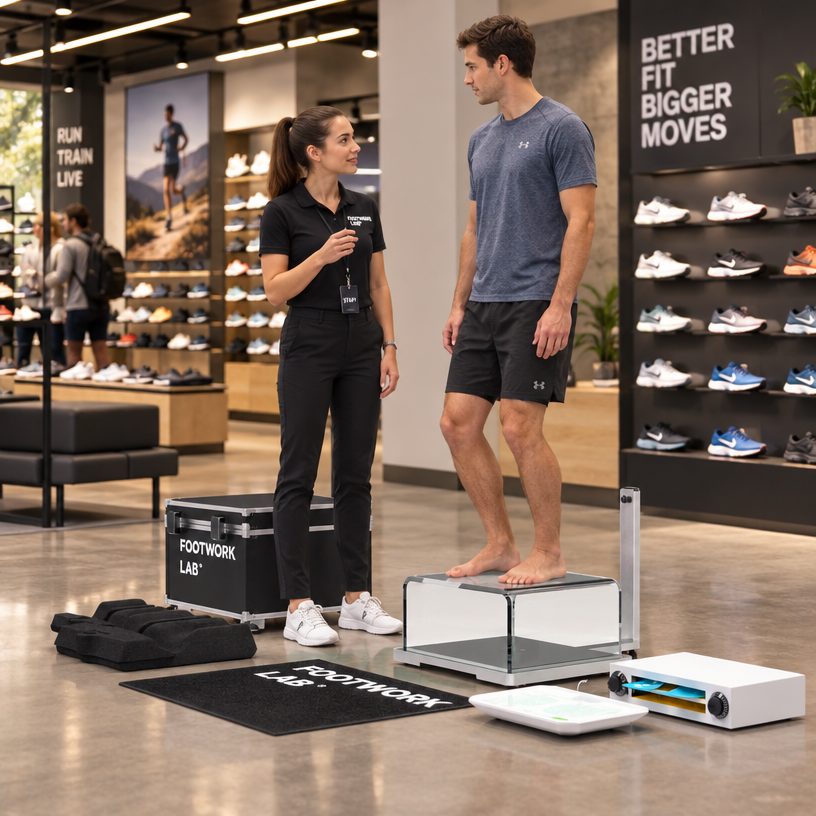
The value of an intake record compounds at the retest. Because the Q1P stores each session against the person and the report keeps the same layout every time, a follow-up screening lands beside the baseline without any rebuilding — arch type beside arch type, alignment status beside alignment status, foot measurements beside the same measurements. What makes that comparison fair is not the device; it is the protocol. The pose sequence has to run in the same order, the instructions have to be given the same way, footwear state has to match, and the person operating the podoscope — or at least the wording they use — has to stay consistent. A baseline captured barefoot cannot be read against a retest captured in shoes, for the same reason a morning session cannot be read against an end-of-day one.
We learned how much this matters on a support call. A retail buyer running screenings across two branches found the reports from the same customers coming back different between locations, and suspected the hardware. Our engineers walked through both setups on the shared WhatsApp group and found the difference in the instructions: one branch walked customers through the pose sequence verbatim from the manual, the other paraphrased it from memory, so customers were holding slightly different positions. Both branches adopted the printed script, and the records from the two sites became readable against each other within a week. The podoscope had been identical all along; the protocol had not.
For a rehabilitation centre, the archive around the podoscope is worth designing as deliberately as the capture itself. Three fields make a retest usable months later: the date and the pose-script version in force that day, the footwear state the person arrived in, and the name of whoever ran the session. None of these lives inside the report, which is why teams that keep them on a single intake sheet beside the unit get more out of the same device than teams that rely on memory. The record the Q1P produces is consistent; whether two records from different months can be compared is decided by the paper — or the habit — around it.
For teams that want the record to feed their own documentation system, the software is customisable, with that work quoted separately from the equipment. And the device itself travels well — the Q1P ships in a portable suitcase with the podoscope host, camera accessories, heating box, shaping pillows for adults and children, and the mat — so a screening service can run at intake, in a second room, or at an outreach event, provided the protocol travels with it unchanged.
Frequently asked questions
What ankle data does the Q1P actually record?
The manual lists three detection functions: plantar data detection, lower-limb biomechanical alignment detection, and ankle data detection. The report returns foot arch type, foot shape classification, hallux valgus and calcaneal status, tibial rotation, and foot length and width with a size recommendation, captured while the person holds a defined sequence of standing and bending poses.
How long does one screening take?
The Q1P is built as a rapid screener — a session completes in minutes, which is why the manual positions it for the shoe-store counter. In a rehabilitation setting, that speed is what lets the record sit at intake without slowing the room. The pose sequence the software walks each person through is short by design.
Is the screening report a diagnosis?
No. The report’s own conclusion page states that the analysis is for reference only and that anyone with medical needs should visit a professional institution for further examination. The Q1P documents measurements and presents them; interpretation and any decision about care belong to a qualified professional.
The manual lists the shoe store as the scenario — can a rehabilitation centre still use it?
The manual’s scenario label describes where the product is most deployed, not a restriction. A rehabilitation centre can configure the same rapid screening as its intake documentation step, provided the boundary holds: the record supports the professional’s assessment, it does not replace it or direct the programme.
Can the Q1P track recovery or outcomes over a rehabilitation programme?
It supports the record side of that work: archived baselines and retests under identical conditions give the clinical team comparable documentation at each review. It does not measure joint range of motion or track programme milestones itself, and it makes no claims about outcomes. Progress judgements belong to the professionals directing the programme.
What comes with the device, and what support follows it?
The package includes the Q1P podoscope host, camera accessories, heating box, a set of shaping pillows for adults and children, mat, portable suitcase, manuals and toolkit. The minimum order is one unit, every unit is tested before dispatch, and support runs through a dedicated WhatsApp group with our engineers, remote assistance, and over-the-air updates for connected units.
What we would do next
If you are placing a foot-and-ankle record into an assessment pathway, write down which step it serves — intake documentation, the counter, or outreach screening — and who reads the record afterwards. Send us that outline with your room layout, and we will tell you how the Q1P fits and where you would need a different instrument, including the full pressure-plate systems in our range if your pathway needs dynamic walking records rather than a rapid screen. Our FAQ page carries the order, warranty and support terms in full.
If you already run screenings and your retests do not read cleanly against their baselines, send us the pose instructions your operators currently use — the fix is usually a printed script rather than new hardware. For the full specification of the screener described here, see the Q1P podoscope page.
This article is intended for professional and educational reference. It is not medical advice, and it describes measurement records, not treatment. The Q1P produces measurements and images; clinical interpretation, rehabilitation decisions and any decision about care remain the responsibility of a qualified professional. Certification scope is limited to the documentation we hold: European Union certification and ISO quality system certification.