
A physiotherapist who bought a dynamic gait system last year sent us two reports from the same patient, captured six weeks apart by two different staff members, and asked which one was wrong. Neither was wrong. One operator told the person to walk at a pace the operator chose; the other let the patient pick it. One session ran in the patient’s own worn trainers; the other in clean socks on the belt. The reports looked like two different people because they were, in a meaningful sense, two different protocols. This is the conversation we keep having after delivery, and it is the reason we tell buyers that a gait analysis device is half the purchase. The other half is the written protocol: fixed instructions and stance, fixed footwear and clothing conditions, and fixed retest intervals. Below we set out how we would build those three elements on the F5-LAB before the first patient ever steps on the belt, who should be qualified to run the sessions, and who signs the report.
A device records; a protocol produces comparable records
The distinction sounds like a seminar slide until you sit with two reports from the same person. A device, on its own, produces a record of whatever happened in front of it. If what happened was a walk chosen on the spot, in whatever shoes the person wore that day, captured by whichever colleague happened to be free, the record is accurate and it is also useless for comparison. Nothing on the report tells you whether a change in the butterfly line came from the person or from the conditions.
Comparable records come from a protocol, and a protocol is a short written document that answers a handful of questions in advance. What does the operator say, word for word, before the walk or the run starts. Where does the person stand to begin. What shoes, socks and clothing count as acceptable for a session, and what happens when they do not. How long between a baseline record and the next one. Who is allowed to run the session at all. None of these answers needs more than a page.
We make this point during pre-sales conversations because it changes what a buyer should ask us about. The questions that matter most after the machine arrives are not about the hardware; they are about the session. A buyer who plans the protocol before the first patient gets value from the second visit onward. A buyer who plans it after six months of records has to choose between discarding those records or annotating every one of them with the conditions that produced them.
There is also an honest limit to state up front. The F5-LAB captures the gait cycle, movement posture, dynamic pressure and the bilateral butterfly lines; it does not enforce a protocol, and it does not diagnose. It will happily produce a beautiful record of an inconsistent session. The discipline lives in the room, in the hands of the operator, and that is exactly why the protocol is worth writing down.
The first element: fixed instructions, fixed stance, fixed pace rule
The cheapest source of noise in a gait record is the instruction. One operator says “walk normally”; the patient, wanting to perform well, shortens their steps and looks at their feet. Another operator walks the first demonstration pass themselves; the patient copies that stride, which belongs to someone else. The fix is a script. Write the exact sentences the operator says, read them the same way every time, and give the patient one practice pass to settle before the recorded pass begins.
Stance and start position belong in the script too. On the F5-LAB the person steps onto a treadmill-form belt, so the start is simpler than on a walkway: stand centred, feet at their natural width, hands free, facing forward. The operator’s position also matters. Standing where the patient can see them changes where the patient looks; standing behind the camera line keeps the operator out of the frame. Decide once, write it down, and every session inherits the decision.
Pace needs its own rule, because the F5-LAB runs in two modes — walking and running — and each mode needs a defined condition. A workable rule for walking is to let the person choose a comfortable pace and then record that choice on the report, so the next visit starts from the same number. A workable rule for running is to fix the belt speed by a named protocol the clinic agrees on, and to record anything that deviates from it. Either rule works; switching between them mid-quarter does not.
What the script buys you is the ability to answer a patient’s question in week nine: has anything changed. Without it, the honest answer is a shrug. With it, the two records share instructions, stance and pace rule, and the differences you see are differences in the person, which is the only kind worth chasing.
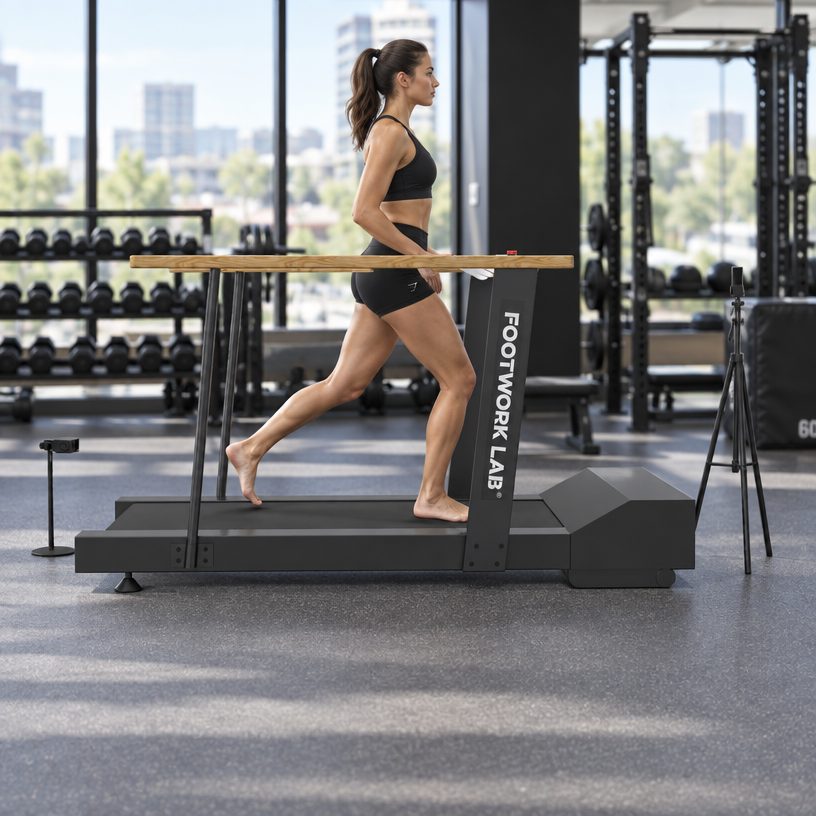
The second element: fixed footwear and clothing conditions
Shoes change a gait record more than most buyers expect. A worn trainer with a collapsed inner edge, a stiff leather shoe and a bare foot in socks produce three different contact sequences from the same person, and all three can look defensible on a report. If the first session ran in the person’s daily trainers and the retest ran in new shoes bought the week before, the comparison is contaminated before it starts.
The fix is a written condition, and the simplest one is: same shoes as the baseline, or a stated equivalent if the originals are worn out. Ask the patient to bring the shoes they actually wear most, record the shoe on the report, and refuse quietly when someone arrives in something else — reschedule rather than capture a session you will not be able to compare later. We have seen a clinic lose an entire quarter of progress notes this way, not because the machine drifted but because nobody owned the shoe rule.
Clothing sits one level up. On the F5-LAB, the two cameras on their brackets record the body’s movement posture while the belt records pressure, so long coats, loose skirts and bulky bags hide exactly the lines the cameras exist to capture. A written condition — fitted clothing, no coats, hair tied back if it crosses the camera line — takes one sentence in the booking reminder and saves the session.
A concrete example of what breaks when this is skipped: a gym member records a baseline in running shoes, follows a training block, and returns in a minimalist pair a colleague recommended. The butterfly lines shift noticeably. The coach reads it as adaptation; the member credits the new shoes; nobody can say which it was, and the argument never resolves. The record was fine. The conditions were not comparable.
The third element: fixed retest intervals and a baseline worth keeping
The first recorded session is not a result; it is a baseline, and it deserves more care than any session after it. A baseline captured casually — wrong shoes, hurried instruction, unfamiliar belt — becomes the reference every later comparison leans on, and its weaknesses propagate forward. We ask buyers to treat the first two sessions as rehearsal: run the protocol, find where it creaks, adjust the script, and only then freeze it and call the next record the baseline.
The retest interval should be fixed in advance and tied to the reason for measuring. A rehabilitation programme that expects to review progress will choose one rhythm; a training block in a gym will choose another; a screening programme at a sports venue may capture a single session with a referral onward. What breaks comparability is not any particular interval but an irregular one — retests booked when the schedule allows, so the gaps between records vary and the comparisons quietly stop meaning the same thing.
Whatever interval the room chooses, the conditions from the first two elements travel with it: same script, same stance, same shoe rule, same mode. The F5-LAB makes this easier than most set-ups because the treadmill form holds pace and surface constant between visits — the belt does not change the way a corridor does — but the hardware holding one variable steady is not a licence for the others to float.
One more honest note: a retest record that shows a difference is a finding to be read by a qualified professional, not a verdict the machine issues. The report puts the two butterfly lines side by side; it does not say what caused the difference. That reading — training effect, footwear, fatigue, or the protocol itself — belongs to the person who signed the baseline and knows the conditions behind it.
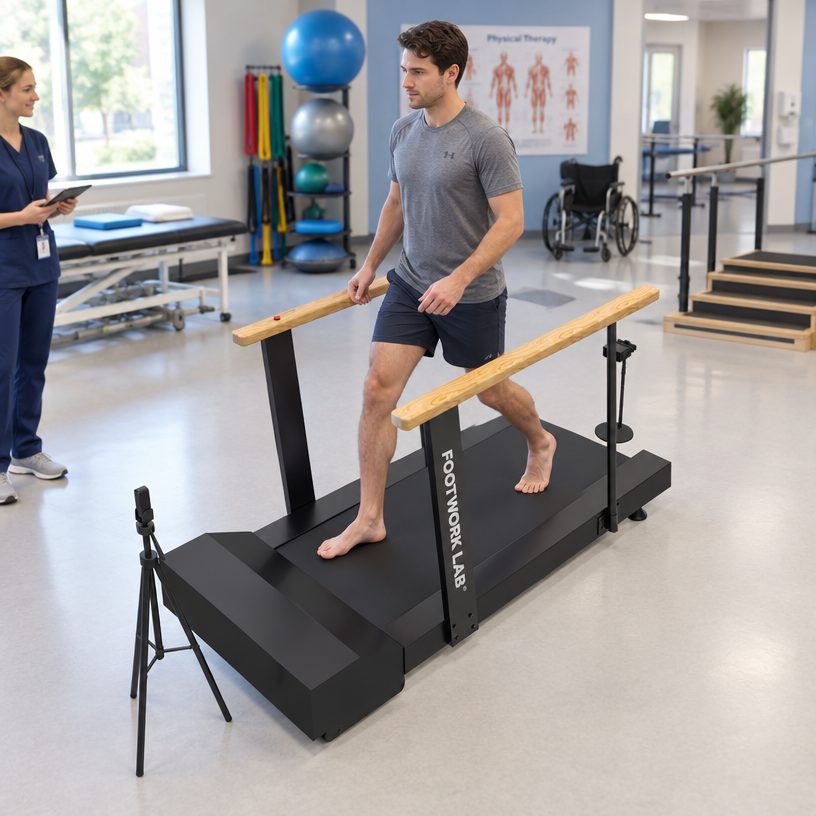
Who is qualified to run the device, and who signs the report
A second purchase decision hides inside the first: who will actually operate this machine. The F5-LAB is not difficult to run, but it is easy to run inconsistently, and inconsistency is invisible until two operators’ records meet. Before delivery, a buyer should be able to name the people who run sessions, the training they will receive, and the rule for what happens when that person is on leave — because an untrained substitute quietly breaks the protocol you just wrote.
Our own position is that the manufacturer trains operators on the mechanics: capture, modes, calibration checks, report generation, the meaning of each recorded quantity. We do not train clinical judgement, because that is not ours to teach. The interpretation — what a shifted COP path or an asymmetric pair of butterfly lines means for a particular person — is the responsibility of the qualified professional in the room, whoever that is under the buyer’s local rules.
The signature is the visible end of that chain. We encourage buyers to decide, in writing, whose name goes on the report: the operator who ran the capture, the professional who read it, or both. A report with a signature is a document someone owns. A report with no signature drifts into being a printout nobody defends, and it is the unsigned reports that get quoted to patients as if they carried more authority than they do.
This division of labour is also why our software stops where it does. The system assembles the record — gait cycle, movement posture, dynamic pressure, the bilateral butterfly lines — and presents each quantity as a record, not a conclusion. The report ends with a note that it is for reference and that medical needs belong with a professional institution. We mean it, and buyers who intend to lean on the machine otherwise should hear that before the order, not after.
What the F5-LAB hardware fixes in place — and what it leaves to the protocol
It is fair to ask what the hardware contributes if the protocol carries so much weight. The F5-LAB’s treadmill form is the first answer: a walkway records a few strides per pass and depends on the person hitting the capture zone cleanly, while a belt holds the person in place and captures cycle after cycle under a speed the operator has set. Pace and surface, the two variables that float most on a corridor, are pinned by the machine itself.
The two cameras on their brackets are the second answer. While the belt records dynamic pressure, the cameras record the body’s movement posture above it, and the report brings the two into one view. That is why the clothing condition in element two matters here more than on a pressure-plate-only set-up: the camera line is part of the record, and it is the part most easily spoiled by a coat.
The walk and run modes are the third. A dynamic gait system that only walks answers a smaller set of questions than the buyers we meet at trade events tend to have; a platform that records running under a fixed belt speed lets a sports-focused clinic build a running protocol with the same discipline as its walking one. The bilateral butterfly lines — the paired pressure paths for left and right — are the output most often put in front of a patient, because they are the one image a non-specialist can read without training.
What the hardware does not fix is everything in the first three elements. It cannot stop an operator improvising instructions, and it will not ask a patient about their shoes. Buyers sometimes expect the machine to be the protocol; our honest answer at the factory and at every show since our first Canton Fair is that the machine is the instrument and the protocol is the instrument’s handle. Every unit ships after a seven-day test, the equipment minimum order is one unit, the warranty runs twelve months against non-human damage with free parts, and support continues through a dedicated group with our engineers, remote sessions and over-the-air updates — but the protocol is written on your side, and it is worth writing well.
Frequently asked questions
Does the F5-LAB enforce a protocol on its own?
No. The hardware holds pace and surface constant through the treadmill form and records the gait cycle, movement posture, dynamic pressure and the bilateral butterfly lines, but instructions, stance, footwear conditions and retest intervals are set by the buyer’s written protocol. We help buyers draft it; the room has to own it.
What exactly do the two cameras record?
They record the movement posture of the body above the foot — the lines of the trunk, pelvis and legs in motion — while the belt records pressure. The report brings the two captures into one view so a pressure picture is read next to the posture that produced it. The cameras do not scan the shape of the foot.
Can the same person be recorded walking and running?
Yes. The F5-LAB runs in two modes, walking and running, each under a belt speed the operator sets. The practical rule is to define the speed condition for each mode in advance and keep it fixed between visits, so a running retest is comparable with a running baseline.
What are the butterfly lines on the report?
A pair of pressure paths — one for each foot — showing how the centre of load travels through stance. They are recorded quantities with reference material printed alongside, and they are the image most often used to open a conversation with a patient. Reading what a difference between them means belongs to a qualified professional.
How should retest intervals be chosen?
Fix the interval in advance and tie it to the reason for measuring — a review point in a rehabilitation programme, a training block in a gym, or a single screening session with referral onward. The interval itself matters less than its consistency: irregular gaps are what quietly break comparability between records.
Who should operate the device and who signs the report?
The manufacturer trains named operators on capture, modes and report generation; clinical interpretation stays with the qualified professional under the buyer’s local rules. We encourage a written decision on whose name appears on the report, so every record leaves the room owned by someone accountable for it.
What support and terms come with the equipment?
Minimum order for equipment is one unit, each unit is tested for seven days before dispatch, and the warranty runs twelve months against non-human damage with free parts. Support runs through a dedicated WhatsApp group with our engineers, remote sessions and over-the-air updates. We do not diagnose, and the report says so.
What we would do next
Draft the one-page protocol before the machine ships, not after. Write the operator script, the stance, the shoe and clothing rule, the pace condition for each mode, the retest interval and the signature line — six decisions, one page. Send us the draft and we will mark the places where two operators would produce two different records, which is far cheaper to fix on paper than in week nine of a patient file. The F5-LAB system page sets out the hardware in the manual’s own wording, and our FAQ page carries the order, warranty and transit terms in full.
If you already run a dynamic gait system and your records do not survive comparison between visits, the gap is usually the protocol rather than the hardware. Tell us who operates it, what instructions they give, and what patients wear, and we will tell you where the noise enters. For rooms that need the whole body’s posture in the same record as the foot, our X5 system covers a broader posture set, and the gait training side is discussed further in Gait Training Protocols on the F5-LAB. The contact page reaches the team directly.
This article is intended for professional and educational reference. It is not medical advice. Foot assessment equipment produces measurements and images; clinical interpretation and any decision about care remain the responsibility of a qualified professional. Certification scope is limited to the documentation we hold: European Union certification and ISO quality system certification.