
A scan finishes, the customer leaves with a report in her hand, and somewhere between the counter and the workshop a small, complete transaction either holds together or falls apart. The scan was impressive; that was never the risk. The risk lives in the handover — the moment the record stops being a document a customer reads and becomes an order a workshop works from — and the handover only survives if the record carries the fields production actually needs. A scan is not an order until its fields make it through. This article walks that handover field by field: why the moment matters more than the capture, the four entries a record must carry for insole work to start — arch type, pressure distribution, size, and the style-and-grade line — why each one is load-bearing in the workshop, how the X3 moves the record through a shoe library, an AI shoe recommendation step and a report that travels by QR code, by email or on paper, what happens when a field is missing, and where the division of labour sits between the equipment, the staff and the professional. It is written for shops and clinics wiring a scanner to an insole programme for the first time.
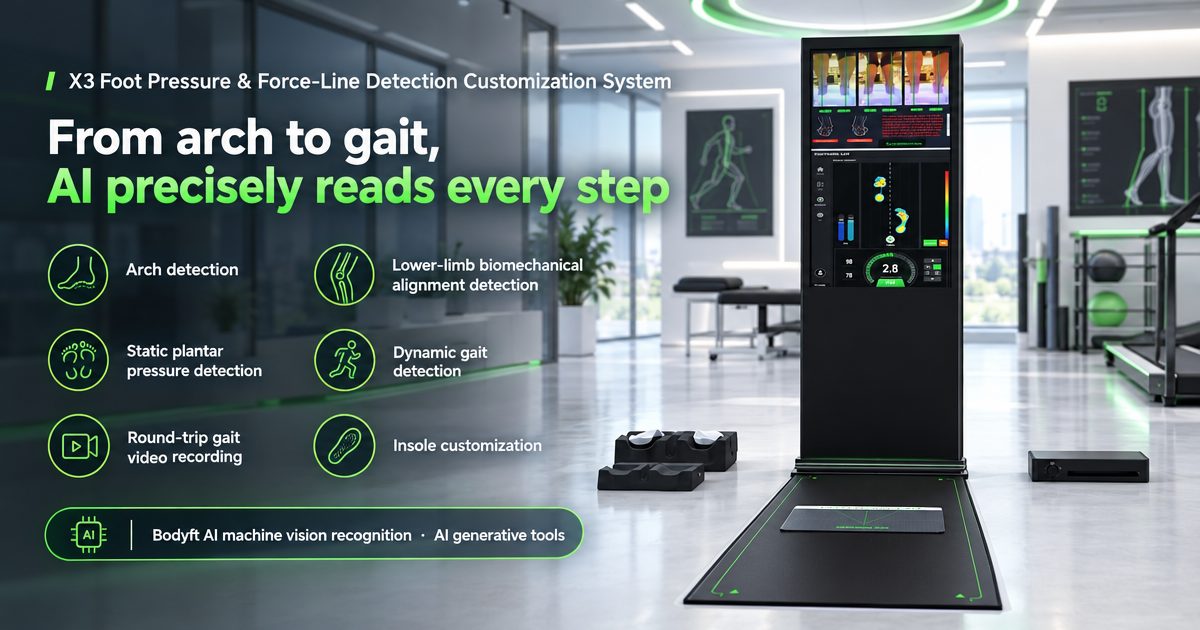
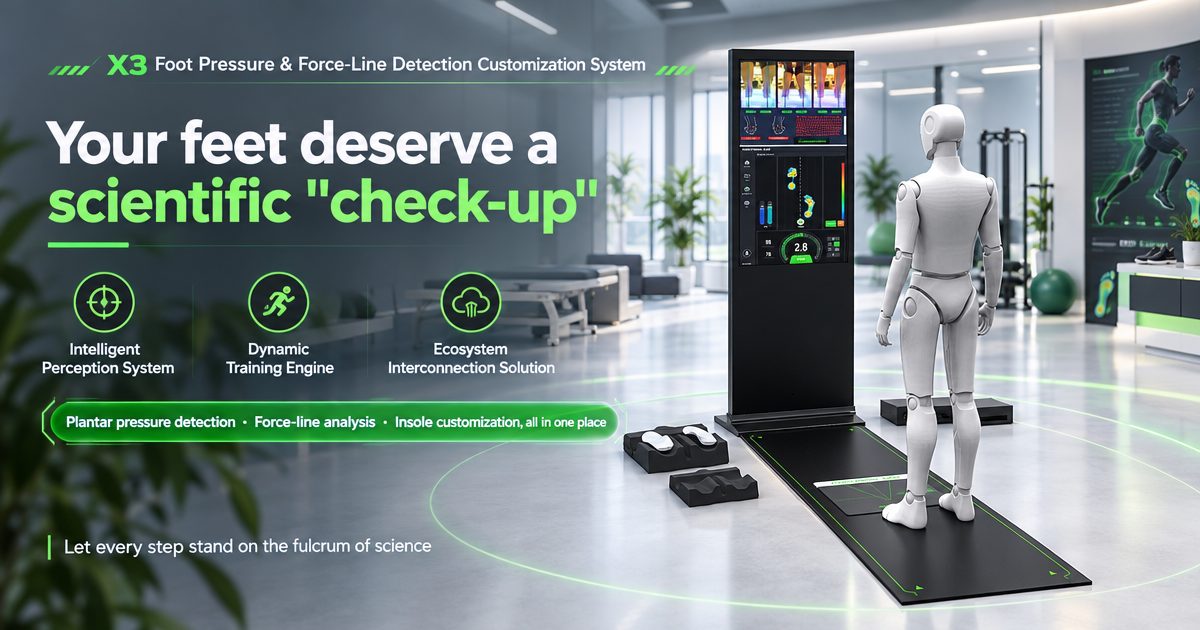
Some context on the system doing the carrying. The X3 is a foot pressure and force-line detection and insole customisation system: arch detection, lower-limb force-line capture, static plantar pressure, dynamic gait, back-and-forth gait video, and the customisation step that follows. It needs the shop’s shoe library entered before its AI shoe recommendation works, and its reports leave the system by QR code, by email, or printed on the spot. Its rooms are the ones where the scan-to-order distance is shortest: shoe stores, podiatry clinics, foot therapy centres, children’s fitness programmes.
The handover where a scan becomes an order
Two rooms, one record: that is the structure of every scan-to-order business. The first room captures — customer, session, report, conversation. The second room produces — a bench, a heating box, an operator who never saw the customer and never will. Between them runs the handover, and everything the second room does is built from what the handover carries. The capture can be flawless and the order still fail, because failure at the handover is silent: the workshop simply starts late, asks twice, or guesses.
What makes the handover fragile is that the two rooms speak different languages. The report is written to be read by a customer — rounded, visual, encouraging. The order is written to be worked by a builder — specific, complete, unambiguous. A record that exists only in the first language forces somebody, at the moment of handover, to translate it into the second from memory, and memory is where the fields fall out. The shops that run the loop smoothly are the ones that abolished the translation step: their record already contains the order.
The failure mode is easy to recognise once seen. The workshop calls the counter: which arch was it, left or right? What grade did the fitter intend? Which size — the recorded one or the shoe she bought? Each call is small, and each one costs a conversation, a delay, and a small withdrawal from the trust the scan built. Multiply by a busy Saturday and the programme’s economics quietly change.
So the question this article answers is not “how good is the scan” but “what does the record have to carry”. The answer is short enough to memorise — four fields — and demanding enough to organise a whole operation around, which is exactly what it should do.
The four fields the record has to carry
Field one is the arch type, for each foot separately. Not a visual impression, not a circle ticked by the fitter — a recorded category, stated by the system from the capture, with both feet recorded independently because they frequently differ. The arch type is the first thing a build decision consults, and it is the field most often abbreviated when reports are retyped by hand, which is precisely why it must live in the record rather than in the operator’s memory.
Field two is the pressure distribution, static and dynamic. The static pass shows where load rests; the dynamic crossings show how it travels — the foot axis angle, the contact and flat phase proportions, where the step peaks. The distribution is what separates the build that carries a contour from the build that also answers how the foot behaves through the step, and no workshop can set a grade line without it.
Field three is the size, and it must be the recorded size rather than the shoe size printed on the customer’s current pair. Recorded length and width come off the capture; the shoe on the foot came off a different brand’s last. The build is fitted to the foot, so the recorded dimensions are the ones production works from, with the shoe conversation happening at the fitting bench, not in the workshop.
Field four is the style and grade line, and it is the only field a person fills in. The record can state the arch, the distribution and the size; choosing the style — daily, recovery care or sport — and the grade combination is the fitter’s judgement, made against the foot in the room and the use the pair will see. That judgement must be written into the record the same way the measured fields are, because the workshop cannot infer intent from a contour alone. Four fields, three recorded and one declared, and the handover holds.
Why each field is load-bearing in production
The arch type decides the contour the build carries. A build for a low arch presents one way; a build for an arch that reads low standing and flattens further under load presents differently again, and the dynamic field is what catches the difference the static field alone would miss. In the workshop the arch entry is the first line consulted, and the moulding step is set against it before anything else happens.
The pressure distribution decides the grade emphasis. Where the step peaks, how long the foot spends in contact, how the axis points — these decide whether the build leans towards firmer support, toward added cushioning under a heavily loaded zone, or toward a balance the fitter specified on the fourth field. A distribution that arrives incomplete produces a build that is generically reasonable and specifically wrong, which is the kind of wrong the customer notices on the second day of wear, not the first.
The recorded size decides the geometry. Length and width set the outline the build is cut to, and the width is the quiet half of the pair: a build correct in length and wrong in width fits like a mistake, and the customer cannot articulate why beyond “it doesn’t feel right”. The recorded dimensions are the workshop’s defence against exactly that complaint, which is why the field must come from the capture rather than from the shoe box the customer brought in.
The style-and-grade line decides the intent. Two feet with identical records can receive different builds — one for a customer on her feet in work shoes all day, one for a runner training on hard ground — and the difference lives entirely in the declared field. Production reads that line as the specification’s final word. When it is missing, the workshop either picks a default and hopes, or stops and calls; neither is a process.
How the X3 moves the record
The capture sequence is designed so the four fields accumulate in one session rather than across several visits. Arch detection and static plantar pressure come from the standing pass. Dynamic gait and the back-and-forth gait video come from the walking passes, with the video letting the fitter replay the step against the numbers. Lower-limb force-line capture adds the alignment layer above the foot. By the end of the session the record already holds the three measured fields; the fitter adds the fourth at the bench, and the record is complete before the customer leaves.
The shoe library is the step shops most often underestimate, and it deserves its own paragraph. The AI shoe recommendation only works after the shop’s own shoe range has been entered into the system — models, categories, characteristics — because the recommendation runs against the shelf that actually exists. A shop that skips the library gets generic advice and blames the system; a shop that spends the entry time gets recommendations its staff can stand behind, because they point at stock that is really there.
The report then has to move, and the X3 offers three routes for the same document. The QR code puts the report on the customer’s phone, which makes her the carrier of her own record — she returns, the record is in her pocket, the comparison takes a scan. Email sends it to whoever needs it, including the workshop or a second location. The printed copy leaves the counter in the hand that wants paper. All three routes carry the same fields, which is the point: the handover does not depend on which route the customer prefers.
What the document must never become is a prescription. The record carries the fields; the fields inform the build; the decision to fit, and the choice of what to fit, is made by the fitter with the foot in the room, and where the question is clinical it moves to a qualified professional. The system is built to make that division natural — it records completely, hands over cleanly, and leaves the judgement where the licence lives.
What happens when a field is missing
Each missing field has a known cost, and knowing them in advance is what turns the checklist from bureaucracy into protection. A missing arch type stops the build at the first step: the contour cannot be set, the workshop cannot start, and the pair waits. A missing distribution lets the build start but strips it of its reasoning — the grades get set from the arch alone, and the specific behaviour of the step, the part the customer actually feels, is lost to defaults.
A missing recorded size forces production onto the shoe size, which imports another brand’s last into the build and turns width into a coin toss. And a missing style-and-grade line leaves intent to be inferred, so the workshop picks a conservative default — usually a middle grade, usually wrong in one direction or the other for the customer who was standing at the bench an hour ago. None of these failures announce themselves; all of them surface as a remake or a shrug days later.
The recovery procedure is the same for every case, and it is worth writing down before it is needed: the missing field goes back to the source. A missing measured field means the customer is re-booked for a short capture — not a full session, just the pass that failed to record. A missing declared field means the fitter’s line is reconstructed from the session notes, and if the notes are silent, the honest move is a call to the customer rather than a guess at the bench. The rule that matters is the one after that: fix the routine so the field cannot go missing again, because a handover that drops fields twice is not unlucky, it is unwritten.
Prevention, in practice, is one printed line beside the bench: the four fields, in order, ticked before the customer leaves the room. Shops that run the tick-line report the same thing afterwards — they had assumed the record took care of itself, and the assumption had been costing them a remake a week in ways nobody had connected. The tick-line is not a system feature; it is a habit. The system’s job is to make the habit easy, and it does.
The division of labour, and what we state plainly
The clean way to run the loop assigns each party one job. The equipment captures and states: arch type, distribution, dimensions, alignment images, all recorded values. The fitter declares: the style, the grade combination, the intent, written into the record like any other field. The workshop builds: to the record, to the declared line, to nothing else. And the professional reads: anything in the report that raises a question beyond fitting moves to a qualified professional, whose judgement is not the equipment’s to simulate. Every handover failure we have traced came from one party doing another’s job from memory.
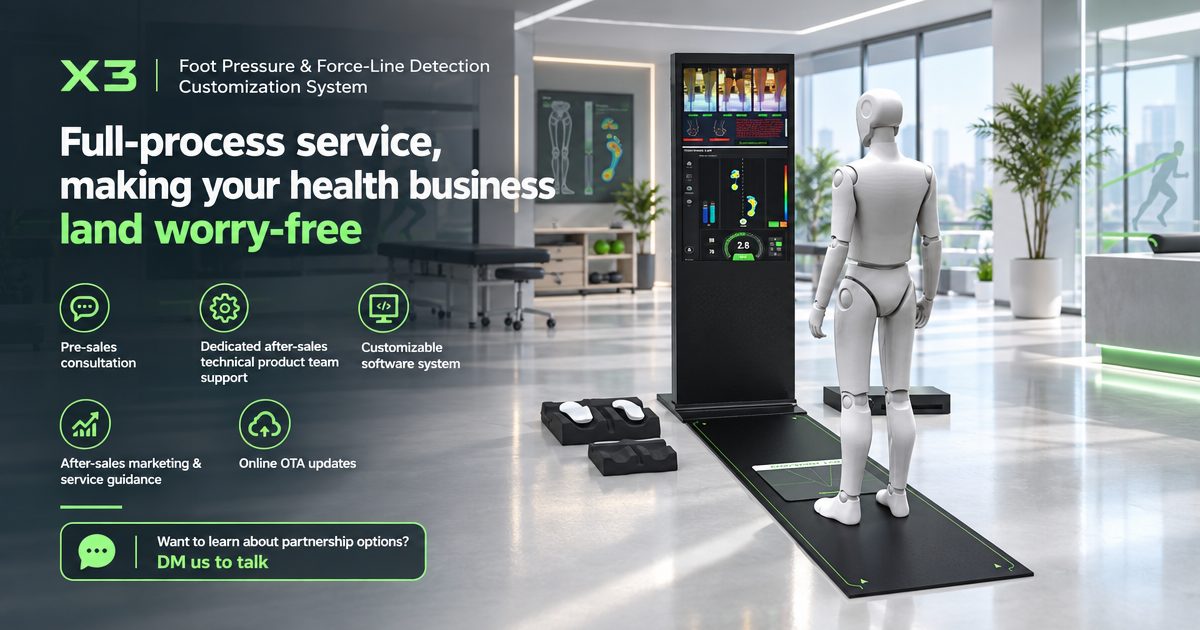
What we state plainly on our side. The X3 is a pressure and force-line detection and customisation system; it records and describes, and it does not diagnose — every report carries the reference line, and the reading of findings belongs to a qualified professional. The machine carries a minimum order of one unit and accepts ODM; every unit is tested at the plant for seven days before dispatch, and the warranty covers twelve months against non-human damage with free parts. On the insole side, the minimum order is two hundred pairs mixed styles and sizes, samples ship within three days, and both ODM and OEM are accepted. We do not publish prices in an article; a quotation follows a configuration.
We also state the loop’s dependency honestly: the AI shoe recommendation is only as good as the shoe library behind it, and the shoe library is only as complete as the entry work the shop puts in. That entry work is the one task this system asks of a shop before it performs as demonstrated, and we would rather say it in the first conversation than discover it together in the first month. Buyers who budget the entry time get the loop they were shown; buyers who skip it get half a loop and a support ticket.
What we offer beyond the hardware is the handover checklist itself — the four fields, the recovery procedure, the tick-line — as a one-page document a shop can tape beside the bench. Send the room and the staffing through the contact channel and we will return it with the fields mapped against the report, so the scan-to-order loop starts complete rather than being completed by telephone.
Frequently asked questions
Which fields must the record carry for insole production?
Four: the arch type for each foot, the static and dynamic pressure distribution, the recorded length and width, and the declared style-and-grade line. Three are recorded by the system in the session; the fourth is the fitter’s judgement, written in at the bench. A handover with all four is a handover the workshop can start from.
Why does the size have to be the recorded one, not the shoe size?
Because the build is fitted to the foot, and the shoe size came off another brand’s last. Recorded length and width come from the capture; width in particular is the dimension that most often disagrees with the label on the shoe the customer arrived wearing.
How does the AI shoe recommendation work?
Against the shop’s own shoe library, which must be entered first: models, categories, characteristics. Once the library holds the real shelf, the recommendation points at stock that exists. Without the library, the recommendation is generic — which is why the entry step is the one task a shop must budget time for.
How is the report delivered?
Three routes for the same document: a QR code the customer scans, email to whoever needs the record, or a printout at the counter. All three carry the same fields, so the handover does not depend on which route the customer prefers.
What happens if a field is missing when the order reaches the workshop?
The field goes back to its source: a missing measured field means a short re-capture of the pass that failed; a missing declared line means the fitter’s intent is reconstructed from notes, or honestly confirmed with the customer. Then the routine is fixed so the field cannot go missing again.
Does the report replace the fitter’s or the clinician’s judgement?
No. The record carries recorded values and the fitter’s declared line; the decision to fit and the choice of build are made by the fitter with the foot in the room, and clinical questions move to a qualified professional. Every report carries the line stating the data is for reference.
What are the order terms around the system?
The machine carries a minimum order of one unit and accepts ODM; every unit is tested at the plant for seven days before dispatch, and the warranty covers twelve months against non-human damage with free parts. Insoles are ordered at a minimum of two hundred pairs mixed styles and sizes, with samples shipping within three days.
What we would do next
Print the four fields on one line and tape it beside the bench this week — before the next busy day, not after the first remake. If you want the version we hand our own buyers, with the fields mapped against the X3’s report routes, send the request through the contact page. The X3 system page lists the capture items and delivery routes in the system’s own wording, and the insole range page shows the styles and grades the fourth field is chosen from.
For the boundaries of the same loop, a foot orthotic scanner does not write the prescription holds the division of labour in short form, and an insole scanner sells the assessment covers the commercial side. A custom moulded insole begins with a mould shows the production end of the handover, and scanning feet for orthotics walks the capture stage.
This article is intended for professional and educational reference. It is not medical advice. Foot assessment equipment produces measurements and images; clinical interpretation and any decision about care remain the responsibility of a qualified professional. Certification scope is limited to the documentation we hold: European Union certification and ISO quality system certification.