
A sports facility manager walks into a training room that has just been fitted out and counts three different things claiming to record movement: two cameras on a frame above a treadmill, a plate set into the floor, and a box of small sensors the physiotherapist straps to a runner’s shoe. All three were bought in response to the same search phrase, and nobody in the building can explain what each one is for. The cameras were described as motion capture, the plate as pressure analysis, the sensors as wearable tracking, and the manager is fairly sure that at least one of the three was unnecessary.
It probably was not. Each of the three records a different property of movement, and the useful question is not which one to buy but which segment of the training cycle each one covers. Cameras describe positions. Pressure describes load and timing. Wearables describe what happens when the athlete leaves the building. This article separates the three, explains what each one can and cannot see, and then argues the case that a serious training room ends up combining them rather than choosing. It is written from the manufacturer’s side, for buyers who are trying to spend once.
A note on the phrase itself before the technology. Motion detect sensor is borrowed from building services, where it means a passive device that switches a light on when somebody walks past. Half the search results a buyer sees belong to that industry, and the other half belong to three unrelated measurement trades. The word detect is doing damage here: in a training room nothing is being detected, in the alarm sense. Movement is being recorded, and recording is a much more specific promise.
Three ways to record movement, and what each is actually measuring
A camera records position over time. From a sequence of images, software can describe where the knee was, when the foot left the ground, how the trunk leaned and how the arms swung. What it cannot record is force. A photograph of a foot landing tells you the foot landed; it does not tell you how hard, or how the load travelled across the sole while it was there.
A pressure platform records force distribution over time. It knows when contact began, how long the foot stayed, where the centre of pressure travelled, and how the two sides compared. What it cannot record is anything happening above the plate. A pressure record of a runner whose knee collapses inwards looks almost identical to one whose knee tracks cleanly, because the difference is happening above the surface being measured.
A wearable records whatever it is built to sense, wherever the person goes. An inertial unit on a shoe can describe how the foot orientates through a stride on a track, on a hill, in a game. What it cannot do is provide a fixed reference: without a known position to start from, small errors accumulate, and a session recorded in the field drifts in a way a session recorded in a room does not.
Those three paragraphs are the whole argument in miniature. Each technology is excellent at one property of movement and blind to the other two. A buyer who understands that stops asking which is most accurate and starts asking which property she needs to describe, and at which point in the athlete’s programme.
The camera: positions, timing and the shape of a stride
Cameras earn their place by showing what a force record cannot: the arrangement of the body while the force is applied. In the running platform we build, two cameras on a frame watch the runner from the side and from behind while the belt turns, and the software assembles the stride into a cycle that can be reviewed frame by frame. Foot strike, knee tracking, trunk lean, arm carriage, the height of the swing leg — all of it visible, none of it measurable in newtons.
The strengths are obvious and the limits are worth stating. A camera needs light and a clear line of sight; loose clothing hides the joint it is meant to describe; and a single viewpoint flattens a movement that happens in three dimensions. Two views solve most of the third problem and none of the first two, which is why a room with cameras still needs a person standing in it who knows what a good stride looks like.
Session design is where cameras are won or lost. A runner who steps onto a belt cold will produce a first cycle that belongs to the stairs outside, not to the training block, so the routine usually begins with a few minutes of easy walking before anything is recorded. The same applies to the review: the frames worth keeping are the ones from the middle of the session, once the stride has settled, not the ones from the first ten steps.
Where cameras change a training conversation is in the review. An athlete who has been told her knee drifts inwards will argue; an athlete shown four frames of it happening will not. That is not a diagnostic act, and it does not require the coach to interpret anything clinical. It is a description of a movement, offered to the person who made it, and it is the single most useful thing a camera does in a training room.
The plate: load, timing and the asymmetry nobody feels
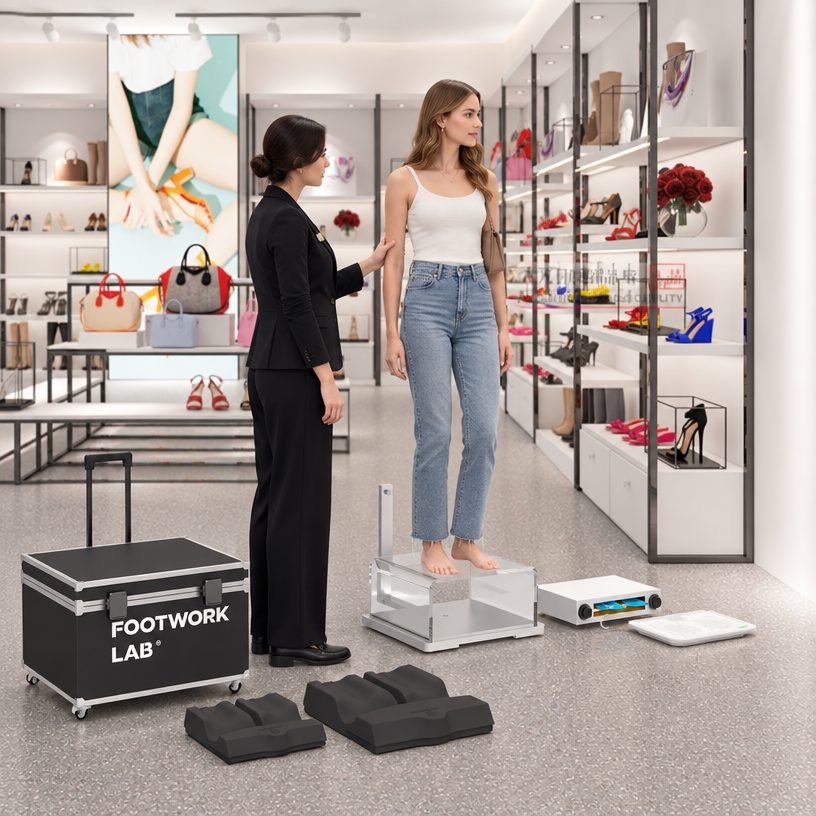
A pressure plate answers the questions a picture cannot. How long did each foot stay on the ground, and how did that change as the runner tired? Did the load cross the sole in a straight line or wander? Is the left side carrying more than the right, and by how much? None of these are visible in a video, and all of them are ordinary entries on a pressure report.
In the platform form, the plate sits under a moving belt, which changes what can be captured. Instead of a few passes across a floor, the system records continuously while the athlete walks or runs, and the software segments the stream into cycles. That gives a record of a gait under sustained effort rather than a snapshot of a gait performed for a machine — a distinction that matters as soon as the session is long enough for fatigue to appear.
The report items are unglamorous and useful: the contact and flat phases as proportions of the cycle, peak and mean pressure by region, the path and speed of the centre of pressure, and the paired comparison between feet. In our platform the two feet are also drawn as a butterfly diagram, which is the view most operators look at first because asymmetry shows up in it before it shows up in any table.
What the plate cannot do is say why. A heavier load on one side may be a habit, a previous injury, a shoe, a surface or a deliberate choice, and the record will not distinguish between them. It reports a distribution; the explanation lives with the clinician or the coach who knows the athlete. Rooms that forget this start treating symmetry as a target, which is a mistake with a long tail.
The wearable: the only record that leaves the building
A wearable’s advantage is coverage. A session in a room captures twenty minutes of a week; a sensor in a shoe captures the week. For an athlete training on a track, a court or a hill, the field record is the only one that describes the conditions the training is actually for. It is also the only one that can be repeated often enough to show a trend rather than a moment.
The costs are real and should be quoted to any buyer. Wearables need charging, fitting and a routine, or they end up in a drawer by the third week. They drift, so the numbers are best read as changes within one athlete rather than as absolute values comparable between athletes. And they produce a great deal of data that nobody reviews, which is worse than producing none, because it creates the impression of monitoring without the practice of it.
What a wearable record actually holds is narrower than the marketing suggests: an estimate of when the foot was on the ground, how long it stayed, how regular the rhythm was, and how the two sides compared across a session. That is enough to answer whether the athlete did the work and whether the rhythm changed when they were tired. It is not enough to describe load, and it should never be presented as though it were.
The most useful arrangement we see is a division of labour. The room provides the reference: a high-detail record taken at the start of a block and again at the end, under controlled conditions. The wearable provides the middle: whether the athlete is doing between sessions what the programme assumed. Neither replaces the other, and a programme that uses only one of them is either measuring a moment or guessing at a week.
Stacking the three across a training cycle
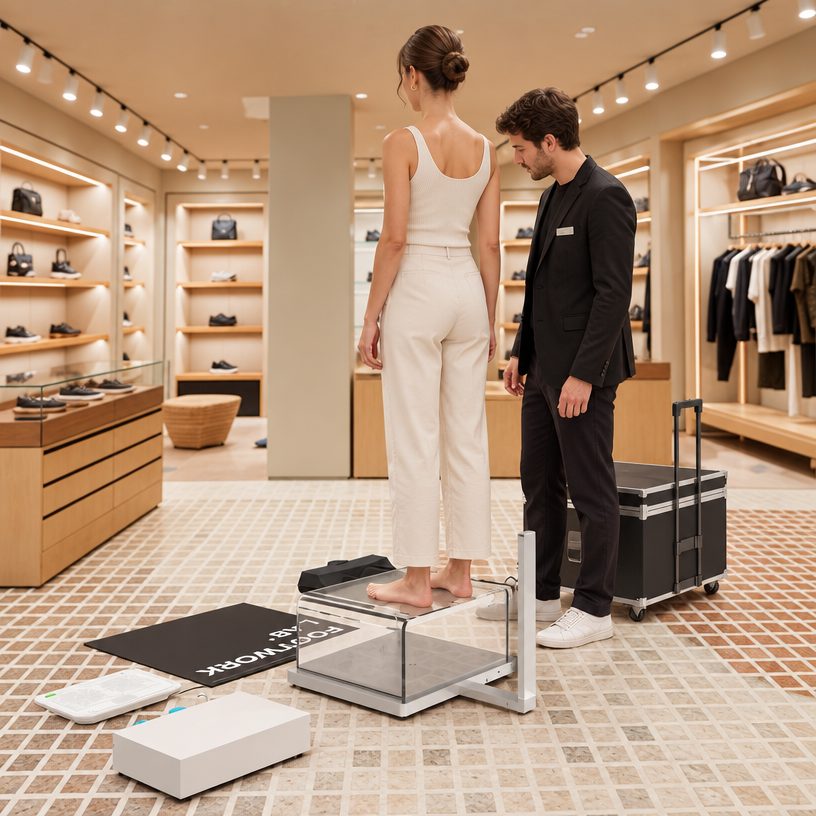
Put the three in sequence and the design becomes obvious. The baseline belongs in the room, where cameras and a plate can be held to fixed conditions and the record can be compared with the next one. The intervention happens in the field, where a wearable can say whether the work is being done. The retest returns to the room, on the same equipment, under the same routine, so that the comparison holds.
This is the argument for combining rather than choosing, and it is not a manufacturer’s argument in disguise. A room that owns only a plate will describe load and miss the movement. A room that owns only cameras will describe movement and miss the load. A room that owns only wearables will have a trend with no reference point. Each of those rooms can run a programme; none of them can answer the question a serious athlete eventually asks, which is what changed and how much.
The practical constraint is money and floor space, and both are finite. The sequence above tells a buyer where to start: with the reference, because a trend without one is not a trend. If the room can only hold one system, hold the one that produces a repeatable baseline, and add the field layer later when the programme has a review habit to justify it. That order of purchase is the reverse of the one most buyers follow, which is to buy the cheapest device first and discover the gap at the first review.
The gap shows up in a specific way. Somebody asks whether the athlete improved, and the room produces a video from March and a video from June, taken from different angles, in different shoes, on different days. The conversation that follows is about the videos, not the athlete. A fixed routine on one system prevents that conversation entirely, which is worth more than any single feature on any of the three devices.
Buying the combination without buying twice
The first question is not which sensor but which decision the record has to support. A coach reviewing a stride wants frames and a cycle; a clinician reviewing a course of care wants load, timing and a comparison; a facility selling assessment sessions wants a report a member can hold. Those three outputs come from different mixes of the same technologies, and writing the output down first prevents most bad purchases.
The second question is who reads it. Every one of these systems produces more pages than most rooms use, and the pages nobody reads are the ones that generate arguments about whether the equipment was worth buying. A room that decides in advance to use four items consistently will get more out of a modest system than a room that uses none of eleven on an elaborate one.
The third question is what the room will not do, and here is our own list. We do not make wearables; our equipment is the room-based capture, and a buyer who needs field data is buying that from somebody else. Our systems record load, timing and alignment, and they do not diagnose. And we do not publish prices in an article, because a quotation depends on configuration, quantity and destination. What we will do is describe the record precisely enough that a buyer can tell whether it covers the segment of the cycle she is trying to measure.
Frequently asked questions
Is a motion detect sensor the same as a motion capture camera?
No. The phrase comes from building services, where it describes a passive switch. In a training room the useful distinction is between cameras that record positions, plates that record load and timing, and wearables that record wherever the athlete goes. Three different records, often bought under one search term.
Can cameras measure force?
No. A camera records position over time, which gives you joint arrangement, timing and the shape of a stride. It cannot tell you how hard a foot landed or how the load crossed the sole. That is what a pressure plate is for, and the two records answer different questions about the same step.
What does a pressure platform record during running?
The contact and flat phases as proportions of the cycle, peak and mean pressure by region, the path and speed of the centre of pressure, a paired comparison between the feet, and a butterfly view of both soles. The stream is segmented into cycles, so the record describes a gait under sustained effort rather than a single pass.
Are wearables accurate enough to compare with a lab record?
They are useful and not equivalent. A wearable drifts over a session, so its numbers are best read as changes within one athlete over time rather than as absolute values comparable with a fixed system. The room record is the reference; the wearable describes what happened between visits.
Which should a training room buy first?
The reference, not the field device. A trend without a baseline is not a trend, and a review meeting with two videos taken differently is not a review. Start with a fixed system that produces a repeatable record, then add the field layer once the programme has a review habit that justifies it.
How many sessions before a comparison is meaningful?
Two, provided both were taken the same way. What makes a comparison meaningful is the routine, not the number of sessions: same start position, same camera distance, same footwear, same instruction, same order of passes. Written down, those conditions survive staff changes.
What are the order and support terms for the equipment?
Machines start at one unit, each is tested at the plant for seven days before dispatch, and the warranty covers twelve months against non-human damage with free parts. Support runs through a dedicated channel with engineers who can assist remotely, and connected units can take over-the-air updates.
What we would do next
Draw the cycle on one page — baseline, block, retest — and mark which segment each device is meant to cover. If two devices land on the same segment, one of them is probably not needed yet. Send that page through the contact page and we will tell you which part of it the room-based record can carry and which part it cannot. The F5-LAB platform page sets out the camera arrangement, the pressure capture and the walking and running modes in the manufacturer’s own terms.
Two shorter pieces follow the same thread. What a gait analysis system is made of takes the platform apart component by component, and a running gait analysis platform describes how one sports facility scheduled the baseline and the retest around its existing training blocks.
This article is intended for professional and educational reference. It is not medical advice. Foot assessment equipment produces measurements and images; clinical interpretation and any decision about care remain the responsibility of a qualified professional. Certification scope is limited to the documentation we hold: European Union certification and ISO quality system certification.