
A clinic owner in Nairobi draws four rooms on the back of a quotation and asks which one the machine goes in. The plan is not complicated: a door where people wait, a small room where feet are looked at, a bench where things are measured, and a table where a pair of insoles is handed over. She has been quoted for one device and has assumed it will serve all four, because the phrase she searched says machine in the singular. The quotation is not wrong. The assumption is. Each of those rooms asks a different question of a piece of equipment, and a device bought for the door will be the wrong device at the bench in exactly the way a reception desk is the wrong place for an examination. This article sorts the phrase room by room: what belongs at the screening door, what the assessment bench needs that the door does not, where the fitting table sits in the sequence, and the sentences we refuse to let a machine say in any of them.
One word, one box, several rooms
The phrase is singular because shopping is singular. A buyer types a category, receives a grid of products and picks one, and the grid rewards whichever listing has the clearest photograph. Nothing in that process asks how many rooms the work happens in, or whether the same device is expected to be in two of them on the same morning. Yet a clinic is a sequence of rooms, and the equipment in each one is answering a different question — which is why a purchase that looks efficient on a screen can produce a queue in a corridor.
The first thing to establish is what kind of question each room asks. At the door, the question is whether this person needs to be here at all, and the answer has to arrive inside a few minutes with somebody standing in their socks. At the bench, the question is what is actually happening under load and how the leg carries it. At the fitting table, the question is whether the object being handed over matches what was decided. Those are three different depths of record, and a device that does one of them well is more useful than a device that does all three badly.
The second thing to establish is who operates each room. A screening position is often run by somebody who is not a clinician — a fitter, a shop assistant, a receptionist with an afternoon of training. An assessment position is run by somebody who is. A fitting table is usually run by whoever made the decision, or somebody trained by them. The equipment has to match the operator as much as the room, and a system that assumes clinical training will be abandoned at a shop counter within a month.
That is the shape of the argument in this article, and it points somewhere unfashionable. The right purchase is often smaller than the buyer expected and placed earlier in the sequence than he intended. A screening device at the door, earning its keep on volume, will usually do more for a clinic’s revenue than a deeper system nobody has time to run. The deeper system comes later, when the appointments exist to justify it, and it comes with a different set of questions attached.
The screening door: minutes, a shape and a size
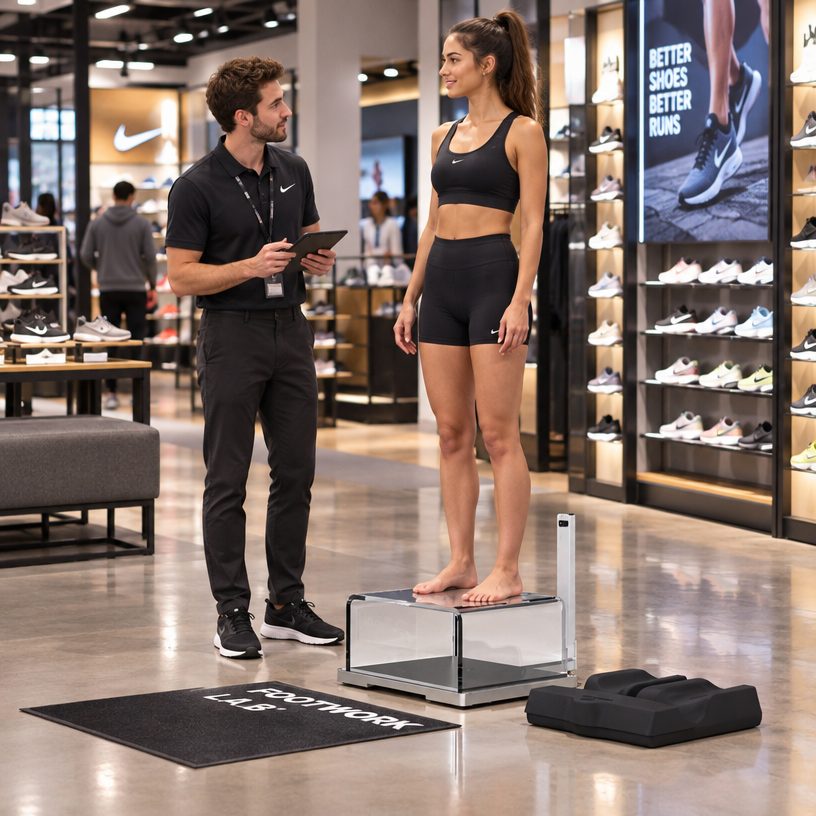
A screening position has one job: turn a passer-by into an appointment, or a waiting customer into a conversation, without pretending to be an examination. That means the session has to be short, the output has to be legible to somebody who is not a clinician, and the whole thing has to survive being run by a member of staff who has six other things to do. Anything that needs a darkened room and twenty minutes of setup belongs somewhere else.
The Q1P is built for that position. It takes the podoscope form — the person stands on a surface, the sole is recorded, the alignment above it is captured — and produces a conclusion page with a small number of items: arch type, foot type, the angle at the first toe, the position of the heel, the rotation carried by the shin, foot length and width, and a shoe size suggestion. That is enough to have a useful conversation at a counter and not enough to mistake the conversation for a clinical one.
The shoe size suggestion is the item that gets used most, and it is worth being precise about what it is. It is a suggestion derived from the recorded length and width, offered as a starting point for a fitting, not an instruction and not a substitute for trying the shoe. Shops that use it as an instruction end up with returns; shops that use it as a way to bring three boxes instead of six end up with fewer. The difference is entirely in how the staff member introduces it.
The conclusion page carries a line stating that the data is for reference and that anybody with a medical need should go to a professional institution. That line is not there to protect the software. It is there to protect the conversation, because the person most likely to over-read a screening page is the customer, and the second most likely is the staff member trying to be helpful. A shop that reads that line out loud, in its own words, before showing the page, has solved most of the problem in advance.
The assessment bench: when the record has to be deeper
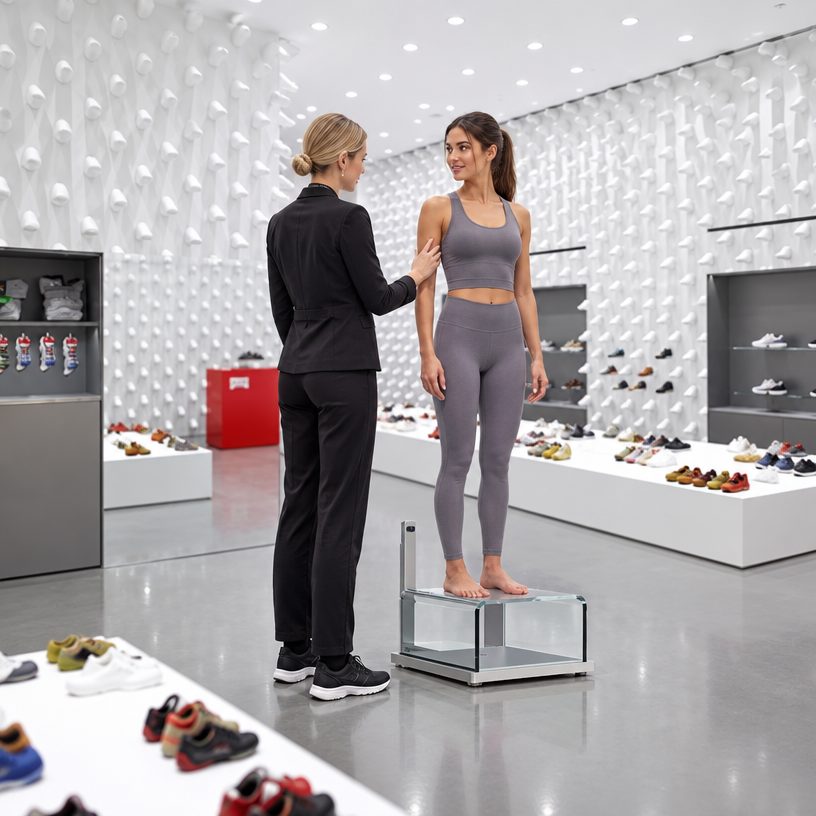
The bench asks a different question. Here the person has already decided something is worth looking at, and the record has to be deep enough to support a decision about what to do. That usually means load under the sole rather than a picture of it: where pressure sits at rest, how it moves through a step, whether the arch behaves the same way standing and walking, and how the centre of pressure travels forward as the foot rolls.
It also means the record has to be repeatable. A screening page is a moment; an assessment record is a baseline, and a baseline is only worth taking if the next one can be set beside it. Same number of passes, same foot first, same instruction, same position in the room. A clinic that runs the session differently each time will produce a folder of images that look impressive and cannot be compared, which is the most expensive possible outcome for a piece of equipment.
The third thing the bench needs is a handover. Somebody has to be able to open the record afterwards, on a computer that is not the device, and read it without the operator standing there explaining. That sounds like a software detail and it is actually the difference between a record and a performance. If the only person who can interpret the document is the person who ran the session, the clinic has bought a party trick with a warranty attached.
Where the bench and the door share a room, the equipment has to survive both uses without either one degrading. A screening position that is also the assessment position will be set up and taken down several times a day, and anything with a delicate alignment requirement will drift. Buyers planning a dual-use room should say so at the quotation stage, because the honest answer may be that the door should have the smaller device and the bench should have the deeper one, in two rooms, with a corridor between them.
The fitting table: where a record becomes an object
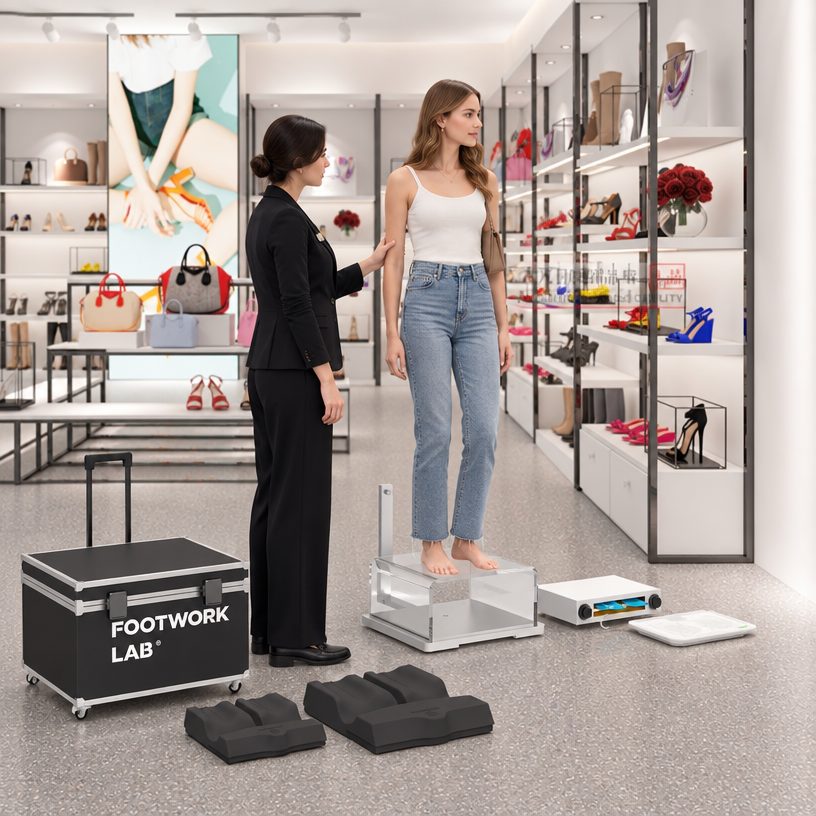
The fitting table is where the record stops being a document and starts being something a person wears. That transition needs three inputs and no more: the record, a specification written by whoever read it, and the measurements that only hands can take. A device can supply the first. It cannot supply the second, and it cannot supply the third however many cameras are pointed at the foot.
This is the room where the temptation to automate is strongest, and where it does the most damage. A system that offers to choose the insole from the record has removed the professional from the only step where the professional’s judgement is irreplaceable. The record says the arch presents a certain way under load; the specification says what the pair should do about it for this person, in this shoe, with this history, at this stage of a plan. Those are different sentences, and the second one is not a calculation.
What the fitting table does need from the equipment is a document that travels. A conclusion page that can be printed on the spot, sent to an email address, or opened later from a code is a practical necessity in a room where three people are waiting. The format matters less than the reliability: a page that fails to print at the moment of handover turns a professional conversation into an apology, and it happens most often on the busiest afternoon of the week.
It also needs the session to have produced something worth keeping. A clinic that hands over a pair of insoles and a photograph has given the customer a receipt. A clinic that hands over a pair, a page and a date for a review has given them a plan. The second is a different business, with a different price structure and a different conversation at the second visit, and none of it requires the equipment to say anything it cannot support.
Buying in room order rather than feature order
Most buyers shop in feature order: they compare devices, find the one with the longest list, and then work out where to put it. The result is predictable. A device with capabilities nobody runs sits in the best room, the room that needed a simple device has none, and the clinic concludes that equipment does not pay for itself. The fix is to shop in room order, which is slower and produces a much shorter list.
Start at the door and write down the volume. How many people pass the position in a week, how many minutes can be spent with each, who is available to run it, and what the position is supposed to produce — an appointment, a sale, or a conversation. Those four answers decide the device almost completely, and they will usually point at something small, fast and legible rather than something deep and impressive.
Then write down the bench. How many assessments a week, who runs them, how long an appointment is, and whether a review visit is part of the offer. If the answer to the last question is yes, the record has to be repeatable and the comparison has to be easy; if it is no, a deeper record is a cost without a return, and the clinic should buy the screening device and stop. That is an uncomfortable thing for a supplier to say, which is why so few say it.
Then write down the fitting table, and be honest about whether the clinic makes anything at all. A clinic that orders finished pairs from a factory needs the fitting table to produce a specification and a handover, not a manufacturing step. A clinic that forms on site needs the bench, the consumables and the storage as well, and that is a different purchase with a different set of questions. Mixing the two in one quotation is how buyers end up owning half of each.
What we will not let a machine say
We will not describe a screening page as a diagnosis, and we do not build a report that reads like one. Arch type, foot type, the angle at the first toe, heel position, shin rotation, length, width and a size suggestion are records of what was observed in a defined stance. They are not findings about cause, severity or what should be done, and a staff member who presents them as such has gone beyond what the equipment can support.
We will not claim that any of our devices replaces an examination, and we will not sell a system on the implication that it does. The conclusion page carries a line directing anybody with a medical need to a professional institution, and we would rather that line was read too often than skipped once. A shop that screens feet is doing something useful; a shop that screens feet and implies it has answered a medical question is doing something else, and the second one ends badly.
We will not publish prices, and we will not promise exclusivity by region. A quotation depends on configuration, destination and the service wrapped around the unit, and a figure printed in an article would be wrong by the time it was read. Territorial protection is a distribution agreement with obligations on both sides rather than a sentence in an order confirmation, and a buyer who needs it should ask for the document.
What we will state is what we control. One unit is the minimum order. Machines accept ODM. Every unit is tested at the plant for seven days before dispatch. The warranty runs twelve months against non-human damage, with free parts. Support runs through a dedicated WhatsApp group with engineers reachable directly, remote assistance when a session goes wrong, and over-the-air updates where the unit is connected to a network. None of that is exciting, and all of it is the reason a device is still running in the third year.
Frequently asked questions
Can one device serve every room in a clinic?
Usually not well. A screening position needs speed and a legible page; an assessment bench needs a repeatable, deeper record; a fitting table needs a document that travels. One device can sometimes cover the first two, but the setup discipline and the operator differ enough that most clinics end up separating them.
What does a screening session record?
Arch type, foot type, the angle at the first toe, heel position, the rotation carried by the shin, foot length and width, and a shoe size suggestion. The conclusion page states that the data is for reference and that a medical need belongs with a professional institution.
Is the shoe size suggestion reliable?
It is a starting point derived from recorded length and width, not an instruction. Shops that use it to bring three boxes instead of six get on well with it; shops that use it as a substitute for trying the shoe end up with returns.
Who can run the screening position?
A trained member of staff rather than a clinician, provided the script is fixed and the page is introduced honestly. The equipment matches the operator as much as the room, and a system that assumes clinical training will be abandoned at a shop counter.
What does the assessment bench add?
Load under the sole rather than a picture of it: distribution at rest, behaviour through a step, arch behaviour standing and walking, and the travel of the centre of pressure. It also adds a repeatable routine, which is what makes a review visit possible.
Can the system choose an insole from the record?
No. The record informs a specification written by the professional who read it. Choosing the build is a judgement about a person, a shoe and a stage of care, and the equipment supplies evidence rather than a decision.
What are the order terms?
One unit is the minimum order, machines accept ODM, each unit is tested at the plant for seven days before dispatch, and the warranty covers twelve months against non-human damage with free parts. Support runs through a dedicated WhatsApp group with direct engineer access.
What we would do next
Draw the floor plan, mark where each session happens, and write beside each mark how many minutes it takes and who runs it. Send the plan through the contact page and we will say which room each device belongs in, and which room should wait a year. That reply is worth more than a specification comparison, because it is the only one that starts from the building rather than from the brochure.
The Q1P system page lists the screening items and the conclusion page in the equipment’s own terms. Two articles go further into the room-by-room question: podiatry instruments in a clinic room takes the bench apart item by item, and a podoscope foot screening takes minutes describes the door position from the counter’s side.
This article is intended for professional and educational reference. It is not medical advice. Foot assessment equipment produces measurements and images; clinical interpretation and any decision about care remain the responsibility of a qualified professional. Certification scope is limited to the documentation we hold: European Union certification and ISO quality system certification.