
The customer folded the printout in half, thanked the room, and slid it into her bag beside her keys. At home that evening her husband asked what the assessment had found, and she handed him the pages rather than repeating it. He read them at the kitchen table, slowly, with no operator nearby to ask. Every page a foot assessment produces lives this double life: it is written in a room, by people who were present, and it is read somewhere else, later, by people who were not. The spouse, the coach, the physiotherapist next quarter, the customer herself in six months. What survives that journey is not the conversation, the demonstrations on screen or the explanation at the desk; it is the paper. So the question of what belongs on the page a customer takes home is not a formatting question. It is a question about honesty at a distance: which numbers mean something without an operator standing beside them, which images tell the truth on their own, and which sentences need to be on the page so a stranger cannot read it as something it is not. This article works through the printed summary the way experienced rooms build it, line by line, and says plainly what we leave off.
A page read by people who were not in the room
The first reader outside the room is usually the household. The customer comes home, someone asks what the assessment found, and the pages answer in the operator’s absence. That reader needs plain statements: what was measured, on which foot, under what conditions, and what each figure on the page describes. What that reader does not need is jargon carried straight over from the software, or a page so dense with tables that the honest content hides inside it. A summary written to impress the room reads badly at the kitchen table, and the kitchen table is where it will actually be read.
The second reader is professional: the physiotherapist across town, the specialist next quarter, the same room at the next visit. This reader looks for different things — the conditions under which each record was taken, whether a standing pass was filed or an average, whether anything was captured seated. A summary that omits its conditions does not become simpler for this reader; it becomes unusable, because comparison is the whole point of their reading. The page has to serve both audiences at once, and everything below assumes exactly that: two readers, neither of them present when the record was made.
One page that points at the record, not replaces it
A capture session produces far more than a page can hold: pressure images across standing and walking passes, posture photographs from the camera, curves across the contact phase, tables of figures for each region of the foot. The printed summary is a selection from that material, chosen for the customer in front of the operator, and it works best when it says so openly. At the top of the page: name, date, the class of equipment that produced the record, and a line stating that the full session is kept on file at the room. The page points; the folder holds. A summary that tries to be the whole record stops being a summary and becomes a filing cabinet with bad organisation.
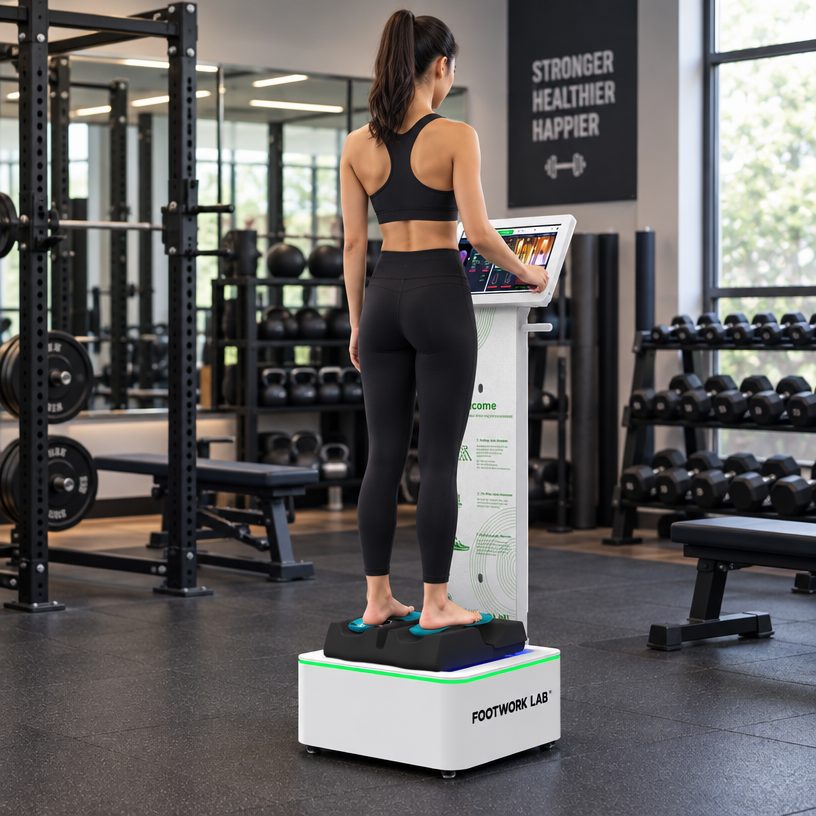
On capture systems such as our X5 foot, ankle & posture system, the record combines pressure sensing, camera posture capture and analysis software output. The summary page takes a deliberate slice of each: one or two pressure images, one posture view, the handful of figures worth carrying. Choosing that slice is a skilled act rather than a default — it is the operator deciding what this particular customer’s page is for. The honest default is fewer items with clear captions rather than more items with none, because every item without its context is a small invitation to misread.
The numbers that carry meaning on their own
Three kinds of figure survive the journey off the machine better than the rest: peak pressure, contact area, and timing across the contact phase. They survive because a reader can be told in one clause what each one describes. Peak pressure states where load concentrated during the filed pass; contact area states how much of the sole shared the load; timing states how the step moved from heel through to forefoot. None of the three means anything without that clause, which is why the clause travels with the number on the page. A figure printed without its definition is decoration, and readers can tell.
Every figure also carries its conditions silently inside it. The same foot measured at three points in a working day does not give the same numbers, as our article on the same foot at three points in a working day explains, and a standing record differs from a walking one by design rather than by error. Static and dynamic records are labelled as such on the page, and no number is presented without the pass it came from. A number that could belong to either condition is a number the reader will misread, quietly and with complete confidence, which is the most expensive kind of misreading a page can produce.
Choosing which figures to print becomes easier when the page is built backwards from the reader’s question. A customer asking why one foot matters more than the other needs the comparison, clearly labelled. A customer whose question is about a specific shoe needs the condition that shoe creates written beside the numbers. Rooms that print the same figure set for every customer are not saving effort; they are postponing it to the reader, who has less information, less training and no machine in front of them.
What the images on the page do and do not say
The pressure image is the page’s most readable element, and also the most over-read. Taken honestly, it shows how contact presented under stated conditions: which regions took load, how the pattern sat between left and right, how the arch presented during the filed pass. It does not show why the foot behaves that way, and it does not diagnose. The caption keeps it in its lane: which pass, which condition, standing or walking, footwear on or off. An image without a caption invites the reader to write their own story over it, and readers always will, kindly or otherwise.
The posture photograph works the same way with one extra caution. It shows alignment as the camera saw it from one viewpoint, at one moment, with the clothing the customer wore that day. What a camera cannot see — the inside of a shoe, anything outside the frame, the foot in motion — stays out of the caption, and the caption states the view and the moment. Both images together give the take-home page its visual anchor; both need their conditions written beside them; and neither turns the page into a conclusion. The page documents a measurement session. Interpretation belongs to a qualified professional, and the page says so in one line near the bottom.

The sentences that keep a summary honest
Between the numbers and the images sits the least glamorous part of the page and the part that does the most work: the condition sentences. Standing capture, three passes taken, the second filed. Seated support capture taken additionally because the customer steadied on the rail. Footwear removed, game socks worn. One sentence, written the way the operator would say it out loud, travels better than any layout. Rooms that keep these sentences produce folders that can be compared across visits; rooms that skip them produce pages that look complete and answer nothing six months later, when someone finally needs them to.
Just as deliberately, some things stay off the page. Statements nobody made in the room. Implications drawn beyond what the session captured. Any phrasing that turns measurements into conclusions about the customer or their future. Leaving these off is not modesty; it is accuracy. The printed page will be read longer, and by more strangers, than anything else the session produces, and a sentence that overreached at the desk overreaches worse in someone else’s hands. The disclaimer line at the foot of every summary we describe exists for the same reason: it draws the boundary once, in print, where the operator will not be there to draw it in person.
The sentences work best when they are written the way the room talks. The customer sat slightly to one side because the other heel was uncomfortable that day — written down, that explains a contact pattern a stranger would otherwise read as a finding. Footwear stayed on because the customer came from work and preferred not to remove it — that sentence rescues an image that would otherwise be compared against barefoot records it was never taken to match. None of these lines is technical. They are ordinary words doing precise work, and they read the same six months later as they did at the desk. Jargon ages badly on paper; plain sentences do not, and a room’s plain sentences, kept consistent across staff changes, become part of how its records speak.
When the page is meant to be worked, not filed
Some summaries never go home at all; they go to a workshop. When the session feeds a custom insole build, the page becomes a working document: the contact images, the chosen figures and the customer’s own words travel together from the room to the build, and our article on the customer’s own words becoming a build spec describes how that handover works in practice. The same honesty rules apply, with one addition — the working page also records what the customer asked the build to do, in the customer’s own phrasing, because that is an input the workshop cannot reconstruct later and will not invent.
A working page is allowed to carry questions as well as answers, and the good ones do. Where the record leaves something open — how the foot behaves inside the specific shoe, how load sits when the customer arrives at the end of a working day — the page says so, and the build team asks back rather than guessing. That back-and-forth is a feature of honest documentation, not a failure of it. A page that claims completeness forces the next reader to invent whatever is missing; a page that flags its gaps gets asked better questions and produces a better build.
The page that comes back through the door
The best test of a summary page is its second visit. The customer returns, the folder opens, and the page comes out of a pocket or a shoe box, sometimes folded, sometimes annotated in handwriting nobody in the room recognises. Rooms that asked the customer to report back on specific things — how the first weeks felt in the footwear the page describes, what changed, what did not — get a follow-up conversation that starts from evidence rather than memory. The operational questions we hear most often from rooms building this habit are collected on our FAQ page, and the short list of what a customer should be asked to report back early is worth putting on the wall beside the printer.
When the follow-up record is taken, the old page earns its conditions line. Comparing the new session against the old only works when both were captured the same way, which is exactly what the sentence at the top of the page was for. Rooms discover at this moment whether their summaries were written for real: if the conditions are recoverable, the comparison is defensible; if not, the honest answer is that the two records cannot be compared, and the conversation starts from what is known rather than what was hoped. That outcome is not a failure of the equipment. It is the cost of the line nobody wrote.
Frequently asked questions
What belongs on the printed page a customer takes home?
The essentials a reader outside the room needs: who was assessed and when, which capture conditions applied, the contact images chosen for the record, a small set of numbers with their definitions beside them, and one line stating that the equipment produces measurements and images while interpretation belongs to a qualified professional. Everything else can stay in the full record held by the room.
Should the summary include the posture photographs?
Yes, when they were part of the session, with a caption stating the view and the conditions: standing or seated, footwear off or on, and the moment in the session the frame comes from. A photograph without its conditions invites readers to see more in it than a camera frame taken from one viewpoint can honestly show.
How many numbers should a one-page summary carry?
Fewer than rooms usually expect. Peak pressure, contact area and timing, each labelled with the condition it was taken under, say more than a table of every figure the software produces. Numbers lose meaning when a reader cannot see what they describe, so the page carries the few that matter with their context, and the full tables stay on file.
Can the printed page be handed over as a diagnosis?
No. The page documents what the equipment measured and captured under stated conditions. Naming what those findings mean for the customer’s foot, and any decision about care, belongs to a qualified professional. A summary written to look like a conclusion overreaches the measurement and creates exactly the misreading the page was meant to prevent.
What conditions need to be written on the page?
Standing or seated capture, how many passes were taken and which was filed, footwear on or off, whether a single frame or an average was used, and anything unusual about the session. One sentence covers it. Readers who were not in the room cannot reconstruct the day, so the conditions have to travel with the record itself.
Should the summary show left and right side by side?
Where both feet were captured under the same conditions, a side-by-side layout is usually the most honest presentation, because readers compare less when the page compares for them. Each side keeps its own labels, and the caption states that both records come from the same pass and the same conditions.
What should the customer be asked to do with the page?
Keep it with the footwear or folder it concerns, and bring it back at the next visit. A summary that returns through the door lets the room compare like with like, and gives the customer a fixed reference instead of a memory of what was said at the desk months earlier.
What we would do next
Take one page from this week’s sessions and read it as the three readers above: the relative at the kitchen table, the professional across town, and the room at the next visit. Where a reader would have to guess, add the sentence that removes the guess — the conditions line, the caption under each image, the clause beside each number. The capture side of this workflow is described on the X5 foot, ankle & posture system page, and the FAQ page collects the operational answers rooms ask for most often. If you would rather have us look at a draft of your own summary template before you standardise it, send it through our contact page; a short review usually finds the one or two sentences doing the most damage.
This article is intended for professional and educational reference. It is not medical advice. Foot assessment equipment produces measurements and images; clinical interpretation and any decision about care remain the responsibility of a qualified professional. Certification scope is limited to the documentation we hold: European Union certification and ISO quality system certification.