
The queue at the fitting bench is three deep, the till is beeping, and a customer is standing in the aisle holding one shoe of a pair she is not sure about. She has been on her feet since the car park, she has tried four pairs, and she says the thing floor staff hear forty times a Saturday: my feet always ache when I shop. Nobody in the building disagrees. Nobody in the building knows what to do with the information either.
A shoe shop is the only place on the high street where strangers voluntarily discuss their feet with a professional, several times a day, for free. This piece is written for retailers and distributors thinking about putting a quick screening corner between the racks: what a five-minute screen can honestly measure, what it must never claim to do, how to fit it into a selling day without slowing the till, and how to keep the whole thing honest when the staff who run it change every season.
Saturday on the retail floor
The retail floor is a foot observation machine that nobody has ever switched on. Customers walk all morning, try shoes on and off, stand at mirrors in front of staff, and complain about their feet out loud in front of strangers. Every member of staff on the floor could describe the walking of a dozen customers before lunch — the man who favours his right side, the woman who toes out, the teenager whose heels roll in the moment she stands up in the new pair. The observations happen for free, all day, and then evaporate.
What the floor never has is a place for those observations to go. Staff are not clinicians and should not pretend to be; the shop has no equipment, no sheet, no corner where a customer can stand still for two minutes while something official happens. So the richest source of foot information on the high street — thousands of feet, seen at the exact moment their owners are thinking about footwear — produces nothing but small talk at the bench.
The gap is worth naming precisely, because it defines the whole project: the shop does not need diagnosis, does not want clinical responsibility, and cannot slow the selling day. What it could use is a fast, structured, honest look at the foot at the moment of purchase, recorded in words a customer can take home and a professional could later read. Everything below follows from keeping that definition tight.
Why the shoe shop is the right room
Customers arrive at a shoe shop already thinking about their feet, which is a frame no clinic ever gets for free. They have walked from the car park, they have stood in front of the mirror, they have felt the difference between two pairs underfoot and tried to describe it in words like “these pinch” and “these feel like they lean”. The moment of shoe selection is the moment of maximum foot awareness on the entire high street.
It is also the moment when a quick, factual screen carries the most weight. A customer choosing between two widths will genuinely use information about how her load sits when she stands; a customer who has complained about her arches all morning will hear a two-sentence observation differently than she would hearing it in a clinic waiting room, because she came here to act, not to wait. Retail is where foot awareness turns into a decision, and decisions are when measurements get used.
There is a floor-level argument too, and it is commercial without being cynical. Staff who can run a structured two-minute screen ask better questions at the bench — about how the customer spends her days on her feet, what she has tried before, which shoes she actually wears — and the better questions lead to better-fitting shoes, fewer returns, and customers who come back because the last pair finally fit. The screen serves the fitting; the fitting serves the sale; and the sale serves the customer. In that order.
What a five-minute screen is — and what it is not
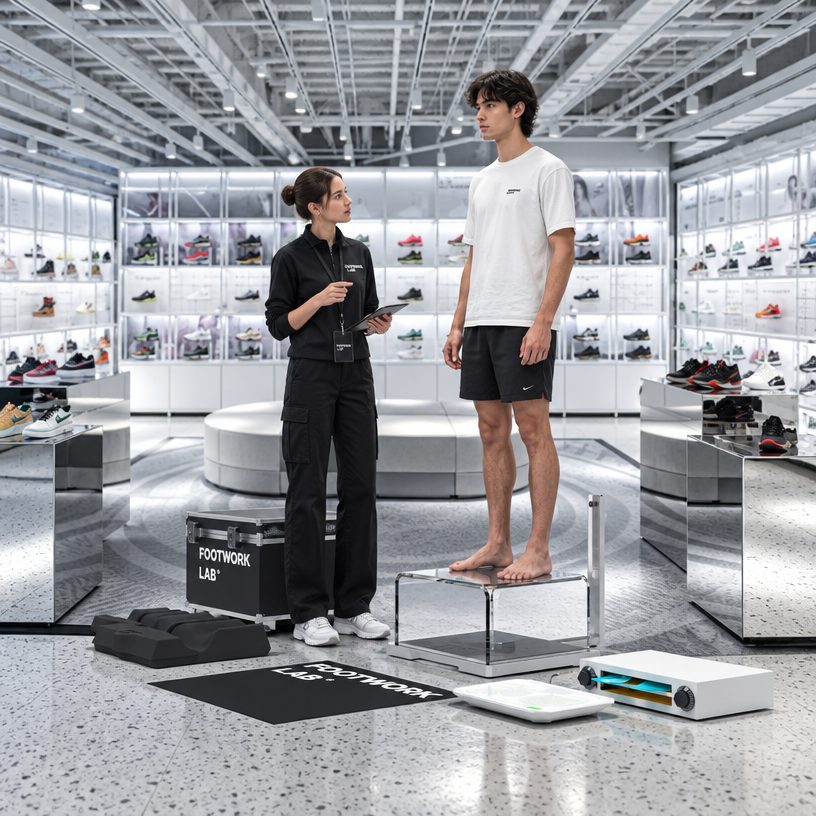
The honest definition first. A quick screen is a measurement session, short and structured: the customer stands, walks a few steps if the floor allows, and the equipment records how her load distributes. A compact podoscope such as the Q1P foot and leg quick-screening system exists for exactly this kind of corner — small footprint, fast session, output a customer can look at while the staff member narrates what is being shown. The whole interaction fits inside the time a customer already spends at the bench deciding.
What it is not, and this must be said as plainly inside the shop as it is here: it is not a diagnosis, not a treatment plan, and not a referral decision. The equipment produces images and measurements; what they mean is a question for a qualified professional, and the shop’s script should say so in the same breath as it says anything else about the screen. A shop that lets the screen drift toward diagnosis has taken on clinical responsibility it cannot carry, with customers who did not ask for it, on a floor built for selling shoes.
The boundary is easier to keep than shops fear, because the screen’s honest output is descriptive, not interpretive: how load sits when this customer stands, where the pressure concentrates, whether the two feet behave alike. Those are observations about a foot on a Saturday, useful for choosing shoes and for handing to a professional if the customer wants one. They are not claims about anyone’s future, and a floor that keeps its language descriptive will find the boundary holds itself.
Making the corner fit the selling day
The screen lives or dies by workflow, and the workflow can be drafted tomorrow morning before the doors open. Choose the location first: a corner with room to stand and step, out of the main traffic line, visible from the fitting bench but not blocking it. Choose the moment second: the screen runs while the customer waits anyway — between the fit check and the till, or while a size is fetched from the stockroom. A screen that adds waiting time will be abandoned by staff within a fortnight; a screen that fills existing waiting time gets used.
Assign the roles as concretely as the location. Whoever runs the bench runs the screen, on a rota that names the person for each shift, because “anyone who has time” means nobody has time by three o’clock on a Saturday. Set a simple trigger for offering it: the customer who mentions her feet, the customer trying a third pair for the same complaint, the customer who asks whether an insert would help. Those three situations cover most of the honest demand, and they arrive several times a day on any decent-sized floor.
And put a cap on it, in writing: the screen takes five minutes, and the sixth minute belongs back to the customer’s shopping. The cap sounds bureaucratic until the first busy Saturday, when it is the only thing standing between the screen and a queue at the bench. A screening corner that respects the selling day will be allowed to stay; one that competes with the till will be quietly retired by the staff themselves.
Saying what you see, and nothing more
The script does the compliance work, so write it once and train everyone on the same words. The shape is simple: describe, hand over, offer. “This shows how your load sits when you stand — more weight through this side, your right foot carries a little differently from your left.” That is description, and description is safe. “If you want to know what this means, take the sheet to your doctor or a foot professional — we are happy to print it for you.” That is handover, and it is where the screen’s responsibility ends.
What the script must not contain is any word that closes a loop the shop cannot close: nothing that names a condition, nothing that says what the customer should do about it, nothing that predicts what her feet will be like in ten years. Words that alarm travel fast and come back to the shop as complaints; words that reassure falsely travel faster. We have written about the language problem in detail in Saying the Map Out Loud: Words That Reassure and Words That Alarm, and the same rules govern a retail corner — perhaps more strictly, because the person speaking is not a clinician and the customer knows it.
The printed sheet carries some of the load that the voice must not. Put the measurement, the date, and the shop’s name on it, plus one line in plain words: this is a retail foot screening, produced by measurement equipment, and its interpretation belongs to a qualified professional. A sheet with that line on it protects the customer, the staff member and the shop at once, and it costs nothing but the discipline to never leave it off.
Feeding the screen into the shoe conversation
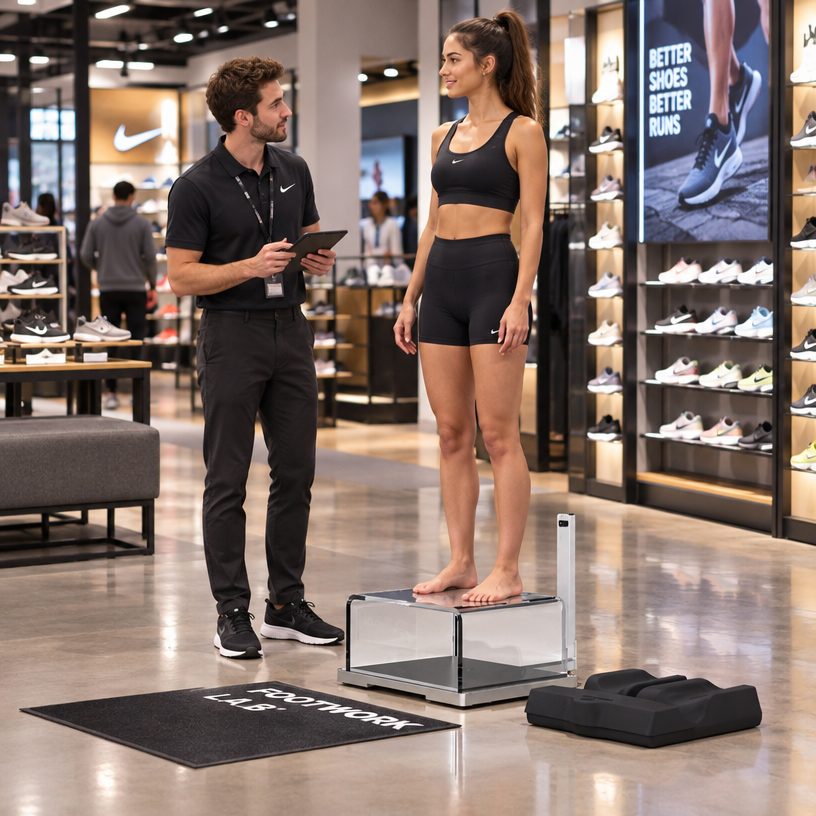
The screen earns its corner when it changes the next five minutes of the sale, and the connection from measurement to shoe is where staff training actually pays. A standing record that shows load concentrated on the inside edges makes the width conversation concrete: the customer sees her own footprint while the staff member discusses which of the available widths and depths gives that foot room to sit level. The screen does not pick the shoe. It sharpens the question the shoe has to answer.
The same applies to depth, to heel counter discussion, to the insert question that arrives a dozen times a week. A customer whose screen shows load pooled under the forefoot in standing is a customer with whom the toe-box depth conversation suddenly has a picture attached. None of this requires the staff member to interpret anything clinically — it requires her to connect one descriptive observation with one fitting decision, which is exactly the skill good floor staff already have with their eyes and have never had on paper.
Two cautions keep the connection honest. First, the screen informs the fitting of shoes the shop actually stocks; it is not a gateway to prescribing anything, and if the customer needs more than shoes, the handover line does the work. Second, a screen never overrides a customer’s own report: if she says a shoe feels wrong, the shoe is wrong for her, whatever the footprint shows. The screen sits beside the customer’s experience, never above it. Shops that keep those two rules find the screen becomes the most trusted thing at the bench — and the least argued with.
Staff turnover and keeping the screen honest
Every retail manager knows the real threat to any floor programme: by spring, the staff who were trained in autumn have moved on, and the screen is being run from memory by whoever is least busy. The defence is boring and effective: the script on a laminated card inside the corner, the trigger list on the same card, the cap on minutes in the same place, and the one-line interpretation disclaimer printed on every sheet. A new starter should be able to run the screen correctly on their second shift, using nothing but what is taped to the corner.
Run the consistency check monthly, and keep it small: one manager, one shadowed session, the sheet compared against the script. What drifts, drifts predictably — the description slides toward interpretation (“that’s a weak arch”) under customer pressure, and the cap stretches when the queue is short. Both drifts are correctable in a two-minute conversation, but only if the check exists. We have written about small screening spaces in Fitting a Screening Corner Into a Small Room and about temporary floors in The Pop-Up Booth: Screening Where the Room Is Not Yours, and both pieces end on the same note: the screen is only as honest as the last person trained on it.
Make the training part of onboarding rather than an event. Fifteen minutes on the first week’s schedule — watch two sessions, run one shadowed, read the script aloud once — and the screen survives turnover indefinitely. Programmes that get a launch day and nothing else die quietly by the second season; programmes that live in the onboarding schedule outlast the manager who installed them, which is the only kind of success worth having on a retail floor.
Frequently asked questions
Can a shoe shop screen feet without becoming a clinic?
Yes, if the boundary is kept in the script. A screen measures how load distributes in standing and steps, describes what it shows, and hands the customer a printed sheet whose interpretation belongs to a qualified professional. Description and handover are retail work; diagnosis and treatment plans are not, and the script keeps the line visible to everyone.
How long does a quick screen take on a busy Saturday?
About five minutes, and it should run inside waiting time the customer already has — between the fit check and the till, or while a size is fetched. Set a written cap on the minutes; a screen that adds waiting will be abandoned by staff, while one that fills waiting gets used.
Which customers should be offered the screen?
The customer who mentions her feet, the customer trying a third pair for the same complaint, and the customer who asks whether an insert would help. Those three triggers cover most of the honest demand, arrive several times a day on a decent-sized floor, and keep the offer relevant rather than automatic.
What can staff say about the screen result?
Descriptions only: how load sits, where pressure concentrates, whether the two feet behave alike. No condition names, no predictions, no instructions about care. The script has three parts — describe, hand over, offer the printed sheet — and every staff member should be trained on the same words.
Does the screen pick the right shoe for the customer?
No, and it should never be sold that way. It sharpens the fitting conversation — width, depth, heel counters, inserts — by attaching a picture to a question the staff member was already asking. The customer’s own report of how a shoe feels always outranks the screen; the screen sits beside the experience, never above it.
How do we stop the screen drifting when staff change?
Tape the script, the trigger list and the minute cap inside the corner, print the interpretation disclaimer on every sheet, train new starters in the first week of onboarding, and run a small monthly check comparing one shadowed session against the script. Programme honesty is an onboarding habit, not a launch event.
What goes on the printed sheet the customer takes home?
The measurement, the date, the shop’s name, and one plain line: this is a retail foot screening produced by measurement equipment, and its interpretation belongs to a qualified professional. That sheet protects the customer, the staff member and the shop at once, and it should never be skipped, however busy the floor is.
What we would do next
Walk your own floor tomorrow with two questions: where does the waiting happen, and which forty minutes of the week produce the most foot complaints? Where the answers overlap is where the corner goes. Draft the script the same afternoon — describe, hand over, offer — and print it on the same sheet as the disclaimer line, so the first session ever run is already the compliant one.
The wider pattern is worth naming for anyone planning beyond one shop: the screening corner is a small, disciplined version of the same idea that works in clinics and at trade events — meet the foot where the person already is, measure something honest, and hand the meaning to the professional who owns it. What the retail version adds is volume and variety: more feet in a day than most rooms see in a week, each of them at the exact moment of maximum foot awareness.
And a question for the retail readers: when a customer looks at her own footprint on the screen and asks “so what shoe should I buy?” — what do your best staff actually say in the next ten seconds, and has that answer ever been written down anywhere in the company?
This article is intended for professional and educational reference. It is not medical advice. Foot assessment equipment produces measurements and images; clinical interpretation and any decision about care remain the responsibility of a qualified professional. Certification scope is limited to the documentation we hold: European Union certification and ISO quality system certification.