
A clinic that decides to offer walking insoles usually starts by shopping for a machine, and that is the first mistake. The hardware is the most visible part of the service and the easiest to compare on a quotation, so it absorbs attention. But an in-house fitting service is a workflow before it is a machine: capture, specification, forming, fitting check, record. Get the sequence right and modest equipment produces good insoles. Get it wrong and the best machine on the market produces expensive coasters.
This article is written for the clinic owner, podiatry practice manager or small laboratory weighing up an in-house service for walking insoles — the everyday, medium-support product that replaces a sock liner in ordinary footwear, as distinct from a thin rigid shell built for a clinical prescription. FOOTWORK LAB builds both the assessment equipment that generates the data and the insoles that come out of it, in our own plant in Ruichang, so we see the whole chain rather than one link of it.
We also see where it breaks. The recurring pattern is not equipment failure. It is a clinic that bought a forming machine before it had a repeatable way to capture a foot, then discovered that every pair it made came out slightly different and nobody could explain why.
What “walking insoles” means in the trade
In retail language, a walking insole is a comfort product: a foam or gel insert that goes into a trainer or a walking shoe and makes the shoe feel less harsh at the end of a long day. In the trade, the phrase describes a category defined by its use case rather than its material. Walking insoles are built for footwear with a removable sock liner, moderate cushioning, moderate support, and a wear pattern that accumulates over hours rather than minutes.
That use case sets the engineering brief. A walking insole has to survive being worn inside a closed shoe for most of a day, in a shell that flexes at the ball of the foot. It has to fit without lifting the heel or crowding the toes. It has to be thin enough that the customer does not have to change shoe size, and stable enough that the arch support does not collapse under a full day of body weight.
Compare that with two neighbouring categories. Sports insoles are built for higher transient loads and more aggressive direction changes, which pushes the design toward grip, torsional stability and forefoot cushioning. Clinical orthoses are often thinner and stiffer, built to a specific load redistribution brief. A walking insole sits between them: supportive enough to matter, comfortable enough that the customer keeps wearing it.
The commercial consequence is important. Walking insoles are the highest-volume entry point for a clinic adding a product line, because the customer does not need a referral to want one. They need a reason to believe the pair in their hand was made for their foot rather than picked off a rack. That belief is created by the assessment, not by the machine.
The sequence that decides whether the service works
An in-house service has five stages, and the equipment only owns one of them. Capture produces the data. Specification turns data into a build instruction. Forming produces the physical insole. Fitting confirms the result against the foot and the shoe. Record keeping makes the second pair possible without starting from zero.
Clinics that skip straight to forming tend to produce what the industry calls a “shaped blank”: a thermoformed shell with an arch in it, made to a foot, but not made to a brief. It looks convincing and behaves generically, because nothing in the process decided how much support the foot needed where, or which part of the load pattern the insole was supposed to change.
The sequence also determines your staffing model. Capture and fitting are appointment-based and person-dependent. Specification can be standardised with templates. Forming is batch work that can be pushed into quiet hours. If you design the workflow around that rhythm, one practitioner can run a meaningful number of fittings per day without the forming step interrupting consultations.
There is a second reason to settle the sequence first: it tells you what to buy. A clinic that captures well but forms badly needs better blanks and a controlled oven routine. A clinic that forms well but captures badly needs a better assessment platform, and no amount of forming equipment will compensate.
Step one: capture the foot under load
Walking insoles are specified from two kinds of information: how the foot loads the ground, and how the lower limb aligns while it does so. The first comes from plantar pressure measurement, recorded both in static stance and during walking. The second comes from camera-based posture and alignment capture, taken from the front and from behind while the patient stands and moves.
Static recording shows the shape of the contact area and where load concentrates when the patient is still. Dynamic recording shows the sequence: where load enters the foot, how it travels, how long each region stays loaded, and whether one side carries more than the other. For a walking insole, the dynamic recording is the more useful of the two, because the product is used in motion. Static data alone tends to produce an insole that fits the foot at rest and behaves oddly in a shoe.
Repeatability is what separates a clinical service from a gadget demonstration. The same patient, captured twice on different days, should produce recordings that a colleague can recognise as the same foot. That requires a set routine: same stance position, same footwear condition, same instruction to the patient, same number of walking passes, and a note of anything that differed. Operators who improvise produce data that cannot be compared, and comparison is the whole point of a record.
Two practical details matter more than buyers expect. First, capture barefoot with the sock the patient normally wears, and record which one, because a thick sock changes the contact area. Second, capture the shoe as well if the insole is going into a specific pair, since internal volume decides how much build the insole can carry before the fit becomes tight.
Step two: write a specification a factory can build
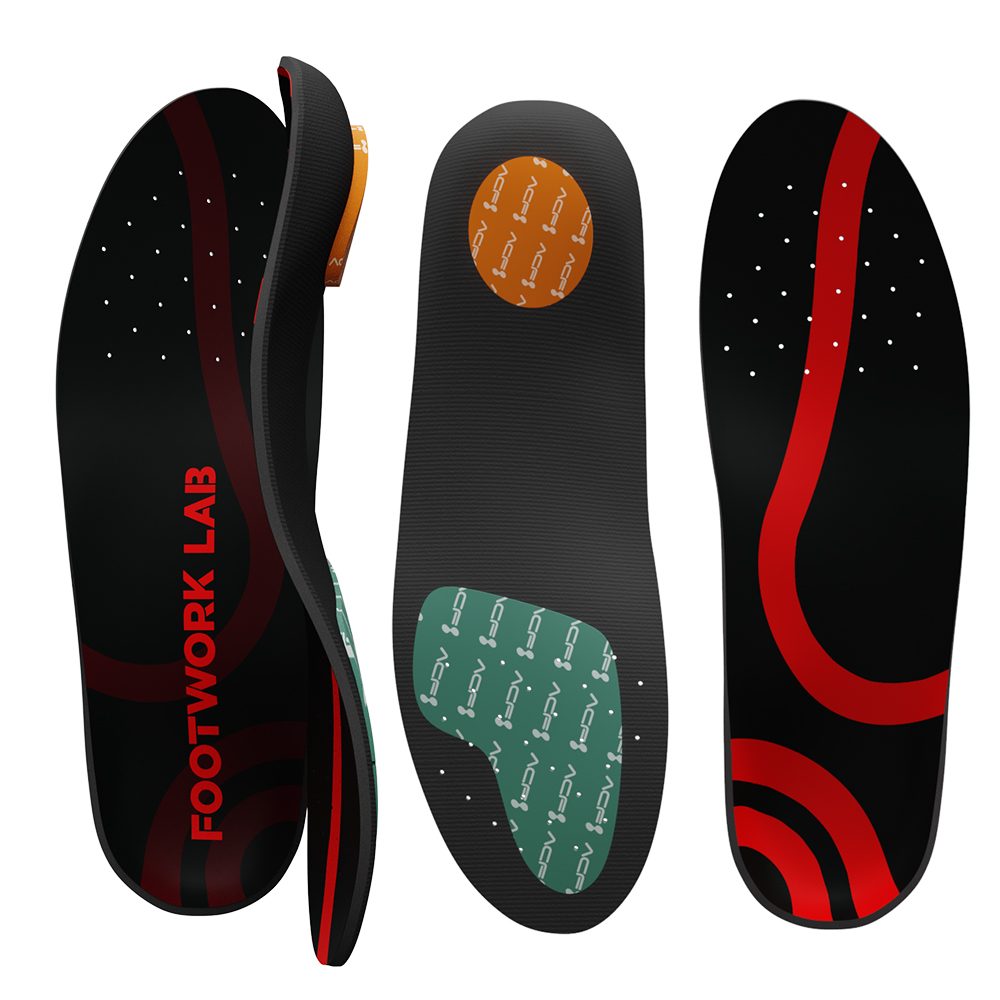
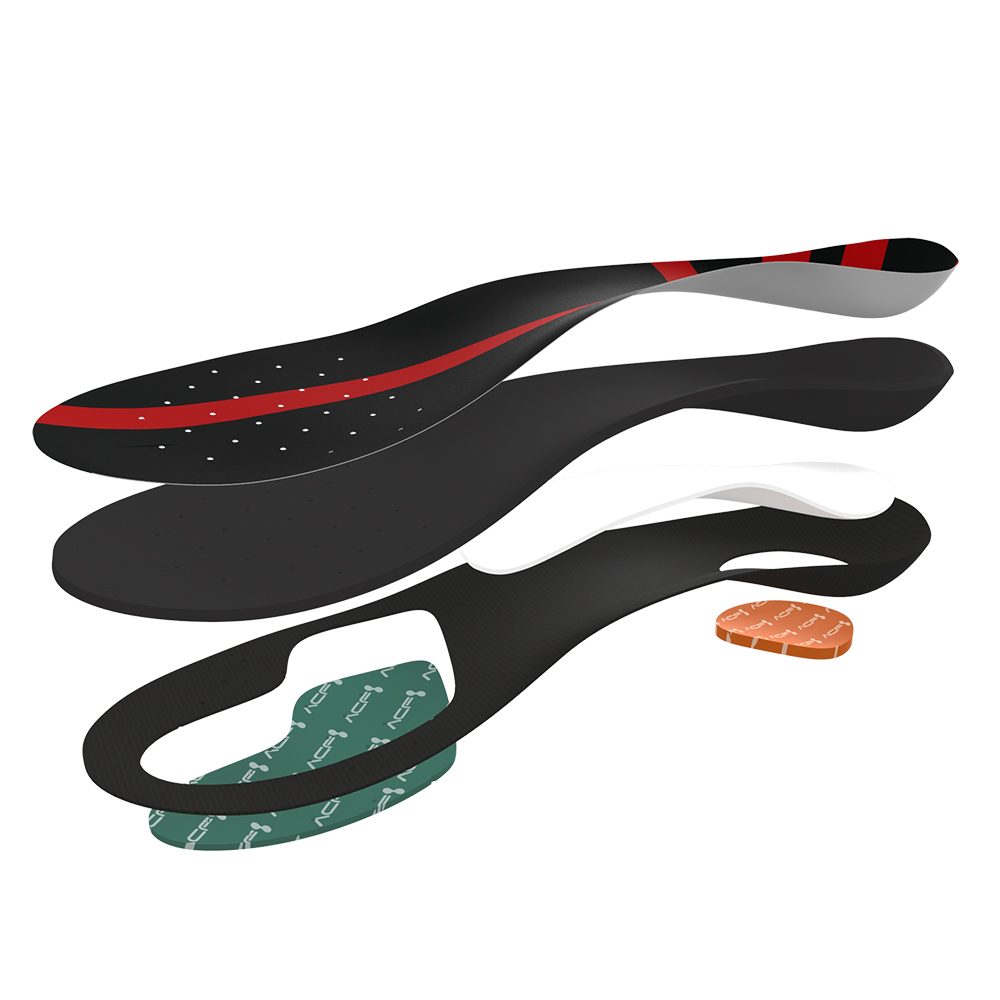
The specification is the document that turns an assessment into a product. In a well-run service it is short, and it uses language a production team can act on without guessing. It covers the shell material and its stiffness, the arch fill and where it sits, the depth of the heel cup, the cushioning layer and its position, the top cover, and the intended footwear.
Stiffness is the variable that most often gets lost in translation. “Medium support” means nothing to a production line. What a factory needs is a material grade, a thickness range and a geometry: how far the shell extends forward, how much of the arch it covers, how the medial edge is shaped. When those three are pinned down, two pairs made a month apart behave the same way. When they are vague, the pair depends on whoever was on the press that morning.
The specification should also state what the insole is not meant to do. A walking insole for a customer who spends the day on their feet in a soft trainer is a different product from one built for a customer who walks on hard pavement in a stiff shoe. Writing the intended use down protects the clinic later, when a customer returns with an insole that was asked to do something it was never specified for.
This is the stage where a manufacturer’s input earns its place. A factory that produces insoles daily knows which material combinations survive a year of wear inside a shoe, and which ones look good in a sample and delaminate in the field. That knowledge should show up in the specification template you use, not in a conversation after the first batch comes back.
Step three: forming and finishing
There are two routes to a finished walking insole, and the right one depends on volume. The first is in-house forming from thermoformable blanks: heat the blank, position it on the foot or on a cast, let it cool under load, then trim and finish. The second is factory production from the same specification, with the clinic handling capture, specification and fitting only.
In-house forming gives short lead times and a strong story for the customer, who can watch the pair being made. It also introduces variables. Oven temperature, dwell time, the position of the foot on the blank, the pressure applied during cooling and the trimming line all change the result. A clinic running this route needs a written routine and a way to check that the routine was followed, otherwise two practitioners will produce two different products from the same specification.
Finishing is the unglamorous half. Edges have to be smoothed so they do not catch on the sock liner. The top cover has to be bonded without wrinkles, because a wrinkle becomes a pressure point. The heel cup has to be checked for symmetry. Trim lines have to follow the shoe, not the trim template, when the two disagree.
Factory production removes those variables at the cost of lead time and a minimum order. For a clinic whose volumes are steady, sending specification to a plant and holding a small stock of finished pairs is often the cheaper model, because it converts a skilled labour problem into a purchasing problem. For a clinic that wants same-day delivery, in-house forming is the only route that works, and the routine has to be given the same seriousness as any other clinical procedure.
Step four: the fitting appointment and the record
The fitting appointment is where the service either earns a repeat customer or loses one. It has three jobs: confirm that the insole matches the specification, confirm that it works inside the intended shoe, and give the customer a clear idea of what to expect over the first weeks of wear.
Checking against the specification is straightforward if the specification exists. The practitioner compares shell stiffness, arch height and heel cup depth to the documented brief, confirming that what came out of production is what was ordered. Without a specification, this check collapses into an opinion, and opinions are hard to defend when a customer is unhappy.
Checking inside the shoe is where most problems surface. The insole may match the specification and still be unusable, because the shoe has no removable sock liner, or the toe box is too shallow, or the heel counter lifts when the insole is inserted. A clinic that keeps a small selection of common shoe types for this check catches those problems before the customer leaves rather than after.
The record closes the loop. It should hold the pressure recording, the posture capture, the specification, the production date, the material batch if the factory provides one, and a note of any adjustment made at fitting. That record is what makes the second pair a reorder rather than a fresh assessment, and it is what allows a colleague to take over the case without starting again.
Capacity, staffing and the honest economics
Capacity planning starts from the appointment, not from the machine. A capture and fitting appointment takes a predictable block of time, and the forming step can usually be batched. A single practitioner with a dedicated room can therefore handle a steady flow of fittings while forming runs in the background, provided the workflow does not require them to be in two places at once.
Staffing is the constraint most often underestimated. Someone has to be trained to capture consistently, someone has to own the specification template, and someone has to be accountable for the forming routine. In a small clinic those three roles can sit with one person, but they cannot be left unassigned. Services that stall usually stall because nobody owns the middle stage.
Consumables deserve a line in the budget before the machine does. Blanks, top covers, adhesives, trimming blades and packaging are per-pair costs that scale with volume, and they are the reason a service that looks profitable at ten pairs a month looks different at a hundred. Ask any supplier for the consumable cost per pair in writing, alongside the equipment price.
Then there is the honest question of whether in-house production is the right model at all. If the clinic’s strength is assessment and customer relationships, buying finished insoles to a specification may produce a better margin than making them, because the capital and the labour sit with the factory. The in-house route makes sense when lead time or customisation depth is the differentiator, not when it is simply a way to avoid a supplier conversation.
Where clinics overspend
The most common overspend is buying forming capacity for a volume that does not exist yet. A machine sized for a busy laboratory will sit idle in a clinic doing a handful of pairs a week, and idle capital is worse than a longer lead time. Start with the smallest setup that produces a pair you are willing to put your name on, and add capacity when the appointment book justifies it.
The second is duplicate capture hardware. A clinic that buys a second scanning device before it has standardised its first routine ends up with two datasets that cannot be compared. One platform, used consistently, produces better records than two platforms used interchangeably.
The third is handling training as an onboarding formality. Capture technique and forming routine are skills. A half-day session at installation, with no follow-up, produces operators who know which buttons to press and not why the sequence matters. Ask any supplier what training looks like in month three, not just on day one.
Finally, clinics overspend on specification complexity. A walking insole does not need every parameter the software can record. It needs the four or five decisions that actually change how the product behaves, documented clearly enough that production can repeat them. Restraint in the specification is what makes a service scalable.
Frequently asked questions
Do I need a machine to offer walking insoles at all?
No. You can offer them from a catalogue, or order to specification from a factory using a paper measurement routine. What the equipment adds is a repeatable record: a pressure recording and a posture capture that can be compared over time and reused for the next pair. Whether that is worth the capital depends on whether you intend to build a measured service or simply stock a product.
Can I start with pre-shaped blanks and add scanning later?
Yes, and many clinics do. The risk is that blanks push the service toward a generic product, because the shape is decided before the foot is measured. If you start there, keep a written record of the measurements you take so that the data can move to a specified build later without re-assessing every customer.
What does the assessment equipment actually record?
Plantar pressure across the contact area, in static stance and during walking, plus camera-based capture of posture and lower-limb alignment from the front and rear. The output is measurement data and images. Interpretation, and any decision about care, remain with the qualified professional using the system.
How long does a capture and fitting appointment take?
Long enough to brief the patient, capture static and dynamic recordings, take the posture views and discuss the intended footwear. It is a consultation, not a scan at a kiosk, and scheduling it as a short slot is one of the reliable ways to produce poor data.
What is the minimum order if I send specifications to your factory instead?
Two hundred pairs for insoles, and the quantity can be mixed across models and sizes. Samples are dispatched within three days of specification approval, so a clinic can evaluate the build before committing to a production run.
Do you supply the forming machines as well?
No. Our scope is foot assessment systems and finished custom orthotic insoles. We will explain the forming workflow and specify insoles that suit it, but we do not manufacture presses, ovens or trimming equipment, and we would rather say so than sell outside our competence.
What happens after installation if the team struggles with the routine?
Each system ships with a dedicated WhatsApp group, direct access to our engineers, remote assistance where the site allows it, and over-the-air updates for units connected to the internet. Machine warranty runs twelve months on non-human damage, with free replacement parts.
What we would do next
If you are designing an in-house service, write the five-stage workflow on one page before you request a single quotation, and mark which stages you intend to own. That document will tell you more about the equipment you need than any product brochure. Then compare the assessment platform against your capture routine — our F2 and FMP platform covers combined pressure and posture capture for exactly this workflow, and the insole categories page shows the product families available for a first mixed order.
For the commercial terms behind this article — minimum order, samples, ODM and OEM, warranty, logistics — see the FAQ page. If you would rather talk the workflow through with the people who build both sides of it, the contact page reaches our team directly, and the factory page shows where the insoles are produced.
This article is intended for professional and educational reference. It is not medical advice. Foot assessment equipment produces measurements and images; clinical interpretation and any decision about care remain the responsibility of a qualified professional. Certification scope is limited to the documentation we hold: European Union certification and ISO quality system certification.