
A foot sensor array records pressure, and pressure is a number per unit area per moment, which sounds precise and describes less than buyers assume. The array reports where load sits and how it moves; it does not report why, and the difference between those two statements is the difference between a measurement and a conclusion.
The confusion is worth addressing because it affects purchasing. Buyers compare sensor densities and sampling behaviour as though each increment bought a clinical insight, and then discover that the hard part of using a pressure system is not the sensing but the protocol around it.
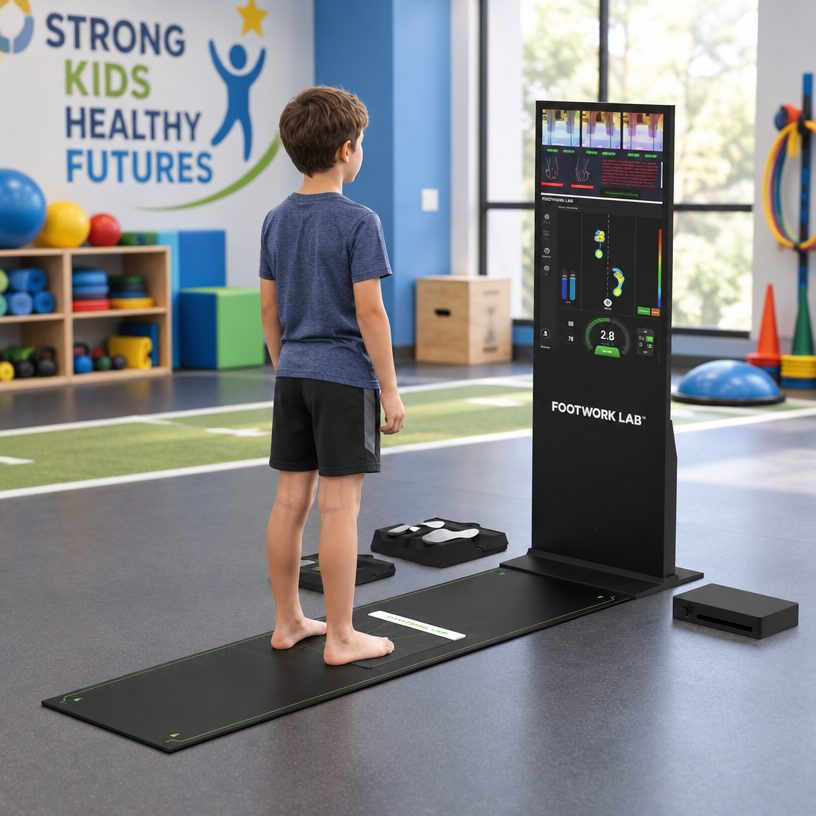
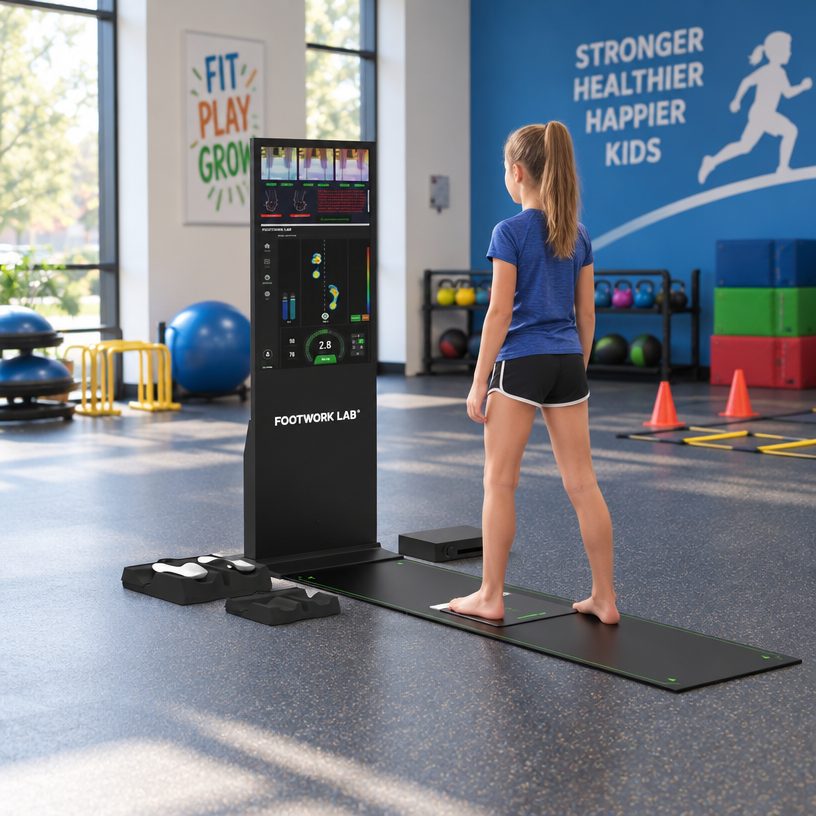
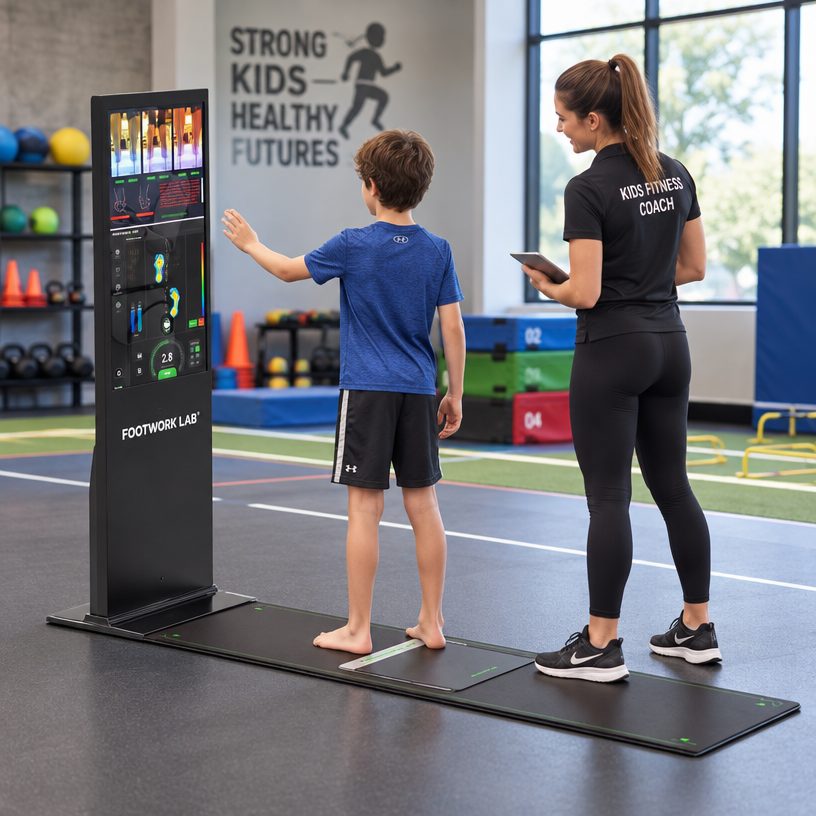
This article describes what a sensor array physically records, what the software does with it, where the honest limits sit, and how to write a requirement that a supplier can answer. Our own systems use pressure sensing with camera-based posture capture, so the description below follows the architecture we build rather than a generic diagram.
What an array physically records
An array is a grid of sensing elements, each reporting a value at a moment in time. The grid defines spatial resolution and the sampling defines temporal resolution; both are fixed by the hardware, and both interact with what the software can subsequently compute.
The values are not absolute pressure in the everyday sense. They are relative readings calibrated against a reference process, and they are meaningful because they are consistent, not because they are true in some final way. Consistency across visits and across machines is what makes comparison possible.
The surface between the foot and the array matters as much as the array. Socks, a shoe’s insole, and the rigidity of the surrounding floor all change what the sensors see. A record taken barefoot on a hard plate and a record taken in a shoe are not the same measurement, and neither is more real.
That is why a protocol belongs with every record. The array reports the interaction of a foot, a surface and a moment; change one and the numbers change for reasons that have nothing to do with the person.
There is also a physical fact worth stating plainly: the array measures the interface, not the foot. What it reports is the interaction between a foot, a surface and a moment, and every one of those three can change the numbers without anything about the person changing.
Spatial and temporal resolution
Spatial resolution decides how finely the load pattern can be described. A coarse array reports regions; a finer array reports gradients within those regions. For most clinical conversations regions are enough, and the extra detail becomes useful mainly when a design has to be specified at a fine scale.
Temporal resolution decides what can be said about timing. Walking involves rapid transitions, and a system that samples slowly reports a sequence of positions rather than a continuous motion. Static capture is forgiving of this; dynamic capture is not.
The two resolutions trade against data volume and cost, and the trade is a design decision rather than a quality ranking. A clinic that captures mostly standing posture does not gain from a system built for fast walking; a lab studying transitions needs the opposite.
Ask the supplier to describe both in terms of what becomes observable, not in numbers alone. ‘Enough to resolve the heel-to-forefoot transition during walking’ is a more useful statement than a sampling figure, and it is harder to fake.
It is worth asking how the system behaves at the edges of its range. A capture that saturates produces a flat-topped map that looks calm and means the opposite, and a capture below the sensing threshold produces a faint map that looks like low load. Both are artefacts, and both are invisible unless the software flags them.
There is a practical test for resolution that costs nothing: capture a foot with a known feature, such as a prominent metatarsal head, and see whether the system resolves it as a distinct region or smooths it into the surrounding area. The answer tells you more than a specification figure.
What the software adds
Raw frames become regions, zones, peaks, paths, symmetry indices and phase timings through a chain of choices: boundary definition, smoothing, segmentation of steps, normalisation. Those choices are the analysis, and they are where two systems can disagree about the same foot.
A useful system makes the choices visible. If the region boundaries can be inspected and adjusted, the operator can see what the software did and can explain it to a client. If the output is a single score with no intermediate view, the operator is repeating a number they cannot defend.
The second thing software adds is memory. Records stored with context — date, protocol, shoe, operator — can be compared; records stored as screenshots cannot. The value of a pressure system over five years is almost entirely a function of this decision.
The third is export. A record that can leave the system belongs to the clinic; one that cannot creates a dependency that is invisible on a quotation and expensive at the end of a lease. Test the export before signing.
The software’s most underrated function is bookkeeping. Which record belongs to which client, which protocol was used, which shoe was worn, and whether the record has been reviewed. A system that handles bookkeeping well gets used; one that leaves it to the operator gets abandoned in a busy month.
It is worth asking whether the software records the raw frames as well as the processed output. Raw frames allow a later re-analysis with a different setting; processed output only allows a re-read of the same conclusion. Storage cost is the reason suppliers skip it, and it is usually worth paying.
Where the honest limits sit
A pressure record does not identify a condition. It describes load under stated conditions, and the interpretation of that description requires a professional who has examined the person and knows the history. Systems that present an interpretation as an output have moved from measurement into something else.
A pressure record also does not describe muscle activity, joint stiffness or tissue properties. Those require other instruments. A record that is asked to answer a question outside its domain will produce a confident answer that happens to be unsupported.
The third limit is the sample. A capture covers seconds; a person walks for hours. A record describes a sample of behaviour under observation, and behaviour under observation differs slightly from behaviour unobserved — which is why protocols include a settling period.
Stating those limits is not modesty; it is what makes the measurement usable. A clinic that knows what a record can support uses it confidently, and a clinic that over-reads one eventually stops trusting the instrument.
A fourth limit is the observer effect. People stand and walk differently when they know they are being measured, and the difference is largest in the first minute. Protocols that include a settling period are not being fussy; they are correcting for a known bias.
It is also worth stating the limit that surprises buyers most: the record describes the foot inside the conditions of capture, so a change of shoe can change the record more than a change in the person. That fact alone justifies keeping the footwear in the protocol.
Writing a requirement a supplier can answer
State the question the instrument must answer, in one sentence: for example, to describe load distribution under a standing foot and to compare it with the same foot six months later. Everything else follows from that sentence.
Then state the protocol constraints: barefoot or in-shoe, standing or walking, how long, how many repeats, and who operates. A supplier who knows the protocol can propose a configuration; one who does not will propose a catalogue item.
Then state the record requirements: what must be stored, how it is named, how it is found, what must be exportable, and in which format. These are the requirements that decide whether the system is an asset in year five.
Then state the support requirement with a time attached. Ours is a WhatsApp group with an engineer reachable directly, remote assistance, and software updates delivered over the air. A supplier’s answer to that requirement tells you more about the relationship than the specification sheet does.
It also helps to state the deliverable. A requirement that ends with ‘a report a client can understand in one page’ produces a different shortlist from one that ends with ‘a dataset for research’, and the difference is settled before any demonstration is booked.
It also helps to state the required lifetime. A system expected to serve five years needs a calibration routine, a spare-parts route and a software roadmap; one expected to serve two needs a support contract and an exit plan. Specifying the lifetime changes the questions worth asking.
It is worth stating the deliverable in the same breath as the requirement. A record that a client can understand, a data set that a colleague can compare and a file that another program can open are three different asks, and naming all three prevents a late surprise.
Installation and the conditions around it
A pressure surface is sensitive to its base. A plate installed on an uneven floor reports differently from one installed on a level base, and the difference is not obvious until two sites compare records. Installation drawings exist for this reason.
Lighting and camera placement matter for posture capture that accompanies the pressure record. Reflections, backlight and a camera mounted too high or too low all change the image, and images that change for environmental reasons cannot be compared clinically.
Temperature affects some sensing materials, and air movement affects the person. Neither is usually a problem in a treatment room and both become one in a temporary setting such as an exhibition or a mobile screening event.
The practical approach is to record the conditions once, in a short installation note, and to keep them stable afterwards. A note that names the room, the surface, the camera height and the lighting is enough, and it takes ten minutes to write.
Cabling deserves a mention because it decides where the system can live. A surface that needs a cable run across a treatment floor will be installed once and then avoided; one that can be positioned freely will be used. It is a small detail with a large effect on utilisation.
The installation note should also record who installed the system and when, because a change of site or a change of operator is the most common reason two records from the same clinic are not comparable.
What to look at in a demonstration
Ask for a capture with the client in the footwear they normally wear, then a second capture the same way. Compare the two and look for differences that the operator can explain; unexplained difference is the signal to examine the protocol rather than the product.
Ask to see an exported file on a computer without the supplier’s software. What remains visible is what the clinic owns, and it is worth knowing before purchase rather than after.
Ask the operator to change a region boundary and explain what changed in the output. A system that allows this and a supplier who can explain it indicate that the analysis is understood by the people selling it.
Finally, ask what happens when the surface needs recalibration, and what the procedure does to records taken before and after. A supplier with a routine answer has installed systems for years; a supplier who improvises has sold boxes.
Finally, ask what the supplier does with the data question. Where records are stored, who can access them, and what happens if the clinic changes computers are ordinary questions with ordinary answers, and a supplier who answers them clearly is a supplier who has installed systems in real clinics.
Frequently asked questions
What does a foot sensor array measure?
It records pressure distribution across a grid of sensing elements over time. The result is a measurement of load under stated conditions; interpretation requires a professional who has examined the person.
Does higher sensor density mean better assessment?
Not automatically. Density and sampling interact with the protocol and the software. What matters is whether the system can answer the question you actually ask of it, consistently across visits.
Can a pressure record identify a condition?
No. It describes load distribution. Clinical interpretation and any decision about care remain with a qualified professional, which is why our systems are described as assessment equipment.
Can records be compared between visits?
Yes, if the protocol is constant — surface, footwear, duration, operator. The record needs its context stored with it for a comparison to mean anything.
Do your systems include posture capture?
Our pressure systems combine pressure sensing with camera-based posture and alignment capture, so one appointment produces both a load record and an alignment image.
What support and warranty come with the equipment?
A dedicated WhatsApp group with an engineer, remote assistance, and software updates delivered over the air to connected units. Machines carry a twelve-month warranty against non-human damage.
How do we keep records usable over several years?
Store them with context, agree a naming convention, and require an exportable format. Those three decisions determine whether a record can be found and understood later.
What we would do next
Write the question the instrument must answer before comparing specifications, and test the export before signing. The X3 page describes the pressure and force-line system we build, and Our Factory covers installation and support.
The article on reading a foot scanner machine as three layers explains how the sensing, software and reporting layers fail independently.
This article is intended for professional and educational reference. It is not medical advice. Foot assessment equipment produces measurements and images; clinical interpretation and any decision about care remain the responsibility of a qualified professional. Certification scope is limited to the documentation we hold: European Union certification and ISO quality system certification.