
Custom orthotic insoles for sport work best when the level of support, anti-torsion, cushioning and starting ability is chosen for the discipline, not lifted from a generic template. The FX Sport line is the sport series of our human-mechanics detection custom insoles, built to be specified per activity and produced from a foot assessment record. This article explains what the FX Sport series is built on in the manual’s own terms, how the four grading levels shift across individual sports, and why the insoles are paired with the X5 human-mechanics detection customization system rather than made from experience alone. It is written from the manufacturing side — we make the insoles in our own plant and supply them to podiatry clinics, rehabilitation practices, shoe stores, gyms and sports training institutions.
If you are specifying insoles for an athlete or a training population, the useful way to read this is to start from the movement demands of the sport and work backwards to the grade, instead of starting from a single insole design and hoping it fits every activity. A golf swing and a basketball cut load the foot in completely different ways, and one “sport” insole cannot serve both well.
Where sport insoles are specified: who orders them
The FX range covers three lines — daily comfort, rehabilitation care and sport — and the sport line is the one built for training and competition loads. The manual lists the sport disciplines by name: golf, outdoor, skateboarding, skiing, fitness, basketball, paddle sports, running, football and cycling. That spread is the point: a single insole grade cannot serve a rotational sport, a lateral-cutting sport and a linear endurance sport with equal effect, so the line is set up to be specified per discipline rather than sold as one catch-all “sport” product.
In a podiatry or rehabilitation practice the conversation is usually about matching an insole to the loads a patient actually places on the foot during their sport, then reviewing it after a block of training. In a shoe store or gym the conversation is shorter and more about fit, the shoe type the athlete uses, and the grade that matches their main activity. In a sports training institution the insole is often one part of a larger load-management plan rather than a standalone product.
The practical constraint in every setting is the same: the grade has to come from a foot record, not from a guess. That is why the sport line is documented in the manual as working together with the X5 human-mechanics detection customization system — the detection step is what turns a generic insole into a specified one, and it is the same combination we demonstrate when we meet buyers at trade shows from Dubai to Vietnam.
What the FX Sport series is built on, in the manual’s own terms
The manual describes the FX insoles as human-mechanics detection custom insoles, and it names the enabling technology without ambiguity: BODYFIT AI intelligent detection and assessment, together with senthmetic flexible fabric sensing technology. The manual states that the insoles are customized on specific equipment through data features, and that they are used with the X5 human-mechanics detection customization system — the hardware and software combination is spelled out in the manual rather than left implied.
Four grading levels run through the whole FX range, including the sport line: Support level, Anti-torsion level, Cushioning level and Starting ability level. These four are the levers a specification uses. Instead of describing an insole by a single vague word such as “sporty”, the manual frames it through how much support, anti-torsion control, cushioning and starting response a given activity needs, and those levels are assigned from the detection record rather than from a fixed chart.
The foot-zone framework the design works within is also named in the manual: the ten anatomical zones M1 to M5, HL, HM, MF, T1 and T2 to T2-5, where M1 to M5 are the first to fifth metatarsal regions, HL and HM are the lateral and medial heel areas, MF is the midfoot, T1 is the great toe and T2 to T2-5 are the remaining toes. The design attention sits on the load regions M1 to M3, HL and HM, because that is where pressure concentrates during sport.
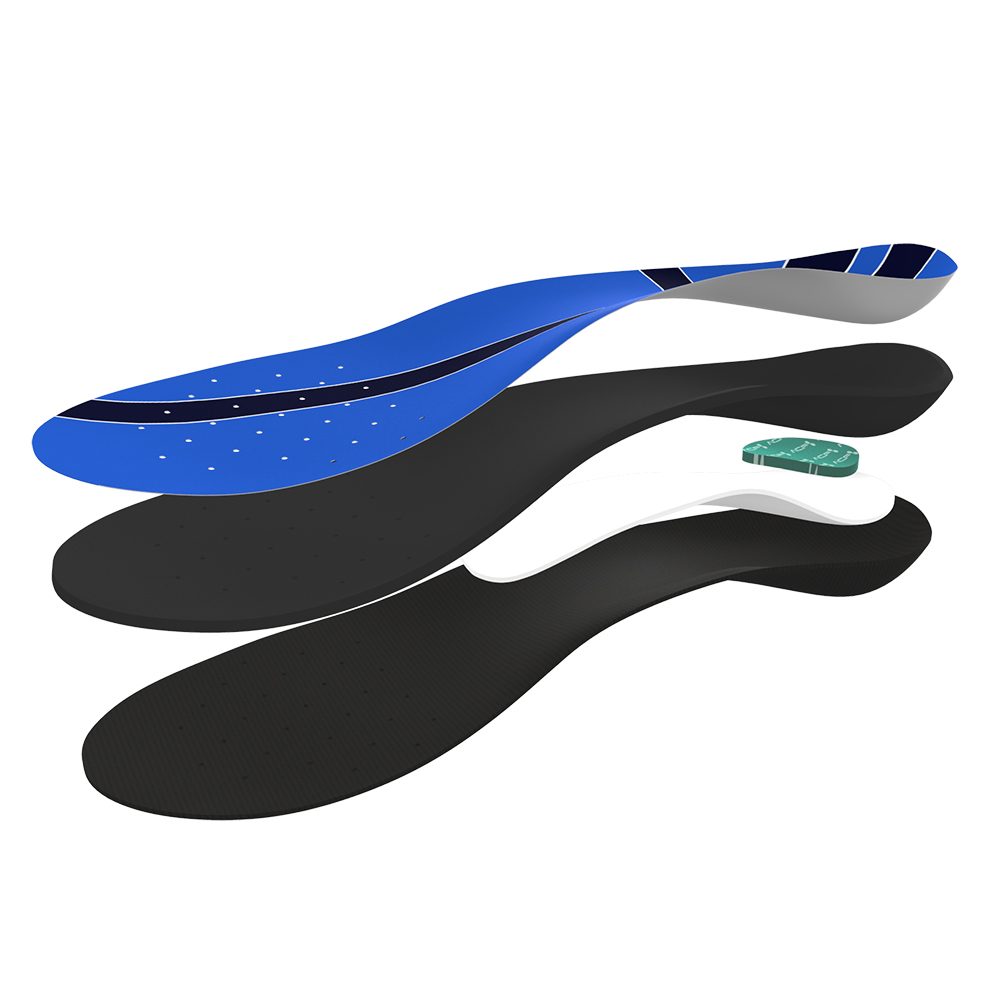
The material set is described without thickness figures: sports mesh fabric, corrugated fabric, Osolite cushioning layers, AQ polymer shaping support plates, XRD external cushioning pads and ACF artificial cartilage cushioning material, bonded with a spun-lace hot-melt base layer. The insoles suit sports, casual and outdoor shoes and are produced across a wide size range.
How each sport moves the four levels
The four levels exist because different sports ask different questions of the foot, and the manual’s framework assigns them from the detection data of the individual foot combined with the demands of the activity. Reading the disciplines separately makes the logic clear.
Golf. A rotational sport built on a stable stance and a controlled weight transfer. The grading leans toward Support and Starting ability for a grounded, repeatable base, with moderate Anti-torsion and Cushioning — the foot has to stay quietly planted and then push off cleanly, not absorb repeated hard impacts.
Skateboarding. A board-feel sport with repeated side-load, impact and the explosive movement of a trick. Anti-torsion and lateral Support move to the top of the priority order, with Cushioning added for flat-land and gap impact and Starting ability supporting the quick pop. A generic insole under-supports the edge the skater actually rides on.
Skiing. A rotational-and-impact sport with long edging forces and hard landings. Cushioning and Anti-torsion carry the most weight — the edge needs to resist twisting while the boot takes repeated shock — with Support high and Starting ability lower, because the discipline is about sustained control rather than explosive first steps.
Basketball. A lateral-cutting sport with jumping, hard stops and direction changes. Support, Anti-torsion and Cushioning all sit high, with Starting ability also high for the explosive drive. This is the profile most often under-served by a single “sport” grade, because three of the four levels are simultaneously demanding.
Paddle sports. Tennis, badminton and similar racket disciplines are quick-lateral, pivot-heavy and full of short explosive starts. Anti-torsion and Starting ability lead, Support sits moderately high, and Cushioning stays moderate — the foot needs to react and re-react, not to soak up a long endurance load.
Running. A linear endurance sport with repetitive forefoot and heel loading. Cushioning takes the lead, with moderate Support and Anti-torsion and a moderate Starting ability, because the recurring demand is shock management over distance rather than multidirectional cutting.
Football. A multidirectional sport of cutting, kicking and repeated sprints. Anti-torsion and Support sit high, Starting ability is high for acceleration, and Cushioning is moderate — the boot is taking direction changes and planting forces more than long landings.
Cycling. A repetitive, low-impact discipline where pedalling torque loads the plantar surface. Anti-torsion for pedal force and Support for the arch lead, with Cushioning moderate and Starting ability lower, since the foot is fixed and driving rather than sprinting from standing.
Fitness and outdoor. Fitness mixes lifting stability with dynamic movement, so Support and Anti-torsion lead with moderate Cushioning and Starting ability. Outdoor — hiking and long uneven-terrain walking — leans toward Cushioning and Support for sustained load, with moderate Anti-torsion and Starting ability. The point across all ten disciplines is the same: the four levels are weighted from the detection record and the activity, not copied from a chart.
Where buyers in each room go wrong
For a clinic or rehabilitation practice. The trap is reading the insole as a treatment. FX Sport insoles support load distribution, alignment and stability during sport; they are not a treatment and they do not diagnose a condition. The rooms that use them well present them as part of load management and equipment fit, inside the professional’s own scope of practice.
For a shoe store or retail fitting station. The trap is treating the catalogue setup as optional and letting a quick fitting stand in for a real foot assessment. The sport line is documented as working with the X5 detection system, so skipping the record skips the step that makes the four levels specific to the foot in front of you — the store ends up selling a generic grade and calling it custom.
For a distributor or wholesale buyer. The trap is assuming factory-direct and trading-company terms are interchangeable, treating MOQ and lead time as negotiable everywhere, and seeing the on-site customization module and the factory production line as competitors rather than two steps of one workflow. We are a manufacturer, so the questions that matter are about configuration, training and after-sales support.
For a sports training institution or gym. The trap is specifying one insole for a mixed training population. A rotational golfer, a cutting basketball player and an endurance runner pull the four levels in different directions; buying a single grade leaves some athletes under-supported in the dimension their sport actually stresses. The fix is a per-discipline grade driven by each athlete’s detection record.

Product file: FX Sport custom orthotic insoles
What it is. The sport series of our human-mechanics detection custom insoles, specified per discipline and produced from a foot assessment record.
Enabling technology. BODYFIT AI intelligent detection and assessment, together with senthmetic flexible fabric sensing technology; customized on specific equipment through data features.
How it is specified. Four grading levels run through the line — Support level, Anti-torsion level, Cushioning level and Starting ability level — assigned from the detection data and the demands of the activity.
Used with. The X5 human-mechanics detection customization system, as the manual’s stated hardware and software combination for detection-led customization.
Sport disciplines covered. Golf, outdoor, skateboarding, skiing, fitness, basketball, paddle sports, running, football and cycling.
Design framework and materials. Built around the foot zones M1 to M5, HL, HM, MF, T1 and T2 to T2-5, with design attention on the load regions M1 to M3, HL and HM. Material set includes sports mesh and corrugated fabric, Osolite cushioning layers, AQ polymer shaping support plates, XRD external cushioning pads, ACF artificial cartilage cushioning material and a spun-lace hot-melt base layer. Suits sports, casual and outdoor shoes across a wide size range.
What we do not claim. FX Sport insoles support load distribution, alignment and stability during sport; they are customized from detection data rather than from experience or a fixed template. They do not diagnose a condition and they are not a treatment. Buyers comparing them with a clinical or therapeutic service should compare the two on what each actually does.

Frequently asked questions
What makes FX Sport insoles “custom” for a discipline?
The four grading levels — Support, Anti-torsion, Cushioning and Starting ability — are assigned from a foot assessment record and the demands of the activity, using BODYFIT AI detection and senthmetic flexible fabric sensing. The manual ties the line to the X5 detection system, so the grade comes from data features rather than from a standard template.
Which sports are covered by the FX Sport line?
The sport disciplines listed in the manual are golf, outdoor, skateboarding, skiing, fitness, basketball, paddle sports, running, football and cycling. The line is organized so the four levels can be specified per discipline rather than applied as one generic sport grade.
Are the insoles made without a foot assessment?
No. The manual states the insoles are customized on specific equipment through data features and are used with the X5 human-mechanics detection customization system. The detection record is what drives the four levels, which is the step that makes the result specific to the individual foot.
How do the four levels differ between sports?
They shift with the movement demand. Golf and cycling weight Support and Anti-torsion, basketball and football weight Support, Anti-torsion, Cushioning and Starting ability together, running leads on Cushioning, and skateboarding and skiing lead on Anti-torsion and Cushioning. The grade is assigned from the detection record and the activity, not copied from a chart.
Can the sport line be ordered alongside other FX lines?
The FX range has three lines — daily comfort, rehabilitation care and sport — and they are separate designs with separate intent. A foot record read with the activity decides which line and which grade apply; mixing a sport insole where a daily-comfort or rehabilitation profile is called for would be a mismatch.
How are the insoles produced and supported?
The insoles are manufactured in our own plant as a factory-direct supplier, and we accept ODM and OEM. Customization follows the detection data, and the software used with the X5 system can be customized for a specific workflow at separate cost. Support runs through a dedicated WhatsApp group with our engineers and over-the-air updates for connected units.
What we would do next
If you are specifying sport insoles, start from the movement demands of the activity and list the level each demand maps to — support, anti-torsion, cushioning and starting ability. Send us that list with the foot record you intend to use, and we will tell you whether the FX Sport line covers the grades you need and which detection workflow produces the cleanest data for them.
If you already fit insoles without a detection step, the cheapest improvement is usually to add the record first and let the four levels follow from it. Tell us how you specify today and we will point out where a data-led workflow would change the grade you would otherwise have chosen by experience.
This article is intended for professional and educational reference. It is not medical advice. Custom orthotic insoles support load distribution, alignment and stability; clinical interpretation and any decision about care remain the responsibility of a qualified professional. We do not provide treatment. Certification scope is limited to the documentation we hold: European Union certification and ISO quality system certification.