
A clinic manager forwards a screenshot of a pressure map and asks the question that lands in our inbox most weeks: the middle of the foot shows almost no load — is that good or bad? The honest answer is that the picture alone cannot say, and that answer is exactly why zone labels matter. Buyers who search for foot arch pressure are usually trying to do one of two things: understand what the arch region of a pressure record is supposed to show, or decide which part of a report they should be reading at all. Both are reading questions, not diagnosis questions. This guide is written for the people who ask them — podiatry clinics, rehabilitation hospitals, shoe stores and sports facilities that are about to put a plate like the F2 on their floor and want a shared vocabulary for what comes back.
The F2 manual names the system a Foot Pressure Detection System and lists three core functions: static pressure detection and evaluation, dynamic pressure detection and evaluation, and balance pressure detection and evaluation. What turns those captures into something two people can discuss without arguing is a second piece of vocabulary: the regions of the foot the product literature divides the sole into. Once a clinic, a coach and a fitter agree on the region names, a conversation about a record stops being “the dark patch near the middle” and starts being a statement about a zone everyone can find. The sections below cover what buyers actually ask, the zone list itself, how the F2 produces a reading for each zone, and where a reading has to stop.
What buyers mean when they ask about foot arch pressure
In our pre-sales calls, the arch question arrives in two shapes. Clinic buyers ask whether the midfoot region should carry load, and how much. Retail and facility buyers ask whether the record can tell them a person’s arch type from the print alone. Both questions are reasonable; neither has the single-number answer people expect.
What a pressure record actually gives you is the load distribution of one person, on one day, under one set of capture conditions. A midfoot region that shows little load in a standing record may show considerably more once the same person walks across the plate, because the foot deforms and loads differently through the contact phase. Another person shows the opposite. Neither pattern is, by itself, a grade — the record describes what happened, and a qualified professional decides what it means for that person. We make a point of saying this during demonstrations, not as a hedge but because it is the whole point of the equipment: the F2 produces measurements and images for a professional to read, and it deliberately stops short of a clinical conclusion. A buyer who wants a machine to hand out verdicts is shopping for something no pressure plate should claim to be.
Once that boundary is set, the arch region becomes genuinely useful — as one zone in a ten-zone picture rather than a single answer. The next section sets out those zones exactly as the product literature names them.
The zones the manual names, and what each one answers
According to the medical-anatomical division used across our product documentation, the sole of the foot divides into ten regions. Each one answers a different question when you read a record:
- M1 to M5 — the first to fifth metatarsal heads
- The forefoot row, read left to right across the ball of the foot. This row shows how load spreads during push-off, and whether one metatarsal head is taking a disproportionate share.
- HL and HM — the lateral and medial heel
- The heel pair, read as inside and outside rather than one blob. The balance between them says where the heel takes load at first contact and while standing.
- MF — the midfoot
- The region most people mean when they say “the arch”. It is the zone whose reading varies most between individuals, and the one buyers most often over-read or dismiss.
- T1 — the big toe
- The final push-off region in a walking record, read together with the metatarsal heads in front of it.
- T2 to T5 — the lesser toes
- Usually the quietest zones on the map; useful mainly as a reference for symmetry between the two feet.
The product design documentation notes that heavy load concentrates in the M1 to M3 range, HL and HM — the inside forefoot column and the heel pair. That is why our insole designs anchor their support and cushioning work in those regions, and it is also a practical reading order for a report: heel pair first, forefoot row second, midfoot third, toes last. A reader who follows that order sees the midfoot in context instead of in isolation, which is precisely what the arch question needs.
One more habit belongs in this section: read the two feet against each other before reading either one against a reference. The left and right records sit side by side on the F2 report for exactly this reason. A midfoot zone that loads differently from its partner is a far more actionable observation than any absolute number, because the person is their own best control — same body, same day, same conditions. The same symmetry logic applies along the zones themselves: the HL and HM pair, the metatarsal row, even the lesser toes. A report read as ten independent numbers is noise; read as a structure of pairs and rows, it starts to say something a professional can act on.

How the F2 puts a record under each zone
The F2 captures on Sinmec Fabric flexible-fabric sensing, which supports both standing and walking capture on the same plate, without changing hardware between the two. Each of the three core functions serves the zone reading differently. Static holds the standing distribution: where load sits under each region at rest. Dynamic holds the sequence: the order in which the regions take load as the person walks, which is when the midfoot either joins the picture or does not. Balance holds the small corrections a person makes to stay upright — a stability question, separate from both.
During capture, a lower-limb camera and a posture camera record alongside the plate, so a report can place the pressure picture beside a biomechanical alignment view of the leg above it. The report itself is assembled with AI-assisted report generation and carries, beside the pressure visualisation: foot axis angle, the contact phase and flat phase shares, footprint length and width, peak pressure, average pressure, the contact area curve, surface area, and centre of pressure velocity, with left and right foot shown together. None of those fields is a verdict on its own; each is a measurement a professional can place next to the zone picture.
The dynamic record is where zone reading earns its keep. A standing map freezes one arrangement of load; the walking record shows MF loading and unloading through the step, the heel pair handing load to the forefoot row, and the centre of pressure travelling its path. At trade fair demonstrations we regularly run a visitor through both captures back to back, and the midfoot difference between their own standing and walking records is usually the moment the zone vocabulary clicks — the map stops being a heat picture and becomes a sequence they can narrate.
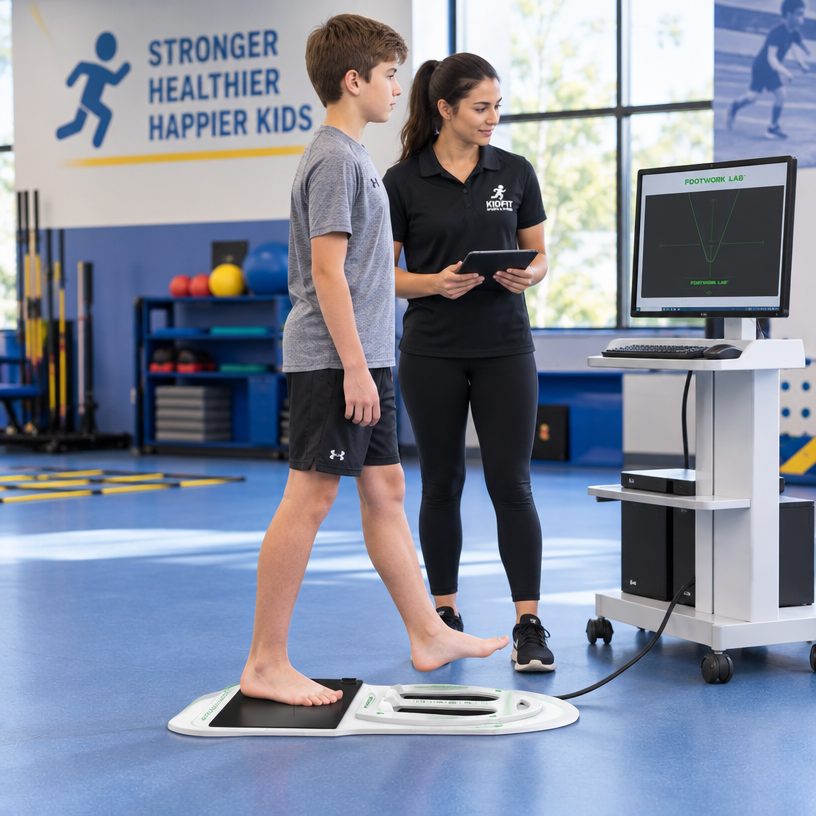
The capture itself takes minutes, and that speed shapes how the zones get used. A shoe store can run a static and a walking pass inside a fitting conversation; a children’s fitness institution can screen a group in an afternoon and keep every record filed against a name; a rehabilitation hospital can schedule a midfoot read as a repeatable part of a review appointment. The zone labels are what make those different rooms comparable — a physiotherapist, a fitter and a coach can discuss the MF zone by name without the record ever leaving its own format. That portability of vocabulary, more than any single field on the report, is what buyers are actually purchasing when they purchase a zone-based system.
Reading the midfoot zone without over-reading it
Because MF is the zone people care about most, it is also the zone most often over-read. Three habits keep the reading honest.
First, read MF against the other zones, never alone. A midfoot reading only means something next to the heel pair and the forefoot row — the same absolute load can be unremarkable for one foot and notable for another, depending on how the rest of the sole is sharing the work. The documentation’s own emphasis on the M1–M3, HL and HM load concentration exists for this reason: those regions carry the bulk, and the midfoot is read as its share of that distribution.
Second, match the capture conditions before comparing two records. Our engineers saw this on a support call: a rehabilitation clinic had been comparing two visits in which the midfoot colours looked nothing alike, and the cause turned out to be simple — the first record was captured barefoot in the morning, the second shod after a training session, by a different operator giving different instructions. Once the clinic fixed a short written protocol and re-ran the pair, the two records became readable against each other. The hardware had not changed; the discipline around it had.
Third, keep the boundary between record and conclusion visible on purpose. The same pressure map can support two different professional readings, and the software is built to present measurements and images rather than close the case. That restraint is not a limitation we apologise for — it is what makes the record usable by different professionals in different rooms, from a rehabilitation hospital to a shoe store fitting counter, without the equipment speaking outside its competence.
A worked example shows the difference discipline makes. A sports-training facility captured a young athlete whose midfoot zone read quiet in standing and busy in walking, and the coaching staff wanted the record to settle an argument about the athlete’s arch on the spot. The record could not do that, and we said so — what it could do was serve as the first point of a series. Three months later, with the same protocol, the same comparison sat next to the first one, and the conversation moved from “what is this foot” to “what changed in this foot”. That shift — from a single frozen question to a comparable series — is the whole practical value of reading zones with discipline, and it is available to any buyer willing to write the protocol down.
Frequently asked questions
What does foot arch pressure actually measure?
It measures the load recorded under the midfoot region — the MF zone in the ten-region division of the sole — as one part of the whole plantar pressure distribution. On the F2 it can be read in a static standing record, a dynamic walking record and a balance record, each of which shows the midfoot doing a different job. The reading is a measurement for a professional to interpret, not a grade of the foot.
What do the zone labels M1 to M5, HL, HM, MF and T1 mean?
They are the medical-anatomical regions used in our product documentation: M1 to M5 are the first to fifth metatarsal heads across the ball of the foot, HL and HM are the lateral and medial heel, MF is the midfoot (the region commonly called the arch), T1 is the big toe and T2 to T5 are the lesser toes. Using the same labels keeps a clinic, a fitter and a coach pointing at the same region when they discuss a record.
Does a low midfoot reading mean a flat arch?
No — and no single reading means that. Midfoot load depends on the capture state (standing versus walking), the person and the conditions. The record describes the load distribution that occurred; deciding what it says about foot structure is the professional’s call. Our software presents measurements and images and deliberately stops short of a clinical conclusion.
Which F2 record should I use to read the arch — static, dynamic or balance?
Each answers a different question, which is why the manual lists them as three functions. Static shows where load sits at rest; dynamic shows how the midfoot loads and unloads through the walking sequence; balance shows standing stability corrections. Most clinics that care about the midfoot region run a static and a dynamic pass in the same session and read them side by side.
What does the F2 report contain besides the pressure picture?
Foot axis angle, contact phase and flat phase shares, footprint length and width, peak pressure, average pressure, the contact area curve, surface area and centre of pressure velocity, with left and right foot displayed together and a lower-limb and posture camera view alongside. Reports can be printed on site or online, and the software layout can be customised, with that work quoted separately from the equipment.
What is the minimum order for the F2 and how is it supported?
The minimum order for equipment is one unit. Every unit is tested for seven days before dispatch and carries a twelve-month warranty against non-human damage with free parts. Support runs through a dedicated WhatsApp group with our engineers, remote assistance where a screen can be shared, and over-the-air updates for connected units.
What we would do next
If you are specifying a pressure system and the arch region is one of your core questions, write down the three sessions you intend to run — standing, walking, balance — and who will read the records. Send that with your room dimensions to our team via the contact page, and we will tell you how the F2 covers those sessions in your space. The F2 and FMP foot assessment systems page gives the full system overview, and our FAQ page carries the order, warranty and transit terms in full.
If you already produce pressure records and the arch zone keeps causing arguments in the room, the fix is usually a written reading order and a fixed capture protocol, not new hardware. We are glad to walk through your current routine and show where two operators would produce two different pictures of the same foot.
This article is intended for professional and educational reference. It is not medical advice. Foot assessment equipment produces measurements and images; clinical interpretation and any decision about care remain the responsibility of a qualified professional. Certification scope is limited to the documentation we hold: European Union certification and ISO quality system certification.