
A buyer keeps two quotations open on the same table, and both describe a pressure plate gait system in almost the same words. Both list a plate, a camera, a report; both promise a walk recorded under load. The difference between them sits in things the quotations never print: how long the walkway is, how many crossings the routine asks for, whether the report leaves the software as a file the buyer can send, and what happens in year two when the analysis screen changes. He found both suppliers by typing three words with a typo in them — presure plate gait — and neither listing corrected him, which is the first hint that the phrase is doing less work than he assumes. This article is about the gap between a listing and a delivered routine. It covers what a gait record on a plate has to contain, how repeatability is tested rather than promised, what an extended walkway changes about both the capture and the room, and the checks worth running in the first week after installation. It is written from the manufacturing side, for buyers who will have to defend the purchase to a therapist, a coach or an accountant.
The F2-PRO is the extended version of our F2 pressure system: the same fabric-sensing principle, a longer walkway, and a capture built around a full dynamic cycle rather than a few steps. It records stance and swing, the double-support phase, pressure over time and the path of the centre of pressure, and it is meant for rooms where people actually walk rather than step on and off. What follows applies to any plate of this kind, ours included.
The spelling in the search bar tells you who is asking
Very few clinicians type the phrase. The people who type presure plate gait, or pressure plate gate, or gait plate machine, are usually retailers, clinic managers, coaches and distributors — buyers who have been told by someone that a plate is the thing to own, and who are now trying to work out what a plate is. The misspelling is not a mark against them. It is a useful signal about the stage of the purchase, and it explains why so many listings answer a question the buyer did not ask.
What the buyer is actually looking for, nine times out of ten, is a record of how someone walks. Not a footprint, not a photograph of an arch, not a shape file. A walk: the sequence of contact from heel to toe, repeated enough times to see a pattern, with the load carried through each phase and the two sides compared. Whether that walk is captured on a fixed plate, a longer platform or a mat is a secondary question that the phrase hides.
So the first check is not a specification at all. It is whether the supplier can describe, in plain sentences, what the customer will do on the equipment and what will be on the screen afterwards. A supplier who answers with the word “analysis” and stops has told the buyer nothing. A supplier who says “the customer walks across it a few times, and you get a record of each crossing with the load split between the two feet” has answered the question the search was really asking.
There is a commercial reason to sort this out early. Buyers who order against the phrase rather than against the routine tend to buy the biggest plate in the catalogue, because size reads as capability in a listing. They then discover that the plate does not fit the room, that the walkway crosses the shop floor, and that the staff who were going to run it have nowhere to stand. The routine should decide the equipment; the search phrase should not.
What the record has to contain before walkway length matters
Start with the items that make a gait record a gait record rather than a pressure picture. The split between the phase when the foot is loaded and the phase when the sole is flat against the plate. The percentage of the cycle spent in each. The path the centre of pressure takes from heel to forefoot, and how fast it travels. Peak and mean pressure under named regions. Contact area. The timing of left against right, and the periods when both feet are down at once.
Those items are what a therapist or a coach will point at during a conversation, and they are what makes a second session comparable with the first. A report that shows a colourful footprint and a single number has given the buyer a poster. A report that shows phases, timings and a comparison between sides has given the buyer a working document. The difference is not cosmetic; it decides whether the file is looked at once or kept.
Ask to see a real report, not a brochure page, and read it as the person who will use it. Are the region names the ones your staff use? Is the left-right comparison on the same screen as the single-foot data, or buried? Can a paragraph of interpretation be added, and is it clear who wrote it? Every one of these questions is answered by a sample report in five minutes and by a specification sheet never.
One boundary belongs here, because it is the one buyers most often blur. The record describes load and timing. It does not say why the pattern looks as it does, and it does not decide what should be done about it. That reading belongs to a qualified professional, and any supplier who implies the software performs it is selling a claim the equipment cannot support. We put that sentence in every report we ship, and buyers should expect to find it in yours.
Repeatability is a routine, not a specification
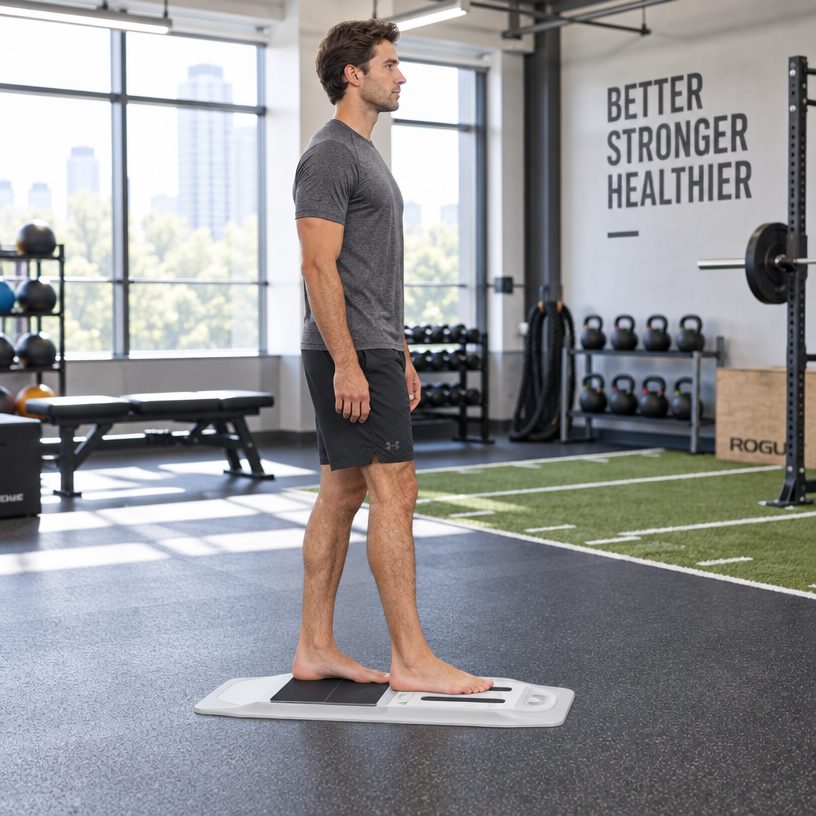
Two plates with identical item lists can produce records that cannot be compared with each other, because comparability comes from the session, not the hardware. Barefoot or in shoes, which foot starts, how many crossings, whether the customer is asked to walk at a natural pace or a counted one, where the plate sits relative to the floor and the wall — every one of those choices changes the numbers, and none of them appears on a quotation.
The practical test is easy to run in a demonstration and almost nobody runs it. Take one person, record three crossings, and look at how much the figures move between them. Some movement is normal; a person is not a machine. What you are looking for is whether the variation is small enough that a change of a few percent between two visits means something. If three crossings in one session scatter widely, a comparison across six months will be noise dressed as progress.
Ask the supplier for the written routine as a deliverable, on one page, in the language your staff speak. Pass order, crossing count, starting foot, footwear rule, the instruction given to the customer, and the position of the plate marked on the floor. This is the document that decides whether your second record means anything, and it costs a supplier nothing to provide. A supplier who cannot produce it has not thought about the second visit.
Then make it a house rule that the page is briefed to every operator, including the one who covers a Saturday. In our experience the failure mode is never a bad plate; it is a good plate run three different ways by three people, with a file that no longer answers the question it was bought for.
The extended walkway: what it changes, and what it costs
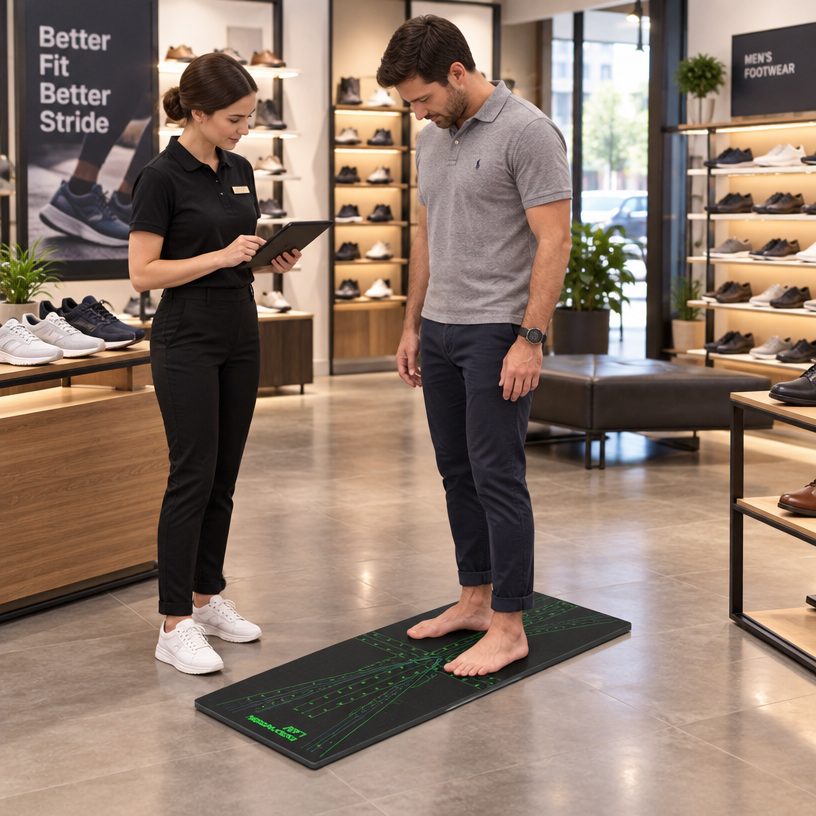
A short plate captures steps. You step on, you step off, and the record is a slice of the walk with the entry and exit cut away. That is enough for a shoe-fitting conversation and for a balance trial, and it is what most counters actually need. What it cannot give you is the cycle: the swing phase, the timing of the two feet against each other, the rhythm of a walk that has settled into itself after a few paces.
A longer walkway buys that cycle, and the price is paid in floor. The equipment needs a run of clear space, an approach that lets the customer arrive at a natural pace rather than a shuffle, and enough room at the far end for them to keep walking after the plate rather than stopping on it. Rooms that looked generous on a floor plan turn out to be tight once a bench, a chair and a waiting customer are in them.
It also changes the operator’s job. A short plate can be run by whoever is at the counter. A walkway needs someone who watches the approach, gives the same instruction every time, and knows when a crossing is worth keeping. That is a training question, not a hardware question, and it should be settled before the order rather than after delivery.
Our own position is straightforward: the longer platform is the right purchase when the room genuinely intends to record gait as a service — repeated sessions, comparison over time, a therapist or coach who will read the cycle. Where the equipment is there to support a fitting conversation and a balance check, the shorter plate does the job and leaves the floor to the shop. Buying the walkway for the showroom effect is how a good system ends up under a dust sheet.
The software you will still be using in year three
Buyers spend their attention on the plate and their lives inside the software, which is why the second deserves more of the meeting than it usually gets. Three questions cover most of it. Can a report leave the system as a file that can be emailed, printed at the counter or opened by scanning a code? Can the fields and the wording be adjusted for the language your customers read? And when the analysis screens change, how does the change reach you?
On the last point, ask directly whether the equipment can receive updates over a network connection, and who initiates them. A system that needs an engineer to fly in for a software revision is a system that will run the version it shipped with. A system that updates remotely, with the operator’s consent, keeps its report format current and its bugs fixed without a service visit.
Data handling is the other half. Where do the records live — on the machine, on a clinic server, in an account? Who can export them, and in what format? If a customer asks for their file, can you hand it over? If a member of staff leaves, does the record go with them? These are dull questions with expensive answers, and a supplier who has not considered them will answer them badly.
Finally, look at what the report does at the end. Ours closes with a page stating that the data is for reference and that interpretation belongs to a professional. That page is not decoration; it is the sentence that keeps a counter conversation inside its boundary. Check that whatever you buy carries something equivalent, and check that your staff know why it is there.
The acceptance test in the first week
Every unit we ship runs a test at the plant for seven days before dispatch, and the buyer should still run their own test in the first week, because a plant test proves the machine works and a site test proves the routine works. Pick one willing colleague, run the written routine three times across three days, and keep all three records. Then compare them item by item, the way you would compare two visits six months apart.
Export a report on day one and open the file on a laptop that has never seen the software. Print it. Scan the code if there is one. Send it to an email address outside the building. Half the failures we hear about are discovered at this step, and they are almost always configuration rather than hardware: a language pack missing, a print template pointed at the wrong printer, an export path that no longer exists.
Then test the support channel with a real question rather than a greeting. Our after-sales arrangement is a dedicated group chat with the engineers who built the unit, remote assistance when the problem needs eyes, and a warranty of twelve months against non-human damage with free parts. Whatever the supplier offers, use it once in the first fortnight, while the question is small and the answer is cheap.
Write the result down: what was run, what drifted, who was called, how long the answer took. That page, filed with the routine, is what a buyer has to show when the equipment is questioned a year later by someone who was not in the room when it was chosen.
Frequently asked questions
Is a pressure plate the same thing as a pressure mat?
No. A plate is a rigid platform, usually set into or onto the floor, that records load through a small number of steps with high detail in that window. A mat is flexible and longer, so it captures more consecutive steps with less precision per unit of area. Which suits you depends on whether you need detail under one footfall or a longer sequence of them.
Do I need the extended walkway or the shorter plate?
Choose the longer platform when gait is a service you intend to repeat: sessions that will be compared, a clinician or coach reading the cycle, room for a natural approach and exit. Choose the shorter plate when the equipment supports fitting, balance checks and short walks in a shop or clinic room. Floor space is the real constraint in most decisions.
How many crossings should a routine record?
Enough to see whether the pattern is stable, and the same number every time. Three crossings per foot is a common starting point for a short plate; a walkway may ask for more passes to fill the record. The number matters less than the rule: fix it, write it on the routine page, and never change it between visits.
Can records from two different machines be compared?
Only with care. Two units of the same model, run to the same written routine, can be compared usefully. Records from different plate designs, or from a mat and a plate, should be treated as separate series. If a group is buying several units for one programme, specify the model and the routine together, not unit by unit.
What does the report contain?
On our F2-PRO: the split between the loaded and flat phases of contact, the timing of each side, double-support periods, peak and mean pressure by region, contact area, and the path and speed of the centre of pressure, with camera images of lower-limb alignment taken in the same session. Other suppliers will name the items differently; ask for a sample.
How is the equipment tested and supported after delivery?
Each unit runs a seven-day test at our plant before dispatch. The warranty covers twelve months against non-human damage with free parts, support runs through a dedicated group with the engineers, remote assistance is available where the site allows it, and the software can be updated over a network connection with the operator’s consent.
Does the software tell the operator what the record means?
No, and it should not be bought as though it does. The system measures load, timing and alignment and assembles them into a report. Reading those findings, and any decision that follows, belongs to a qualified professional. Every report we ship carries a line saying the data is for reference.
What we would do next
Before the next quotation is opened, write the routine you intend to run: who walks, how many crossings, barefoot or shod, where the plate sits, who reads the report and who it is sent to. That page tells you which platform length you need far more reliably than any catalogue. Send it through the contact page and we will tell you whether it fits the shorter plate or the longer walkway, including when the answer is the smaller machine. We do not print prices in an article of this kind, because a quotation depends on the configuration, the quantity and the destination.
The F2-PRO page lists the record items and the capture conditions in the equipment’s own wording. The reading list below takes the same question from the room’s side rather than the catalogue’s, which is the order we would read it in.
This article is intended for professional and educational reference. It is not medical advice. Foot assessment equipment produces measurements and images; clinical interpretation and any decision about care remain the responsibility of a qualified professional. Certification scope is limited to the documentation we hold: European Union certification and ISO quality system certification.