
A buyer types “footscan pressure plates” into a search bar, and what they are usually shopping for is not a brand — it is a walking session that actually works. The word footscan has become loose market vocabulary for any plate you walk across to record plantar pressure, which is why the phrase turns up clinics, sports facilities and shoe stores in the same result list. Behind the search sits a protocol question most listings never answer: how long does the walkway need to be, how many walking passes make a usable record, and does running belong on the same plate at all. This guide is written for the person who has to fix those answers before the equipment arrives — the clinic manager planning a gait room, the coach who wants a baseline for a squad, the retailer deciding what a plate can honestly do at the counter.
The F2-Pro manual names the device a Foot Pressure Detection System – Extended Version. It is the upgraded, lengthened version of the F2, built to capture and analyse plantar pressure distribution across dynamic cycles — which is the technical way of saying it is designed for what happens while a person keeps walking, not just for the moment they stand still. Its three core functions are static pressure detection and evaluation, dynamic pressure detection and evaluation, and balance pressure detection and evaluation. Buyers comparing footscan pressure plates rarely see the sensing area itself in a listing; what they should compare first is the walking path around it, because that decides whether the dynamic record is complete. Everything below is about how those three records turn into a protocol you can repeat.
Why footscan pressure plates live or die by the walkway length
A short plate and a long plate do not answer the same question, and the difference is easiest to see with a foot rather than a specification sheet. A single human step already contains several phases: the heel lands, the foot flattens under load, the body passes over it, the toes push off. A walking record is only complete when it captures the full support phase and the swing that follows — and support and swing are precisely the parameters a gait report is supposed to describe. On a plate barely long enough for one footprint, the walker arrives mid-stride and leaves mid-stride. You catch a slice of contact, lose the approach steps that show how the person normally walks, and the report’s phase breakdown starts describing a compromised pass instead of a habit.
This is the problem the extended walkway exists to solve. With a longer sensing path, a person can approach the plate at their own rhythm, take the steps they would take on any corridor floor, and finish the stride without landing on or stepping off the sensing area. The capture then contains complete cycles from heel contact through push-off, which is what makes stance and swing percentages, double-support timing and the centre-of-pressure path readable in the first place. Gait parameters are comparative by nature — left against right, this visit against the last — and comparison only means something when every record was captured under the same complete conditions.
We watched this play out at a Canton Fair booth, where a visitor from a sports training academy tried the demo plate after telling us his current short mat only ever caught the heel strike. He walked the extended path once, looked at the screen, and asked why the phase chart on his old mat had always started halfway through. It had not started halfway through on purpose — the plate had simply never seen the beginning of the step. That conversation is the honest version of what a longer walkway buys: not more numbers, but complete ones.
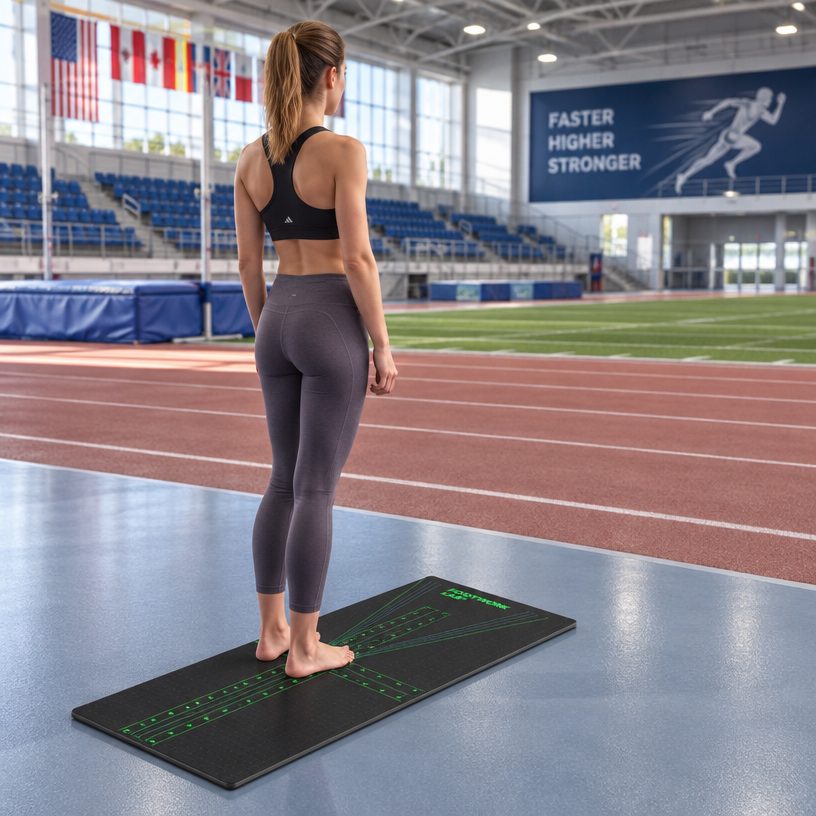
Setting up a walking protocol session on the F2-Pro
A protocol is a short, fixed routine that any operator can run the same way every time. The three functions of the F2-Pro suggest a natural order. First a static record: the person stands still on the flexible-fabric sensing surface and the system captures how load sits under each foot at rest. Then the dynamic pass: the person walks the extended path at their own pace while the system records the pressure sequence of each cycle. Then, if the room’s work calls for it, a balance record: the small weight corrections a person makes while standing, which describe stability rather than walking and answer a different question from both of the first two.
The sensing technology underneath is Sinmec Fabric — a flexible-fabric sensor layer that supports both standing and walking capture on the same surface, so the three records come from one unit in one appointment instead of three setups. The report is assembled with AI-assisted report generation, which lays the measurements out on screen while the person is still in the room. Captured data also runs through a lower-limb camera and a posture camera on the F2 platform family, so a pressure picture can sit beside an alignment image instead of standing alone.
Three protocol decisions matter more than anything written on a datasheet. First, footwear off for every record, so the sensing surface sees the foot rather than the shoe. Second, the same verbal instruction every time — we suggest one short sentence about walking normally, delivered identically by whoever operates the unit, because told-to-walk-normally people still walk differently depending on how they are told. Third, a set number of passes, recorded the same way at every session. None of this is complicated, and all of it is the difference between a folder of pictures and a series that can be compared across months.
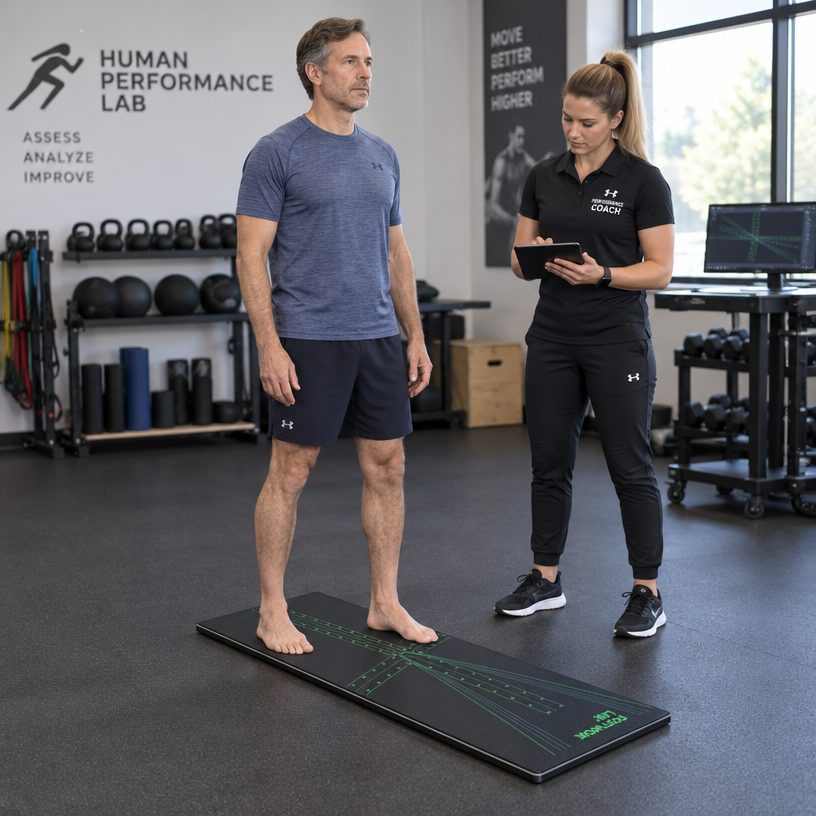
Our support engineers see the cost of skipping this on nearly every WhatsApp group they join. On one recent call, a rehab hospital could not work out why two visits from the same patient looked nothing alike; walking through their setup, the engineers found the first record had been taken with one nurse’s instructions and the second with a different nurse’s, at a different walking speed, three months apart. The plate had performed identically both times. Once the hospital wrote a one-page protocol and pinned it beside the unit, the next set of records finally lined up. That call cost less than an hour; the habit it fixed had been quietly wasting their data for a year.
What the dynamic-cycle report shows back
The report screen puts the pressure visualisation and the parameter list side by side, left and right foot together. For the walking record, the parameters that matter most are the ones the complete cycles made possible: support phase and swing phase for each foot, the double-support windows where both feet share load, the contact phase and flat phase within each step, foot axis angle, footprint length and width, peak and average pressure, the pressure change curve across the cycle, and the path of the centre of pressure from heel to toe. Each value sits beside a reference band so the reader can see where the measurement falls for a general population.
The bands deserve a sentence of their own, because they are the most over-read element on the screen. A value outside the band is a measurement relative to a population, not a verdict about the person who just walked the path. The same reading can be unremarkable for one walker and worth a conversation for another, and the record itself stops at the number — the professional in the room decides what it means. That boundary is deliberate in our demo material and in the software: the system presents measurements, curves and images, and leaves interpretation to the person qualified to give it. Pressure distribution and alignment are recorded; nothing on the screen closes a case.
What the report earns in practice is comparison. A follow-up visit lands in the same layout as the baseline, so a coach can show an athlete how the load path moved across a training block, or a clinician can place two appointments side by side without rebuilding anything. Reports print online or on site, which matters in busy rooms where the person walking the path wants something in hand before they leave.
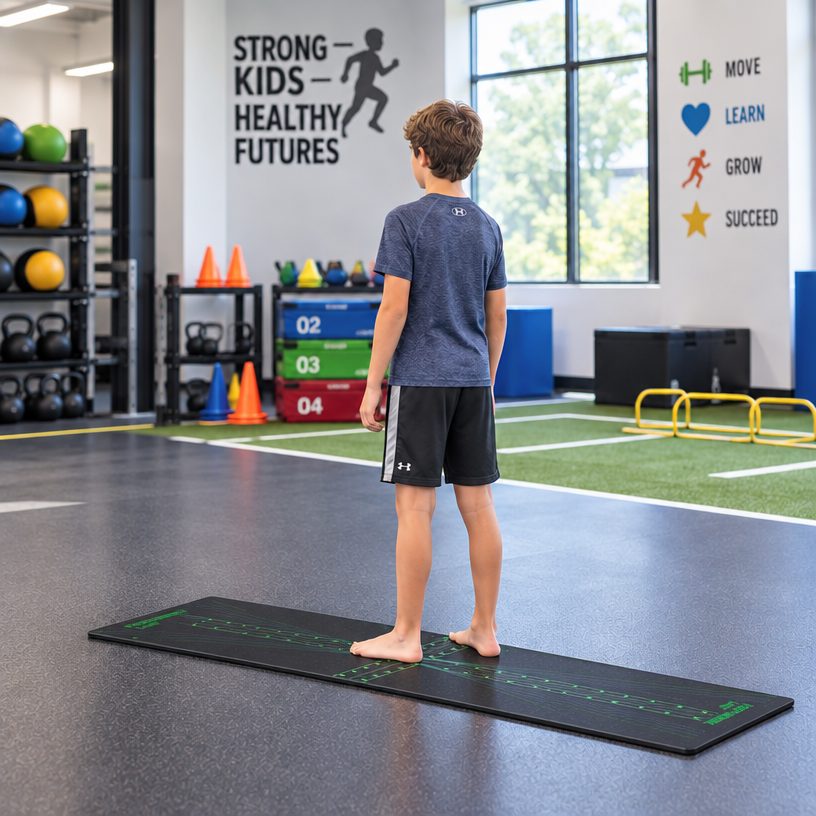
Where running belongs in the protocol — and where it does not
Buyers searching for footscan pressure plates often assume the plate handles running the same way it handles walking, and this is the question we would rather settle before an order than after. A walking protocol relies on the walker moving at a self-chosen pace across the sensing path, and the extended walkway exists so those cycles complete. Running changes the arithmetic: speed rises, each foot is on the surface for a fraction of the contact time, flight phases enter the picture, and a fixed walkway gives each foot only a small number of usable contacts per pass. You can record running passes across a plate, and the capture is real pressure data — but it is not the same quality of protocol as the walking record, and a buyer should know that before planning a running program around a walkway.
That is why our product line splits the job. For running protocols — stride after stride at controlled speed, with the athlete staying in place — the F5-LAB dynamic gait platform pairs a treadmill form factor with dual cameras and captures the gait cycle continuously, alongside dynamic pressure evaluation and the double-foot pressure trace. Clinics and training facilities that work with runners typically place the two roles side by side: the extended plate for walking baselines, standing records and balance, the platform for the running sessions. A facility that only assesses walkers may never need the second unit; a running club that buys only a walkway will run into the contact-time limit within a month. In our pre-sales calls with sports training buyers, this is the split we walk through first, because it decides the room layout and the budget more than any other single choice.
Frequently asked questions
What does the F2-Pro actually record during a walking session?
It records plantar pressure distribution across complete dynamic cycles: the support phase and swing phase for each foot, double-support timing, contact and flat phases within each step, foot axis angle, footprint length and width, peak and average pressure, the pressure change curve, and the path of the centre of pressure. Static standing records and balance records are captured as separate states in the same session.
Why choose the extended version instead of a shorter plate?
The extended walkway lets a person approach, walk and finish the stride naturally, so each capture contains complete support and swing phases from heel contact to push-off. On a plate that is barely longer than a footprint, the walker enters and leaves mid-stride and the phase breakdown describes a compromised pass rather than a normal one.
Can the F2-Pro be used for running protocols?
Running passes across a walkway produce real pressure data, but each foot is on the surface briefly and each pass yields few usable contacts, so it is not the strongest protocol for running. For continuous running capture we point buyers to the F5-LAB dynamic gait platform, which keeps the athlete in place on a treadmill form factor and records the gait cycle stride after stride.
Does the system diagnose anything?
No. The F2-Pro records pressure, timing and alignment measurements and presents them beside reference bands. A qualified professional reads the record and decides what it means for the person in the room; the software stops at measurements and images by design.
How is the equipment supported after delivery?
The minimum order is one unit, every unit is tested for seven days before dispatch, and the equipment carries a twelve-month warranty against non-human damage with free parts. After delivery, support runs through a dedicated WhatsApp group with our engineers, remote assistance where a screen can be shared, and over-the-air updates for connected units. Custom software work is quoted separately from the hardware.
What should we decide before the plate arrives?
Write the protocol before delivery: footwear off, one fixed instruction sentence, a set number of passes, and who operates the unit at each session. Decide which of the three records — static, dynamic cycle, balance — your room will actually run, and measure the floor so the extended path has clear space at both ends. We can review a draft protocol against your room layout before you order.
What we would do next
Sketch the session you intend to run — which of the three records, how many walking passes, who operates the unit — and measure the corridor or room where the extended path will sit, including the clear space before and after the sensing area. Send that sketch with your intended use and we will confirm the capture plan, flag anything the walkway cannot honestly answer, and point out where a platform rather than a plate would serve the protocol better. The F2-Pro extended pressure plate page carries the system overview, and our FAQ page lists order, warranty and transit terms in full.
If you already run a plate and your records refuse to line up between visits, the fix is usually the written protocol, not new hardware. Send us the routine your operators follow now and our engineers will mark the places where two operators would produce two different pictures. For the wider family, see the F2 and FMP foot assessment systems, and for running-specific capture, the F5-LAB dynamic gait platform.
This article is intended for professional and educational reference. It is not medical advice. Foot assessment equipment produces measurements and images; clinical interpretation and any decision about care remain the responsibility of a qualified professional. Certification scope is limited to the documentation we hold: European Union certification and ISO quality system certification.