
If you are comparing 3D scanners for sale, the listings will not help you
tell the builders from the brokers. Two suppliers can show the same foot plate, the same
camera arm and the same screenshot of the analysis screen, while one designed and assembles that
machine and the other forwards it from a warehouse it does not own. The difference does not surface
on the day you pay. It surfaces months later, when a software update is due, a sensor needs
replacing, or your team asks for one extra field in the report.
This article is written from the production side. FOOTWORK LAB has built foot assessment
equipment since 2014 and has run its own plant in Ruichang, Jiangxi Province since 2018. We sell
direct, which means we compete with trading companies every week and have watched buyers discover
the same gaps far too late. What follows is the checklist we would run if we were the ones placing
the order — including the parts of a supplier’s process that are worth asking to see.
What a 3D foot scanner does, and the line it should not cross
The term is used loosely, and sellers rarely agree on a definition. In practice, equipment sold
under this name does one or more of the following:
- Foot geometry capture — recording the shape of the foot, the arch profile and
the length or width, usually through optical, laser or contour scanning. - Plantar pressure measurement — recording how load is distributed under the
foot, either while standing still (static) or during movement (dynamic). - Lower-limb alignment capture — measuring or imaging leg and ankle position so
that force-line alignment can be described. - Posture and body assessment — using camera-based machine vision to describe how
the body is balanced over the feet.
What it is not, in a clinical or retail setting, is a diagnostic instrument. A scanner
produces measurements and images. Reading those measurements, deciding what they mean for one
person, and choosing what to do next are professional judgements made by a qualified person, not
functions of the hardware. A listing that implies the device itself delivers a diagnosis, or an
outcome, is describing something the equipment cannot do.
The distinction is commercial as much as clinical. Buy expecting a diagnostic device and receive a
measurement tool, and the machine will disappoint in your setting however well it is built. Buy a
measurement tool knowing what it is, and it becomes a dependable part of an assessment routine.
It is also worth being clear about what the hardware does not decide. It does not choose which
presentations are worth offering, it does not set your appointment length, and it does not tell you
which people are suitable for a particular insole design. Those are decisions your team makes, and
the equipment only supports them.
Three routes a unit takes to reach your door
Almost every overseas purchase arrives one of three ways, and the long-term cost profile of each
is different.
Straight from the manufacturer
The company that designed and assembles the device sells to you directly. Technical questions
reach the people who wrote the firmware. Changes — an extra report field, a different interface
language, an export that matches your existing records — are feasible because the source code and
the tooling sit in the same building.
Through a trading company
An intermediary buys finished units and resells them. This can be a genuine service: a good
trading partner stocks spare parts, offers first-line support in your language and handles import
logistics. It becomes a problem when the intermediary is essentially a website with a forwarding
address, because every technical question has to be relayed and every part re-imported.
Under a different badge
The same hardware is sometimes sold under several brand names, with a new enclosure or simply a
new sticker. Prices can differ widely for identical internals. The practical risk is divergence:
firmware and documentation drift apart over time, so an update written for the original unit may
never have been tested on the badged version.
None of these routes is automatically wrong. A well-run trading partner can serve you better than
a distant factory that answers slowly. What matters is knowing which route you are on, because the
questions you should ask and the risks you should price in are not the same.
There is one more distinction worth drawing. A company can be a genuine factory and still not own
the software it ships, and a trading company can hold real inventory and real service capability.
The label matters less than the substance: who holds the design, who holds the tooling, and who will
still be reachable when the unit needs attention. A supplier who can answer all three plainly is
the one worth a second conversation, whatever badge is on the enclosure.
The questions that separate a factory from a forwarding address
You do not need to demand confidential information. A handful of simple questions will tell you a
great deal, because a company that builds its own equipment can answer them in a single reply.
- “Can you send a photograph of the production line for this model, taken this
month?” A manufacturer can walk out and take it. A reseller usually forwards a marketing
image they were given. - “Who writes the analysis software, and can report fields be changed on
request?” A manufacturer answers with a team, a process and an example. A reseller answers
with “we will ask the supplier”. - “What is the minimum order for a customised software build?” This separates
companies that own their code from companies that license it. The figures are commercial terms and
will differ by supplier; what you are testing is whether the answer is specific or vague. - “Who carries out pre-shipment testing, and can I see the record?” Factories
test before dispatch and can describe what they test. Intermediaries often cannot say who opened
the box.
Two more are worth adding. Ask what happens to a unit that fails testing, and ask how a technician
would troubleshoot a fault from another continent. The quality of those answers, not the polish of
the brochure, is the real signal of who is behind the product.
Notice that none of these questions tests the product itself. They test the organisation behind
it, and that is deliberate, because in this category the hardware is rarely the variable that causes
trouble. What causes trouble is distance: distance between the buyer and the person who can actually
change something. A short chain to the source is worth more than a long specification sheet, and it
is the one thing you can assess before any money changes hands.
What to verify before money moves
Software ownership and the update path
Most of the long-term value of a scanner sits in its software, not its frame. Ask how updates
reach you — over the air, by installer file, or only on a service visit — and what happens when the
operating system the software depends on reaches the end of its life. A device with no update path
has a working life measured in a few years, no matter how solid the hardware is.
The after-sales structure
Hardware fails eventually; what matters is the response. Ask who provides first-line fault
diagnosis, whether the factory’s own engineers are reachable, and whether components are modular
enough to be replaced individually rather than swapping a whole assembly. FOOTWORK LAB, for
instance, runs a seven-day test cycle before dispatch and opens a per-customer group so the buyer,
the sales contact and an engineer are in one conversation; machines can also be supported remotely
and, where the unit is online, updated over the air. That is a fair benchmark to hold any supplier
to — not because every supplier must work that way, but because every supplier should be able to
describe their own process clearly.
Wear parts and consumables
Pressure-measurement equipment sometimes uses components that wear: surface coverings,
calibration references, cables, cameras. Ask what is expected to be replaced within a few years and
how those items are sourced. Equipment with an unclear consumable path becomes expensive quietly,
and the complaint usually arrives long after the sales contact has moved on.
Certification paperwork
Certification claims are frequently overstated in this category, so ask for documents rather than
logos. Our own position is deliberately narrow: our products hold European Union certification and
ISO quality system certification, and we state that as the whole scope rather than implying broader
clearances we do not hold. When you see a regulatory mark on a listing, ask which product, which
market and which document supports it — and expect to be able to check it independently.
Documentation is a practical asset too. A device delivered without a maintenance manual, a
calibration procedure and a software reference is harder to keep in service, especially once the
original sales contact is no longer with the company.
Fitting the device to the setting you actually run
The most common buying error is not overspending. It is buying a configuration built for a
different environment. The same scanner behaves very differently depending on where it stands.
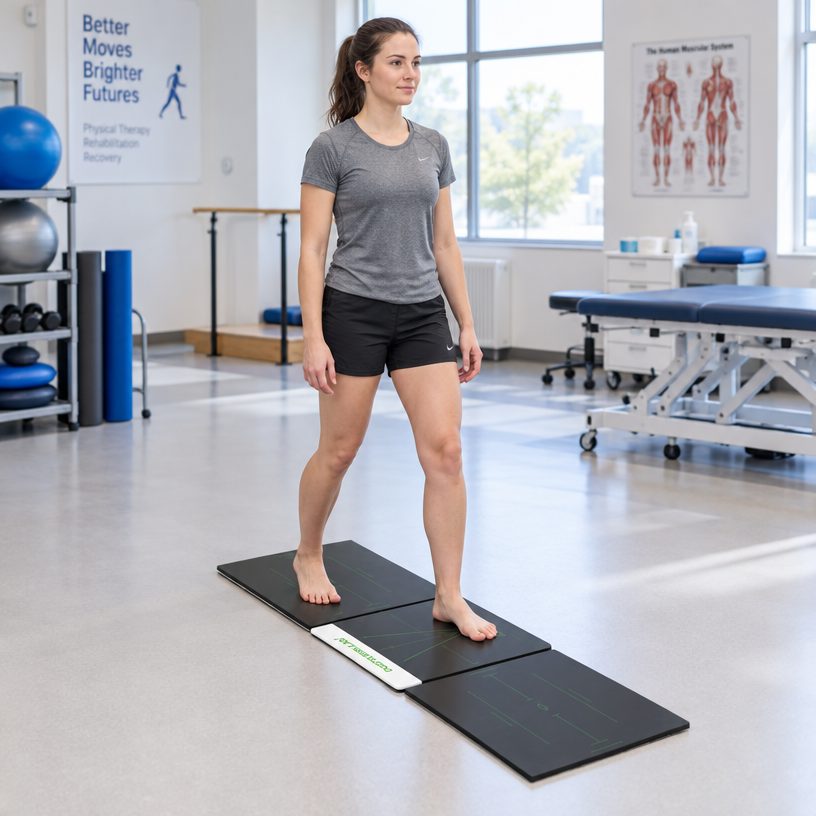
- Podiatry and foot-ankle clinics need repeatable measurements, fast patient
turnaround and a report a person can follow in the room. Depth of analysis matters more than raw
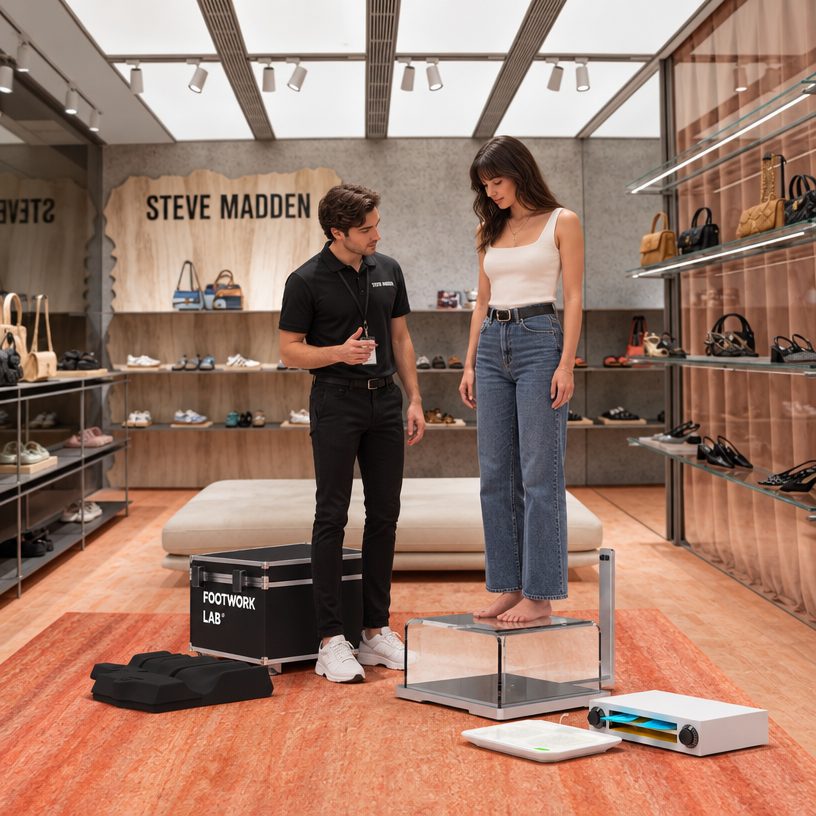
capture speed. - Footwear retail needs a scan that fits inside a sales conversation — minutes,
not half an hour — with output that supports a recommendation rather than a clinical reading. - Rehabilitation and sports settings need to observe movement, not only standing
posture, which generally means measuring pressure during walking or running and therefore floor
space. - Orthotic workshops need the captured geometry to be usable downstream, so that
the step from measurement to a finished insole is practical in the space you actually have.
Where someone presents with flat feet or a foot that overpronates, the equipment’s role does not
change: it records load distribution and geometry, and any interpretation belongs to the clinician.
A configuration tuned for a retail counter will frustrate a rehabilitation team, and a full movement
platform is often more than a small clinic can use well. Decide the workflow first, then the
specification.
Floor space is the constraint buyers underestimate most often. A pressure platform needs a clear
run for a person to walk across; a full movement set-up needs considerably more, plus somewhere for
a desk and a screen. Before comparing devices, measure the room you actually have and walk the route
a patient or customer would take through it. Equipment that fits the workflow but not the room is
still the wrong equipment.
Mistakes that only become visible after the invoice
- Comparing specifications instead of workflows. Two devices with similar
measurement capability can imply completely different appointment lengths. - Settling price before defining scope. Price follows configuration, support
level and software scope. Ask for those three first, and regard any figure offered without them as
provisional. - Assuming the reseller will still be reachable. Relationships in this category
change. A direct line to the party that builds the device is a durability question, not a loyalty
one. - Skipping the trial. Where a demonstration unit or a guided video walkthrough is
offered, take it. Twenty minutes on the interface tells you more than any datasheet. - Ignoring licence terms. Whether the analysis software is perpetual,
subscription-based or locked to a single workstation changes the total cost of ownership
considerably.
We would add a sixth: not asking what a supplier does not do. A company that can name its
limits — the categories it does not serve, the claims it will not make, the certifications it does
not hold — is usually easier to work with than one that answers yes to everything.
Frequently asked questions
Are you a manufacturer or a trading company?
We are a manufacturer. FOOTWORK LAB has been developing and producing foot assessment equipment
since 2014, and has operated its own production plant in Ruichang, Jiangxi Province since 2018.
Development and production are carried out in-house.
Can I buy a single unit, or is there a minimum order?
For machines, the minimum order is one unit. We would rather a buyer start with a machine they
can use straight away and expand later than commit to a fleet they cannot deploy yet.
Do you offer OEM or ODM?
We accept ODM for machines, and both ODM and OEM for insoles. Machine OEM requires a different
commercial arrangement because the enclosure and branding change, so it is discussed case by case.
For insole OEM the minimum is 200 pairs, and those pairs can be mixed across types and sizes.
How is the equipment tested before shipping?
Every unit goes through a seven-day testing period before dispatch. We run the machine and check
its functions, and we check insole output where the order includes insoles, before the unit leaves
the factory.
What happens if something fails after delivery?
The machine carries a twelve-month warranty covering non-human-caused failures, with free parts
during that period. Our machines use a modular design and the software includes remote-control
functionality, so in many cases we can identify and resolve an issue from video and photographs, or
with remote access given your consent.
How long does delivery take?
Insole samples ship within three days. Standard insole production runs at roughly 500 to 1,000
pairs per day, and standard machine production at three to five units per day. Express delivery
typically takes six to seven working days, air freight ten to twelve, and ocean freight around
thirty to thirty-five.
What we would do next
If you are working through 3D scanners for sale, start by writing down the workflow you want the
device to carry: how many people per day, what the output feeds into, and whether insole production
is part of the plan. Then put the questions above to each supplier and compare how specific the
answers are, not how glossy the brochure is.
Ask us the same questions. We will tell you which configuration fits your setting and, just as
usefully, which parts of our range you do not need. Our product range and
the الأسئلة الشائعة cover the commercial and service terms in detail, and you can reach the
team through the contact page.
One last piece of advice we would give any buyer: keep the questions with you. A short written
list, asked consistently of every supplier, turns a category of glossy listings into a
straightforward comparison. The suppliers who answer well will not mind the questions, and the ones
who do will tell you something useful without meaning to. We would rather answer an awkward question
before the order than a surprised one after it.
This article is intended for professional and educational reference. It is
not medical advice. Foot assessment equipment produces measurements and images; clinical
interpretation and any decision about care remain the responsibility of a qualified professional.
Certification scope is limited to the documentation we hold: European Union certification and ISO
quality system certification.