
A dynamic plantar pressure map is a record of how load moves under the
foot during movement, and its value depends entirely on knowing what it does not contain.
Used well, it turns a vague description of how someone walks into a set of positions and timings
that two colleagues can look at together and discuss. Used badly, it becomes a colourful picture
that gets over-interpreted, and the person reading it starts making claims the recording never
supported. The difference between those two outcomes is not the equipment. It is whether the team
agreed, in advance, what questions the recording was there to answer.
FOOTWORK LAB has manufactured foot assessment platforms since 2014 and has run its own plant in
Ruichang, Jiangxi Province since 2018. In that time we have installed systems into clinics,
rehabilitation units, laboratories and retail settings, and we have watched the same handful of
misunderstandings appear in almost every new installation. This article sets out what a dynamic
pressure recording is, what it can reasonably be used for, and where the boundaries sit.
What a pressure map is, and what it is not
A pressure map is an array of sensing elements under the foot, recorded over time, presented as a
picture. Each element reports how much load is passing through its small area at a given moment.
Colour is added for readability: warmer tones for higher load, cooler tones for lower. Animated or
sequenced over time, the map becomes a record of movement rather than a snapshot of position.
What it is not is a picture of the foot. Buyers sometimes assume the image they see is a
photograph or a shape capture, because it has the outline of a sole. It is a summary of load, drawn
inside a footprint boundary. Shape and load are related but distinct: two people with similar
foot outlines can load their soles quite differently, which is precisely why pressure measurement
exists as a separate discipline.
It is also not an instruction. The map describes where load sat at each moment of the recording.
It does not state why, and it does not state what should happen next. Interpretation requires a
qualified professional who can combine the record with history, examination and context. Our own
wording on this is deliberate: the equipment produces measurements and images, and the professional
draws the conclusion.
Why dynamic recording differs from a standing measurement
Standing pressure and moving pressure answer different questions, and the confusion between them
causes more specification errors than any other single issue in this category.
A standing recording captures the loading pattern while the body is still. It is quick, it is
easy to repeat, and it is highly comparable between sessions, which makes it useful for tracking
change over time. What it cannot show is what happens during movement — and movement is when most
of the interesting loading events occur.
A dynamic recording captures the sequence: contact, transfer of load along the sole, and push
off. It shows when load arrives under a region, how long it stays, and how it leaves. It can show
whether the two sides behave symmetrically, whether load lingers in one area longer than elsewhere,
and whether the pattern changes as the person moves faster.
Neither is more advanced. They are complementary, and a well-equipped assessment room usually
wants both, because the comparison itself is informative. A person whose standing pattern looks
unremarkable may show a very different picture once movement begins, and the reverse also occurs.
Recording only one and assuming it represents the other is the most common shortcut we see.
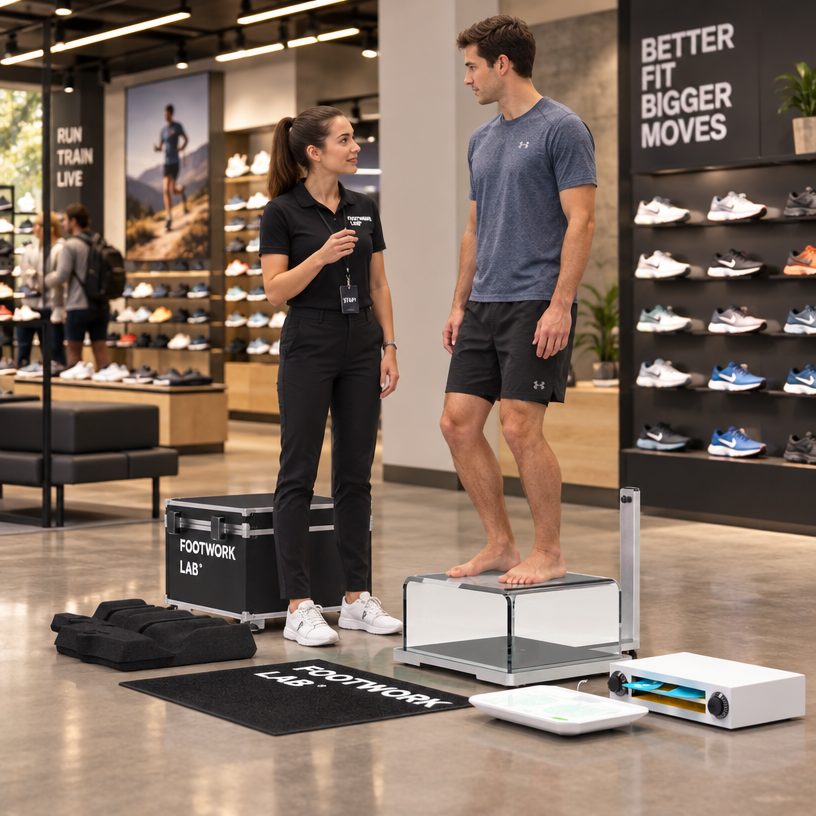
Reading a pressure map without over-reading it
New users tend to look for a conclusion in the image. Experienced users look for a question. The
shift is a matter of habit, and it can be taught in one session with three simple prompts.
- Where is the load, and where is it not? Describe regions and their relative
loading before reaching for any explanation. Most of the useful information is a comparison between
areas, not an absolute value at a single point. - How does the pattern change over the sequence? A static-looking image hides
timing. Watching the sequence reveals how long load remains in one region and how it transitions to
the next. - How does this compare with the other side, and with a previous session?
Comparison is where pressure data earns its keep. A single recording in isolation is far less
informative than the same person recorded at two points in time.
Notice that none of those prompts ask what the pattern means. That is intentional. The map is at
its most useful when it is read as evidence that supports a conversation, and at its least
useful when it is presented as the conversation’s conclusion.
Terminology matters here for a practical reason. Load distribution, force-line alignment, centre
of pressure and gait cycle are measurable quantities with defined meanings. Borrowing clinical
vocabulary to describe an image, without the examination that would justify it, is how assessment
tools get a reputation for overclaiming — and that reputation damages every supplier in the
category, including the careful ones.
A useful exercise for a new team is to describe three recordings in writing before discussing
them out loud. The description should be limited to what is visible: load here, lighter there,
longer duration on this side, a change of pattern at this point in the sequence. Only after the
description is agreed does the conversation move to possible explanations. Teams that adopt this
habit early find that their recordings become genuinely comparable, because everyone is describing
the same things in the same words, and disagreements become specific rather than general.
It is also worth recording the limitations alongside the data. A short note on every session
stating the capture conditions, the number of passes and anything unusual during the recording
turns an image into a document. That note is what makes a recording reviewable six months later by
someone who was not in the room.
What the recording cannot tell you
Every measurement method has a boundary, and it is more honest to name our own than to let a
buyer discover it after installation.
A pressure recording does not identify a cause. Two people with identical loading patterns may
arrive there for entirely different reasons, and the recording alone cannot separate them. It does
not capture what happens inside a shoe unless the measurement is taken in a condition that allows
it. It does not describe the upper body, except indirectly through how load changes. And it does not
replace examination, history or professional judgement — it complements them.
There is also a practical boundary around the setting. A recording taken in a clinic corridor
during a short walk describes that walk. It is evidence about a moment, not a verdict about a
person’s movement in general. Teams that keep that distinction in mind use the equipment far more
productively than teams that read each recording as a final answer.
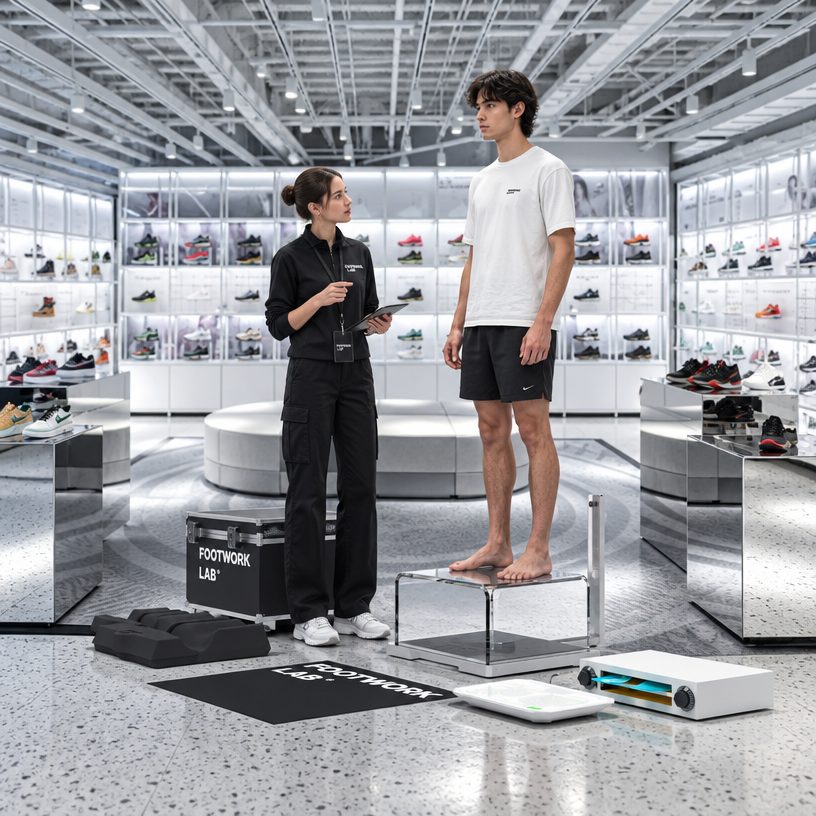
Where dynamic mapping fits in a working week
Equipment that is bought and then left covered is almost always equipment that was specified
without a slot in the schedule. So before choosing a platform, describe where the recording sits in
the working week.
Assessment and intake
A dynamic recording integrated into an initial assessment provides a baseline that later sessions
can be compared against. The value appears months later, when a team can look at two recordings side
by side rather than relying on memory.
Product specification
Where a service supplies insoles or footwear, loading data informs how a design is specified, and
it provides a record of the reasoning. Our insole line is produced in the same plant as our
equipment, which is one reason we care about this link; the insole
categories page shows how the design families are organised.
Rehabilitation and monitoring
Units monitoring change over a course of sessions use repeatable dynamic recordings as one of
several tracking inputs. Used consistently, the same capture routine across sessions is worth more
than a more elaborate capture used irregularly.
The practical test for this setting is whether the routine survives a busy week. If the recording
is only taken when there is spare time, it will be taken rarely, and rarely is not enough for
comparison. Building the capture into the standard appointment, with a defined trigger, is what
keeps the record intact across a course of sessions.
Sports and performance settings
Teams working with runners and athletes care about how loading changes as speed increases. That
is a different question from clinical assessment, and it usually justifies a walkway or platform
configuration rather than a single standing plate. The F5-LAB
dynamic gait system is the platform in our range built for that context.
Equipment decisions that follow from the job
Once the job is written down, the equipment conversation becomes much shorter. Five questions
settle most of it.
- What capture conditions does the room need? Standing, walking, running, in
shoes or barefoot. This single answer determines more about the platform than any other. - How much space is genuinely available? Walkway configurations need a run-up
and a run-out, and a room that cannot provide them will produce poor recordings even with good
equipment. - Who will operate it, and how often? A system used by many staff across
different shifts needs a different interface from one used by a single specialist. - Where does the data need to end up? Ask about export formats, records
integration and interface language before placing an order, not after. - What support exists in year two? Sensors, software and consumables all have a
life span. Ask who supplies them and how quickly.
can be agreed in a single meeting, which is a strong argument for holding that meeting before
quotations are requested rather than after. Buyers who arrive at a supplier with those five answers
already written down consistently describe the process as quicker, and they are noticeably less
likely to be sold a configuration their room cannot use.
We answer the last question in public because it is the one buyers most often forget to ask. A
twelve-month warranty on the machine covers non-human damage with free spare parts within that
scope. Support runs through a dedicated WhatsApp group with direct engineer access, remote
assistance where the setting allows, and over-the-air updates for connected units. None of that is
unusual; what is unusual is publishing it before being asked.
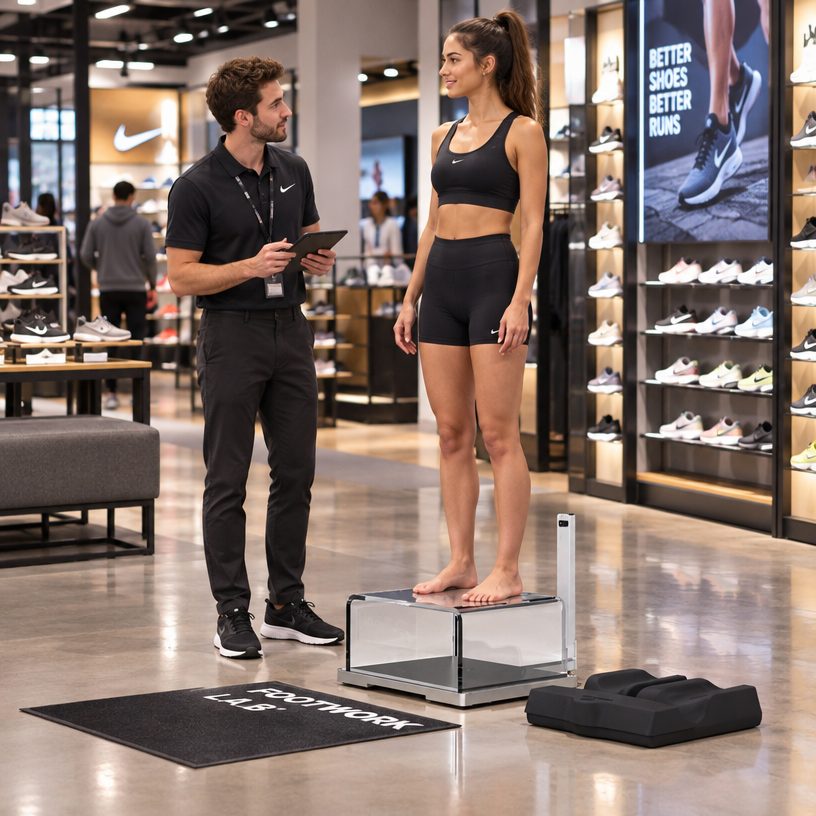
Common mistakes we see in new installations
These are the recurring issues that come back to us in the months after a system goes live. All
of them are avoidable, and none of them are hardware faults.
Capturing too little. One recording per person, taken once, in a setting that
cannot be repeated. The data is then impossible to compare with anything, which removes most of its
value.
Changing the routine. A different walk length, a different surface, a different
number of passes between sessions. Variation in the method swamps variation in the person.
Reading the image alone. Presenting the map without examination findings sets
expectations the equipment cannot meet, and it puts the operator in an uncomfortable position
later.
Skipping the trial. Buying on the strength of a demonstration rather than
running the machine in the actual room. Our machine minimum order quantity is one unit precisely so
that a single system can be trialled in place, and we would rather support that than push a larger
first order.
Forgetting the records question. A system that holds data beautifully but cannot
share it will be duplicated manually, and manual duplication is where interest fades.
Frequently asked questions
How is a dynamic pressure recording different from a standing one?
A standing recording captures the loading pattern while the body is still, which makes it quick
and easy to compare between sessions. A dynamic recording captures the sequence of loading during
movement: when load arrives under a region, how long it remains, and how it transfers through push
off. They answer different questions and work best alongside each other.
Does the equipment tell us what a loading pattern means?
No. The system produces measurements, sequences and images. Deciding what those measurements mean
for a particular person, and what should happen next, is a professional judgement made by a
qualified practitioner using the recording as one input among several.
Can the system record loading with shoes on?
Capture conditions are a specification decision rather than a constant property, and they should be
agreed before purchase. The important thing is consistency: whichever condition you choose, using
the same one across sessions is what makes comparison possible.
How fast can your machines be produced and delivered?
Production capacity is roughly three to five machines per day, and every unit is tested in-house
with a seven-day testing period before dispatch. Typical transit is six to seven working days by
express, ten to twelve by air, and thirty to thirty-five by sea.
Can we start with a single system and expand later?
Yes. The minimum order quantity for machines is one unit, and buyers frequently start with one
system in a single room before standardising across a group. Insoles can be mixed across models and
sizes within an order, with a lower minimum.
Do you supply the insoles that would be specified from this data?
We do. Our insole range covers everyday, sports and rehabilitation-oriented designs, and we
accept both ODM and OEM on insoles. Sample insoles ship within three days, and production runs at
roughly five hundred to one thousand pairs per day.
What certification and warranty apply?
Our documentation covers European Union certification and ISO quality system certification.
Machines carry a twelve-month warranty covering non-human damage, with free spare parts within that
scope, supported through a dedicated WhatsApp group with direct engineer access.
What we would do next
Write the job down before you compare platforms: which capture conditions, which room, which
staff, which records. Then ask each supplier for an anonymised sample report from a real session and
compare those reports against your paragraph. If you need pressure and posture data in a dedicated
assessment room, our F2 and FMP platform is where most buyers
land, and the X5 deployment case shows how one of these systems
was installed abroad. If movement data is the priority, start with the
F5-LAB dynamic gait system, or read
what a gait analysis report actually shows first. Questions about
configuration, MOQ or support can go straight to the team through
our contact page.
This article is intended for professional and educational reference.
It is not medical advice. Foot assessment equipment produces measurements and images; clinical
interpretation and any decision about care remain the responsibility of a qualified professional.
Certification scope is limited to the documentation we hold: European Union certification and ISO
quality system certification.