
Personalised footwear and custom orthotics are usually sold as one idea and produced by two industries that rarely speak to each other. One is a fashion and volume business with seasons, lasts and factories measured in thousands of pairs. The other is a clinical fabrication business with individual specifications and batches of a few hundred. Putting them together is a supply chain problem before it is a design problem.
The commercial promise is obvious: a shoe made for one foot, with an insole made for the same foot, sold as a single experience. The difficulty is that the two halves have different lead times, different tolerances and different definitions of what “the size” means. A clinic that promises both without understanding that gap ends up apologising for one of them.
We manufacture custom insoles to specification, and we do not make shoes. That boundary is useful here, because it lets us describe the interface honestly: what a footwear partner needs from an insole maker, what an insole maker needs from a shoe, and where the sequence should start.
Two industries, two definitions of size
Footwear sizes are a convention, not a measurement. A size in one brand is not a size in another, and the width is often not stated at all. Custom insole production works from a shape, not a size, which is why the two systems struggle to meet.
The practical bridge is a physical reference: a last, a tracing, or a cavity measurement. Anything that converts the shoe into geometry the insole maker can use. Without it, the insole is made to a size and the shoe is made to a convention, and the customer discovers the difference.
Where a footwear partner is producing to a customer’s foot shape, the last becomes the shared object. The insole and the shoe are then designed around the same geometry, which removes most of the interface risk in one step.
Where the shoe is an existing model, the cavity is the shared object. The insole maker works from the cavity dimensions and the sockliner allowance, which is the same discipline a clinic uses when specifying for a client’s own shoes.
Naming matters in both cases. “Size 42” tells an insole maker almost nothing; “cavity length, width at the ball, heel depth, sockliner thickness” tells them what they need.
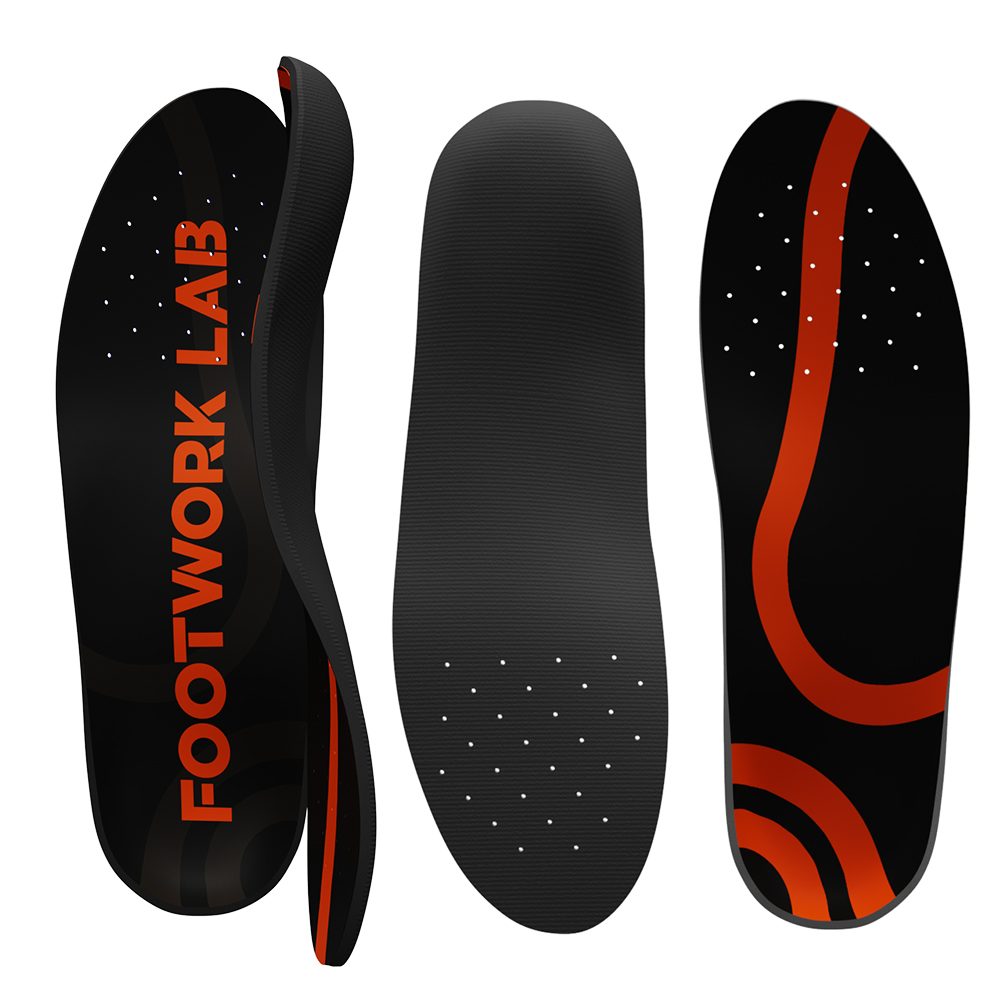
The order of operations
The sound sequence is: assess the foot, choose or make the shoe, then specify the insole. The shoe constrains the volume and the flex, so it has to exist before the insole specification is settled.
In practice, commercial pressure reverses this. A customer orders the shoe and the insole together, the shoe has a lead time measured in weeks, and the insole is specified from a foot shape before the shoe exists. The result is predictable.
A workable compromise is to specify the insole against the intended last rather than the finished shoe. If the footwear partner can supply the last dimensions, the insole can be designed to fit the cavity that last will produce.
Where that information is not available, the honest option is to deliver the insole after the shoe, fitted to it. That splits the delivery into two moments, which is a marketing problem rather than a technical one, and it is usually the right trade.
Whichever route is chosen, write the sequence into the customer promise. A promise that both arrive together, when the information needed for the second does not exist until the first is finished, is a promise that will be broken.
Lead times and the customer promise
Insole production at our plant runs at roughly five hundred to a thousand pairs a day, with samples dispatched within three days of specification approval and a minimum order of two hundred pairs. Footwear production, especially custom, runs on a different clock.
The mismatch is manageable if it is planned. Delivering the insole first and the shoe second is often better than the reverse, because the insole can be fitted to the customer’s existing shoe in the meantime.
Logistics add their own layer: express in six to seven working days, air in ten to twelve, sea in thirty to thirty-five. A promise built on sea freight and a three-day sample cycle has to be designed rather than assumed.
The useful discipline is to publish two dates rather than one: when the insole ships and when the shoe ships. Customers accept two dates; they lose trust over a single date that moves twice.
Where both are coming from the same supplier, that supplier has to be able to see both schedules. A single point of contact who owns the combined promise is worth more than a discount.
Design decisions that belong to both
The sockliner is the obvious shared decision. A shoe designed with a removable sockliner gives the insole room; one with a glued liner forces a thinner build. That decision is made by the footwear designer, months before the insole exists.
The heel counter is the second. A firm, deep counter supports a rearfoot device; a soft, low one does not. A footwear partner who knows an insole will be fitted can choose accordingly.
The third is the lasting board. A stiff board limits the effect of a flexible insole; a soft board lets the insole do more. Neither is better in general, and the pair has to be consistent.
The fourth is the closure. Lacing or strapping that cannot accommodate extra volume will make a well-made insole uncomfortable, and the remedy belongs in the shoe rather than in the insole.
None of these are exotic. They are ordinary footwear decisions that become interface decisions the moment a custom insole is added, and they are cheapest to settle in a single conversation before either product is ordered.
Who is responsible when the fit is wrong
Two suppliers and one customer is a recipe for a blame conversation. The way to avoid it is a shared specification, signed by both suppliers, that states what each is responsible for measuring.
A practical division: the footwear partner owns the cavity dimensions and the last; the insole maker owns the build and the trim; the clinic or retailer owns the foot measurement and the fitting conversation. Each hands the next a document rather than an assumption.
When something goes wrong, the document answers the first question, which is whether the specification was met. If it was, the issue is in the design; if it was not, the issue is in production. Either way the conversation starts from evidence.
Returns and remakes should also be allocated in advance. Who pays for a remake caused by a cavity dimension that was reported incorrectly is a question worth answering before the first order, not after the tenth.
Most partnerships that survive have a short written agreement covering exactly this. It is not a legal document; it is a shared understanding that prevents the argument.
What the customer experiences
The customer experiences one purchase and expects one standard. If the shoe arrives first and the insole later, the experience is a delay; if they arrive together and do not fit, the experience is a failure.
Managing that expectation is a retail skill rather than a production one. A customer who understands that the insole is fitted to the shoe, and that the shoe has to exist first, will accept a sequence that would otherwise feel like a problem.
The fitting moment is where the promise is kept or lost. A pair fitted in the clinic, in the actual shoe, with the client walking, is a different product from a pair posted with instructions.
Where distance makes a fitting impossible, provide a simple check the customer can do: heel down, edge not proud, toe clear. Three checks catch most of what a remote fitting would catch.
And provide a route back. A customer who knows how to ask for an adjustment is a customer who stays; one who suspects there is no route back writes a review instead.
The commercial shape of a combined offer
A combined offer usually prices the shoe and the insole separately, even when they are sold together. Bundling hides the value of each and makes it impossible to compare with competitors who sell only one.
It also complicates remakes. If the insole is replaced under a bundle, the price of the replacement is undefined, and the customer and the supplier invent different answers.
Keeping the parts visible also helps the clinic explain what it is charging for: the assessment, the device, and the fitting. That breakdown is the same one that works for insoles alone.
Where a discount is used to encourage the combined purchase, apply it to the service rather than to the product. A discount on the fitting is understood; a discount on the device invites a comparison with commodity products.
We do not publish prices for our insoles, because the composition changes with specification, volume and destination. The same logic applies to a combined offer: a single number invites comparison, a clear breakdown invites a conversation.
Where this model works, and where it does not
It works where the customer has a specific problem the shoe can solve: an unusual size, a need for extra depth, a requirement for a particular closure. In those cases the shoe is part of the assessment, and personalising it is the point.
It works less well as a premium tier for ordinary footwear. A standard shoe with a custom insole already delivers most of the benefit, and adding a made-to-measure upper adds cost without adding much for most customers.
It does not work where the volume is one-off and the customer expects retail speed. Custom footwear has a production cycle, and a customer who wants the pair this week is better served by a stock shoe and a custom insole.
A clinic considering the model should start with the insole and add footwear only where a real case demands it. That sequence keeps the complexity proportional to the demand.
For a retailer, the reverse can be true: the shoe is the core product and the insole is the differentiator. In that case the insole should be specified to fit the existing range rather than designed as a bespoke product.
The assessment that makes the offer credible
A combined offer without an assessment is a fitting service with extra steps. What makes it different is a recording that shows why the shoe and the insole were specified as they were, and that can be compared when the customer returns.
That recording is also the commercial justification. Customers accept a longer lead time and a higher price when they can see what the specification is based on, and they rarely accept either when the process looks like a size chart and a brochure.
The recording should be stored with both products’ specifications. A customer returning in two years with a worn pair is asking a question the record can answer, and a clinic that cannot answer it starts from scratch.
Where the footwear partner is remote, share the recording rather than a summary. A shape and a load pattern travel better than a paragraph, and they remove the ambiguity that turns into a remake.
Finally, keep the assessment separate from the sale in the customer’s mind. A customer who feels assessed buys with more confidence than one who feels measured for a transaction, and that confidence is what carries a combined offer through a long lead time.
None of this requires a new capability. It requires deciding that the assessment is the product’s foundation rather than its sales pitch, and then building every order, every promise and every fitting around that decision rather than around the catalogue.
Frequently asked questions
Do you make custom footwear as well as insoles?
No. Our scope is custom orthotic insoles and foot assessment equipment. We work with footwear partners on the interface, but we do not manufacture shoes.
What does the insole maker need from the footwear partner?
Cavity length, width at the ball, heel depth and sockliner thickness, plus whether the sockliner is removable. A last dimension is even better where the shoe is made to order.
Which should be delivered first?
Usually the shoe, because the insole is specified against its cavity. Where that is impossible, specify against the intended last and fit the insole to the finished shoe before delivery.
What is the minimum order for insoles?
Two hundred pairs, mixable across models and sizes. Samples are dispatched within three days of specification approval.
Do you accept ODM and OEM?
Yes, both on insoles. Machine orders start from a single unit and we accept ODM on equipment.
How long does production take?
Insole capacity runs at roughly five hundred to a thousand pairs a day, with samples in three days. Shipping is six to seven working days by express, ten to twelve by air, thirty to thirty-five by sea.
Who is responsible if a combined order does not fit?
That should be agreed in writing before the first order, with each party responsible for the dimensions it measures. A shared specification makes the conversation evidence-based rather than personal.
What we would do next
If you are considering a combined offer, write the interface document first, before choosing suppliers. It will tell you which partner you need and which questions to ask. The insole categories page shows the families we produce to specification, the FAQ page covers minimum order, samples and ODM terms, and our article on how a production order moves from data to dispatch explains the insole side of the timeline.
This article is intended for professional and educational reference. It is not medical advice. Foot assessment equipment produces measurements and images; clinical interpretation and any decision about care remain the responsibility of a qualified professional. Certification scope is limited to the documentation we hold: European Union certification and ISO quality system certification.