
An orthopedic assessment scanner is a phrase the market uses and the catalogue abuses. Listings attach it to pressure plates, optical scanners, camera rigs and occasionally to a phone app with a ruler. The buyer searching it usually has an orthopedic-adjacent practice — an orthopedic clinic adding foot assessment, a distributor supplying one — and needs to know what, physically, the phrase can honestly describe.
The honest answer starts with a distinction: scanning implies an image of structure, while assessment implies a record of behaviour. Most equipment sold under the phrase does the second, not the first, and the two are bought for different questions. Confusing them produces rooms with the wrong instrument and invoices nobody can defend to a committee.
We manufacture assessment systems — pressure sensing, camera capture, analysis software — and we write this article the way our quotations read: with the category’s vocabulary sorted, the verification checklist explicit, and the edges of our own equipment stated before they are discovered.
Sorting the vocabulary before the shortlist
Structure imaging answers what the foot’s architecture looks like — bone positions, contours, deformity description. Behaviour measurement answers what the foot does — how load distributes, how a walk sequences, how the body lines up above the sole. Scanners in the strict sense do the first; the great majority of assessment equipment does the second, and the word scanner migrated onto it because search traffic went one way.
Neither half is inferior; they are different purchases. An orthopedic practice that already images structure may need only the behaviour half; a retail or screening context rarely needs imaging at all and is overserved by anything with imaging vocabulary attached to its price.
Buyers should therefore rewrite their search term into their question before contacting anyone. The rewritten question — what record does my room need, of which task, stored how — turns a catalogue of scanner listings into a shortlist of instruments that answer it. Every serious supplier can be briefed in one paragraph from that rewrite, and the quotations that come back become comparable.
The rewrite exercise also has a committee version: ask each stakeholder to write their one record question — the surgeon’s, the physiotherapist’s, the administrator’s. The three questions usually disagree, and the disagreement is the specification: an instrument chosen to satisfy one stakeholder’s question serves the room; one chosen to satisfy the catalogue serves the brochure.
What an assessment system consists of
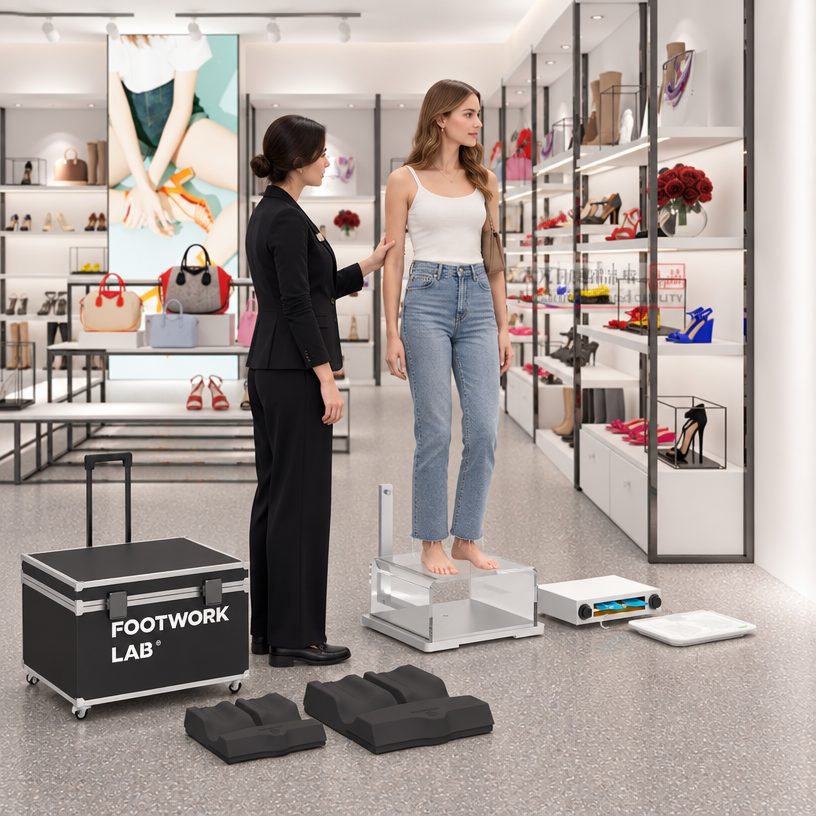
An assessment system, described without decoration, is three subsystems. The pressure layer: sensors under the standing or walking surface reporting load and its movement over time. The camera subsystem: posture and alignment captured in the same session. And the software: assembling both into a report the professional reads and the file keeps.
Each subsystem has a verification question. For the pressure layer: stability of the zero point, repeatability across sessions, and the calibration routine. For the camera: whether the streams are synchronised — captured together, aligned in time. For the software: the report layout seen live, and the export of the underlying record in a form your files control.
Those three questions, asked of every vendor, do more sorting than any specification table. Vendors who answer them concretely, with a live demonstration, are selling instruments; vendors who answer with adjectives are selling the vocabulary — and the vocabulary is what the phrase orthopedic assessment scanner mostly consists of.
The subsystem questions also have a demonstration order that keeps the demo honest: pressure first, camera second, software last. Starting with the software — as most demos do — shows the buyer a finished story before the evidence exists. Ending with it shows the story assembled from what the room just watched being captured, and the difference in confidence is the difference the committee will hear.
The demonstration order also has a discipline for the buyer: take notes in the demo the way the committee will read them — one line per question, evidence or not witnessed. The note-taking changes the questions asked, because a buyer who must write a line either asks for evidence or writes the vendor’s adjective down and flags it. By the third vendor, the shortlist is writing itself in defensible sentences.
The orthopedic buyer’s specific questions
An orthopedic-adjacent practice brings questions a general clinic does not. The records must integrate with an imaging-heavy workflow — which means export formats and storage that a hospital file accepts, not a proprietary summary that lives in the vendor’s cloud alone. Ask the export question first; the answer sorts the shortlist faster than any feature list.
Session time is the second orthopedic question. Orthopedic consultations are scheduled tight, and an assessment that needs twenty minutes of positioning will not survive the template. The capture must be assistant-runnable in a few minutes, with the report assembling itself — a requirement our workflow is built around and one worth watching live in every demo.
The third question is vocabulary discipline for the referral letter. The assessment produces a record of behaviour; the orthopedic file already holds the structural imaging. The two documents serve each other when neither pretends to be the other — and the supplier who understands that division writes reports that a specialist can cite without footnotes of apology.
The orthopedic workflow question also has a data-volume edge worth asking: how much storage a year of records consumes, and who pays for it. Assessment records are modest by imaging standards, but a proprietary format that multiplies them, or a cloud tier that meters them, changes the instrument’s running cost after the invoice. The question takes one sentence and belongs in the first meeting.
Verification: from listing to quotation
Move the verification from conversation to document. Ask each shortlisted vendor for the report sample, the export sample, the installation requirements, and the support terms — in writing, in one reply. Vendors who assemble that package quickly run their sales the way their support will run; the speed of the pre-sale reply is the ceiling of the after-sale one.
The reference calls come next, and they should be orthopedic references: two customers of similar size and workflow, asked what broke in year one and how long it took to reach a working answer. Specifications describe the instrument on delivery day; references describe the instrument on day four hundred, which is the day the purchase is actually judged.
Then the commercial structure, laid out on separate lines: base instrument, options, subscriptions if any, service year, warranty scope. We write every quotation on those lines, and we tell buyers to hold the same layout in front of every vendor — because the layout, like the export, is a behaviour rather than a feature, and behaviours are what the verification is for.
The document package also has a verification step the buyer can run alone: open every file the vendor sends in the software the room actually uses. Quotations that arrive as proprietary viewers, reports that open only online — each is a small statement about how the vendor treats your files, and the statements accumulate into the export answer the committee will eventually ask for.
Where our own equipment sits — and does not
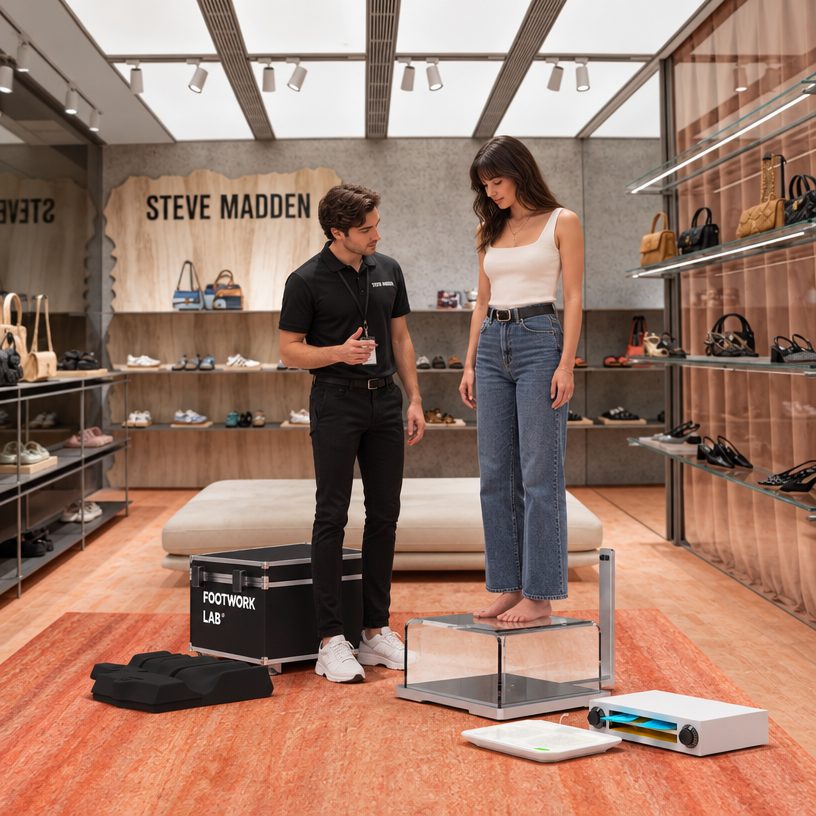
Our systems are assessment systems in the sense this article has used throughout: pressure sensing for distribution and timeline, camera capture for posture and alignment, software for the report. They are not imaging devices; they do not produce structural scans, and our quotations say so in the first paragraph rather than the last.
The 3D and laser vocabulary that populates this category appears in our materials only where it belongs — as the market’s search language, the terms buyers type — never as a description of what our instruments do. A buyer reading our catalogue will find that boundary stated in the same words a quotation uses, because the two documents should never disagree.
For buyers whose rooms need both halves — structure imaging and behaviour measurement — the equipment comes from different suppliers, and the integration question is the export question again: two records that both export into your files can be read together; two records trapped in proprietary formats cannot. Plan the files first; the instruments follow.
Our boundary statement has a practical edge for buyers comparing us against imaging vendors: the two instruments’ records are complementary in a file, not competing on a bench. Practices that plan the storage around the pairing — behaviour records beside structure imaging, both exportable — buy both instruments once. Practices that let the vendors settle the integration between themselves buy it twice.
The committee pack: what to assemble
Orthopedic purchases pass committees, and the committee pack has a standard shape worth assembling early. The rewritten question from the first section. The shortlist with each vendor’s three verification answers. The reference call notes. The commercial table on separate lines. And the workflow drawing: where the instrument sits in the room’s session, who operates it, where the record goes.
The pack’s discipline is that every claim in it traces to a demonstration or a document. Committees do not resist purchases; they resist unverifiable ones. A pack built this way moves through review because its weakest page is still evidence, and the vendor who helped assemble it has pre-answered the meeting’s questions.
Our team assembles this pack with buyers as routine — report and export samples, installation requirements, support terms, workflow drawings. We do it because the orthopedic buyer who buys on evidence becomes the reference the next buyer calls, and that loop is worth more to us than any single order closed on vocabulary.
The committee pack also has an order of assembly that saves weeks: the rewritten question and the workflow drawing first, the vendor documents second, the references last. Committees read the first page hardest, and the pack that opens with the room’s own question gets its documents read; the pack that opens with a vendor’s brochure gets skimmed. Assembly order is rhetoric, and rhetoric is allowed.
The pack’s reference section has a last-mile question most buyers skip: ask the reference what they would check first if they bought again. The answers cluster revealingly — export, service speed, calibration — and the cluster is the category’s real specification, written by owners rather than by marketers. One reference call spent on that question is worth three spent on satisfaction.
A closing word on the phrase itself
The phrase orthopedic assessment scanner will keep evolving, because it is search behaviour, not product naming. Next year’s variant will arrive with new adjectives, and the year after’s will too. The buyer armed with the distinction — structure versus behaviour, image versus record — walks through every variant of the vocabulary unchanged.
The equipment industry serves buyers best when it writes plainly about what instruments do, and worst when it borrows whatever term the traffic favours. We hold our own materials to the first standard, including in the very pages that carry the popular search terms — because a buyer who arrives on a search term and leaves with a distinction is a buyer who will not need to buy twice.
That is the article’s whole argument: sort the vocabulary, verify the three subsystems, demand the documents, and let the phrase mean whatever the market needs it to mean. The room you build will outlast all of them.
A closing note on the phrase’s afterlife in your own documents. Once the room is running, the search term reappears in the practice’s own marketing — and the practice now writes it with the distinction built in. That is the quiet victory of buying on evidence: the vocabulary migrates from the vendors’ listings to the professionals’ pages, and the market’s language slowly becomes more accurate one purchase at a time.
Frequently asked questions
Is an assessment scanner an imaging device?
Most equipment sold under the phrase measures behaviour — pressure distribution, walking sequence, posture — rather than imaging structure. Sort the two before comparing quotations; they answer different questions.
What are the three subsystems to verify?
Pressure sensing, camera capture and analysis software. Verify calibration stability, stream synchronisation, and the live report with full export — one question each.
Do your systems produce 3D scans?
No. Our systems are pressure and camera assessment instruments. The 3D and laser words belong to the market’s search language in our materials, never to the description of what our instruments do.
Why does export capability matter so much?
Because orthopedic workflows hold many record types. Records that export into your files can be read alongside imaging; records trapped in a vendor’s format cannot.
How should a committee evaluate vendors?
On documents and demonstrations: verification answers in writing, orthopedic reference calls, and a commercial table on separate lines. Committees resist unverifiable purchases, not purchases.
What does the service year cover?
Calibration support, software updates and hardware service terms — stated in the quotation. Our baseline is a twelve-month warranty with engineer access through a dedicated WhatsApp group.
How fast should a pre-sale technical question be answered?
Fast enough to be useful — and treat that speed as the ceiling of after-sale response. We answer pre-sale questions directly and put the same engineer behind the after-sale channel.
What we would do next
Send us your rewritten question — the record your room needs, of which task, stored how — and we will return the three verification answers for our systems in one written package, report and export samples included.
For buyers integrating behaviour records into an orthopedic workflow, our team assembles the committee pack routinely; ask for it and the workflow drawing comes with it.
This article is intended for professional and educational reference. It is not medical advice. Foot assessment equipment produces measurements and images; clinical interpretation and any decision about care remain the responsibility of a qualified professional. Certification scope is limited to the documentation we hold: European Union certification and ISO quality system certification.