
The lease is signed in spring, the fit-out finishes in early summer, and somewhere between those two dates the new owner stands in a reception area with a bare wall, one power socket and a decision to make. There is a treatment room with a chair in it, a second room with a couch still wrapped in plastic, and a stretch of floor near the door that nobody has planned for. The reflex is to duplicate the first room so that two clinicians can work at once. The answer that survives a half-full diary is quieter: leave the second room as a shell for a season, and put a screening point where the patient first stands still. A screening corner is not a smaller treatment room. It is a sorting station with a camera, a mat and a printer, and in a new clinic it earns its floor space before the second chair does. This article covers the arrangement of that corner, the question of who operates it, the page the patient carries out, the point at which the case belongs behind a closed door, and how to weigh the cost of the space against the number of sessions it actually runs.
The spare room is not the problem; the front wall is
Walk into a clinic that opened six months ago and the pattern is easy to read. The treatment room is fully equipped. The second room holds a couch, a stool, a box of stock and a stack of frames nobody has hung. The reception desk has a screen, a card terminal and a queue that forms in the doorway. The most valuable unbuilt asset in the building is the wall beside that queue, and it is being used to lean a mop against.
Sorting is the function that a new clinic underestimates, because it does not appear on any equipment list. Every person who walks in belongs to one of three queues: they need footwear and a conversation about it, they need a record kept and a review later, or they need to be seen properly today by the person with the treatment room. Deciding which queue, in the first few minutes, without spending a clinical appointment on the decision, is what a screening corner does. It is a reception function that happens to use a clinical instrument.
Position matters more than specification here. A unit placed at the back of the building, past the desk and through a door, is used for the patients who were going to be seen anyway. A unit placed where people wait is used on people who came in for something else — a shoe that rubs, a child’s school shoes, a parent asking whether their own feet are the reason their knees ache on a Sunday. The second location produces the appointments; the first only documents them.
What we do not do is design clinics. We make the instrument, and we answer layout questions because they arrive with every enquiry from a practice that is fitting out. The most common correction we offer is a move of a couple of metres: away from the window wall, out of the through-route to the treatment room, and onto a length of wall where a person can stand square to the camera without an audience behind them.
What the corner needs, down to the floor marks
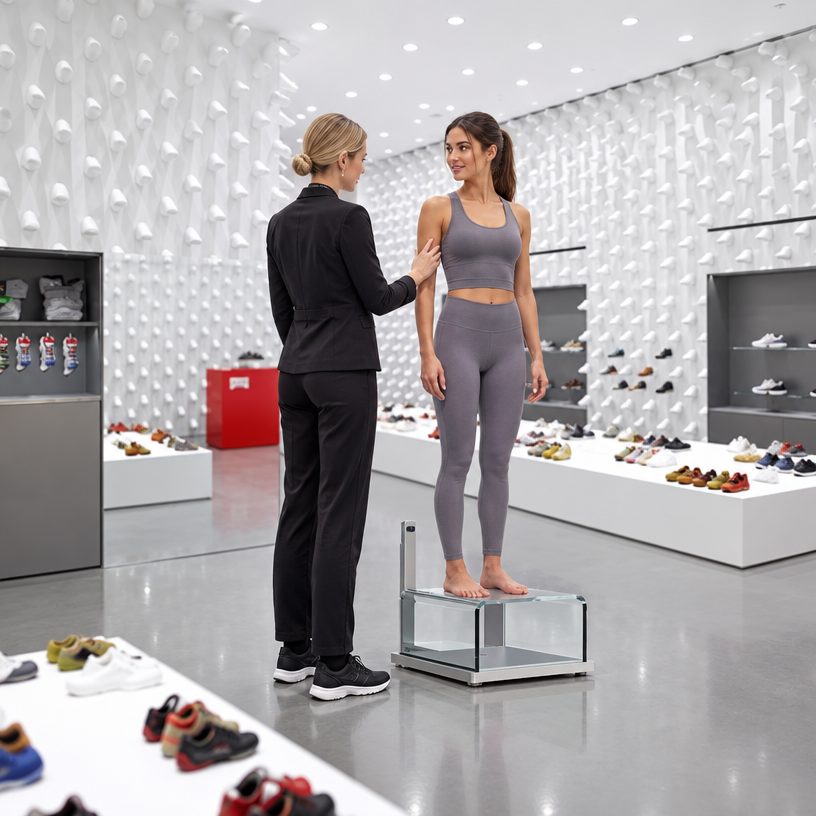
The Q1P is a podoscope in form as well as name. The person stands on a mat, the cameras record the underside of the foot and the line of the leg above it, and the software assembles a findings page. Foot data, lower limb alignment and ankle data arrive in one pass. In a room, that means a mat on the floor, a low unit at the wall, a screen at reading height and a stool within reach. The footprint is smaller than a fitting bench and considerably smaller than a couch.
Three arrangement rules cover most of the mistakes. First, the wall behind the person should be plain and matt, because a mirror, a poster or a glass partition gives the camera a second edge to interpret. Second, the light should come from the front or the side, never from behind the person: a window at their back turns the leg line into a silhouette and the capture into guesswork. Third, the standing position should be marked, not remembered. Two strips of tape at the heel and a mark for the toe line cost nothing and are the difference between a comparable record and a new one every visit.
Camera height and distance are set once, at installation, and then left alone. The failure mode is mundane: the unit is shifted to sweep the floor, the bracket is nudged, and nobody re-aims it for a month. The reports still print, and they quietly describe a person standing slightly further away than the last one. If the corner is cleaned by someone other than the operator, put a mark on the floor for the unit as well as for the feet.
Privacy is the part that new clinics get wrong in a way patients notice but rarely mention. A curtain on the corridor side, running from the wall to a ceiling track, does more than a screen placed around the machine, because the person has to take their socks off and would rather not do it in view of the waiting area. The same applies to sound: the findings should be discussed at the unit, not read out across the desk. And there should be a tray for shoes and a bin for wipes within arm’s reach, or the operator will improvise and the corner will look improvised.
Reception or clinical assistant: who should hold the session
Two staffing models work, and the choice follows the shape of the diary rather than the size of the practice. In the first, the receptionist runs the screening between calls. It costs nothing extra and it fails in a predictable way: the session is interrupted twice, the person is left standing on the mat while a card payment is taken, and the capture ends up with the weight shifted onto one leg. The record looks fine and is not.
In the second model, a clinical assistant runs every screening. The records are consistent and the conversation is better, but those are the most expensive minutes in the building, and a practice that puts them into sorting will find reasons to stop booking screenings in a busy week. Most clinics that make this work land somewhere in between: one named operator, one named backup, and a fixed slot in the day when screenings are booked. Not offered when someone is free — booked, like any other appointment.
The operator needs a script, and it should be short enough to say without reading. Four sentences cover it: this is what the unit records; these are the ranges the numbers are compared with; this page is a record, not a conclusion; and this is what happens next. The drift to guard against is the fifth sentence, the one where a receptionist looks at the heel line and says the arch has collapsed. That sentence is not in the script, it is not what the software produced, and it is the sentence a patient repeats to a friend a week later.
Training takes an afternoon rather than a course. The operator has to be able to place feet the same way every time, to notice a capture that will not read — socks left on, trousers gathered at the knee, weight moved between frames, a person who cannot stand unsupported — and to stop rather than persist. The last of those is the one that matters clinically, because a person who cannot stand steadily for the capture is already a person for the treatment room, and no amount of retaking will change that.
The page the patient takes away
What prints is a set of named findings rather than a score: arch type, foot type, the position of the big toe, the angle of the heel under load, internal or external rotation at the tibia, and foot length and width with a shoe-size suggestion. Left and right sit on the same page, which sounds like a layout preference until you watch someone try to compare two sheets held one behind the other.
Under the conclusion, the report carries its own line: the analysis is for reference only, and where there is a medical need the person should go to a professional institution for further examination. That sentence is often read as legal furniture. It is better read as a description of the object in the patient’s hand. A record of what was measured, against ranges drawn from a population, is a different thing from a judgement about a body, and the wording is there to keep the two apart when the paper travels without the clinician who would normally explain it.
Hand it over rather than narrate it. Three points is the useful maximum at the unit: what the page shows, what it does not settle, and what the next step is. Then let the person hold it and read. A page that is read aloud in full, finding after finding, produces two outcomes and neither is good: the patient remembers the last thing said, or the patient remembers the most alarming word. Both are a form of editing that the clinician then has to undo.
Keep a copy. One goes into the clinical record against the patient’s name, one goes home, and the print or the email is a setting rather than a decision made at the desk. Where a practice wants its own fields, its logo or a different order of findings on the page, the report layout can be customised, and that work is quoted separately from the hardware. What we do not offer is a version of the page that drops the reference-only line; that line is part of the instrument’s position, not a sticker on top of it.
Where the screening hands over to the treatment room
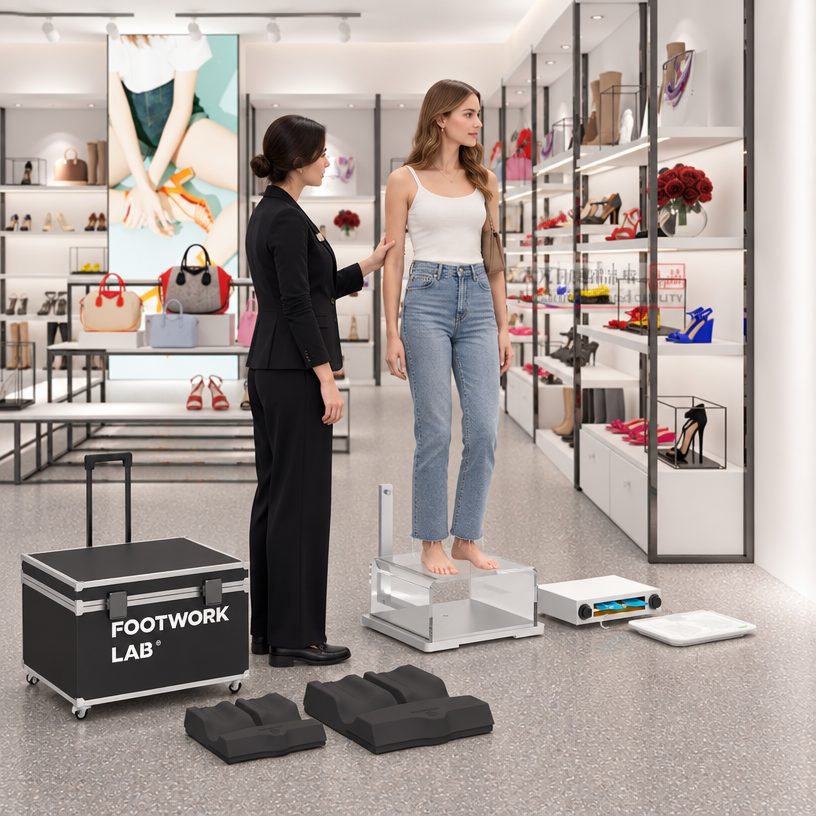
A screening corner without a handover rule becomes a queue that never empties. The rule does not need to be a protocol; it needs to be a list the operator can hold in mind. A finding the person did not come in for. A left-and-right difference that does not match the story they told at the desk. A shoe problem that cannot be solved by size, width or lacing. The same page, unchanged, on a second visit. Anything the operator cannot explain inside the script. Any of those, and the case moves behind a door.
The other direction matters as much, and it is the one that new owners find harder to accept. A good proportion of screenings end with nothing that belongs in a treatment room: a width change, a different lacing pattern, a sock with a seam in the wrong place, a school shoe that is half a size short. Saying so is a result. A screening corner that refers everybody is not screening, it is upselling with a camera, and the referring clinicians notice within a month.
The division of labour is straightforward once it is written down. The screening produces named measurements and images, taken in a fixed way, stored against a name. The clinician decides what those measurements mean for this person, on this day, with this history. Between the two sits a signature: the practice should decide who is accountable for the page, and that name should be on the record. In a small clinic it is usually the owner, even when the assistant ran the session.
What the instrument does not do is the part we are most careful about. It does not diagnose. It does not write a care plan, and it does not decide whether a person needs an orthotic, a shoe, a course of work or nothing at all. Everything on the page is upstream of that judgement, and a practice that presents it as the judgement will find, sooner or later, that a patient has taken the page to somebody who reads it differently.
What the corner costs, and how often it has to run
The cost has four parts, and only one of them is the equipment. There is the unit itself. There is the fitting-out: mat, curtain track, a length of wall, a shelf for the printer, a lockable drawer for records. There is the staff time per session, which in a new clinic is the item that gets underestimated because it is invisible on an invoice. And there is the floor area, which in a city lease is the largest of the four and the one nobody counts, because the corner looks like leftover space until a second chair is needed.
Usage is the test that decides whether the corner was a good idea. Work backwards from new-patient flow: how many people a week arrive without an appointment or with a question that is not yet an appointment. If the honest number is two, the corner will not repay its floor area, and a screening station shared with the treatment room will do the same job for less. If the number is most days, the corner pays in a different currency: the first appointment starts with a page instead of a blank sheet, and the conversation about footwear happens with a record on the table rather than a brochure.
The return paths are worth naming separately, because they are not the same. There is the shoe recommendation, which is a service and often a sale. There is the insole work, where the practice does it and the screening data becomes the starting point for a build in the same visit. There is the second appointment that a first page earns, which is the one that matters most in year one. And there is the referral out that comes back, which is the slowest and most durable of the four. None of them is created by the machine on its own; all of them are made easier by having something to point at.
The commercial terms are deliberately plain, because they are what most first conversations are actually about. The minimum order for equipment is one unit, which is what makes a single-corner trial possible in a practice that has not decided yet. Every unit is tested for seven days before dispatch. The warranty runs twelve months against non-human damage with free parts, support runs through a dedicated group with our engineers, remote sessions and over-the-air updates, and report layout work is quoted separately. We do not publish prices in articles, and we do not quote a return on a room we have never seen.
Frequently asked questions
How much floor space does a screening corner need?
Less than a fitting bench. The working area is the mat, a clear standing distance in front of the unit for the camera line, and a stool for the person to sit on while shoes and socks come off. The constraint that usually decides the layout is not the equipment but the sight line from the waiting area, which is why a curtain on the corridor side is part of the plan rather than an afterthought.
Can the receptionist run the screening, or does it have to be a clinician?
A trained member of staff can run the capture, and in many practices that is the receptionist or a clinical assistant. What the role needs is consistency rather than a qualification: the same standing position, the same footwear condition, the same three sentences at the end. The interpretation of the page stays with the clinician, and the practice should decide in advance who signs the record.
What appears on the Q1P report?
Arch type, foot type, the position of the big toe, the angle of the heel under load, internal or external rotation at the tibia, and foot length and width with a shoe-size suggestion, with left and right shown together. The conclusion page states that the analysis is for reference only and that a medical need should be taken to a professional institution.
Does the report replace a full assessment?
No, and it is not built to. The report is a record of what was measured and how it compares with reference ranges. A full assessment takes history, hands-on examination and the clinician’s reasoning, none of which a camera produces. The value of the screening page is that the assessment starts with data instead of starting with a blank page.
When should a screening turn into a treatment room appointment?
When the page shows something the person did not come in about, when the two sides differ in a way the history does not explain, when the footwear issue cannot be solved by fit alone, or when the same page comes back unchanged on a second visit. A practice should also treat any capture the operator cannot complete steadily as a handover rather than a retake.
Can a pair of insoles be made in the same visit?
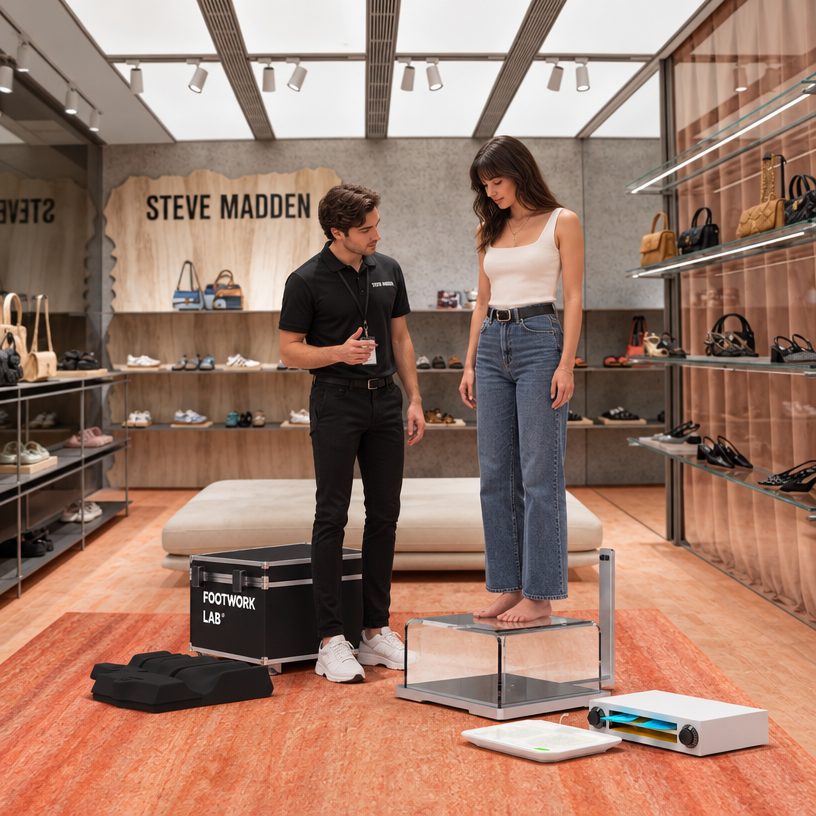
Yes, where the on-site module is part of the order. The unit ships with a heating box, shaping pillows for adults and children, and the auxiliary pieces the forming step needs, so a measured record can become a formed pair before the person leaves. The build is chosen by the person doing the fitting, from the record and the shoe in front of them.
How is the unit supported after delivery?
Equipment minimum order is one unit, each unit is tested for seven days before dispatch, and the warranty covers twelve months against non-human damage with free parts. A dedicated group with our engineers stays with the room after handover, remote sessions cover the first weeks of live use, and connected units take over-the-air updates. Layout changes to the report itself are a separate piece of work, priced apart from the machine.
What we would do next
Take a photograph of the wall you have in mind, note where the daylight comes from and where people queue, and write down the three questions your front desk hears most often in a week. Send those three things and we will tell you whether a screening corner answers two of them, one of them, or none — and whether the unit is better placed at the desk or inside the treatment room. The Q1P podoscope page sets out the capture and the report in the manual’s own wording.
If the practice already owns a unit and the sessions have quietly stopped, the cause is usually the booking rather than the hardware: no fixed slot, no named operator, no script. Send us the routine you use now and we will mark the two places where two members of staff would produce two different records. The contact page reaches the team directly, and a floor plan sketch is more useful to us than a specification question.
This article is intended for professional and educational reference. It is not medical advice. Foot assessment equipment produces measurements and images; clinical interpretation and any decision about care remain the responsibility of a qualified professional. Certification scope is limited to the documentation we hold: European Union certification and ISO quality system certification.